
Solar panels have become more efficient, powerful, and competitive in 2026—but that doesn’t mean every high-rated panel is the right choice for your home.
The best solar panel depends on more than wattage. Efficiency, roof space, temperature performance, degradation, warranty coverage, installer quality, and the total installed price can all affect the value of a solar system.
After comparing current specifications and residential solar options, three panels stand out for different reasons:

- Maxeon 7 — Best for Maximum Efficiency
- REC Alpha Pure-RX — Best Overall Balance
- Qcells Q.TRON BLK — Best Value-Oriented Choice
There is no universal winner for every homeowner. A panel that is excellent for a small roof may not be the most economical choice for a large roof with plenty of available space.
Quick Comparison: 3 Best Solar Panels of 2026
| Solar Panel | Best For | Maximum Efficiency | Power Range |
|---|---|---|---|
| Maxeon 7 | Maximum efficiency | Up to 24.1% | 435–445W |
| REC Alpha Pure-RX | Best overall balance | Up to 22.6% | 450–470W |
| Qcells Q.TRON BLK | Value & balanced performance | Up to 22.0%* | 405–430W* |
*Specifications vary by exact Q.TRON BLK series and market. Always check the current datasheet for the model being quoted.
1. Maxeon 7 — Best Solar Panel for Maximum Efficiency
If your biggest priority is getting as much electricity as possible from limited roof space, Maxeon 7 deserves serious consideration.
Maxeon’s published technical documentation lists the Maxeon 7 at 435W to 445W, with efficiency reaching 24.1% on the 445W model. The panel uses Maxeon’s Gen 7 monocrystalline back-contact cell technology.
That efficiency figure is particularly interesting for homeowners with smaller roofs.
Why Maxeon 7 stands out
A highly efficient solar panel can produce more electricity from a given amount of roof area.
This can matter when:
- Your roof is relatively small
- You have high electricity consumption
- You want to maximize production per square foot
- Roof additions or expansions are difficult
- You want a premium residential system
Maxeon has also highlighted a 0.25% maximum annual power degradation for the Maxeon 7 and a 40-year warranty for applicable installations, although warranty availability and requirements vary by country and installation.
Maxeon 7 specifications
- Power: 435–445W
- Maximum efficiency: 24.1%
- Technology: Maxeon Gen 7 IBC
- Maximum annual power degradation: 0.25%
- Long-term warranty options depending on market
- Premium residential positioning
Pros
- Exceptional efficiency
- Excellent choice for limited roof space
- High power output
- Premium back-contact technology
- Strong long-term performance specifications
Cons
- Premium equipment can cost more
- Availability depends on market and installer
- Paying for maximum efficiency isn’t always financially necessary
Who should buy Maxeon 7?
Maxeon 7 is particularly attractive if roof space is your biggest constraint and you are comfortable considering premium equipment.
If your roof is large enough for a less expensive panel to meet your electricity needs, spending more for maximum efficiency may not produce the best return.
Our rating for this category: Best for maximum efficiency.
2. REC Alpha Pure-RX — Best Overall Solar Panel
The REC Alpha Pure-RX is one of the strongest all-around residential solar panels to consider in 2026.
REC lists the Alpha Pure-RX at 450–470W, with maximum efficiency of 22.6%. It uses heterojunction, or HJT, technology and is designed specifically for residential installations.
REC also lists a minimum power level of 92% in year 25, along with a 20-year product warranty and 25-year performance warranty for the applicable product.
Why we like the REC Alpha Pure-RX
The main attraction isn’t one record-breaking specification.
It’s the combination of:
- High wattage
- Strong efficiency
- HJT technology
- High power density
- Long-term performance
- Residential-friendly design
REC describes the Alpha Pure-RX as its most powerful residential solar panel, reaching 470W in a compact format.
REC Alpha Pure-RX specifications
- Power: 450–470W
- Maximum efficiency: 22.6%
- Cell technology: HJT
- Minimum power in year 25: 92%
- Product warranty: 20 years
- Performance warranty: 25 years
Pros
- Excellent combination of efficiency and power
- High power density
- Strong long-term specifications
- HJT technology
- Attractive full-black appearance
- Good choice for residential rooftops
Cons
- May cost more than basic panels
- Actual installed price varies significantly
- Availability depends on your local installer
Who should buy the REC Alpha Pure-RX?
This is a strong option if you want a premium panel without choosing solely on maximum efficiency.
For many homeowners, that balance is more useful than chasing the highest efficiency number available.
Our rating for this category: Best overall balance.
3. Qcells Q.TRON BLK — Best Value-Oriented Choice
The Qcells Q.TRON BLK takes a different approach.
Instead of focusing entirely on being the most powerful or most efficient panel available, Qcells positions the product around strong residential performance.
The Q.TRON BLK M-G2 series datasheet lists models from 405W through 430W, with efficiency reaching 22.0% for the 430W version.
EnergySage’s 2026 buyer data also lists Q.TRON BLK models among the residential panels available for comparison.
Why Qcells is worth considering
Solar buyers often make one major mistake:
They assume the most expensive panel is automatically the best investment.
That’s not necessarily true.
If your roof has plenty of available space, a slightly less efficient panel may allow you to build the system you need at a better overall price.
That is why Q.TRON BLK can make sense for homeowners who want a strong combination of performance and value.
Q.TRON BLK specifications
Depending on the exact model:
- Power: 405–430W
- Maximum listed efficiency: 22.0%
- Residential solar application
- Multiple configurations and markets
- Current specifications vary by series
Pros
- Strong efficiency
- Good power output
- Established solar manufacturer
- Attractive option for residential systems
- Can provide a good balance between performance and system cost
Cons
- Not the highest-efficiency option in this comparison
- Exact specifications vary by model
- Local pricing can change the overall value
Who should buy Q.TRON BLK?
Q.TRON BLK is worth considering if your priority is good performance without automatically paying for the most premium panel available.
Our rating for this category: Best value-oriented option.
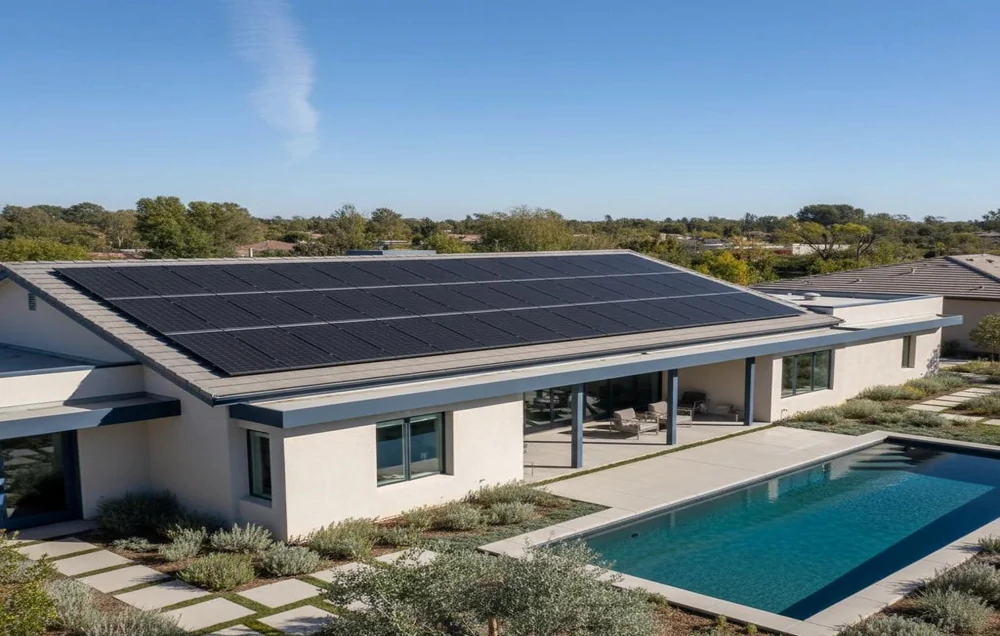
Maxeon 7 vs REC Alpha Pure-RX vs Qcells Q.TRON BLK
So which one should you actually choose?
It depends on what matters most.
| If your priority is… | Consider |
|---|---|
| Maximum efficiency | Maxeon 7 |
| Best overall balance | REC Alpha Pure-RX |
| Value-oriented system | Qcells Q.TRON BLK |
| Small roof | Maxeon 7 / REC Alpha Pure-RX |
| High power per panel | REC Alpha Pure-RX |
| Strong performance without maximum premium | Qcells Q.TRON BLK |
The table is a starting point—not a substitute for a site-specific solar design.
What Makes a Solar Panel “Best”?
There is no single specification that determines whether a solar panel is best.
Instead, look at several factors.
1. Efficiency
Efficiency tells you how effectively the panel converts sunlight into electricity under standardized testing conditions.
Higher efficiency can be particularly valuable when roof space is limited.
Current 2026 market data shows leading residential solar panels exceeding 23% efficiency, demonstrating how quickly panel technology has improved.
But don’t automatically assume the highest-efficiency panel provides the best financial return.
2. Power Output
Panel power is measured in watts.
A 450W panel can produce more rated power under standard test conditions than a 400W panel.
But the total system matters more than one panel.
For example:
10 × 450W panels = 4.5 kW of rated DC capacity
while:
12 × 400W panels = 4.8 kW of rated DC capacity
The second system uses more panels but has a higher total rated capacity.
This is why homeowners should compare the complete system rather than looking only at the wattage of individual panels.
3. Temperature Performance
Solar panels operate outdoors, and their output can change with temperature.
The temperature coefficient tells you how the panel’s electrical performance changes as temperature rises above the reference test conditions.
This can become particularly important in hot climates.
Don’t choose a panel based only on its efficiency rating at 25°C.
4. Degradation
Solar panels gradually lose some production capacity as they age.
That’s normal.
What matters is how much degradation the manufacturer warrants and how the panel is expected to perform over time.
For example, REC lists a minimum 92% power level in year 25 for the Alpha Pure-RX, while Maxeon publishes a maximum annual degradation specification of 0.25% for Maxeon 7.
These specifications aren’t directly interchangeable because manufacturers structure warranties differently, so read the actual warranty documents before comparing them.
5. Warranty
There are usually two important warranty categories:
Product warranty
This generally relates to manufacturing defects or product-related problems.
Performance warranty
This relates to how much power the panel is expected to produce over a specified period.
A longer warranty can be valuable—but only if you understand the actual terms and who is responsible for honoring it.
6. Installer Quality
Even an excellent solar panel cannot compensate for a poorly designed or installed system.
Before signing a contract, investigate:
- Installer experience
- Licensing requirements in your area
- Workmanship warranty
- Equipment compatibility
- System design
- Monitoring
- Roof condition
- Electrical work
- Permitting
- After-sales service
In many cases, choosing a strong installer can be just as important as choosing between two similar panels.
Are the Most Efficient Solar Panels Worth the Extra Money?
Not always.
Suppose you have a large roof with plenty of usable space.
You may have enough room to install a larger number of less-expensive panels and still reach your electricity-production target.
Now consider a homeowner with a small roof.
That person may benefit significantly from higher-efficiency panels because every square foot matters.
A simple example
Imagine two panels:
Panel A
- 400W
- Lower purchase price
Panel B
- 450W
- Higher purchase price
If Panel A allows you to fit enough panels on your roof at a substantially lower total system cost, it could be the better investment.
But if your roof cannot fit enough Panel A modules, Panel B could be much more valuable.
The best panel depends on the problem you’re trying to solve.
How Many Solar Panels Does a Home Need?
There is no universal number.
The answer depends on:
- Annual electricity consumption
- Panel wattage
- Local sunlight
- Roof orientation
- Roof pitch
- Shading
- Temperature
- System losses
- Desired energy offset
For example, a homeowner using significantly more electricity may need a larger system than someone in a similar-sized house with lower consumption.
That’s why home square footage alone is not enough to determine solar-panel requirements.
Best Solar Panels for a Small Roof
If your roof is small, prioritize:
- High efficiency
- High power density
- Good temperature performance
- Low degradation
- Reliable warranty
- Professional system design
For this situation, Maxeon 7 is particularly interesting because of its published 24.1% maximum efficiency. The REC Alpha Pure-RX is another strong candidate because it combines up to 470W with 22.6% efficiency.
Best Solar Panels for a Large Roof
If roof space isn’t a major limitation, efficiency becomes only one part of the decision.
You may be better off comparing:
- Total installed price
- Cost per watt
- Warranty
- Installer quality
- Expected annual production
- Equipment availability
- Financing terms
- Long-term service
A slightly less efficient panel can sometimes produce a better overall project value.
Solar Panel Buying Mistakes to Avoid in 2026
Mistake #1: Buying based only on wattage
A higher wattage doesn’t automatically mean better value.
Mistake #2: Buying the highest-efficiency panel without comparing price
Efficiency is valuable, but you need to know what you’re paying for it.
Mistake #3: Ignoring the roof
Shading and roof orientation can have a major effect on actual energy production.
Mistake #4: Ignoring warranties
Always read the actual warranty documentation.
Mistake #5: Choosing an installer based only on price
The cheapest installation quote isn’t necessarily the best long-term choice.
Mistake #6: Believing guaranteed savings claims
Solar savings depend on electricity rates, system production, financing, incentives, maintenance, and other factors.
Mistake #7: Comparing panels without comparing the entire system
Panels are only one part of a solar installation.
Are Solar Panels Still Worth It in 2026?
For many homeowners, solar can still be an attractive way to generate electricity and reduce dependence on grid power.
But whether it makes financial sense depends heavily on your location and circumstances.
Important factors include:
- Local electricity prices
- Solar resource
- Installation cost
- Incentives
- Financing
- Net-metering or export rules
- Roof condition
- Expected system production
- How long you plan to own the property
Don’t trust a generic online calculator that promises the same savings for every home.
A professional proposal based on your actual electricity usage and property is much more useful.
What About Solar Batteries?
Solar panels and batteries solve different problems.
Solar panels generate electricity.
A battery stores electricity for later use.
Adding a battery can allow a homeowner to use more solar-generated electricity after sunset and may provide backup power during some grid outages, depending on the system design.
If backup power is important to you, compare the battery, inverter, transfer equipment, and critical-load design—not just the panels.
Our Final Ranking
After comparing efficiency, power output, technology, warranty considerations, and different homeowner priorities, our 2026 shortlist is:
🥇 1. Maxeon 7 — Best for Maximum Efficiency
Best for: Small roofs and homeowners prioritizing premium efficiency.
With up to 24.1% efficiency and 445W output, Maxeon 7 is an impressive choice when maximizing production from limited roof space is the goal.
🥈 2. REC Alpha Pure-RX — Best Overall Balance
Best for: Homeowners looking for high power, strong efficiency, and long-term performance.
Its 450–470W output and 22.6% maximum efficiency make it one of the strongest all-around residential options.
🥉 3. Qcells Q.TRON BLK — Best Value-Oriented Choice
Best for: Homeowners looking for strong performance without automatically choosing the most expensive premium equipment.
The Q.TRON BLK series reaches 430W and 22.0% efficiency in the referenced North American datasheet.
Frequently Asked Questions
What are the 3 best solar panels of 2026?
Three strong options to compare are Maxeon 7, REC Alpha Pure-RX, and Qcells Q.TRON BLK. Each has a different strength, so the best choice depends on your roof, budget, energy use, and local installation costs.
What is the most efficient solar panel in this comparison?
The Maxeon 7 reaches 24.1% maximum efficiency according to its published datasheet.
Is REC Alpha Pure-RX a good solar panel?
Yes. REC lists the Alpha Pure-RX at 450–470W, with maximum efficiency of 22.6% and a minimum power level of 92% in year 25 for the applicable product.
Is Qcells Q.TRON BLK a good choice?
It can be a strong option for homeowners who want a combination of efficiency, power, and value. The exact specifications depend on the Q.TRON BLK model and market.
Are more efficient solar panels always better?
No. Higher efficiency is particularly useful when roof space is limited. If you have plenty of roof space, a lower-cost panel may provide better overall project economics.
How long do solar panels last?
Solar panels are designed for long-term operation, but their output gradually decreases over time. Always check the manufacturer’s performance warranty and degradation specifications for the exact panel you’re considering.
Should I choose solar panels based on brand?
Brand can matter, but don’t stop there. Compare the specific panel model, warranty, efficiency, degradation, installer, price, and expected production.
What is more important: solar panel efficiency or price?
Neither is universally more important. The right balance depends on your roof and electricity needs. A high-efficiency panel can be valuable on a small roof, while a lower-cost panel may make more sense when roof space is abundant.
Final Verdict: Which Solar Panel Should You Buy in 2026?
There isn’t one solar panel that wins for every homeowner.
Choose Maxeon 7 if your top priority is maximum efficiency and you have limited roof space.
Choose REC Alpha Pure-RX if you want an excellent balance of power, efficiency, and long-term performance.
Choose Qcells Q.TRON BLK if you want a strong residential panel while keeping value near the top of your priorities.
Most importantly, don’t shop for the panel alone.
Shop for the complete solar system.
Compare the equipment, installation, warranties, expected production, financing, and total cost. A slightly less expensive panel installed correctly can be a better investment than a premium panel paired with an overpriced or poorly designed system.
The smartest solar purchase in 2026 isn’t necessarily the panel with the biggest number on the datasheet.
It’s the system that fits your roof, your electricity use, and your budget.