
Solar Pergola: Benefits, Costs & Installation Guide (2026)
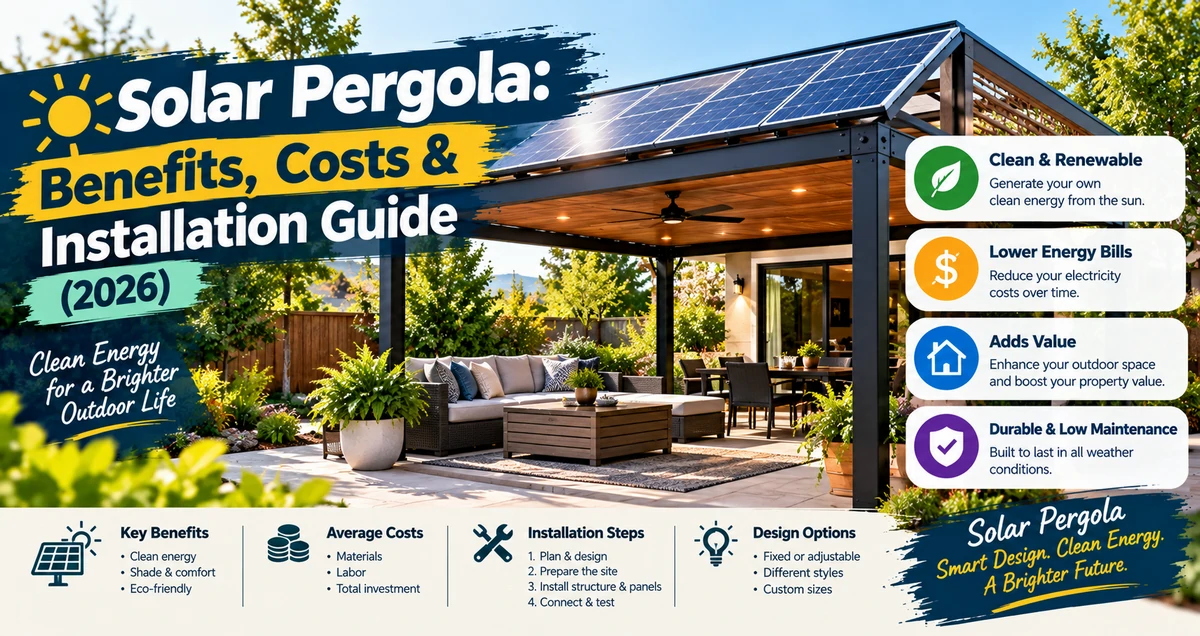
A solar pergola is an outdoor structure equipped with photovoltaic panels that generate electricity while providing shade for a patio, garden, or outdoor living area. Instead of using a traditional fabric canopy or an open wooden roof, this design incorporates solar panels into the roof structure.
For homeowners looking to make better use of their outdoor space, a solar pergola offers two practical benefits: a more comfortable shaded area and the opportunity to produce electricity from sunlight. The generated power can help supply household appliances, lighting, cooling equipment, and other compatible electrical loads.
However, a successful project requires more than choosing attractive solar panels. Structural strength, sunlight exposure, electrical design, water drainage, installation costs, and local building requirements all matter.
A solar pergola can be worthwhile if you want outdoor shade and additional solar electricity but have limited suitable roof space. Its value depends on the available sunlight, system size, installation cost, electricity consumption, and how much of the generated power you can use.

1. What Is a Solar Pergola?
A solar pergola is a covered outdoor structure designed to support photovoltaic solar panels. It can be attached to a house or installed as a freestanding feature in a garden, beside a swimming pool, or over a patio.
Unlike a conventional pergola, which mainly provides shade, a photovoltaic pergola also converts sunlight into usable electrical energy.
Most systems contain the following components:
- Support structure: Wood, aluminum, steel, or another suitable structural material.
- Solar panels: Photovoltaic modules that convert sunlight into direct-current electricity.
- Mounting hardware: Rails, brackets, and approved fasteners that secure the panels.
- Inverter: Equipment that converts solar electricity into alternating current for compatible household circuits.
- Electrical protection: Appropriate disconnects, overcurrent protection, grounding, and other protective devices as required by the design and local regulations.
- Optional battery: A compatible battery system that stores some of the generated electricity for later use.
The panels may form an almost solid roof or use a layout that allows some daylight to pass through. The best choice depends on whether you prioritize shade, natural light, weather protection, appearance, or electricity generation.
2. How Does a Solar Pergola Work?
A solar pergola works on the same photovoltaic principle as a rooftop solar installation. Sunlight reaches the solar cells inside each panel, producing direct-current electricity. An inverter then converts that electricity into alternating current suitable for compatible electrical loads.
Step 1: Solar Panels Capture Sunlight
The photovoltaic modules are mounted above the outdoor area. Their electricity production depends on sunlight intensity, panel orientation, tilt, temperature, shading, and system condition.
Step 2: The Inverter Converts Electricity
The panels generate direct-current electricity. A compatible inverter converts it into alternating current that can supply suitable household circuits or other approved loads.
Step 3: Your Home Uses the Electricity
When the system is connected to a home’s electrical installation, solar electricity can supply operating loads such as appliances, lighting, and other equipment. The amount of electricity used directly depends on the timing of production and consumption.
Step 4: Optional Battery Storage
A compatible battery can store some surplus solar electricity for use when sunlight is limited or after sunset. Battery storage adds equipment cost and conversion losses, so it should be selected according to your energy needs.
3. Main Benefits of a Solar Pergola
3.1. Generate Electricity Without Using More Roof Space
One of the biggest advantages of a solar pergola is that it creates another location for solar panels. This can be useful when the main roof is shaded, faces an unsuitable direction, has limited available space, or would require difficult modifications.
A well-positioned pergola can provide additional generation capacity without placing panels directly on the home’s main roof.
3.2. Create a Comfortable Outdoor Living Area
Solar panels provide shade over a patio or garden seating area. Depending on the panel arrangement and construction, the pergola can help make outdoor dining, reading, and relaxation more comfortable during sunny weather.
A solid panel roof is not necessarily completely waterproof. Water may enter through gaps between modules or around mounting points unless the system is specifically designed with suitable weatherproofing and drainage.
3.3. Potentially Reduce Electricity Bills
The electricity produced by a solar pergola can offset part of your normal electricity consumption. The greatest financial benefit generally comes from using solar electricity when it is being generated, rather than relying entirely on exported electricity or stored energy.
Actual savings depend on the installed capacity, local sunlight conditions, electricity prices, export compensation, system losses, and the timing of household energy use.
3.4. Add a Modern Architectural Feature
Solar pergolas are available in contemporary aluminum designs, traditional timber structures, and custom architectural configurations. Panel frames and support materials can be selected to complement the exterior of the property.
3.5. Support a More Energy-Efficient Lifestyle
Solar electricity can reduce the amount of electricity a household needs to purchase from the grid. The environmental benefit depends on the energy sources displaced, the equipment’s manufacturing impact, its useful life, and how effectively the system operates.
4. Popular Solar Pergola Designs
The right design depends on the location, outdoor activities, budget, and desired solar output. Here are three common options.
Freestanding Solar Pergola
Installed independently in a garden, patio, or poolside area. It can be positioned to improve sunlight exposure and create a separate outdoor living space.
Attached Solar Pergola
Connected to a house or another building. It may offer convenient access to the electrical system, but the wall connection and waterproofing require careful design.
Timber Solar Pergola
Uses a wooden support structure for a natural appearance. The timber must be suitable for outdoor exposure and engineered to support the panels and local environmental loads.
Opaque Panels or Semi-Transparent Panels?
Conventional opaque panels can provide substantial shade. Special glass-glass or semi-transparent photovoltaic modules may allow some light through, depending on their design and cell spacing.
Compare the module’s electrical performance, transparency, cost, weather resistance, and mounting requirements before choosing. A more transparent roof is not automatically more efficient or less expensive.
5. What Affects Solar Pergola Costs?
There is no single price that applies to every solar pergola. The total project cost depends on the structure, electrical equipment, installation conditions, and local labor rates.
| Cost Factor | What to Consider |
|---|---|
| Structure | Material, dimensions, foundation, engineering, and finish. |
| Solar panels | Panel wattage, number of modules, technology, and warranty. |
| Inverter and protection | Inverter type, monitoring, wiring, disconnects, and electrical protection. |
| Installation | Labor, access, groundwork, lifting equipment, and electrical work. |
| Optional battery | Storage capacity, inverter compatibility, controls, and backup requirements. |
| Permits and inspections | Local building approval, electrical inspections, and grid connection where applicable. |
How to Compare Installation Quotes
Ask each installer to provide an itemized quotation that clearly separates the structure, panels, inverter, electrical work, installation labor, and any optional battery.
The quotation should also explain the estimated annual electricity production, expected self-consumption, equipment warranties, structural design, and exclusions.
Avoid choosing a system based only on its number of panels or its advertised annual savings. Two installations with the same panel capacity can produce different results because of shading, orientation, temperature, and other site conditions.
6. Solar Pergola Installation Guide: Step by Step
Installing a photovoltaic pergola involves both construction and electrical work. The following steps provide a planning overview, not a substitute for engineered drawings or the equipment manufacturer’s instructions.
Step 1: Choose the Location
Identify a location with good sunlight exposure throughout the day. Check for shade from trees, walls, neighboring buildings, chimneys, and other obstacles.
Consider how the pergola will be used, where people will walk, and whether doors, windows, and outdoor furniture will remain accessible.
Step 2: Evaluate Sunlight and Orientation
The best panel orientation depends on your location and when electricity is needed. In many locations in the Northern Hemisphere, a south-facing array can provide strong annual production, but east- or west-facing layouts may better match morning or afternoon energy use.
A site-specific solar assessment should account for orientation, tilt, shading, temperature, and expected system losses.
Step 3: Design a Structurally Safe Frame
Solar panels and their mounting hardware add permanent weight and create additional forces during strong winds. The structure, foundations, connections, and anchors must be designed for the applicable loads at the installation site.
Do not attach panels to a decorative pergola unless its load capacity and mounting arrangements have been verified. A qualified structural professional should assess existing structures and design new ones where needed.
Step 4: Select Compatible Solar Equipment
Choose solar panels, mounting hardware, an inverter, and protective equipment that are compatible with one another. The electrical design must respect panel voltage and current limits, inverter specifications, conductor ratings, and applicable installation standards.
If battery storage is planned, verify compatibility among the battery, inverter, controls, and intended operating modes.
Step 5: Install the Structure and Panels
The support structure must be properly anchored before the modules are mounted. Installers should follow the engineered design and manufacturer instructions for panel spacing, mounting points, fastener torque, cable support, and weather protection.
The roof design should also account for rainwater drainage. Some panel systems are not designed to function as completely waterproof roofing.
Step 6: Complete the Electrical Installation
Solar wiring must be protected from moisture, sunlight, mechanical damage, and accidental contact. Appropriate grounding, isolation, overcurrent protection, and other safeguards must be provided according to the equipment instructions and local requirements.
Electrical connections and grid integration should be completed and inspected by appropriately qualified professionals. Do not improvise wiring connections or work on energized solar circuits.
Step 7: Test and Monitor the System
Before regular operation, the installer should verify the system’s electrical safety and operation. Where applicable, complete the required inspections, approvals, and utility connection procedures.
Use the inverter’s monitoring system to check energy production and identify unexpected changes in performance.
7. How Many Solar Panels Do You Need?
The number of solar panels depends on the available roof area, panel wattage, electricity demand, and expected sunlight. A larger pergola does not automatically need to be covered completely with solar panels.
Use this simple formula to estimate the system’s rated capacity:
System Capacity (kW) = Number of Panels × Panel Wattage (W) ÷ 1,000
Example: A Pergola With Eight Solar Panels
Suppose a pergola can accommodate eight panels rated at 400 watts each.
- Number of panels: 8
- Rated power per panel: 400 W
- Total rated system capacity: 8 × 400 W = 3,200 W
- Total rated system capacity: 3.2 kW
This is the system’s rated capacity under specified test conditions, not a prediction of its daily or annual energy output.
Estimate Energy Production
A simplified planning formula is:
For illustration, a 3.2 kW system receiving an assumed equivalent of five peak sun hours per day, with an assumed performance factor of 0.80, would produce:
3.2 × 5 × 0.80 = 12.8 kWh per day
This is a mathematical example, not a site-specific production forecast. Actual output can be lower or higher depending on the season, weather, temperature, orientation, shading, and system configuration.
Before making a financial decision, request a location-specific annual production estimate from a qualified installer or a recognized solar-yield modelling tool.
8. Solar Pergola Maintenance and Safety
A solar pergola generally requires routine inspection and cleaning, just like other photovoltaic systems. Outdoor installations may be exposed to dust, pollen, leaves, insects, wind, and heavy rain.
Keep the Panels Clean
Dust and dirt can reduce the amount of sunlight reaching the solar cells. Check the panels periodically and clean them when needed, following the manufacturer’s instructions.
Use suitable cleaning methods and avoid abrasive tools, harsh chemicals, or sudden temperature changes that could damage the modules.
Inspect the Structure
Check for visible corrosion, loose components, damaged seals, timber deterioration, and signs of water accumulation. Inspections should also account for the local climate and the manufacturer’s maintenance recommendations.
Check Electrical Performance
Review the inverter’s monitoring information for unexpected drops in production or fault messages. Electrical inspections and repairs should be carried out by qualified professionals.
Prepare for Wind and Heavy Rain
Strong winds can create uplift forces on a solar pergola. Proper structural engineering and anchoring are essential, especially in exposed locations.
Make sure rainwater can drain away from the panels and supporting structure. Never climb onto a solar pergola to clean or inspect it unless suitable access and fall-protection measures are in place.
9. Advantages and Disadvantages of Solar Pergolas
Advantages
- Combines outdoor shade with electricity generation.
- Uses space outside the main roof.
- Can help reduce purchased electricity.
- Offers flexible architectural designs.
- Can accommodate optional battery storage.
- May improve the usability of a patio or garden.
Disadvantages
- Often costs more than installing panels on an existing suitable roof.
- Requires a properly engineered support structure.
- Can be affected by trees and nearby buildings.
- May need building approval or other permissions.
- Requires electrical installation and routine maintenance.
- Does not automatically provide waterproofing or outage backup.
A solar pergola is most attractive when the value of the shaded outdoor space is considered alongside the electricity it produces. If your only objective is to generate electricity at the lowest possible cost, a conventional rooftop system may be more economical when your roof is suitable.
10. Frequently Asked Questions
1. What is a solar pergola?
A solar pergola is an outdoor shade structure fitted with photovoltaic panels that generate electricity. It can be installed over a patio, garden seating area, or another suitable outdoor space.
2. Can a solar pergola power a house?
Yes. A properly designed and connected system can supply some of a home’s electricity demand. The amount depends on the system’s capacity, sunlight, household consumption, and electrical configuration.
3. Does a solar pergola need a battery?
No. A battery is optional for many grid-connected systems. It may be useful when you want to store surplus electricity for later use, but it adds cost and does not guarantee backup power unless the complete system supports that function.
4. Are solar pergolas waterproof?
Not necessarily. Some systems are designed as weatherproof roofs, while others allow water through gaps between panels. Check the manufacturer’s specifications and ensure that drainage and sealing are appropriate for the intended use.
5. Can I add solar panels to an existing pergola?
Potentially, but the structure must first be assessed for the additional weight, wind forces, mounting requirements, and foundation capacity. A decorative pergola should not be assumed to be strong enough to support solar panels.
6. Do solar pergolas work on cloudy days?
Yes. Photovoltaic panels can still generate electricity in diffuse daylight, but their output is generally lower than in strong direct sunlight.
7. Do I need permission to build a solar pergola?
Requirements depend on your country, municipality, property, structure dimensions, and grid connection. Check local building and electrical requirements before construction.
8. Is a solar pergola better than rooftop solar?
Neither option is best for every property. Rooftop solar may cost less when the roof is suitable, while a solar pergola can provide both outdoor shade and additional panel space where rooftop installation is difficult.
Final Thoughts: Is a Solar Pergola Right for You?
A solar pergola is a practical way to combine outdoor living space with renewable electricity generation. It can provide shade, make better use of a patio or garden, and help supply a portion of your home’s electrical demand.
The best results come from choosing the location carefully, calculating the appropriate system size, using compatible equipment, and ensuring that the structure can safely support the panels in local weather conditions.
Before investing, compare itemized installation quotes, request a realistic production estimate, and check local building and electrical requirements. Consider battery storage only if it serves a clear energy need.
Plan Your Solar Pergola Project
Start with your available space, daily electricity needs, sunlight exposure, and budget. A carefully planned system can turn an ordinary patio into a more functional outdoor area that also produces renewable energy.