
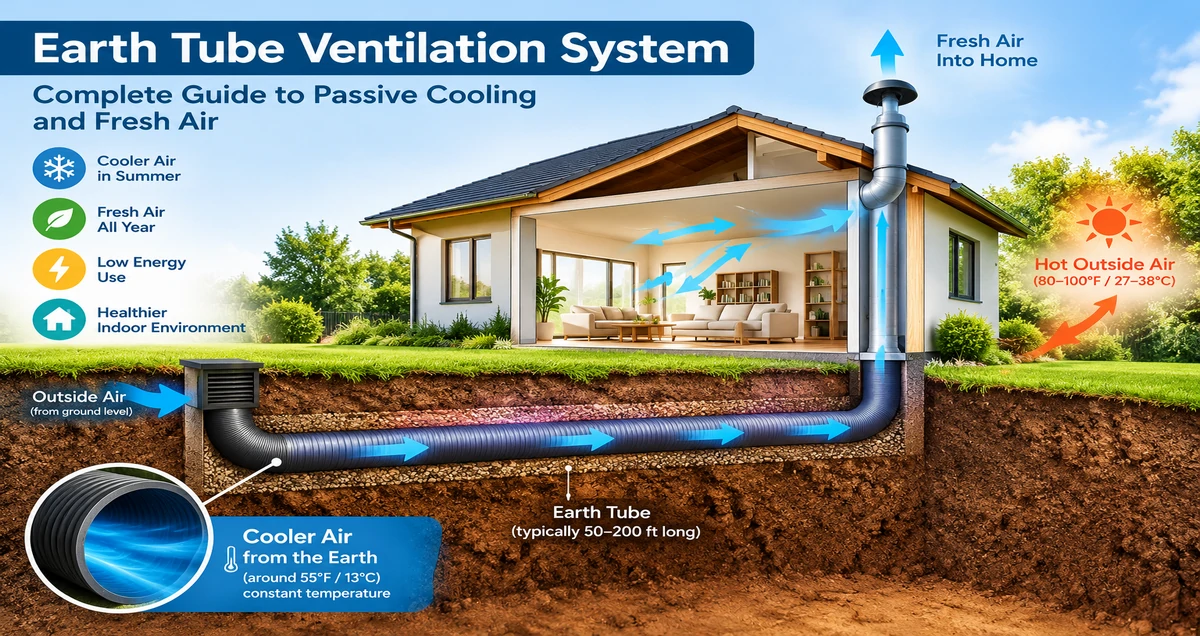
An earth tube ventilation system is a passive or low-energy ventilation method that uses buried pipes to bring outdoor air through the ground before it enters a building. Because soil temperatures are generally more stable than outdoor air temperatures, the ground can naturally pre-cool incoming air during hot weather and pre-warm it during colder weather.
Earth tubes are also called earth-air heat exchangers (EAHEs), ground-air heat exchangers, or underground air heat exchangers.
The concept is simple:
Outdoor air → buried earth tubes → temperature exchange with the ground → filtered air → building
When properly designed, an earth tube can reduce the temperature of incoming air in summer and moderate it during winter. However, it should not automatically be treated as a replacement for a complete mechanical ventilation or air-conditioning system.
This guide explains how earth tube ventilation works, possible benefits and disadvantages, pipe sizing, installation considerations, condensation and moisture control, and when an earth tube system makes sense.
What Is an Earth Tube Ventilation System?
An earth tube ventilation system uses one or more underground pipes to exchange heat between outdoor air and the surrounding soil.
The pipes are normally buried below ground, where temperatures fluctuate less than the outdoor air temperature. Outdoor air enters the pipe, travels through the underground section, and exchanges heat with the surrounding soil before entering the building.
In summer:
Hot outdoor air → cooler ground → cooler incoming air
In winter:
Cold outdoor air → warmer ground → warmer incoming air
The system does not create cold air in the same way an air conditioner does. Instead, it uses the ground as a thermal buffer.
A DOE case study describes an earth tube installation using buried pipe to temper outdoor air before it entered a highly efficient home.
How Does an Earth Tube Ventilation System Work?
The operating principle is based on heat transfer.
Imagine that the outdoor temperature is:
35°C / 95°F
while the soil surrounding a properly buried pipe is substantially cooler.
As the hot outdoor air travels through the pipe, heat moves from the air toward the cooler soil.
The result is air entering the building at a lower temperature than the outside air.
During winter, the process reverses.
If outdoor air is:
0°C / 32°F
and the surrounding soil is warmer, heat moves from the ground toward the incoming air.
The air entering the building is therefore warmer than the outdoor air.
Basic system layout
Outdoor air intake
↓
Filter
↓
Buried earth tube
↓
Condensate/moisture management
↓
Fan or ventilation system
↓
Indoor supply
The actual design should include appropriate filtration, drainage, access for cleaning, and controls.
Earth Tube Ventilation System vs. Air Conditioning
An earth tube is fundamentally different from an air conditioner.
An air conditioner actively removes heat from indoor air using a refrigeration cycle.
An earth tube primarily exchanges heat with the ground.
That means an earth tube generally has much lower mechanical complexity, but its cooling capability is also limited by:
- Soil temperature
- Pipe length
- Pipe diameter
- Airflow
- Burial depth
- Soil moisture
- Climate
- Outdoor temperature
- Pipe material
- Installation quality
- Condensation
- Building insulation
For this reason, an earth tube is often better considered a pre-conditioning system rather than a complete replacement for HVAC.
Earth Tube Ventilation System Benefits
1. Passive Temperature Control
The biggest advantage is that the ground can moderate incoming outdoor air.
Instead of bringing extremely hot or cold outdoor air directly into a building, the earth tube allows the air to exchange heat with the soil first.
This can reduce the temperature difference that the building’s HVAC system needs to handle.
2. Lower Electrical Demand
A passive earth tube does not require a compressor like conventional air conditioning.
If a fan is used, the electrical demand is primarily associated with moving air.
The potential energy savings depend heavily on the climate, building design, airflow, pipe configuration, and operating schedule.
3. Fresh-Air Ventilation
An earth tube can provide a pathway for outdoor air to enter a building.
However, ventilation and cooling are not the same thing.
A system must still be properly designed to provide adequate outdoor airflow and acceptable indoor air quality.
Passive House documentation, for example, treats ground-coupled heat exchangers as one component within a broader ventilation system rather than as the entire ventilation strategy.
4. Useful in Passive and Energy-Efficient Buildings
Earth tubes can work particularly well when combined with:
- Good insulation
- Airtight construction
- Exterior shading
- Thermal mass
- Efficient ventilation
- Heat-recovery ventilation
- Efficient windows
- Solar control
The better the building envelope, the more useful moderate-temperature ventilation air can become.
A Passive House project documented a buried earthloop used to prewarm ventilation air in winter and precool it in summer.
Earth Tube Ventilation System Disadvantages
Earth tubes are not automatically suitable for every building.
There are several important disadvantages to consider.
1. Condensation
This is one of the most important problems.
If warm, humid outdoor air enters a cooler underground pipe, water vapor can condense on the inside of the pipe.
For example:
Outdoor air: 32°C / 90°F
High relative humidity: possible
Pipe surface: significantly cooler
If the pipe surface falls below the air’s dew point, condensation can occur.
Water accumulation can create conditions favorable to biological growth.
Therefore, drainage and moisture management should be considered from the beginning of the design.
2. Mold and Microbial Growth
Poorly designed earth tubes can become difficult-to-clean underground air pathways.
The U.S. Department of Energy has specifically identified potential concerns involving mold, fungi, and bacteria in air-ground heat exchangers.
This is one reason material selection, drainage, filtration, inspection access, and maintenance are critical.
3. Radon and Soil Gas
Because the system is connected to the ground, soil gases need to be considered.
Radon is a naturally occurring radioactive gas that can enter buildings from the soil.
An earth tube should therefore not be treated as simply “a pipe buried in the ground.” The system needs appropriate sealing and site-specific evaluation.
If a property has elevated radon potential, test the building and follow applicable local radon-control guidance.
4. Difficult Maintenance
An underground pipe is much harder to inspect and repair than an exposed ventilation duct.
If a buried pipe develops:
- Leaks
- Cracks
- Standing water
- Contamination
- Blockages
- Animal intrusion
repair can be expensive.
The design should therefore prioritize durable materials and accessibility for critical components.
5. Performance Depends on Climate
Earth tubes can work differently from one climate to another.
DOE notes that air-ground heat exchangers can perform poorly in hot and humid areas because the ground may not remain cool enough and additional dehumidification may be required.
This is especially important in climates where summer humidity is high.
Cooling air is not enough if the system introduces excessive moisture into the building.
How Deep Should an Earth Tube Be Buried?
There is no single universal depth that works for every location.
The ideal depth depends on:
- Local soil temperature
- Climate
- Seasonal temperature variation
- Soil composition
- Moisture
- Available land
- Pipe material
- Required airflow
- System length
The objective is to reach soil conditions that are more thermally stable than the outdoor air.
For example, a documented Passive House earthloop was installed at a minimum depth of approximately 1.8 meters.
However, that should not be interpreted as a universal recommendation for every property.
A local engineer should determine the appropriate installation depth.
How Long Should an Earth Tube Be?
Longer pipes generally provide more opportunity for heat transfer, but longer does not automatically mean better.
As air travels through the tube, its temperature approaches the surrounding ground temperature.
At some point, additional pipe length may provide diminishing returns while increasing:
- Installation cost
- Pressure drop
- Fan energy
- Cleaning difficulty
- Condensation exposure
A properly engineered system balances heat exchange against airflow resistance.
Earth Tube Pipe Diameter
Pipe diameter affects both airflow and pressure loss.
A larger pipe can move more air with lower air velocity, while a smaller pipe may create greater resistance.
However, simply choosing the largest possible pipe is not necessarily the best design.
The designer should calculate:
Required airflow + pipe length + diameter + bends + pressure loss + fan capacity
For residential systems, airflow requirements should be based on the building and ventilation standard rather than an arbitrary pipe size.
How Many Earth Tubes Do You Need?
A larger building may require multiple tubes instead of one very long tube.
Multiple parallel tubes can provide greater total airflow while distributing the heat-transfer surface across a larger area.
A conceptual arrangement might look like:
Outdoor intake
↓
Filter
↓
Manifold
↓
Tube 1 ───────────┐
Tube 2 ───────────┤
Tube 3 ───────────┤ → Indoor ventilation system
Tube 4 ───────────┘
The actual number depends on required airflow and pressure-drop calculations.
Earth Tube Ventilation System Design Example
Consider a small energy-efficient house that needs outdoor ventilation air.
Suppose the system is designed around:
- Multiple buried pipes
- A filtered outdoor intake
- A low-energy fan
- Condensate management
- A central distribution system
The goal is not necessarily to make the incoming air equal to the soil temperature.
Instead, the objective is to reduce the temperature difference between outdoor air and indoor conditions.
For example:
Outside: 35°C
Ground around tube: cooler
Air entering building: potentially moderated
The exact outlet temperature must be calculated or measured because it depends on the complete system.
A real Passive House case study reported an earthloop designed to provide approximately 1 kW of heating or cooling effect to the incoming ventilation air.
That demonstrates an important point:
Earth tubes can provide useful thermal conditioning, but performance is highly system-specific.
Can Earth Tubes Cool a House?
Yes, but there is an important qualification.
An earth tube can cool incoming ventilation air, but that does not mean it can necessarily cool an entire house during a hot day.
The total cooling requirement of a building depends on:
- Solar heat gain
- Windows
- Roof
- Walls
- Occupants
- Appliances
- Lighting
- Outdoor temperature
- Humidity
- Building insulation
- Thermal mass
A highly insulated home with exterior shading may require relatively little active cooling.
A poorly insulated home with large unshaded windows may require much more cooling than an earth tube can provide.
Can Earth Tubes Heat a House?
Earth tubes can pre-warm incoming ventilation air during cold weather.
However, they generally should not be assumed to replace a dedicated heating system.
Their main advantage is reducing the temperature difference between outdoor ventilation air and indoor conditions.
In a well-designed energy-efficient building, this can be useful because ventilation loads can represent a meaningful portion of heating demand.
Earth Tubes and Heat Recovery Ventilation
One interesting approach is combining an earth tube with a heat recovery ventilator (HRV).
The basic concept can be:
Outdoor air → earth tube → HRV → living spaces
while:
Indoor exhaust air → HRV → outdoors
The HRV transfers heat between outgoing and incoming air.
Passive House ventilation systems commonly use heat recovery to reduce the energy required to condition incoming outdoor air.
This combination can potentially provide:
- Ground temperature moderation
- Heat recovery
- Fresh-air ventilation
- Filtration
- Better control of airflow
However, adding an earth tube does not automatically improve every HRV installation. The complete system should be modeled and designed together.
Earth Tube Ventilation System Materials
Materials commonly considered for underground air pathways include engineered plastic or other products specifically suitable for buried ventilation applications.
The important characteristics include:
- Smooth interior surface
- Airtight joints
- Durability
- Resistance to moisture
- Resistance to soil conditions
- Low contamination potential
- Appropriate structural strength
- Compatibility with local building requirements
Avoid assuming that any inexpensive drainage or construction pipe is automatically suitable for supplying indoor breathing air.
The material should be selected specifically for the intended application.
How to Prevent Condensation in Earth Tubes
Condensation management should be part of the original design.
Potential strategies include:
1. Proper Pipe Slope
A controlled slope can help direct condensation toward a designated drainage point.
2. Drainage
Standing water should not be allowed to remain inside the air pathway.
3. Moisture Monitoring
In humid climates, monitoring temperature and humidity can help identify condensation risks.
4. Appropriate Controls
The system can be controlled according to outdoor temperature, humidity, dew point, and indoor conditions.
5. Good Sealing
Water infiltration from the surrounding soil should be prevented.
Moisture problems in ventilation systems are important because wet duct surfaces can support mold growth. EPA guidance notes that moisture in ducts can contribute to mold when surfaces remain wet.
Do Earth Tubes Need a Fan?
Not always.
A system can potentially use:
- Natural airflow
- Stack effect
- Wind pressure
- Mechanical fans
However, relying entirely on natural airflow makes the ventilation rate less predictable.
A controlled mechanical fan can provide more consistent airflow.
The choice depends on the building design, climate, pressure losses, and required ventilation rate.
Earth Tube Ventilation System With Solar Power
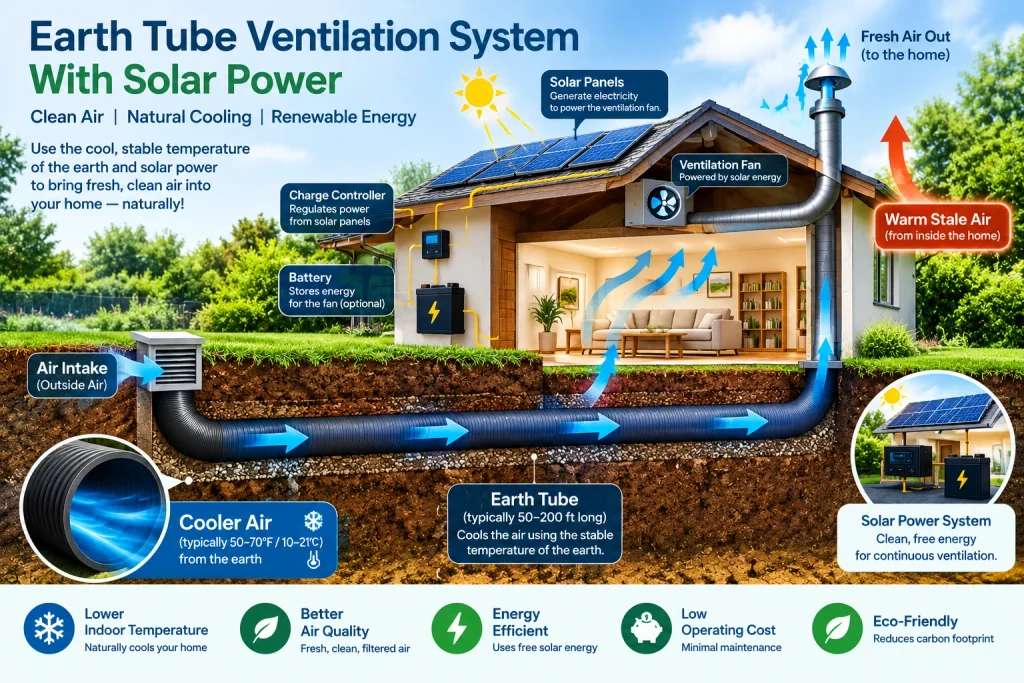
An earth tube can also be combined with solar power.
A simple off-grid concept could include:
Solar panels
↓
Solar charge controller
↓
Battery
↓
DC ventilation fan
↓
Earth tube
↓
Fresh air
This can be useful for remote buildings such as:
- Cabins
- Workshops
- Small agricultural buildings
- Off-grid homes
- Remote shelters
The system still needs proper filtration, drainage, and air-quality controls.
Solar power can operate the fan, but it does not solve poor earth-tube design.
Is an Earth Tube Ventilation System Worth It?
An earth tube may be worth considering when:
- The building is new construction
- Excavation is already planned
- The building has high insulation levels
- The climate has significant seasonal temperature variation
- Land is available
- Long-term energy efficiency is important
- A professional ventilation design is being used
It may be less attractive when:
- Excavation is extremely expensive
- The climate is hot and humid
- Soil conditions are unfavorable
- The system cannot be properly drained
- Inspection and cleaning access is impossible
- A conventional efficient ventilation system already provides better value
DOE has identified dry areas with significant seasonal temperature variation as a potentially more promising application for air-ground heat exchangers.
Earth Tube Ventilation System: Pros and Cons
| Advantages | Disadvantages |
|---|---|
| Uses stable ground temperatures | Installation can require excavation |
| Can pre-condition outdoor air | Condensation can be a problem |
| Low operating energy potential | Difficult underground maintenance |
| Can work with efficient buildings | Moisture can create air-quality concerns |
| Can reduce ventilation heating/cooling load | Performance depends heavily on climate |
| Can be combined with HRV systems | Soil gases such as radon must be considered |
| Can work with solar-powered fans | Not a complete replacement for HVAC |
Common Earth Tube Installation Mistakes
Mistake 1: Making the Pipe Too Long
More length does not always mean proportionally more cooling.
Mistake 2: Ignoring Condensation
A cold pipe carrying humid air can produce water.
Mistake 3: No Drainage Plan
Standing water inside a ventilation pathway is a serious design problem.
Mistake 4: No Filter
Outdoor air can contain dust, pollen, insects, and other contaminants.
Mistake 5: Poorly Sealed Connections
Leaks can allow unwanted soil moisture or gases into the system.
Mistake 6: Assuming It Replaces Air Conditioning
Earth tubes primarily moderate incoming air. They do not provide the same cooling capacity as a properly sized refrigeration-based air conditioner.
Mistake 7: Ignoring Local Codes
Underground ventilation installations should comply with applicable building, mechanical, electrical, drainage, and indoor-air-quality requirements.
Earth Tube Ventilation System Maintenance
Although most of the system is underground, maintenance should not be ignored.
A maintenance plan can include:
- Inspecting outdoor intake screens
- Replacing filters
- Checking drainage
- Monitoring humidity
- Inspecting accessible components
- Checking fan operation
- Checking for unusual odors
- Monitoring indoor air quality
- Testing for radon where appropriate
The underground portion is difficult to inspect, which makes prevention especially important.
Earth Tubes vs. HRV: Which Is Better?
These technologies solve related but different problems.
| Feature | Earth Tube | HRV |
|---|---|---|
| Uses ground temperature | Yes | No |
| Recovers heat from exhaust air | No | Yes |
| Provides ventilation | Yes, when properly designed | Yes |
| Requires underground piping | Yes | No |
| Condensation concerns | Significant | Also possible |
| Mechanical complexity | Low to moderate | Moderate |
| Best use | Ground-temperature preconditioning | Controlled ventilation + heat recovery |
In some efficient buildings, the technologies can be combined rather than treated as competing systems.
Earth Tube Ventilation System Safety Checklist
Before installing an earth tube, consider:
☐ Local soil and groundwater conditions
☐ Climate and seasonal temperatures
☐ Required ventilation airflow
☐ Pipe diameter and length
☐ Pressure drop
☐ Condensation risk
☐ Drainage
☐ Outdoor air filtration
☐ Soil-gas and radon considerations
☐ Airtight connections
☐ Access for maintenance
☐ Fan sizing
☐ Indoor humidity
☐ Local building codes
☐ Professional HVAC/ventilation review
For a new construction project, it is much easier to integrate these requirements before the foundation and site work are completed.
Frequently Asked Questions About Earth Tube Ventilation Systems
How does an earth tube ventilation system work?
It moves outdoor air through buried pipes so the surrounding soil can exchange heat with the air. The system can moderate incoming air before it enters a building.
Are earth tubes good for cooling?
They can reduce the temperature of incoming ventilation air, especially in suitable climates, but they may not provide enough cooling to replace an air-conditioning system.
How deep should earth tubes be?
There is no universal depth. The appropriate depth depends on local ground temperatures, soil conditions, climate, installation constraints, and system design.
Do earth tubes work in winter?
Yes. The warmer ground can pre-warm cold outdoor air before it enters the building.
Can earth tubes cause mold?
They can create moisture-related problems if condensation or water accumulation is not properly controlled. DOE has identified mold, fungi, and bacteria as potential concerns with air-ground heat exchangers.
Do earth tubes need electricity?
A passive system may use natural airflow, but mechanical fans are often used when controlled ventilation is required.
Can an earth tube replace an HVAC system?
Usually, it should not be assumed to replace a complete HVAC system. Its performance depends heavily on the building, climate, soil, airflow, and system design.
Can an earth tube be combined with an HRV?
Yes. An earth tube can potentially pre-condition outdoor air before it reaches an HRV, but the complete system should be engineered together.
Are earth tubes suitable for humid climates?
They can be challenging in hot and humid climates because condensation and dehumidification become important design issues.
Final Verdict: Is an Earth Tube Ventilation System a Good Idea?
An earth tube ventilation system can be an interesting low-energy strategy for moderating outdoor ventilation air.
Its greatest potential is in buildings designed around energy efficiency, good insulation, effective shading, controlled ventilation, and appropriate climate conditions.
But earth tubes are not simply “free air conditioning.”
The biggest issues to solve are:
condensation + drainage + filtration + air quality + soil gases + maintenance + climate suitability.
A well-designed system can use the relatively stable temperature of the ground to reduce the thermal load associated with ventilation. A poorly designed system can instead create moisture and indoor-air-quality problems.
For new construction, the best approach is to evaluate an earth tube as part of the entire building system rather than as an isolated DIY project.
The goal should not simply be colder air—it should be reliable, clean, controllable, and energy-efficient ventilation.
Important Safety Note
This article is educational and does not replace professional HVAC, mechanical, structural, electrical, or indoor-air-quality engineering. Underground ventilation systems can involve condensation, biological contamination, soil gases, drainage, and local code requirements. Have the system professionally evaluated before installation, particularly when it will supply air directly to occupied spaces.