

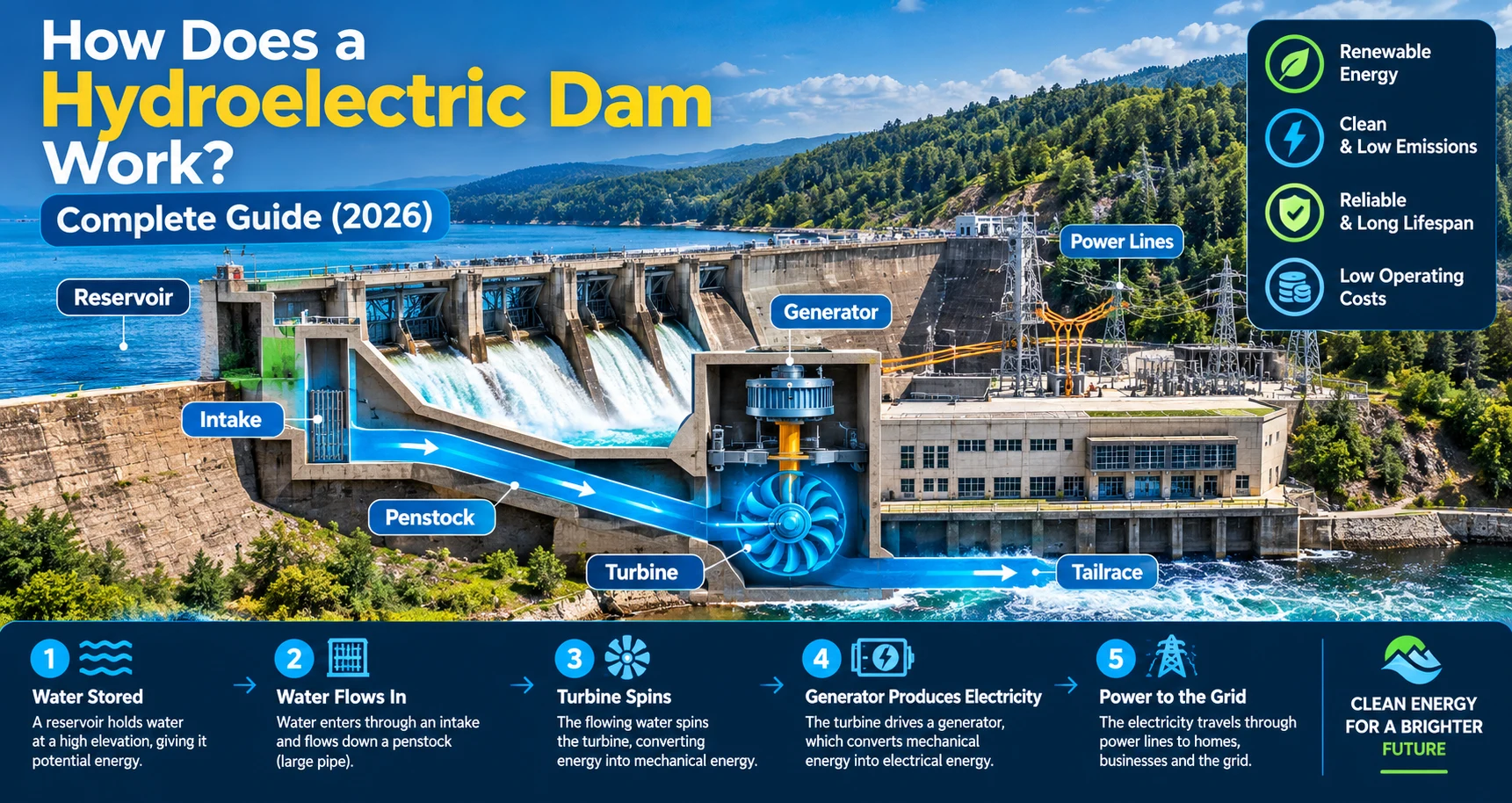
How Does a Hydroelectric Dam Work? Complete Guide (2026)
Hydroelectric power is one of the most established forms of renewable electricity generation. By using the energy of moving water, a hydroelectric dam can produce electricity for homes, businesses, factories, and entire communities.
But how does water stored behind a massive concrete dam become usable electricity? The answer involves several important components, including the water intake, penstock, turbine, generator, transformer, and transmission lines.
Quick Answer: How Does a Hydroelectric Dam Work?
A hydroelectric dam stores water at a higher elevation. When water is released, it flows through an intake and a large pipe called a penstock. The moving water turns a turbine connected to an electrical generator. A transformer adjusts the voltage, and transmission lines carry the electricity toward the power grid.
1. What Is Hydroelectric Power?
Hydroelectric power, also known as hydropower, is electricity produced by using the energy of flowing or falling water.


In a conventional hydroelectric facility, a dam creates a reservoir or raises the water level to provide a useful difference in elevation. This difference, known as hydraulic head, helps water flow toward a turbine with enough energy to turn its blades.
The turbine converts the water’s energy into mechanical rotation. An electrical generator then converts that mechanical energy into electricity.
Unlike a power plant that burns coal or natural gas, a hydroelectric facility does not need to burn fuel to generate electricity. However, dam construction and reservoir operation can have significant environmental and social impacts.
2. Main Components of a Hydroelectric Dam
Each major component has a specific role in moving water through the system and delivering electricity to the grid.
The Dam and Reservoir
The dam controls the flow of a river and may create a reservoir where water is stored. Holding water at a higher elevation provides potential energy that can be converted into electricity when the water is released.
The amount of available water changes with rainfall, snowmelt, seasonal conditions, and water management requirements.
Water Intake
The intake is the entrance through which water enters the water-conveyance system. Screens may be installed to reduce the amount of debris entering the pipes and damaging equipment.
Intake gates help operators regulate or stop the flow of water when necessary.
Penstock
A penstock is a large pipe or conduit that carries water toward the turbine. In many dam-based power plants, it directs water from the reservoir or intake to the powerhouse.
As water moves through the system, its available energy depends on factors such as the elevation difference, flow rate, and hydraulic losses.
Turbine and Runner
The turbine converts energy from moving water into mechanical energy. Water acts on the turbine blades, causing the runner to rotate.
Different turbine designs are used depending on the site’s water flow and hydraulic head. Common designs include Francis, Kaplan, and Pelton turbines.
Generator
The turbine is connected to a generator by a shaft. When the turbine rotates, it turns the generator’s rotor inside a stationary component called the stator.
The movement of the generator’s magnetic field relative to its electrical windings produces electricity through electromagnetic induction.
Transformer
The transformer adjusts the voltage of the electricity produced by the generator. At many power plants, a step-up transformer increases voltage to support efficient long-distance transmission.
The exact electrical arrangement depends on the design of the facility and its connection to the grid.
Transmission Lines
Transmission lines carry electricity from the power station toward the wider electrical grid. Substations and additional transformers may adjust voltage before electricity is distributed to local communities and end users.
Draft Tube and Tailrace
In many reaction-turbine installations, a draft tube carries water away from the turbine runner and helps recover some of its available energy. The tailrace is the downstream channel through which water returns to the river or another waterway.
3. How a Hydroelectric Dam Generates Electricity: Step by Step
Step 1: Water Is Stored at a Higher Elevation
The reservoir holds water above the level of the turbine and downstream river. This elevation difference provides the potential energy used by the power plant.
Step 2: Water Enters Through the Intake
When the system is operating, intake gates allow a controlled amount of water to enter the water-conveyance system.
Step 3: Water Flows Through the Penstock
The penstock directs water toward the turbine. The pressure and speed of the water depend on the available hydraulic head, the flow rate, and losses within the system.
Step 4: The Water Turns the Turbine
Water transfers energy to the turbine runner, causing it to rotate. The turbine’s design determines how effectively it operates under the site’s specific conditions.
Step 5: The Generator Produces Electricity
The rotating turbine drives the generator. Electromagnetic induction converts the turbine’s mechanical rotation into electrical energy.
Step 6: A Transformer Adjusts the Voltage
The generated electricity passes through electrical equipment, including transformers, to prepare it for transmission through the power grid.
Step 7: Electricity Travels to Consumers
Transmission lines carry the electricity toward substations and distribution networks, which ultimately deliver power to homes, businesses, and industrial facilities.
4. How Much Electricity Can a Hydroelectric Dam Generate?
The electricity output of a hydroelectric power plant depends mainly on two factors: the usable hydraulic head and the water flow rate.
- Hydraulic head: The effective elevation difference available to drive the turbine.
- Flow rate: The volume of water passing through the turbine per second.
- Efficiency: How effectively the turbine, generator, and other components convert available water energy into electrical output.
A simplified estimate of hydroelectric power is:
P = ρ × g × Q × H × η
Where P is electrical power, ρ is water density, g is gravitational acceleration, Q is water flow rate, H is net hydraulic head, and η is the overall conversion efficiency.
For a simplified example, assume a facility has:
- Net hydraulic head: 50 meters
- Water flow rate: 10 cubic meters per second
- Overall efficiency: 90%
Using these assumptions, the estimated output is approximately 4.4 megawatts (MW). This is an illustrative calculation, not a specification for a real power plant. Actual output varies with operating conditions and equipment performance.
When water availability decreases during a drought, electricity production may also decrease. A dam’s installed capacity therefore does not mean it will produce that amount of electricity continuously.
5. Benefits of Hydroelectric Power
Renewable Electricity Generation
Hydropower relies on the natural water cycle, which is replenished by precipitation and evaporation. Sustainable operation depends on water availability and responsible management.
Low Direct Operational Emissions
Hydroelectric plants generally produce electricity without burning fossil fuels during normal operation. However, construction, reservoir emissions, and other life-cycle factors can contribute to overall greenhouse gas emissions.
Flexible Power Generation
Many hydropower facilities can adjust their output relatively quickly. This flexibility can help electricity systems respond to changing demand and balance variable renewable sources such as solar and wind power.
Long Operating Life
Well-maintained hydroelectric facilities can operate for many decades, although equipment, infrastructure, and environmental requirements need ongoing attention.
Potential for Energy Storage
Pumped-storage hydropower can store energy by using electricity to pump water to a higher reservoir. The stored water can later flow back through turbines to generate electricity when needed.
6. Environmental Challenges and Limitations
Although hydropower can provide valuable low-carbon electricity, building and operating dams also involves trade-offs.
Changes to River Ecosystems
Dams can alter natural river flows, affect fish migration, change water temperatures, and interfere with the movement of sediment.
Flooding of Land
Creating a reservoir may flood land, vegetation, wildlife habitats, and areas used by local communities. Large projects can also require the relocation of people.
Dependence on Water Availability
Extended droughts and changes in rainfall patterns can reduce reservoir levels and limit electricity production. Water may also need to be shared among power generation, agriculture, communities, and ecosystems.
Construction Costs and Safety
Large dams require substantial investment, detailed engineering, monitoring, and maintenance. Dam safety, emergency planning, and responsible reservoir management are essential.
Evaluating a hydroelectric project requires considering its energy benefits alongside its environmental, social, financial, and safety impacts.
7. Different Types of Hydroelectric Power Plants
Storage Hydropower
A dam creates a reservoir that stores water. Operators can release water through turbines according to electricity demand, water availability, and operating requirements.
Run-of-River Hydropower
Run-of-river facilities use the natural flow of a river, sometimes with a small diversion structure. Depending on their design, they may have limited water storage and can be more directly affected by seasonal river flows.
Pumped-Storage Hydropower
Pumped-storage facilities move water between lower and upper reservoirs. They use electricity to pump water uphill when energy is available and generate electricity when water flows back downhill through turbines.
Pumped storage is an energy-storage method rather than a primary energy source: it generally returns less electricity than it consumes because energy is lost during pumping and generation.
8. Hydropower vs. Solar and Wind Energy
Hydropower, solar power, and wind power all contribute to renewable electricity systems, but they work in different ways.
| Feature | Hydropower | Solar Power | Wind Power |
|---|---|---|---|
| Energy source | Moving or falling water | Sunlight | Moving air |
| Main equipment | Turbine and generator | Solar panels and inverter | Wind turbine and generator |
| Key limitation | Water availability and site suitability | Sunlight and weather | Wind conditions |
| Energy storage | Reservoirs or pumped storage | Batteries or other storage | Batteries or other storage |
These technologies can complement one another. For example, solar power may produce more electricity during sunny daytime hours, while flexible hydropower can help balance changes in electricity supply when water resources and operating conditions allow.
9. Frequently Asked Questions
How does a hydroelectric dam generate electricity?
Water flows from a higher elevation through a penstock and turns a turbine. The turbine drives a generator, which converts mechanical energy into electricity.
What is the purpose of a penstock?
A penstock carries water from the intake or reservoir toward the turbine. It is designed to handle the flow and pressure required by the facility.
What does a turbine do in a hydroelectric power plant?
The turbine converts energy from flowing water into mechanical rotation, which drives the generator.
Why is a transformer used in a hydroelectric dam?
A transformer adjusts electrical voltage. A step-up transformer commonly raises the generator’s output voltage to make long-distance electricity transmission more efficient.
Is hydroelectric power renewable?
Hydropower is generally classified as renewable because it relies on the water cycle. However, water availability and the environmental effects of dams must be considered.
Can hydroelectric dams generate electricity during a drought?
They may continue generating electricity if sufficient water is available, but drought conditions can reduce reservoir levels and limit output.
Does water get used up when generating hydropower?
Water usually continues downstream after passing through a turbine. Nevertheless, reservoirs can experience evaporation, and water management may affect downstream users and ecosystems.
Can hydropower work together with solar energy?
Yes. Hydropower can help balance changes in solar generation, and pumped-storage facilities can store energy for later use. The effectiveness of this combination depends on the system design and available resources.
Conclusion: Why Hydroelectric Dams Matter
A hydroelectric dam transforms the energy of water into electricity through a coordinated system of intakes, penstocks, turbines, generators, transformers, and transmission lines.
Its output depends on water flow, hydraulic head, and equipment efficiency. When properly designed and managed, hydropower can provide renewable electricity, flexible generation, and—in pumped-storage facilities—large-scale energy storage.
However, the benefits must be balanced against environmental impacts, water availability, construction costs, and dam safety. Understanding how each component works helps explain both the value and the limitations of hydroelectric power in the modern energy system.
Learn More About Hydropower
For additional technical information, consult these educational resources: