


SOLAR ENERGY • ELECTRIC VEHICLES • 2026 GUIDE
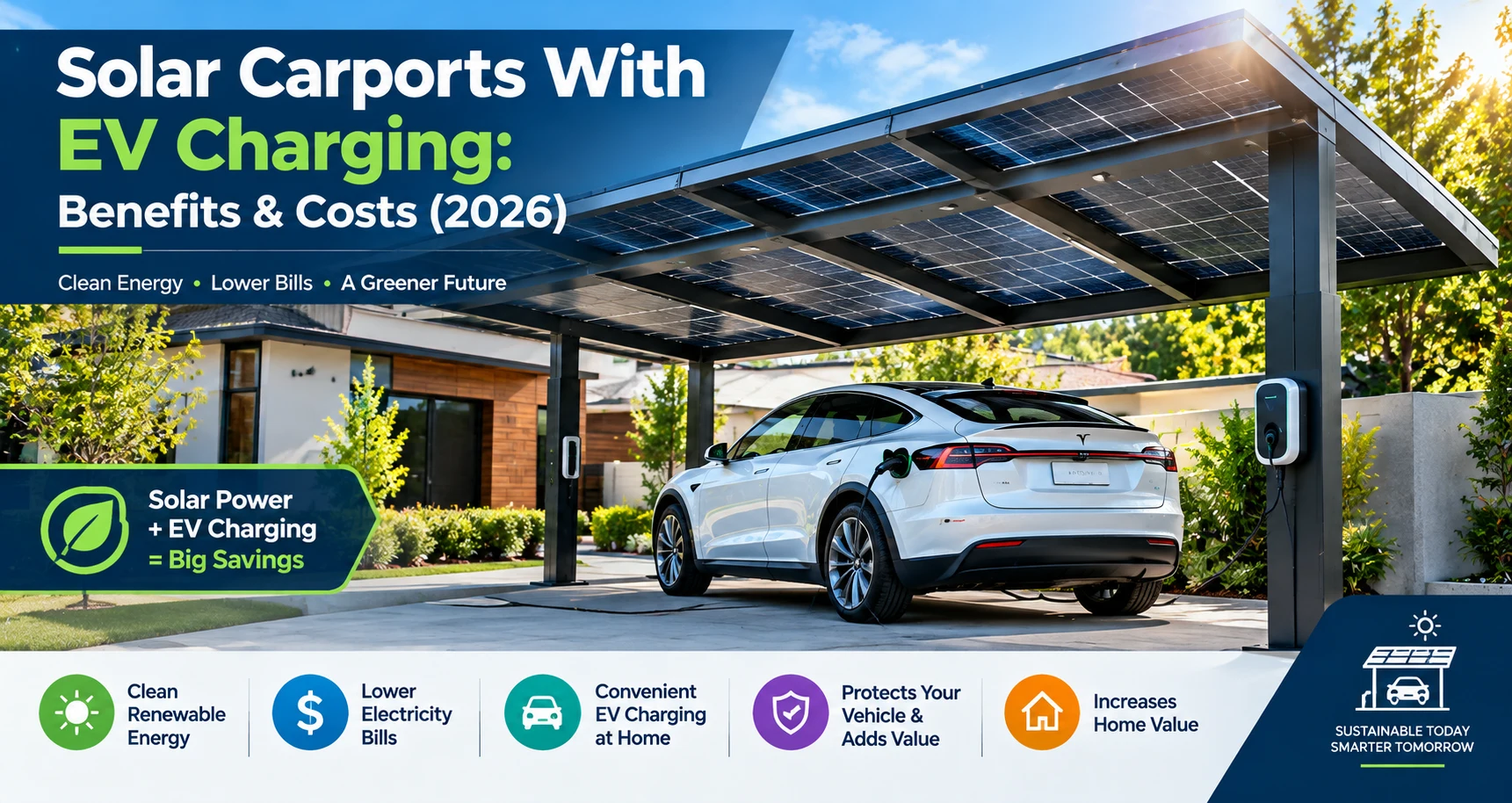
Solar Carports With EV Charging: Benefits & Costs (2026)
Discover how solar carports generate renewable electricity, support electric vehicle charging, protect parked cars, and help homeowners and businesses manage energy costs.
Quick Answer: Are Solar Carports With EV Charging Worth It?
A solar carport with EV charging combines a covered parking structure, solar panels, and an electric vehicle charging station. It can produce renewable electricity, provide shade, and reduce the amount of grid electricity purchased for vehicle charging or building use.
Best for: Homeowners with suitable parking areas, workplaces, commercial properties, hotels, retail centers, and businesses with predictable daytime electricity demand. Financial value depends on installation costs, solar production, electricity prices, charging habits, and available incentives.
1. What Is a Solar Carport With EV Charging?
A solar carport with EV charging is a parking canopy equipped with photovoltaic (PV) panels and one or more electric vehicle chargers. Instead of using a parking area only for vehicles, the structure also generates electricity from sunlight.
The system can be installed at a private home, office, shopping center, hotel, apartment complex, fleet depot, or public parking facility. Depending on its design and electrical configuration, the generated electricity can power EV chargers, support a nearby building, charge a battery, or be exported to the electricity grid where permitted.
Solar Panels
Convert sunlight into electricity for charging and other compatible electrical loads.
Parking Canopy
Supports the panels while providing shade and some protection from rain, hail, and direct sunlight.
EV Charger
Delivers electricity to a compatible vehicle using properly rated charging equipment.
Unlike rooftop solar, a solar carport requires its own supporting structure and foundations. This can make construction more expensive, but it creates a new solar installation area when the existing roof is unsuitable or already fully used.
2. How Does a Solar Carport With EV Charging Work?
The basic process is similar to a conventional solar power system, with additional equipment for vehicle charging.
Important: Solar output changes with sunlight, shading, temperature, and weather. A grid-connected system may draw additional electricity from the grid when solar production is insufficient. A battery or specialized control system can improve flexibility, but it adds cost and complexity.
3. Seven Key Benefits of Solar Carports With EV Charging
“`1. Generate Electricity Where Cars Already Park
Parking lots occupy valuable space, especially at offices, retail centers, and commercial facilities. Solar canopies allow property owners to generate electricity above those spaces without dedicating additional open land to a conventional ground-mounted solar array.
2. Reduce the Cost of EV Charging
When solar electricity is available while a vehicle is charging, it can offset some electricity that would otherwise be purchased from the grid. Savings depend on the value of the solar electricity, charging times, system efficiency, and the cost of grid power.
For example, a workplace with employees charging vehicles during sunny daytime hours may be able to use a larger share of its solar production directly.
3. Provide Shade and Weather Protection
A properly designed canopy helps shield vehicles from direct sun and can reduce exposure to rain and some other weather conditions. Shade can also make the parking experience more comfortable during hot weather.
Protection depends on the canopy design, wind direction, roof coverage, and local climate. A carport is not the same as an enclosed garage.
4. Support Business Electricity Needs
Businesses can use solar electricity for EV charging, lighting, office equipment, refrigeration, or other compatible loads. Reducing purchased electricity can be particularly useful when the site consumes substantial power during solar-production hours.
5. Create Opportunities for Commercial EV Charging
Hotels, shopping centers, offices, and public parking operators can integrate charging into their existing services. Depending on the business model, EV charging may support customer satisfaction, employee benefits, fleet operations, or charging revenue.
However, charger installation alone does not guarantee additional revenue. Owners should evaluate local demand, charging prices, operating costs, and competition.
6. Improve Energy Management
Smart charging systems can adjust vehicle charging according to available solar power, electricity prices, and site demand. This may help avoid unnecessary grid consumption or reduce demand peaks where the utility tariff rewards such management.
7. Support Renewable-Energy Goals
Solar carports can help property owners increase renewable electricity generation and reduce emissions associated with purchased grid electricity. The actual environmental benefit depends on the electricity displaced, the equipment lifecycle, and the local electricity mix.
“`4. How Much Does a Solar Carport With EV Charging Cost in 2026?
The total cost depends on the number of parking spaces, canopy materials, solar capacity, foundation requirements, charger type, electrical upgrades, permits, and labor. Commercial systems may also require advanced controls, multiple chargers, and utility interconnection work.
“`| System Type | Illustrative Budget Range | Typical Application |
|---|---|---|
| Small residential solar carport | $10,000–$25,000+ | One or two parking spaces |
| Residential carport with solar and Level 2 EV charging | $15,000–$35,000+ | Home EV charging |
| Small commercial solar carport | $50,000–$200,000+ | Small workplace or business site |
| Large commercial solar parking canopy | $200,000 to $1 million+ | Larger parking facilities and fleets |
These ranges are illustrative budgeting examples, not quotes or statistical averages. They assume different system sizes and construction scopes and should not be compared without checking what each estimate includes.
What Makes Up the Total Cost?
| Component | What Affects the Price? |
|---|---|
| Canopy structure | Steel or aluminum, spans, height, foundations, drainage, and wind or snow loads |
| Solar panels and inverter | System capacity, equipment specifications, mounting, wiring, and installation |
| EV charging equipment | Charger power, number of ports, networking, payment systems, and cable management |
| Electrical work | Panel capacity, cable routes, trenching, protection equipment, and utility upgrades |
| Battery storage | Battery capacity, power rating, controls, installation, and safety requirements |
| Design and approvals | Engineering, planning permission, inspections, grid studies, and project management |
For comparison, EnergySage reported an average U.S. residential solar carport cost of approximately $34,998 in data covering the first half of 2026. That figure is a solar-carport benchmark, not a universal price for a carport with EV charging; additional chargers, batteries, and electrical work may increase the total. Read the solar carport cost guide.
“`5. How Much Money Can a Solar EV Carport Save?
Potential savings come from using solar electricity instead of buying electricity from the grid. Some businesses may also benefit from lower demand charges, electricity export payments, or charging revenue. These additional benefits depend on local tariffs and the operating model.
“`Example: Estimate the Annual Value of Solar Charging
Imagine a solar carport produces 6,000 kWh of electricity in one year. Suppose 60% of that production is used directly to charge an EV or supply other loads that would otherwise use grid electricity.
Illustrative assumptions
Annual solar production: 6,000 kWh
Directly used solar electricity: 60%
Value of displaced grid electricity: $0.20 per kWh
Solar electricity used on-site: 6,000 × 0.60 = 3,600 kWh
Illustrative annual electricity-bill savings: $720
This example excludes installation costs, maintenance, financing, export revenue, degradation, taxes, and incentives. It is not a prediction of actual savings.
The remaining 2,400 kWh may be exported, stored, or used by other loads, depending on the system configuration. Its financial value will differ from the value of electricity used directly and must be calculated separately.
How to Calculate the Payback Period
For a simple preliminary estimate, divide the net upfront project cost by the expected annual net financial benefit.
SIMPLE PAYBACK FORMULA
Net Project Cost ÷ Annual Net Benefit
For example, a project costing $20,000 after eligible incentives with an estimated annual net benefit of $2,000 would have a simple payback period of 10 years.
Real project economics are more complex. Electricity-price changes, maintenance, financing, inverter replacement, equipment degradation, taxes, export rates, and battery replacement can change the outcome. Simple payback is not the same as investment return over the system’s lifetime.
“`6. How to Size a Solar Carport for EV Charging
The right solar capacity depends on how much electricity your vehicle uses, how often it is parked at the property, and how much sunlight reaches the panels. Begin with driving and charging data rather than choosing a system solely by the size of the parking canopy.
“`Step 1: Estimate Your EV’s Energy Use
Suppose your EV uses 0.30 kWh per mile and you drive 40 miles each day.
Daily energy needed: 40 miles × 0.30 kWh/mile = 12 kWh.
Over 30 days, that equals approximately 360 kWh delivered to the vehicle, before accounting for charging losses and variations in driving conditions.
Step 2: Estimate Solar Production
Solar production depends on location, panel orientation, shading, temperature, weather, and system losses. A professional installer can model expected annual and seasonal production for your specific site.
Step 3: Match Solar Output to Charging Times
If your vehicle is parked at work during the day, direct solar charging may be easier to achieve. If you mainly charge at home overnight, you may need grid electricity or a suitably sized battery to shift some daytime solar energy into the evening.
Step 4: Check Charger Compatibility
For residential installations, an AC Level 2 charger is often a practical option. Commercial sites may need several AC chargers, DC fast chargers, or a combination of both. Higher-power chargers require careful evaluation of electrical service capacity, demand, and installation cost.
7. Do You Need Battery Storage for a Solar Carport?
No. A solar carport can operate without a battery when its design and grid connection support the intended use. Battery storage is an optional addition that can store surplus solar energy for later use.
“`Without a Battery
- Usually lower upfront cost
- Simple solar self-consumption
- May rely more on the grid outside sunny periods
- Surplus power may be exported if allowed
With a Battery
- Stores some surplus daytime energy
- Can support later charging
- Adds cost and conversion losses
- Requires suitable controls and safety provisions
Battery storage is worth evaluating when charging demand extends into the evening, electricity tariffs vary significantly by time, grid capacity is limited, or backup power is an important requirement. A standard grid-connected solar system does not necessarily provide electricity during a grid outage; backup capability requires compatible equipment and appropriate electrical isolation.
“`8. Advantages and Disadvantages of Solar Carports
| Advantages | Disadvantages |
|---|---|
| Produces renewable electricity | Higher initial cost than panels alone |
| Provides shaded parking | Requires structural design and foundations |
| Can reduce purchased electricity | Savings depend on usage and local tariffs |
| Supports workplace and fleet charging | Electrical upgrades may be necessary |
| Makes dual use of parking space | Permits, construction disruption, and maintenance |
A solar carport is not automatically the best investment for every property. If your roof is suitable and your main goal is the lowest-cost solar electricity, rooftop solar may be cheaper. A carport becomes more attractive when covered parking is also valuable or rooftop space is limited.
9. Installation Checklist: What to Check Before Buying
Before committing to a solar carport with EV charging, review the following points with qualified local professionals.
☐ Site assessment: Check available space, shading, drainage, access, and vehicle clearance.
☐ Structural engineering: Confirm foundations and structure can safely handle local wind, snow, and other relevant loads.
☐ Solar design: Review expected annual generation, panel orientation, and system losses.
☐ Charger selection: Choose suitable charging power, connectors, number of ports, and network features.
☐ Electrical capacity: Assess the existing service, protective equipment, wiring, and any required utility upgrades.
☐ Smart charging: Consider controls that coordinate solar production with vehicle charging and other electrical loads.
☐ Battery decision: Compare the extra cost with the value of shifting solar energy to later hours.
☐ Permits and utility approval: Confirm local building, electrical, planning, interconnection, and inspection requirements.
☐ Maintenance and warranties: Check cleaning access, drainage, equipment warranties, and service arrangements.
☐ Financial assessment: Compare itemized quotes, energy rates, incentives, financing, and realistic payback estimates.
Ask each installer to specify exactly what the quote includes. A low headline price may exclude foundations, trenching, charger installation, electrical upgrades, permits, or utility work.
10. Are Solar Carports Eligible for Tax Credits or Incentives?
Incentives vary by country, state, municipality, project ownership, system configuration, and installation date. Some programs may support solar generation, EV charging equipment, or commercial energy projects, but eligibility conditions can be different for each component.
Before including an incentive in your financial calculations, verify the current rules with the relevant government agency, tax professional, utility, or qualified energy adviser. Do not assume that a program is available simply because another solar project qualified for it.
For U.S. readers, the U.S. Department of Energy is a useful starting point for official energy information. Businesses should also confirm applicable federal, state, and local requirements before making an investment.
11. Frequently Asked Questions
“`How much does a solar carport with EV charging cost?
Costs vary considerably. A small residential project may cost tens of thousands of dollars, while a large commercial canopy can cost hundreds of thousands or more. The number of parking spaces, structure, solar capacity, chargers, electrical work, and local labor all affect the final price.
Can solar panels charge an electric car directly?
Yes, through a properly designed system with compatible power-conversion equipment and EV charging hardware. Solar generation varies throughout the day, so grid support, battery storage, or intelligent charging controls may be needed to provide a consistent charging experience.
Are solar carports better than rooftop solar panels?
Not in every situation. Rooftop solar is often less expensive when a suitable roof is available. Solar carports offer additional benefits, including covered parking, a separate panel location, and convenient integration with EV charging.
Do solar carports work on cloudy days?
Yes. Solar panels can generate electricity in cloudy conditions, but output is generally lower than in strong direct sunlight. The amount depends on cloud cover, equipment, location, and other site conditions.
Do I need a battery for EV charging?
No. A battery is optional if the system can meet your charging requirements using available solar generation and grid electricity. Storage may be useful when you want to use daytime solar energy later.
Can a solar carport charge multiple electric vehicles?
Yes, if the solar array, electrical service, charging equipment, and energy-management system are designed for the expected demand. Multiple chargers may need load management to prevent excessive electrical demand.
How long does it take for a solar carport to pay for itself?
There is no universal payback period. It depends on the initial cost, usable solar production, electricity prices, self-consumption, maintenance, financing, incentives, and the value of any exported electricity. Ask for a site-specific financial model before investing.
Can a solar carport power a home during a blackout?
Not necessarily. Many grid-connected solar systems shut down during a grid outage unless they include compatible backup equipment and safe isolation. Confirm the system’s backup capability with a qualified installer.
Final Verdict: Is a Solar Carport With EV Charging Worth It in 2026?
THE BOTTOM LINE
A solar carport with EV charging can turn a parking area into a useful source of renewable electricity while providing shade and convenient vehicle charging. For properties with strong daytime energy demand, suitable parking space, and favorable electricity costs, it may deliver both practical and financial benefits.
However, the best project is not necessarily the one with the most solar panels or the highest-powered chargers. It is the one designed around real charging needs, local conditions, electrical capacity, and a realistic budget.
Before investing, compare several itemized quotes, estimate annual solar production, verify local incentives, and calculate the likely payback period using your actual electricity rates.