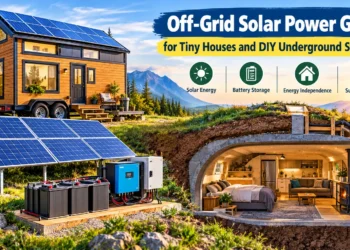

Off-Grid Solar Power Guide for Tiny Houses and DIY Underground Structures
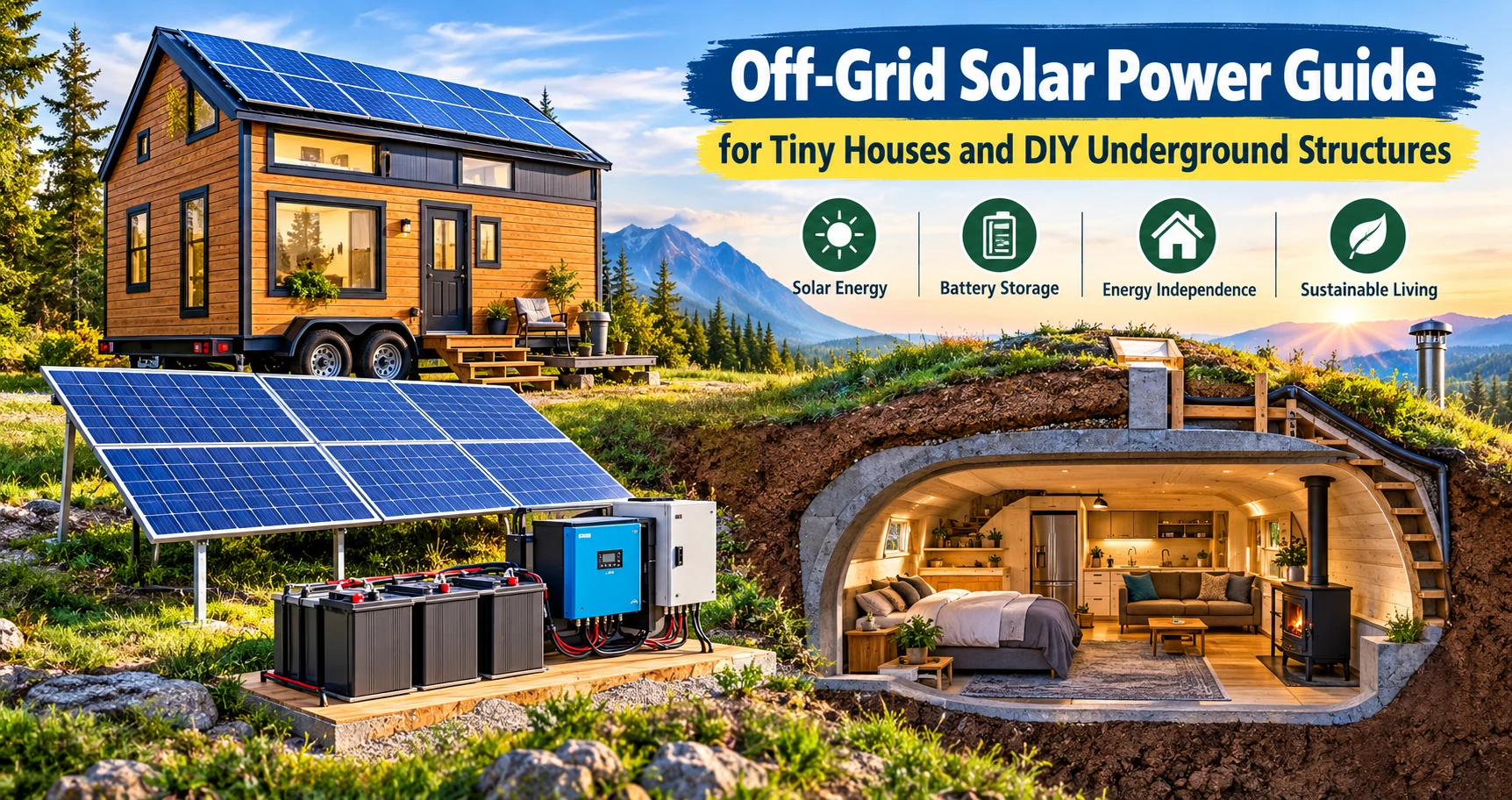
Off-grid solar power for tiny houses offers a practical way to generate electricity without relying on a conventional utility connection. With the right combination of solar panels, battery storage, an inverter, and efficient appliances, a small dwelling can produce much of the electricity needed for everyday life.
The same technology can support certain workshops, remote cabins, and properly designed underground structures. However, underground projects introduce additional challenges, including moisture, flooding, ventilation, equipment access, and the safe location of electrical equipment.
Whether you are planning a tiny house in the countryside or an underground workspace, the first step is to understand how much electricity you need. From there, you can estimate the required solar capacity, battery storage, and inverter size.
A reliable off-grid solar system needs enough solar generation to meet energy demand, enough usable battery capacity to cover periods without sunlight, and an inverter capable of handling the expected electrical loads. Underground installations also need a carefully planned dry equipment location, safe wiring, appropriate ventilation, and protection against water intrusion.
This guide explains how to plan a system, estimate its size, choose suitable components, and avoid common mistakes before starting construction.
1. What Is Off-Grid Solar Power?
An off-grid solar system generates and stores electricity without depending on a normal utility connection. Unlike a conventional grid-connected system, it must manage its own energy supply when sunlight is unavailable.
A typical system uses photovoltaic panels to capture sunlight, a charge controller to regulate charging, batteries to store electricity, and an inverter to supply alternating-current appliances.
Depending on the design, the system may also include a backup generator, a monitoring system, or another renewable energy source.
How Does the System Work?
- Solar panels: Convert sunlight into direct-current electricity.
- Charge controller: Regulates the electricity supplied to the battery bank.
- Battery storage: Stores energy for use when solar production is insufficient.
- Inverter: Converts battery or solar-system DC electricity into AC power for compatible appliances.
- Distribution equipment: Delivers electricity through appropriately protected circuits.
Some hybrid inverters combine several of these functions in one unit. The equipment must be compatible and sized for the actual system design.
The most important difference between grid-connected and off-grid solar is that an off-grid property cannot automatically rely on the utility when its batteries are depleted. Good planning must account for cloudy weather, seasonal changes, and periods of higher electricity consumption.
2. Benefits of Off-Grid Solar for Tiny Houses
2.1. Greater Energy Independence
A properly designed solar and battery system can supply a tiny house with electricity without requiring a conventional utility connection. This can be especially useful for rural properties, remote locations, and sites where grid access is expensive or unavailable.
Energy independence is not automatic, however. The system must be large enough for the household’s consumption and the local solar conditions.
2.2. Efficient Use of Limited Space
Tiny houses often have limited roof area. Compact solar panels, efficient appliances, and carefully planned battery storage can help make the available space more useful.
If the roof cannot accommodate enough panels, a properly located ground-mounted array may provide additional capacity. Its installation must account for shading, security, cable routing, and local requirements.
2.3. Potentially Lower Electricity Expenses
Solar power can reduce or eliminate some purchased electricity, depending on the system and how it is used. However, an off-grid system also has upfront costs for panels, batteries, mounting, electrical protection, and installation.
Long-term savings depend on equipment lifespan, replacement costs, energy consumption, local sunlight, and the cost of alternative power sources.
2.4. Flexible System Design
An off-grid system can be designed around a small cabin, a tiny house on a permanent foundation, or a mobile dwelling. The equipment and mounting arrangements must reflect the structure’s size, location, and intended use.
Mobile tiny houses require additional attention to weight limits, vibration, cable protection, and the safe mounting of equipment during transport.
2.5. Support for Remote Living
A dependable solar installation can support lighting, communications, refrigeration, water pumping, and other essential electrical loads in remote locations.
Heating, cooling, electric cooking, and water heating can require much more energy than basic lighting and electronics. These loads should be considered before selecting equipment.
3. Solar Power for DIY Underground Structures
An underground workshop, partially buried building, or earth-sheltered structure may use solar electricity in much the same way as a conventional small building. The key difference is that the structure itself creates additional design constraints.
An underground room does not receive useful direct sunlight through buried walls. Solar panels generally need to be installed above ground, in an open area, or on a suitable surface with good solar exposure.
3.1. Locate Solar Panels Above Ground
A nearby ground-mounted solar array may be practical when the roof of an underground structure is unsuitable for mounting panels or is frequently shaded.
Before mounting panels on a buried or earth-covered roof, obtain a structural assessment. The roof must be designed for its soil cover, water loads, snow where applicable, solar mounting hardware, and other expected forces.
3.2. Protect Electrical Equipment from Moisture
Underground structures can be exposed to condensation, groundwater, leaks, and flooding. Batteries, inverters, disconnects, and distribution equipment must be installed in locations that satisfy their environmental ratings and the applicable electrical requirements.
Do not place ordinary electrical equipment in a damp underground compartment simply because it is out of sight. If the area is vulnerable to flooding, choose a safer equipment location and design suitable protection against water intrusion.
3.3. Plan Ventilation and Emergency Access
An underground occupied structure needs suitable ventilation, safe exits, moisture control, and a design that meets local building requirements. Solar power does not solve these problems by itself.
Any required ventilation system must be designed for the structure’s occupancy, size, moisture levels, and intended use. Do not assume that a small passive opening is sufficient.
3.4. Choose a Suitable Battery Location
Battery storage requires a dry, protected, accessible location that complies with the battery manufacturer’s installation requirements and local fire and electrical rules.
Battery chemistry matters. Some batteries can release flammable gases under certain fault or charging conditions, while lithium-based batteries have their own thermal and fire risks. Ventilation, clearances, temperature limits, monitoring, and protection must follow the specific equipment requirements.
Do not treat a DIY underground structure as a safe place for batteries, generators, fuel storage, or electrical equipment without a proper design. Flooding, inadequate ventilation, structural failure, electrical shock, and fire can create serious hazards. Obtain qualified structural and electrical advice before construction.
3.5. Account for Cable Distance
If solar panels are installed far from the building, the cable route becomes an important part of the design. Conductor size, voltage drop, environmental exposure, disconnects, grounding, and protection must be considered.
Long cable runs can affect efficiency and installation costs. A qualified designer can help choose a suitable array configuration and cable route.
4. Essential Components of an Off-Grid Solar System
Solar Panels
Solar panels determine how much rated photovoltaic capacity the system can install. Their actual energy production depends on sunlight, orientation, tilt, temperature, shading, and other losses.
Compare module power ratings, dimensions, mechanical specifications, warranty terms, and compatibility with the selected inverter or charge controller.
Battery Bank
The battery bank stores electricity for use at night and during periods of insufficient solar production. Its required capacity depends on daily energy use, desired backup duration, usable depth of discharge, temperature, and the battery’s permitted charge and discharge rates.
Lithium iron phosphate (LiFePO4) batteries are used in many modern off-grid systems because of their cycle-life characteristics and usable capacity. Lead-acid batteries remain an option in some applications, but their usable capacity and maintenance requirements differ.
Always follow the manufacturer’s temperature limits. Some lithium batteries must not be charged below a specified temperature unless their system includes an approved method of preventing unsafe charging.
Inverter
The inverter supplies AC power to compatible household appliances. Its continuous rating must cover the expected simultaneous load, while its surge capability must accommodate equipment that draws additional power during startup.
A pure sine wave inverter is commonly appropriate for household electronics, motors, and appliances. Confirm the required voltage, frequency, output configuration, and equipment compatibility before purchasing.
Solar Charge Controller
A charge controller manages the flow of power from the solar array to the battery bank. Maximum Power Point Tracking (MPPT) controllers are common in larger systems because they can adapt the operating point of the array to improve energy harvesting.
The controller must be compatible with the solar array’s voltage and current as well as the battery chemistry and charging requirements.
Electrical Protection and Monitoring
A complete installation also needs correctly selected wiring, disconnects, overcurrent protection, grounding and bonding arrangements, and other safeguards required by the design and local regulations.
Monitoring equipment helps you track solar production, battery state of charge, and energy consumption. This information makes it easier to identify unusual performance and adjust energy use.
5. Calculate Your Daily Energy Consumption
Before buying solar panels or batteries, make a list of the appliances you expect to use. Estimate each appliance’s power consumption and how long it operates per day.
Use this formula:
For appliances that cycle on and off, use their estimated actual energy consumption rather than assuming they draw their rated running power continuously.
Example Daily Energy Audit
| Appliance | Assumed Daily Energy |
|---|---|
| Efficient refrigerator | 1.0 kWh |
| LED lighting | 0.3 kWh |
| Laptop and communications | 0.6 kWh |
| Water pump | 0.2 kWh |
| Small kitchen appliances | 0.5 kWh |
| Other small loads | 0.4 kWh |
| Illustrative total | 3.0 kWh/day |
These values are illustrative assumptions, not universal appliance consumption figures. Your actual refrigerator, pump, computer, and kitchen equipment may use substantially different amounts of electricity.
Heating, air conditioning, electric water heating, and electric cooking can significantly increase daily demand. Add these loads separately before deciding on a system size.
Calculate Peak Power Separately
Daily energy consumption determines how much electricity the system must produce and store. Peak power determines how much power the inverter and battery must deliver at one time.
For example, a refrigerator, water pump, and kitchen appliance may operate simultaneously. Their combined demand and any motor startup surge must remain within the system’s ratings.
Do not size an inverter using daily kWh alone.
6. How Many Solar Panels Do You Need?
Solar array sizing depends on daily electricity demand, the sunlight available at the site, and system losses. A location with long sunny days may need less panel capacity than a location with short winter days or frequent cloud cover.
A useful preliminary calculation is:
The performance factor accounts approximately for losses caused by temperature, wiring, inverter conversion, dust, and other system conditions. It is a planning assumption, not a substitute for a site-specific production estimate.
Example: A 3 kWh Daily Energy Requirement
Assume the tiny house uses 3 kWh of electricity per day. For a simplified example, assume four peak sun hours per day and a performance factor of 0.75.
The calculation is:
Preliminary array estimate: approximately 1 kW
This example estimates the solar capacity needed to supply the assumed daily energy under the specified conditions. It does not guarantee year-round independence or provide a complete design for battery recharging during extended poor weather.
If the site receives less sunlight during winter, the system may need more panels, more storage, a backup energy source, or lower consumption during difficult periods.
Calculate the Number of Panels
If your preliminary design calls for 1,000 watts of rated solar capacity and you choose 400-watt modules:
Because you cannot install half a panel in a conventional array, you would need to consider at least three such modules to exceed the calculated rated capacity, subject to physical space and electrical compatibility.
The final number must also account for the solar controller’s voltage and current limits, the inverter’s requirements, available mounting space, and the local solar resource.
7. Battery Storage and Backup Power
Battery capacity determines how much energy can be stored for use when the panels are not producing enough electricity. The correct size depends on consumption, the number of backup days desired, usable battery capacity, temperature, and the ability to recharge after cloudy weather.
Estimate Battery Capacity
A simplified formula for preliminary battery sizing is:
For this example, assume:
- Daily electricity use: 3 kWh
- Desired autonomy: 2 days
- Assumed usable fraction: 80%
The preliminary calculation is:
Illustrative nominal battery capacity: 7.5 kWh
This calculation is simplified. If daily energy is measured at the AC appliances, additional allowances may be required for inverter losses and other system consumption. The usable fraction must reflect the actual battery’s permitted operating range.
Two days of autonomy does not guarantee uninterrupted operation during a prolonged cloudy period. Your system also needs enough solar generation to meet current demand and restore the battery charge.
Should You Use LiFePO4 Batteries?
LiFePO4 batteries are common in modern off-grid applications because they offer useful cycle-life characteristics and high usable capacity in many configurations.
Before choosing a battery, review its:
- Nominal and usable capacity
- Maximum continuous charge and discharge current
- Permitted operating and charging temperatures
- Battery management system requirements
- Compatibility with the inverter and charging equipment
- Installation clearances and environmental rating
- Warranty and expected service conditions
For underground structures, battery placement and environmental protection are particularly important. Install batteries only in a location that meets the equipment manufacturer’s requirements and the applicable electrical and fire-safety rules.
8. Choosing the Right Inverter
The inverter converts DC electricity into AC power for appliances that require it. Its rating must be based on the equipment that may run at the same time, rather than the total daily energy consumption.
Continuous Power Rating
Add the running wattage of the loads expected to operate simultaneously. Then select an inverter with a suitable continuous rating, taking account of manufacturer guidance and appropriate design margins.
Startup Surge Capacity
Some appliances, particularly motors and compressors, may draw a brief surge when starting. The inverter must be able to support these demands without shutting down or operating outside its limits.
Check Voltage and Compatibility
Confirm the inverter’s AC output voltage and frequency, battery voltage, charging capabilities, and compatibility with all connected equipment.
A higher-power inverter is not always better. An unnecessarily large inverter may add cost and standby consumption, while an undersized one may fail to start essential appliances.
For systems supplying an entire dwelling, have a qualified electrician review the distribution, grounding and bonding, circuit protection, and required disconnect arrangements.
9. Installation Planning for Tiny Houses and Underground Structures
Step 1: Assess the Property
Record the building’s location, roof dimensions, available ground space, likely shading, access routes, and exposure to local weather.
For a mobile tiny house, also check the roof’s structural capacity, permitted weight, trailer payload, and transport requirements.
Step 2: Complete an Energy Audit
List all appliances and estimate their daily energy consumption and simultaneous power demand. Identify essential loads separately from optional equipment.
Consider how the energy profile may change between summer and winter.
Step 3: Plan the Solar Array
Choose a location with suitable sunlight and a structurally appropriate mounting arrangement. Ground-mounted panels may be useful when the roof area is insufficient.
Do not assume an earth-covered roof can support solar panels. Soil loading, drainage, waterproofing, structural capacity, and mounting details need professional assessment.
Step 4: Design Battery and Equipment Locations
Place electrical equipment in a dry, accessible location that meets manufacturer instructions and applicable regulations. Keep the equipment protected from water intrusion and environmental conditions outside its rated limits.
Ensure that required ventilation, fire protection, clearances, and emergency access are included in the design.
Step 5: Have the Electrical Design Reviewed
The system should include suitable conductors, overcurrent protection, disconnects, grounding and bonding, and compatible equipment.
Do not select wire sizes, fuse ratings, or protection devices from a generic online diagram. These depend on actual voltage, current, cable length, installation conditions, equipment specifications, and local electrical rules.
Step 6: Test and Commission the System
Before regular operation, a qualified installer should verify the system’s electrical safety, battery charging, inverter operation, monitoring, and protective devices.
Complete any required permits, inspections, and approvals before relying on the system.
10. Electrical and Underground Safety
An off-grid solar system contains electrical hazards that remain present even when the utility grid is not connected. Solar modules can produce voltage in daylight, and batteries can supply very high fault currents.
Use Correct Electrical Protection
Use appropriately rated conductors, fuses, breakers, disconnects, grounding, and bonding. Electrical components must be suitable for the DC or AC circuit in which they are installed.
Solar and battery wiring should be installed and inspected by qualified professionals according to the applicable electrical rules.
Prevent Water Intrusion
Underground structures need a drainage and waterproofing strategy appropriate to the site. Consider groundwater, heavy rainfall, surface runoff, and the possibility of pump or plumbing failure.
Do not position critical electrical equipment where floodwater can reach it. A sump pump may help manage certain drainage conditions, but it must not be treated as the only protection against flooding.
Provide Appropriate Ventilation
Ventilation requirements depend on the building, its occupancy, the equipment installed, and the battery chemistry. A sealed or poorly ventilated underground room can create serious risks if it accumulates moisture, hazardous gases, or combustion products.
Never operate a fuel-burning generator inside an occupied building, underground room, or enclosed space. Exhaust contains carbon monoxide, which can be fatal. Place generators outdoors in a suitable location, away from openings, and follow the manufacturer’s safety instructions.
Maintain Safe Access and Emergency Exits
An occupied underground structure requires safe access and emergency egress in accordance with applicable building requirements. Electrical equipment must not block exits or access routes.
The structure’s design should be reviewed for soil pressure, structural loads, water ingress, fire safety, ventilation, and other site-specific hazards.
This guide is for planning and education, not a construction blueprint. Underground buildings and complete off-grid electrical systems require site-specific professional design. Do not occupy an underground structure until its structural safety, ventilation, moisture protection, electrical installation, and emergency exits have been properly assessed.
11. Common Off-Grid Solar Mistakes to Avoid
Buying Panels Before Calculating Energy Use
Purchasing panels before estimating daily consumption can result in an undersized or unnecessarily expensive system. Start with the loads, then size the batteries, solar array, and inverter.
Ignoring Winter Conditions
A system that performs well during sunny summer weather may struggle during winter. Use local seasonal solar data and consider the lowest-production periods relevant to your location.
Underestimating Heating and Cooling
Electric resistance heating and some cooling systems can use substantial amounts of energy. Check the real consumption of the equipment before deciding that a small solar system will be sufficient.
Choosing the Wrong Battery Location
A damp underground room, an area exposed to flooding, or a location outside the battery’s permitted temperature range may be unsuitable. Choose a location that satisfies the manufacturer’s installation requirements and applicable safety rules.
Ignoring Structural Loads
Solar panels, mounting hardware, soil cover, and water accumulation can impose substantial loads on a building. Have the roof and foundations evaluated before adding equipment or building over an underground space.
Assuming Solar Means Unlimited Power
Solar production changes with the weather and seasons. An off-grid property needs a realistic energy budget, adequate storage, and a plan for extended periods of poor sunlight.
12. Maintenance and Energy Monitoring
Routine maintenance helps an off-grid system remain reliable and makes it easier to detect problems before they interrupt power.
Inspect Solar Panels
Check for visible damage, heavy dirt, shading, and other issues that may reduce production. Clean panels when necessary, following the manufacturer’s instructions and using safe access methods.
Monitor Battery Performance
Review the battery state of charge, operating temperature, and any system warnings. Avoid operating batteries outside their specified voltage, current, and temperature limits.
Review Energy Consumption
Compare actual daily energy use with the original estimate. If consumption is consistently higher than expected, identify the main loads before purchasing additional equipment.
Inspect the Building
For underground structures, inspect drainage, waterproofing, ventilation equipment, and signs of moisture intrusion. Address structural movement, cracks, leaks, or drainage problems promptly with appropriate professional advice.
Maintain a Backup Plan
Depending on the location and required reliability, a backup generator or another approved power source may be useful. Any backup source must be installed and operated safely, with appropriate electrical isolation and ventilation.
13. Frequently Asked Questions
1. Can solar panels power a tiny house completely off-grid?
Yes, a properly designed system can supply a tiny house without a utility connection. The required panel capacity, battery storage, and inverter depend on electricity consumption, seasonal sunlight, and the level of reliability required.
2. How many solar panels does a tiny house need?
There is no universal number. Estimate daily energy consumption, use local solar-production data, account for losses, and calculate the required array capacity. Panel wattage and available mounting space determine the final number of modules.
3. Can solar panels be installed on an underground house?
Solar panels can potentially be installed on a suitably engineered roof or on a separate ground-mounted structure. An earth-covered roof must be assessed for structural capacity, waterproofing, drainage, mounting requirements, and other relevant loads.
4. Can I put solar batteries underground?
Only if the specific installation location meets the battery manufacturer’s requirements and all applicable electrical, fire, ventilation, temperature, and environmental rules. Damp or flood-prone underground spaces should not be assumed suitable for battery storage.
5. How much battery storage does an off-grid tiny house need?
Battery capacity depends on daily energy consumption, desired autonomy, permitted depth of discharge, conversion losses, and battery operating conditions. Estimate the required usable energy first, then calculate the nominal battery capacity using the manufacturer’s specifications.
6. Will an off-grid solar system work on cloudy days?
Solar panels generally continue to produce electricity in diffuse daylight, but output is lower than in strong direct sunlight. Batteries help cover the difference, provided sufficient stored energy is available.
7. Is an inverter necessary for every solar system?
Not every load requires an inverter. Some equipment can operate directly from compatible DC supplies, but most standard household AC appliances need an appropriately rated inverter.
8. Is DIY installation a good idea?
DIY planning and some non-electrical tasks may be possible for experienced homeowners, depending on local rules. Structural work on underground buildings and electrical installation involving high-energy batteries or solar circuits should receive qualified professional design, installation, and inspection as required.
9. Can a solar system run heating and air conditioning?
Yes, if the solar array, battery bank, inverter, and backup arrangements are designed for the equipment’s energy consumption and peak demand. Heating and cooling can significantly increase system size and cost.
10. Do I need permits for an off-grid solar system?
Requirements depend on the country, municipality, building type, electrical installation, and land use. Check local planning, structural, electrical, fire-safety, and environmental requirements before construction.
Final Thoughts: Building a Reliable Off-Grid Power System
Off-grid solar power can make tiny houses and certain remote buildings more independent by providing electricity for lighting, refrigeration, communications, water pumping, and other essential loads.
The most reliable systems start with a realistic energy audit. Solar panels, battery storage, and the inverter must be selected together, taking account of seasonal sunlight, peak demand, and the expected duration of periods without sufficient solar production.
Underground structures require additional care. Structural engineering, waterproofing, drainage, ventilation, emergency access, and the safe placement of electrical equipment are essential considerations, not optional extras.
Before beginning a project, compare the available designs, calculate your expected energy use, and consult qualified professionals for structural and electrical work. A well-planned system is safer, easier to maintain, and more likely to meet your long-term energy needs.
Plan Before You Build
Start with your energy requirements, local solar conditions, available installation space, and safety requirements. These decisions will guide the design of a more reliable off-grid system for your tiny house or remote building.