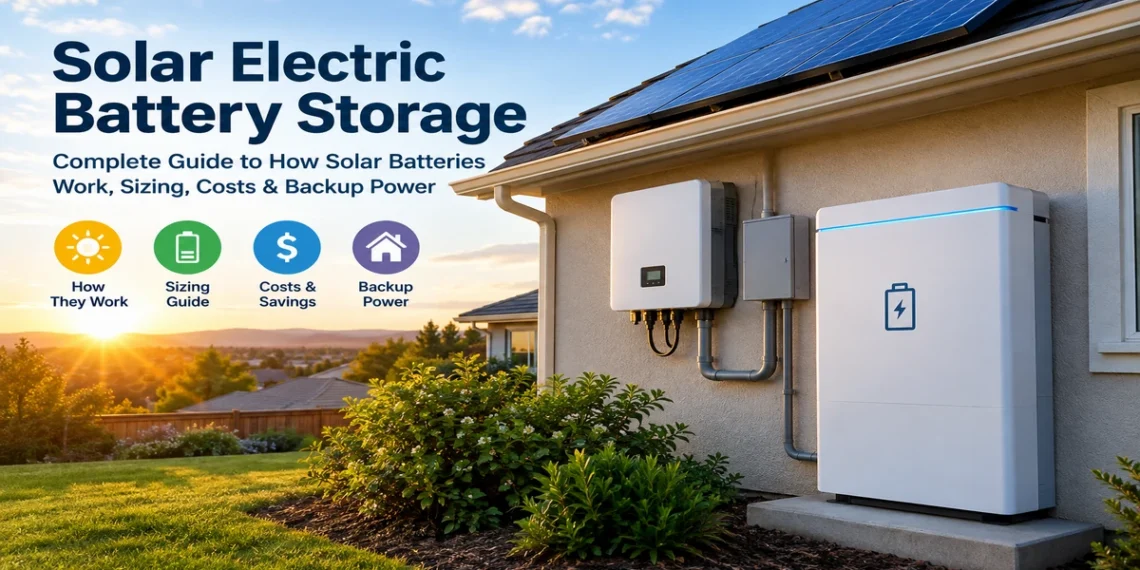

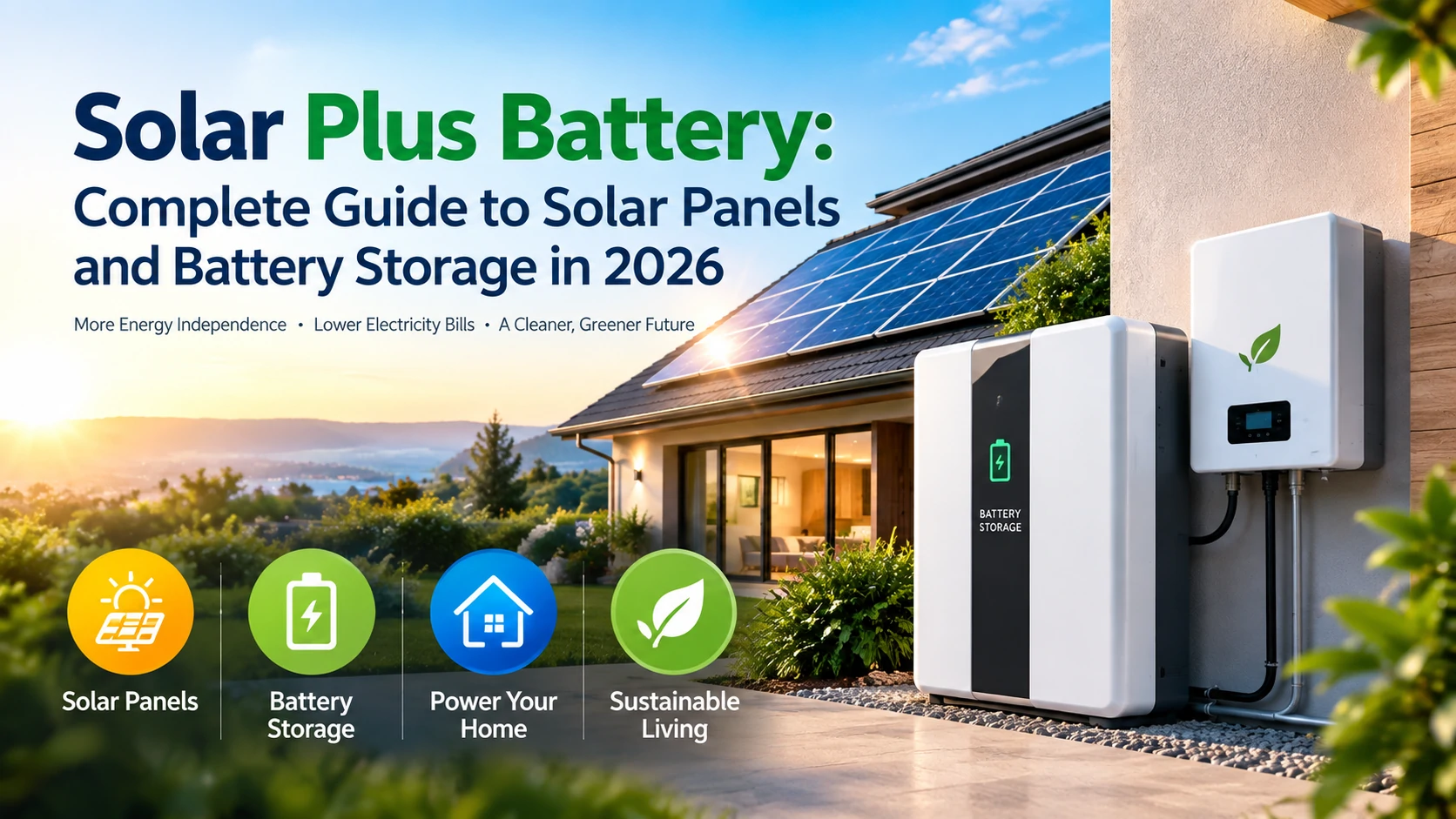
A solar plus battery system combines solar panels with battery storage so homeowners can use more of the electricity their solar system produces. Instead of relying on solar power only while the sun is shining, excess electricity can be stored and used later, including during the evening or, with the right equipment, during a grid outage.
Solar-plus-battery systems are becoming an important option for homeowners who want greater energy independence, backup power, and better control over when they use electricity.
But choosing the right system involves more than simply adding a battery to a solar array. Solar panel capacity, battery size, inverter power, electricity consumption, backup requirements, installation conditions, and local utility rules all matter.
This complete guide explains how solar plus battery systems work, how to size them, what they cost, the different configurations available, and what to consider before installation.
Related Post

What Is a Solar Plus Battery System?
A solar plus battery system combines three major components:
- Solar panels
- An inverter or power conversion system
- Battery storage
Solar panels generate electricity from sunlight. The inverter converts electricity between DC and AC so it can be used by household appliances and compatible equipment. The battery stores available energy for later use.
The U.S. Department of Energy explains that solar-plus-storage systems allow solar energy to be stored and used at times when solar generation is unavailable.
A simple energy flow looks like this:
Sunlight → Solar Panels → Inverter → Home / Battery → Electricity Used Later
Depending on the system design, solar energy can supply household loads first, charge the battery with excess production, or send electricity to the grid when permitted.
How Does Solar Plus Battery Work?
During the day, solar panels generate electricity.
If the home is using electricity at the same time, part of the solar production can go directly to household appliances.
If the solar system produces more electricity than the home needs, the excess can be directed toward battery charging.
Later, when solar production falls or stops, the stored electricity can be discharged to power selected loads or, in a properly configured system, a larger portion of the home.
For example:
Daytime:
Solar panels → Home
Solar panels → Battery charging
Solar panels → Grid, where allowed
Evening:
Battery → Home
Grid outage:
Battery + compatible inverter → Backup loads
The exact operating behavior depends on the inverter, battery, electrical configuration, utility requirements, and backup equipment.
Why Add a Battery to Solar Panels?
Solar panels are excellent at producing electricity during daylight hours, but electricity demand does not always match solar production.
Energy storage allows electricity generated during one period to be used during another.
The Department of Energy notes that solar production varies with time of day, seasons, clouds, dust, rain, snow, and shading. Storage can help shift solar energy to periods when it is needed.
1. Use More of Your Solar Energy
Without storage, excess solar generation may be exported to the grid where grid-export programs are available.
A battery provides another option: store some of that electricity and use it later.
2. Evening Energy Use
Many homes consume significant electricity after sunset when solar panels are no longer producing energy.
A battery can shift some daytime solar production into the evening.
3. Backup Power
A properly designed solar-plus-battery system can provide backup power during some grid outages.
However, solar panels alone generally do not keep a grid-connected home powered during an outage. The system needs appropriate inverter and storage equipment capable of operating safely when the grid is unavailable.
4. Greater Energy Independence
A larger solar and battery system can reduce dependence on electricity purchased from the grid, although complete energy independence requires careful system sizing and sufficient energy production.
5. Energy Management
Battery systems can help homeowners control when stored electricity is used.
Depending on the utility rate structure, this may allow energy to be shifted from one part of the day to another.
Solar Plus Battery vs Solar Panels Only
The main difference is energy flexibility.
| Feature | Solar Only | Solar + Battery |
|---|---|---|
| Daytime solar generation | Yes | Yes |
| Store excess solar | No | Yes |
| Evening solar use | Limited without grid | Yes |
| Backup capability | Usually no | Possible with proper equipment |
| Energy independence | Moderate | Higher potential |
| System cost | Lower | Higher |
| System complexity | Lower | Higher |
A battery does not automatically make a home completely energy independent. The solar array and battery must be sized around the home’s actual electricity consumption and operating requirements.
What Size Solar Battery Do You Need?
Battery sizing should start with electricity consumption rather than choosing a battery based only on its advertised capacity.
Battery capacity is generally expressed in kilowatt-hours (kWh).
Power output is generally expressed in kilowatts (kW).
These measurements answer different questions.
- kWh: How much energy can the battery store?
- kW: How much power can the battery deliver at one time?
The Department of Energy distinguishes energy capacity from power capacity because a battery can store a certain amount of energy while having a different maximum power output.
Simple Battery Runtime Example
Suppose a battery provides 10 kWh of usable energy and the connected loads consume an average of 1 kW.
A simplified calculation is:
10 kWh ÷ 1 kW = 10 hours
Actual runtime can be shorter because of conversion losses, battery operating limits, temperature, reserve settings, and changing household loads.
How Many Batteries Do You Need?
There is no universal number of batteries for every home.
The correct number depends on:
- Daily electricity consumption
- Solar production
- Desired backup duration
- Battery usable capacity
- Battery power rating
- Critical loads
- Inverter capacity
- Weather conditions
- Whether the system is grid-connected or off-grid
A homeowner who wants to keep only essential loads running during an outage may need substantially less storage than someone trying to operate the entire home.
Whole-Home Backup vs Essential Loads
One of the most important decisions is determining what the battery should power during an outage.
Essential-Load Backup
This approach prioritizes important circuits such as:
- Refrigerator
- Internet equipment
- Lighting
- Security systems
- Selected outlets
- Medical equipment where appropriate
- Small appliances
It can reduce the battery capacity required.
Whole-Home Backup
Whole-home backup attempts to support a much larger portion of household electricity demand.
This generally requires more battery capacity, greater inverter power, and careful electrical design.
Large loads such as central air conditioning, electric heating, water heaters, ovens, pumps, and electric vehicle chargers can require substantial power.
Solar Battery Chemistry Options
Different battery technologies are available for energy storage.
Lithium-Ion Batteries
Lithium-ion technology is widely used in modern energy-storage applications because it can provide high energy density and a relatively compact installation.
LiFePO4 Batteries
Lithium iron phosphate, commonly called LiFePO4 or LFP, is a lithium battery chemistry frequently used in residential and off-grid applications.
Its characteristics can make it attractive for stationary storage, but the specific battery’s safety systems, certifications, warranty, operating temperature, and installation requirements still matter.
Lead-Acid Batteries
Lead-acid batteries have a long history in backup and off-grid applications.
They can be useful in some installations, although their characteristics differ from modern lithium-based storage.
The best battery depends on the application rather than a single universal ranking.
AC-Coupled vs DC-Coupled Solar Plus Battery
Solar-plus-storage systems can use different electrical configurations.
AC-Coupled Systems
In an AC-coupled configuration, solar and battery equipment can use separate power-conversion equipment.
This can be useful when adding battery storage to an existing solar installation.
DC-Coupled Systems
In a DC-coupled configuration, solar and battery storage can share parts of the power-conversion architecture.
The Department of Energy explains that PV systems and batteries can be connected using either AC-coupled or DC-coupled configurations, with each approach having different technical and cost considerations.
For a new installation, the best configuration depends on the equipment, system design, energy goals, and installation requirements.
Can Solar Plus Battery Work During a Power Outage?
Yes, but not every solar-plus-battery system provides backup power.
A grid-connected solar system normally shuts down during a grid outage for safety reasons.
A battery system designed for backup can isolate the home from the grid and supply electricity through compatible equipment.
The Department of Energy specifically notes that solar panels alone generally are not sufficient for residential outage resilience; appropriate inverter and storage equipment are required.
Before buying a battery for backup, check whether the complete system supports:
- Automatic backup
- Islanding
- Backup loads
- Required inverter power
- Generator integration, if needed
- Local electrical requirements
Can Solar Panels Charge the Battery During an Outage?
In some properly designed systems, yes.
However, this depends on the inverter and battery architecture.
A system must be capable of operating safely while disconnected from the utility grid and managing solar generation and battery charging.
This is why homeowners should not assume that simply adding a battery to an existing solar installation automatically creates an off-grid backup system.
Solar Plus Battery for Off-Grid Homes
For an off-grid home, solar panels and batteries become even more important because there may be no utility grid available.
An off-grid system generally needs:
- Solar panels
- Battery storage
- Appropriate inverter
- Charge-control or integrated power electronics
- Protection equipment
- Proper wiring
- Monitoring
- Backup generation in some installations
Off-grid systems must be designed around the home’s energy consumption and the local solar resource.
A system that works well during sunny summer months may need additional storage or generation capacity during periods of low solar production.
How Much Solar Do You Need to Charge a Battery?
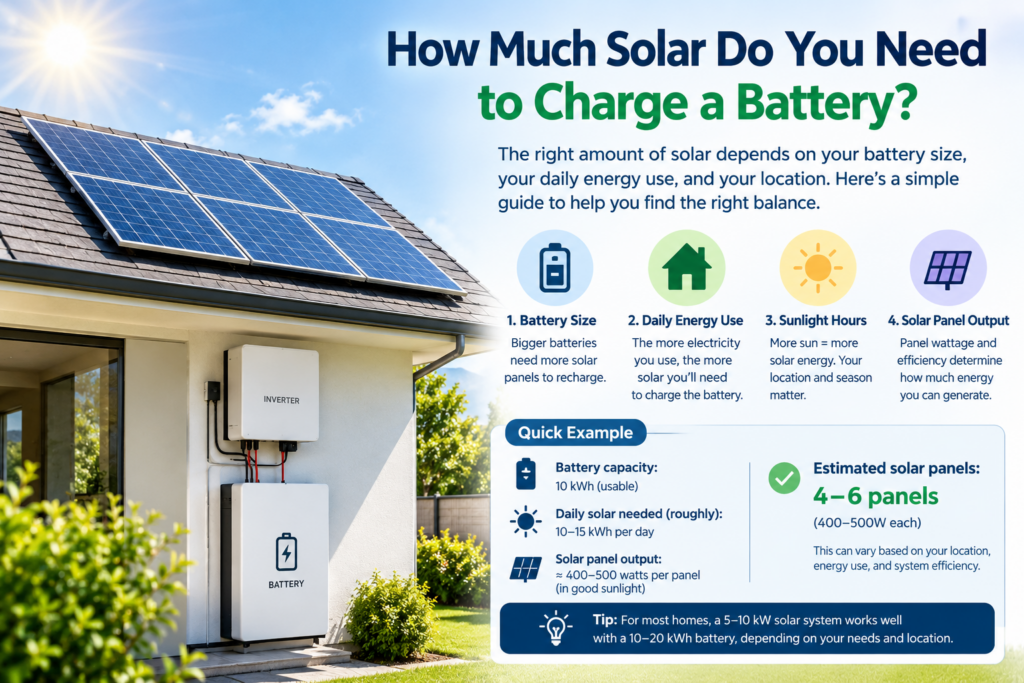
The answer depends on:
- Battery capacity
- Daily household consumption
- Solar production
- Weather
- Panel orientation
- Shading
- System losses
- Desired charging speed
For example, a 10 kWh battery does not necessarily require a 10 kW solar array.
The battery stores energy, while solar panels produce energy over time.
A larger solar array can potentially recharge storage faster, but the battery and inverter must be compatible with the available charging power.
Solar Plus Battery Efficiency
Energy storage is not 100% efficient.
Some energy is lost during conversion and charging/discharging.
The Department of Energy notes that energy storage always involves some efficiency loss during energy conversion and retrieval.
This means you should not assume that every kilowatt-hour sent into a battery will result in exactly one kilowatt-hour available to household loads.
Actual efficiency depends on the battery, inverter, operating conditions, and system architecture.
Solar Plus Battery Cost
The cost of a solar-plus-battery system varies significantly.
There is no single price that applies to every home.
Major cost factors include:
- Solar panel capacity
- Battery capacity
- Battery chemistry
- Inverter
- Electrical equipment
- Backup hardware
- Installation labor
- Roof or ground-mount conditions
- Permitting
- System design
- Location
- Existing solar equipment
- Utility interconnection requirements
Battery systems can also have different costs depending on whether they are installed alongside a new solar system or added to an existing PV installation.
Because prices, incentives, and electricity rates vary by location and change over time, homeowners should obtain current local quotes rather than relying on one generic national price.
New Solar Plus Battery vs Adding a Battery Later
There are two common approaches.
Option 1: Install Solar and Battery Together
This allows the system to be designed as an integrated package.
Potential advantages include:
- Coordinated equipment
- Simplified system design
- Potentially easier installation
- Better planning for backup loads
Option 2: Add a Battery to Existing Solar
This can make sense for homeowners who already have solar panels and want storage later.
However, compatibility is important.
The existing inverter may not support the desired battery configuration, and additional equipment may be required.
Common Solar Plus Battery Mistakes
Mistake 1: Buying the Largest Battery
More storage is not automatically better.
Oversizing can increase the system cost without providing proportional value.
Mistake 2: Ignoring Power Output
A battery may have plenty of kWh but insufficient kW output for high-power appliances.
Mistake 3: Assuming Solar Panels Provide Backup
A standard grid-connected solar system may shut down during an outage.
Backup requires compatible equipment and system design.
Mistake 4: Ignoring Household Consumption
Battery sizing should be based on actual electricity use and backup priorities.
Mistake 5: Ignoring Installation Requirements
Battery systems involve electrical equipment and should comply with applicable electrical, building, fire-safety, and utility requirements.
Mistake 6: Focusing Only on Battery Capacity
Warranty, usable capacity, power output, efficiency, operating temperature, monitoring, safety certifications, and installation support also matter.
Is Solar Plus Battery Worth It in 2026?
For many homeowners, solar plus battery can be attractive when the goals include:
- Using more self-generated solar electricity
- Reducing reliance on grid electricity
- Preparing for outages
- Shifting energy use
- Increasing energy resilience
- Supporting an off-grid or backup-power strategy
However, it is not automatically the best financial choice for every home.
The value depends on electricity rates, solar production, battery cost, incentives, outage frequency, utility policies, and how much of the stored electricity can actually be used.
A good decision starts with your electricity bill and actual energy requirements.
How to Choose a Solar Plus Battery System
Before buying, compare these specifications:
Battery Capacity
Look at usable kWh rather than only the headline capacity.
Continuous Power
Check how much power the battery system can provide continuously.
Peak or Surge Power
Important for appliances and equipment with startup loads.
Round-Trip Efficiency
Higher efficiency can mean less energy is lost during charging and discharging.
Warranty
Review the warranty period, throughput limits, capacity-retention terms, and conditions.
Operating Temperature
Temperature can affect battery performance and installation requirements.
Backup Capability
Confirm exactly which loads the system can support during an outage.
Inverter Compatibility
The inverter and battery must be designed to work together.
Monitoring
A good monitoring system can help homeowners understand solar production, battery charging, battery discharge, and household consumption.
Safety Considerations
Battery storage involves significant electrical energy.
Homeowners should follow the manufacturer’s installation instructions and applicable local codes.
Important considerations include:
- Proper electrical protection
- Correct wiring
- Suitable installation location
- Manufacturer-approved equipment
- Adequate ventilation where required
- Temperature requirements
- Fire-safety requirements
- Professional installation where required
Do not attempt high-voltage electrical work without the required qualifications.
For a permanent residential system, a qualified solar installer or electrician should verify the system design and installation.
Frequently Asked Questions
Is solar plus battery better than solar alone?
It can provide additional benefits such as energy shifting and backup capability, but it also costs more. The right choice depends on the homeowner’s energy goals and local electricity conditions.
How long can a solar battery power a house?
It depends on usable battery capacity and household power consumption. A battery powering a small load can last much longer than the same battery powering a whole home with large appliances.
Can solar plus battery work without the grid?
Yes, a properly designed off-grid system can operate without a utility connection. However, it requires appropriate solar generation, battery storage, inverter capacity, and system controls.
Do solar batteries work at night?
Yes. The battery can discharge stored energy at night if it has sufficient usable capacity and the system is configured to do so.
Can a battery charge from solar panels?
Yes. Solar-plus-storage systems are specifically designed to store electricity generated by a connected solar system.
What is the difference between kW and kWh?
kW measures power, while kWh measures energy.
For batteries, kWh indicates how much energy can be stored, while kW indicates how much power can be delivered at a given time.
Do solar panels work during a blackout?
A conventional grid-connected solar system generally shuts down during a grid outage. A properly configured solar-plus-storage system can provide backup power when designed and installed for that purpose.
Final Verdict
A solar plus battery system can turn a standard solar installation into a more flexible energy system.
Solar panels generate electricity during daylight hours, while battery storage allows some of that energy to be used later. With the right inverter and backup configuration, the system can also provide electricity during certain grid outages.
The best system is not necessarily the one with the biggest battery. Instead, it should match your home’s electricity consumption, solar production, backup requirements, budget, and local electrical requirements.
Before purchasing, compare usable battery capacity, power output, efficiency, warranty, compatibility, safety requirements, and installation costs.
Most importantly, treat solar plus battery as an integrated electrical system rather than simply a collection of individual products. Good system design is what determines whether the investment delivers the performance you actually need.