
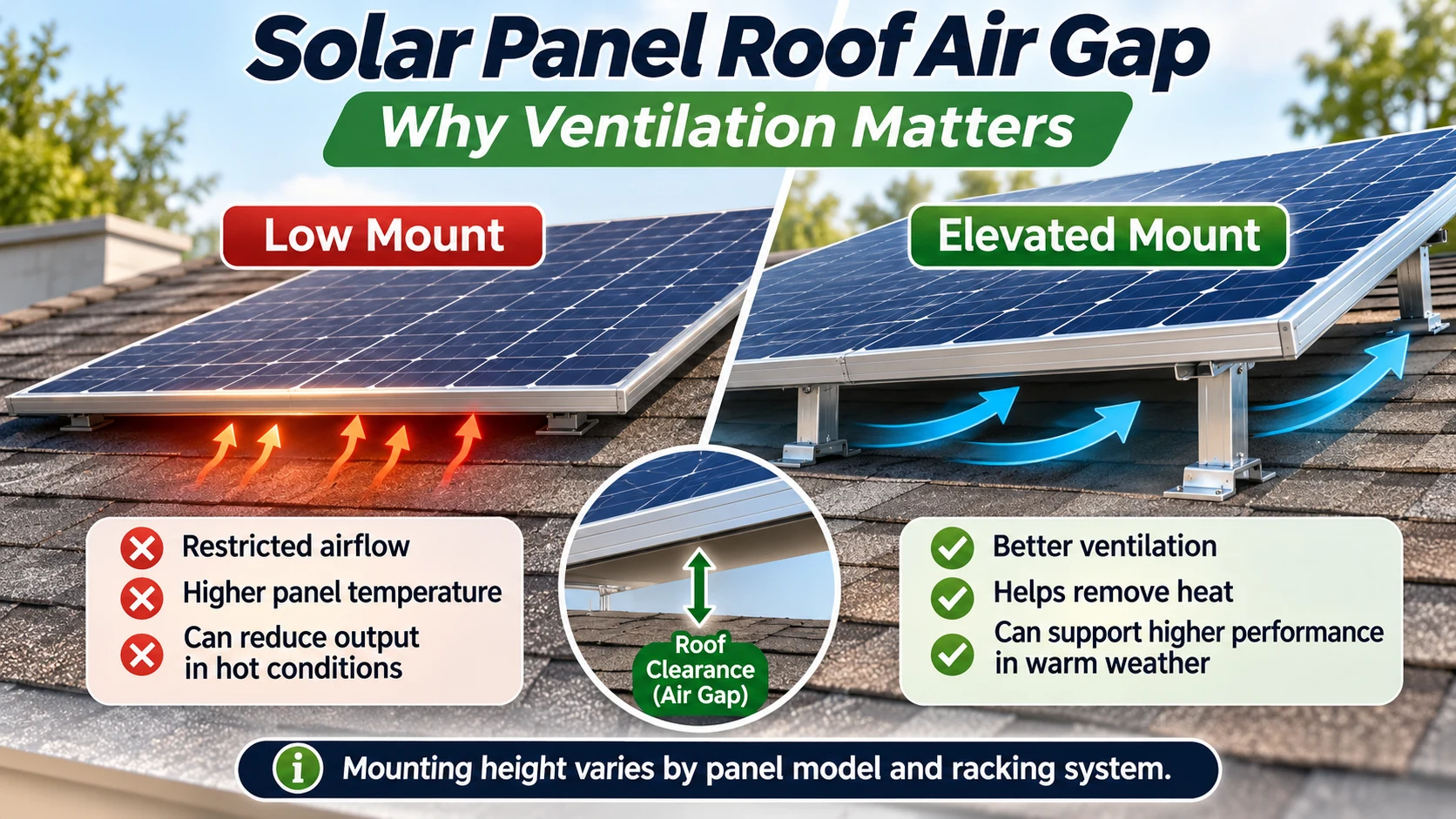
A solar panel roof air gap allows air to move beneath rooftop solar modules, helping remove heat and maintain suitable operating conditions. Around 4 inches (100 mm) is a common reference for conventional roof-mounted panels, but the required clearance depends on the exact panel, mounting system, roof design, and applicable codes.
A larger gap is not automatically better, and a low-profile mount is not automatically unsafe. This guide explains why the space matters, how heat affects solar output, what manufacturers recommend, and what to check before installing rooftop panels.
Solar Panel Roof Clearance: Quick Answer
- Common reference: Approximately 4 inches (100 mm) for many conventional rooftop PV installations.
- Exact requirement: Follow the approved module and racking installation instructions.
- Main purpose: Allow ventilation, heat dissipation, and suitable clearance for equipment.
- Potential benefit: Lower module operating temperatures can improve power output.
- Other considerations: Wind loads, roof structure, drainage, fire classification, and electrical cable management.
- Important exception: Building-integrated solar systems can use different mounting designs.
Bottom line: Do not choose the panel height from an online infographic alone. The correct mounting clearance must be confirmed for your equipment and roof.
FEATURED IMAGE: Insert a 1920 × 1080 educational image comparing a close-mounted rooftop solar panel with a properly ventilated elevated mounting system. Show conceptual airflow and heat buildup without claiming a universal required gap.


Why Does the Space Under Solar Panels Matter?
Solar panels convert sunlight into electricity, but not all incoming solar energy becomes electrical power. Some is converted into heat, which raises the temperature of the solar cells and surrounding materials.
When panels are mounted above a roof with an open air channel, moving air can carry away some of that heat. This process is called convective cooling.
If a conventional rooftop panel is installed too close to the roof, especially when airflow is restricted, it may operate at a higher temperature. The result can be reduced electrical output under otherwise similar conditions.
The gap also helps provide space for suitable wire management and allows moisture or debris to be addressed according to the mounting design.
How Air Moves Beneath Rooftop Panels
Airflow beneath a solar module can be influenced by wind and by natural convection. As air near a hot surface warms, its density changes and it can move upward through a sufficiently open path.
The effectiveness of this cooling depends on the size and shape of the air channel, roof pitch, wind conditions, panel arrangement, and obstacles that restrict the airflow.
A gap by itself does not guarantee effective ventilation if its entrances or exits are blocked.
How Much Air Gap Do Solar Panels Need Above a Roof?
There is no single roof clearance that applies to every solar module. The correct distance must come from the module manufacturer’s current installation manual, the approved racking system, and any relevant local building and fire requirements.
For conventional building-attached solar panels, ASHRAE discusses rear ventilation and identifies approximately 100 mm, or 4 inches, as a typical minimum reference. It also emphasizes the equipment manufacturer’s instructions.
Examples of Manufacturer Recommendations
| Source | Published Guidance | Important Detail |
|---|---|---|
| Maxeon / SunPower | 50 mm (about 2 inches) | For specified modules and mounting conditions |
| Canadian Solar | 102 mm (4 inches) | In the cited module installation manual |
| ASHRAE | Typically 100 mm (4 inches) | General reference; manufacturer requirements govern |
| Some other module manufacturers | Different model-specific distances | Verify the latest applicable manual |
These differences explain why a Pinterest graphic recommending a universal 6- to 8-inch gap is too simplistic.
That distance may be appropriate for some approved mounting systems, but it cannot replace a model-specific requirement.
Manufacturer examples include the Maxeon installation manual and the Canadian Solar installation manual. Always verify which revision applies to your equipment.
Low Mount vs. Elevated Solar Panel Mounting
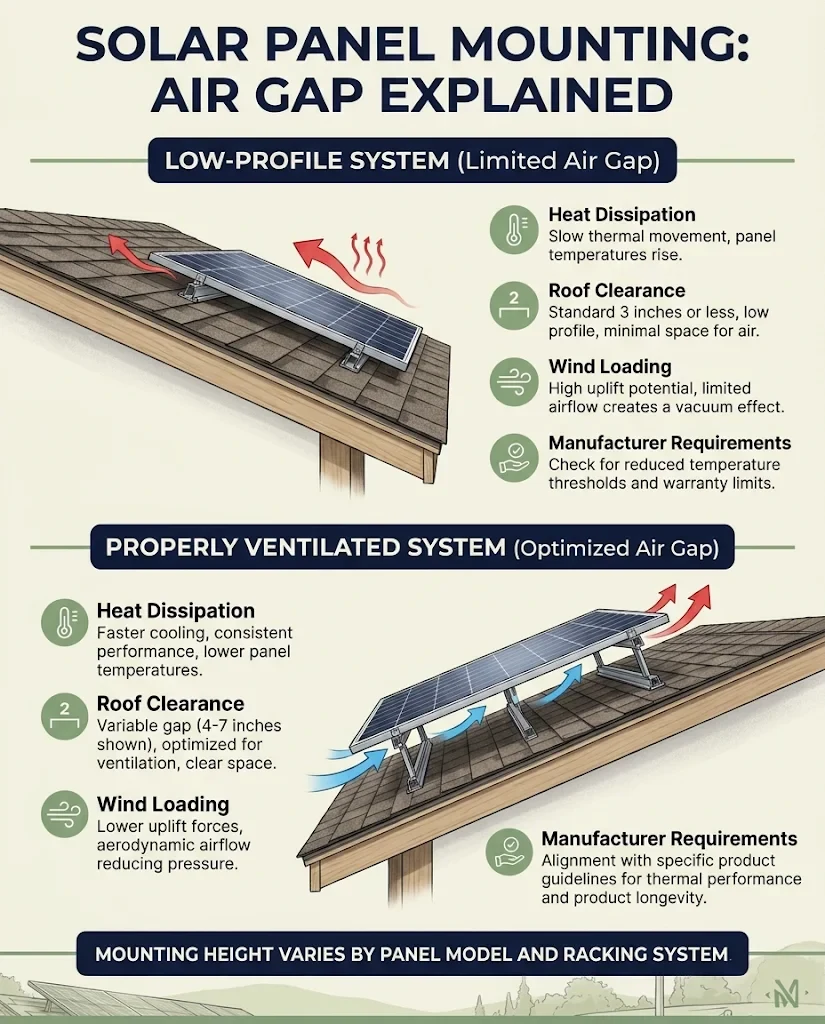
The main difference between these two approaches is the available space beneath the modules. However, a visually low mount does not automatically mean zero ventilation or a defective installation.
| Feature | Low-Profile Mount | Elevated Mount |
|---|---|---|
| Airflow | May be more restricted | May allow more circulation |
| Module temperature | Can be higher | Can be lower |
| Wind loading | Design-specific | Height may change loads |
| Cleaning access | Depends on array layout | Depends on structure |
| Roof appearance | Usually more discreet | Often more visible |
| Code compliance | Requires approved design | Requires approved design |
Elevated systems can improve rear ventilation under certain conditions. But raising panels may also change wind forces, mounting requirements, visual appearance, and costs.
The objective is not to create the largest possible gap. It is to achieve a suitable, verified balance of cooling, mechanical safety, and installation requirements.
How Solar Panel Temperature Affects Efficiency
Most crystalline silicon solar panels produce less power as their cell temperature rises above the standard test reference temperature, assuming similar sunlight conditions.
The exact change is described by a manufacturer’s maximum-power temperature coefficient, often shown as a negative percentage per degree Celsius.
Example: The Effect of a 10°C Temperature Difference
Imagine a panel with an illustrative maximum-power temperature coefficient of -0.35% per degree Celsius.
If two otherwise comparable operating conditions differ by 10°C in cell temperature, the hotter panel would have approximately:
10°C × 0.35%/°C = 3.5%
Approximately 3.5% lower rated power contribution due to that temperature difference, using a simplified linear approximation.
This does not mean raising every panel will increase annual electricity production by 3.5%. It is a mathematical example, not a measured performance gain for a specific roof.
Actual performance also depends on irradiance, ambient temperature, wind, mounting geometry, and the panel’s real temperature coefficient.
Research on ventilated rooftop photovoltaic installations has found that the air gap can affect module temperature and electrical output. However, the amount of improvement varies with the roof, climate, and test conditions.
For a research example, see Effect of Air Gap on the Performance of Building-Integrated Photovoltaics.
Is a 6- to 8-Inch Gap Better for Solar Panels?
Not necessarily. Six to eight inches is approximately 152 to 203 mm, which may offer more space for airflow than a very close-mounted configuration.
But the additional clearance does not guarantee a proportional increase in cooling or electricity production. Cooling gains may diminish as the gap becomes larger, while mechanical requirements can become more demanding.
The installation must also account for roof shape, module mounting instructions, racking certifications, local wind conditions, fire classification, and building structure.
Do not raise an existing solar array simply to copy a recommended gap from social media. Changing the mounting height can affect structural loading, electrical wiring, roof weatherproofing, and the system’s approved fire classification. Have any modification reviewed by a qualified solar installer.
How Roof Material Changes Solar Panel Cooling
The roof beneath a solar array influences heat exchange. Different roof materials absorb, store, and release heat differently.
Metal Roofs
Metal roofs can become hot in direct sunlight. Their surface shape and mounting attachments also influence the available ventilation channel.
Standing-seam systems may use specialized clamps, but their suitability and panel clearance depend on the roof and racking manufacturers’ instructions.
Asphalt Shingle Roofs
Solar mounts on shingle roofs typically attach through the roofing system into suitable structural members. Correct flashing and water sealing are important to prevent leaks.
The clearance must also support the approved mounting configuration and any applicable fire-rating conditions.
Tile Roofs
Tile roofs require mounts compatible with the tile type and the underlying structure. Irregular tile profiles can affect how the gap is measured and how air travels beneath the modules.
Damaging or improperly modifying roof tiles can lead to water intrusion, so attachment and flashing details require careful design.
Flat Roofs
Flat-roof systems may use tilted racks or ballasted mounting structures. Airflow, row spacing, structural loading, roof drainage, and wind forces all influence the design.
The clearance may be very different from that used on a steep, residential shingle roof.
The US Department of Energy Building America roof-anchor guidance discusses structural attachments, roof types, weatherproofing, and mounting considerations.
IMAGE 2: Insert a 1200 × 1500 educational image comparing a conventional low-profile rooftop PV arrangement with a properly designed ventilated mounting configuration. Use airflow arrows but no universal fixed mounting measurements.
Does More Airflow Improve Long-Term Solar Panel Performance?
Appropriate ventilation can reduce excessive operating temperatures, which may improve performance during hot conditions and help avoid some thermal stresses.
However, it would be misleading to claim that any particular gap guarantees better output for 25 years.
Long-term system performance also depends on module manufacturing quality, environmental exposure, thermal cycling, moisture protection, installation quality, electrical equipment, shading, and maintenance.
The system’s product and performance warranties have their own terms. A larger air gap does not automatically extend the warranty or guarantee the stated degradation rate.
Other Safety Factors That Matter More Than Gap Size Alone
Ventilation is only one part of a safe rooftop solar installation. A properly designed system must meet several other requirements.
Wind and Structural Loading
A raised mounting system must withstand expected wind and snow loads. The racking design, roof attachments, and building structure all need to meet the applicable engineering requirements.
Fire Classification and Roof Access
PV module and mounting-system combinations may have specific fire classifications. Required roof access pathways and setbacks can also apply.
These requirements depend on the jurisdiction and approved equipment. Do not assume a higher mounting gap automatically improves fire safety.
Cable Protection and Drainage
Cables must be supported and protected according to the equipment instructions. Wiring should not hang loosely onto roofing surfaces, rub against sharp edges, or obstruct drainage paths.
Waterproofing and flashing are important wherever mounting hardware penetrates the roof.
Pest and Debris Management
Birds and other animals may enter spaces beneath some arrays. Suitable approved screening can help where pests are a concern, provided it does not interfere with ventilation or installation requirements.
Leaves and debris can also accumulate around the edges of solar panels. The maintenance plan should account for safe inspection and cleaning access.
How to Check Whether Your Solar Panels Have Enough Clearance
If solar panels are already installed on your roof, you can review their documentation without climbing onto the roof or touching electrical equipment.
- Find the module model number. Check your installation documents or installer records.
- Read the applicable module manual. Look for minimum rear clearance and approved mounting methods.
- Identify the racking system. Check its roof compatibility, structural design, and fire-rating conditions.
- Review the installer drawings. Look for documented standoff dimensions and panel placement.
- Check your energy monitoring. Watch for unusual performance changes, but do not assume heat is the cause without further analysis.
- Arrange a professional inspection. Ask the installer to verify clearance, attachments, cable support, drainage, and ventilation.
Do not climb onto the roof to measure a gap, loosen a rail, or lift a solar module yourself. Rooftop PV work combines fall hazards with electrical equipment that can remain energized in daylight.
Can You Improve Solar Panel Cooling Without Changing the Mounts?
If your system is performing poorly during hot weather, increasing the roof gap is not necessarily the first or best solution.
Other factors can include shading, dust, inverter behavior, system design, module temperature, and normal seasonal changes in sunlight.
- Review monitoring data: Compare output under similar weather and sunlight conditions.
- Check for shading: Trees, new structures, and roof equipment can reduce generation.
- Inspect for visible debris: Use safe, ground-level observation or professional maintenance.
- Check inverter fault records: Some performance issues are unrelated to module temperature.
- Ask about ventilation obstructions: Have a professional check whether installed accessories obstruct airflow.
- Follow manufacturer guidance: Do not modify the mounting arrangement without approval.
If dirt or debris is affecting output, our guide to cleaning sand and dust off solar panels covers safe maintenance considerations.
Common Solar Panel Mounting Mistakes
- Assuming every solar panel needs the same air gap: Manufacturers specify different mounting conditions.
- Using social-media measurements as installation instructions: A diagram cannot replace the approved manual.
- Ignoring thermal performance: Restricted rear airflow may raise operating temperatures.
- Raising panels without engineering review: The change may increase structural demands.
- Blocking ventilation with accessories: Screening and cable hardware must be installed correctly.
- Ignoring waterproofing: Poor roof penetrations can lead to water damage.
- Assuming taller mounts guarantee higher lifetime output: Long-term performance depends on more than ventilation.
- Using unauthorized mounting parts: Unapproved hardware may compromise system certification or warranties.
Frequently Asked Questions
What is the best air gap between solar panels and a roof?
There is no single best distance for every solar installation. Around 100 mm (4 inches) is a common reference for conventional rooftop panels, but the correct clearance depends on the module, racking system, roof conditions, and local requirements.
Do solar panels need ventilation underneath?
Most conventional roof-mounted PV modules benefit from adequate rear ventilation. However, building-integrated products may use a different approved design. Always follow the manufacturer’s requirements.
Does a bigger gap make solar panels more efficient?
Additional clearance can improve cooling in some conditions, but the benefits are not unlimited. Roof geometry, wind, shade, and mounting requirements also affect performance and safety.
Is a 2-inch solar panel roof gap enough?
It may be acceptable for certain approved modules and mounting systems. Other manufacturers require larger clearances. A 2-inch gap should not be assumed safe or compliant without checking the actual product documentation.
Should rooftop solar panels be mounted 6 to 8 inches high?
Only if that height is suitable for the specified mounting system, roof, and structural design. The 6- to 8-inch range shown in some online infographics is not a universal requirement.
Does solar panel ventilation help the roof?
A ventilated rooftop array can change heat transfer around the roof, but the effect depends on the roof assembly, climate, and solar installation. It should not be treated as a guaranteed building-insulation or cooling improvement.
Can poor mounting damage solar panels?
Improper mounting may create mechanical, thermal, electrical, or waterproofing problems. The correct installation must meet the manufacturer’s instructions, equipment ratings, and applicable safety requirements.
Solar Panel Roof Air Gap: Final Checklist
- Identify the exact solar module model.
- Read its current installation manual.
- Check the specified roof clearance.
- Confirm the approved mounting-system design.
- Review structural wind and snow loading.
- Check relevant fire and roof access requirements.
- Confirm cable support and weatherproofing details.
- Keep required airflow and drainage paths unobstructed.
- Consider professional maintenance and pest prevention.
- Use a qualified solar installer for modifications or inspections.
Choosing the Right Rooftop Solar Mounting Clearance
The space beneath rooftop solar panels matters because adequate ventilation can help manage operating temperature and maintain reliable conditions for the installation.
But the right clearance is determined by more than heat alone. Roof type, module design, racking, wind loading, drainage, fire requirements, and manufacturer instructions must all work together.
Use online illustrations to understand the concept, not to select mounting dimensions. The safest approach is to follow the approved documentation for the exact equipment and have the installation evaluated by a qualified solar professional.
Technical references: ASHRAE: Solar Energy Use, Maxeon Module Installation Manual, Canadian Solar Installation Manual, DOE Building America: Roof Anchor Systems, and NREL/NLR SAM: PV Module Temperature Models. Follow the latest manual for the installed product and all applicable local requirements.