
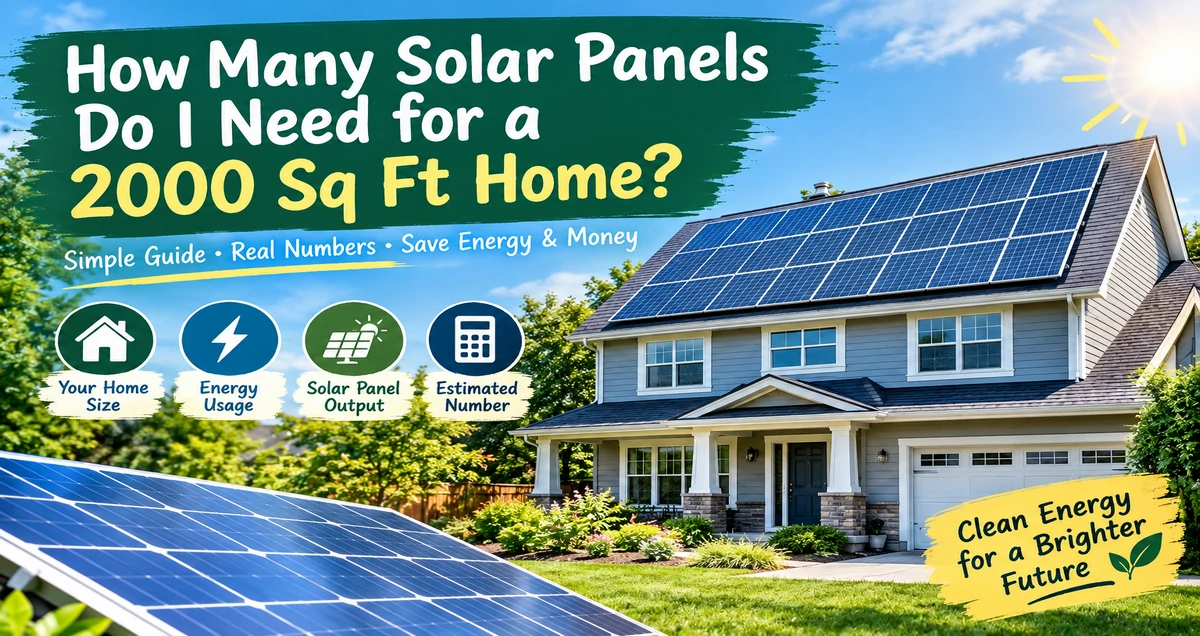
how many solar panels do I need for a 2000 sq ft home
If you have a 2,000 square foot home, you may be wondering how many solar panels you need to cover your electricity use. The answer isn’t determined by square footage alone.
A 2,000 sq ft home could need a very different solar system from another home of the same size. Your electricity consumption, location, roof orientation, sunlight, panel efficiency, household appliances, and future energy needs all affect the final system size.
For many homes, a solar system in the 6 kW to 10 kW range may be a reasonable starting point for evaluation, but the correct size should be based on actual electricity consumption rather than home size alone.
Related Post
In this guide, you’ll learn how to estimate the number of solar panels needed for a 2,000 sq ft home, how to calculate your solar system size, what affects production, and how to avoid buying a system that is either too small or unnecessarily large.
Quick Answer: How Many Solar Panels for a 2,000 Sq Ft Home?
A typical 2,000 sq ft home might require approximately 15 to 25 solar panels, depending on the panel wattage and the home’s electricity consumption.
For example:
| Solar Panel Size | 6 kW System | 8 kW System | 10 kW System |
|---|---|---|---|
| 300W panels | 20 panels | 27 panels | 34 panels |
| 400W panels | 15 panels | 20 panels | 25 panels |
| 450W panels | 14 panels | 18 panels | 23 panels |
| 500W panels | 12 panels | 16 panels | 20 panels |
These numbers are examples, not a universal recommendation.
The most important question isn’t “How big is my house?”
It’s:
“How much electricity does my home use?”
Why Square Footage Isn’t Enough
Home size can provide a rough indication of potential electricity demand, but it doesn’t tell you how much energy the household actually consumes.
Two 2,000 sq ft homes could have completely different electricity bills.
For example, one home might have:
- Energy-efficient appliances
- LED lighting
- A gas water heater
- Moderate air-conditioning use
- Few occupants
Another home might have:
- Electric heating
- Central air conditioning
- An electric water heater
- An electric vehicle
- A swimming pool
- Several refrigerators and freezers
- More people living in the home
The second household could use substantially more electricity.
That’s why your electricity bill or utility consumption history is usually a much better starting point than square footage.
Step 1: Check Your Electricity Usage
Look at your electricity bills from the previous 12 months.
Your utility bill normally shows electricity consumption in kilowatt-hours (kWh).
For example, imagine a household uses:
- January: 750 kWh
- February: 680 kWh
- March: 620 kWh
- April: 700 kWh
- May: 850 kWh
- June: 1,050 kWh
- July: 1,200 kWh
- August: 1,180 kWh
- September: 980 kWh
- October: 760 kWh
- November: 700 kWh
- December: 800 kWh
The annual consumption would be about 10,270 kWh.
That number is far more useful for solar sizing than the home’s 2,000 sq ft measurement.
Step 2: Calculate Your Average Monthly Electricity Use
Add your electricity usage for the previous 12 months and divide it by 12.
Example
If your annual electricity consumption is:
10,800 kWh
Then:
10,800 ÷ 12 = 900 kWh per month
Your average electricity consumption is approximately 900 kWh per month.
You can then use this figure to estimate the solar system size you may need.
Step 3: Estimate Your Solar System Size
Solar production depends heavily on location and available sunlight.
A simplified example can help explain the process.
Suppose your home uses approximately:
900 kWh per month
That’s:
900 ÷ 30 = 30 kWh per day
If your solar panels receive an equivalent of approximately 5 peak sun hours per day, a rough calculation would be:
30 ÷ 5 = 6 kW
Because real-world solar systems experience losses from temperature, wiring, inverter efficiency, shading, dirt, orientation, and other factors, the final system may need to be somewhat larger.
This is why professional solar design should use local solar-production data rather than relying on a simple formula alone.
Step 4: Convert System Size Into Number of Solar Panels
Once you have an estimated system size, divide it by the wattage of the panels you plan to install.
Example: 400W Solar Panels
A 6 kW system would require:
6,000W ÷ 400W = 15 panels
So:
15 × 400W = 6,000W
That’s a 6 kW array.
Example: 450W Solar Panels
For a 9 kW system:
9,000W ÷ 450W = 20 panels
So a 9 kW system could use approximately:
20 × 450W panels
How Many Solar Panels Does a 2,000 Sq Ft Home Usually Need?
There is no single number that works for every 2,000 sq ft house.
However, the following examples can help you understand the relationship between system size and panel count.
6 kW Solar System
With 400W panels:
6,000 ÷ 400 = 15 panels
7 kW Solar System
With 400W panels:
7,000 ÷ 400 = 17.5
You would need approximately 18 panels.
8 kW Solar System
With 400W panels:
8,000 ÷ 400 = 20 panels
9 kW Solar System
With 400W panels:
9,000 ÷ 400 = 22.5
You would need approximately 23 panels.
10 kW Solar System
With 400W panels:
10,000 ÷ 400 = 25 panels
So a 2,000 sq ft home could potentially use anywhere from around 15 to 25 high-wattage panels, depending on electricity consumption and local solar conditions.
What Factors Determine Solar Panel Requirements?
Several factors can change the number of panels required.
1. Electricity Consumption
This is one of the most important factors.
A household using 500 kWh per month may need a much smaller solar array than a household using 1,500 kWh per month.
Always check your actual electricity consumption before selecting a system.
2. Location
Solar production varies significantly by location.
Homes in areas with abundant sunshine can potentially produce more electricity from the same installed capacity than homes in areas with less solar resource.
Your local climate should therefore be considered when sizing a system.
3. Roof Orientation
The direction your roof faces can affect solar production.
A roof with excellent sun exposure can generally produce more electricity than a roof that is heavily shaded or poorly oriented.
4. Roof Shading
Trees, chimneys, nearby buildings, and other structures can reduce solar production.
Even a relatively large roof may not provide enough usable space if significant portions are shaded.
5. Solar Panel Efficiency
Not all panels produce the same amount of electricity per square foot.
Higher-wattage panels can sometimes allow you to install fewer panels while maintaining similar total system capacity.
For example:
20 × 400W = 8,000W
while:
16 × 500W = 8,000W
Both arrays have an 8 kW nameplate capacity, but the second example uses fewer physical panels.
How Much Roof Space Do You Need?
The number of panels isn’t the only consideration.
You also need enough usable roof area.
Modern residential solar panels can vary in physical dimensions, but a typical panel may require roughly 18–22 square feet of roof space.
For example, 20 panels could require roughly:
20 × 20 = 400 square feet
of panel area.
However, the actual roof area required will be greater because installers need to account for:
- Roof edges
- Setbacks
- Walkways
- Obstructions
- Vents
- Chimneys
- Fire-access requirements
- Roof geometry
- Local building requirements
A 2,000 sq ft house therefore does not necessarily have 2,000 sq ft of usable solar roof space.
What If Your Home Uses a Lot of Electricity?
High-energy households may need a larger solar system.
For example, electricity demand can increase substantially if you have:
- Electric heating
- Electric water heating
- Central air conditioning
- An electric vehicle
- A swimming pool
- Hot tub equipment
- Large appliances
- Home workshops
- Multiple refrigerators
- High year-round cooling demand
If you are planning to purchase an electric vehicle or replace gas appliances with electric versions, consider those future loads before installing your solar system.
What If You Want Solar Battery Storage?
Solar panels and batteries perform different jobs.
Solar panels generate electricity.
A battery stores electricity for later use.
A battery can allow you to use stored solar energy after the sun goes down, and depending on the system design, it may also provide backup power during a grid outage.
If you’re installing solar plus battery storage, you should consider both:
Solar panel capacity
and
Battery storage capacity
A large battery doesn’t automatically mean you need more solar panels, and more solar panels don’t automatically mean you need a large battery.
The right combination depends on your electricity consumption, solar production, backup goals, utility rules, and rate structure.
How Many Solar Panels Do I Need for 1,000 kWh per Month?
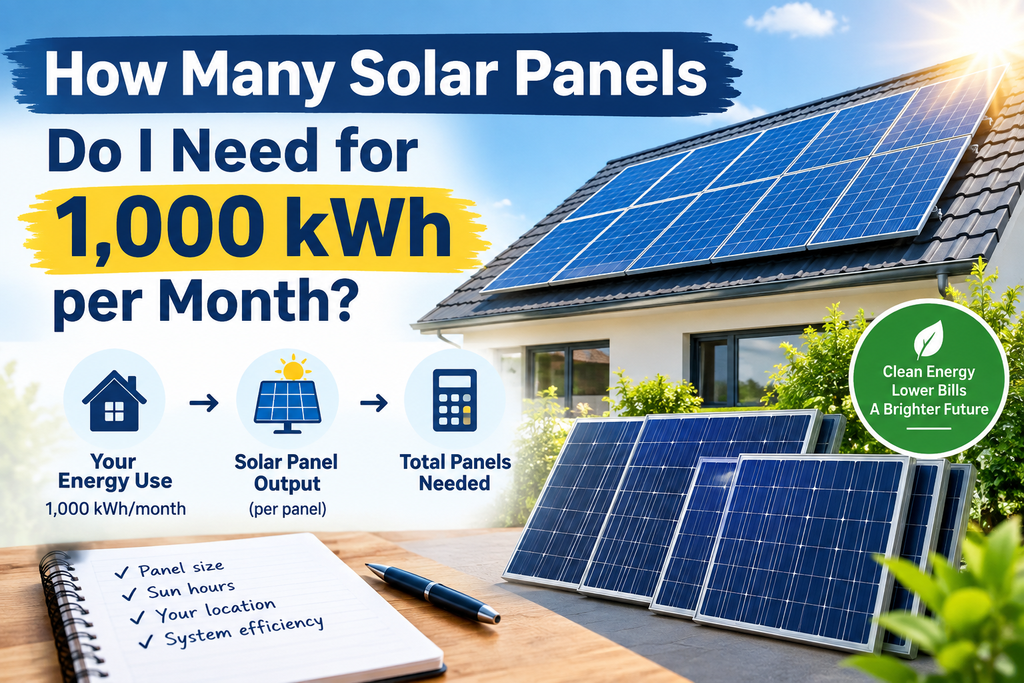
Suppose your home consumes approximately:
1,000 kWh per month
That’s approximately:
12,000 kWh per year
The solar system required to offset that consumption depends on local solar production.
As a simplified example, an 8 kW system might use:
20 × 400W panels
But the actual annual production could be higher or lower depending on your location, shading, orientation, weather, equipment, and system losses.
This is why production modeling is more reliable than simply multiplying panel count by a generic number of sunny hours.
Should You Install More Solar Panels Than You Need?
Sometimes homeowners install additional solar capacity for future electricity demand.
This could make sense if you expect to:
- Buy an EV
- Add electric heating
- Install a heat pump
- Increase air-conditioning use
- Add a pool
- Add battery storage
- Electrify appliances
However, oversizing a system can also increase upfront costs.
Before installing additional panels, check your utility’s rules for solar exports, net metering or other compensation programs, and system-size limits.
How to Get the Most From a Solar System
Installing solar panels is only part of the equation.
You can also reduce electricity consumption through energy efficiency.
Consider:
Use efficient appliances
Energy-efficient refrigerators, air conditioners, heat pumps, and other appliances can reduce household electricity demand.
Improve insulation
Better insulation can reduce heating and cooling requirements.
Reduce standby consumption
Some electronics consume electricity even when they aren’t actively being used.
Use smart energy management
Smart thermostats and energy monitoring systems can help you understand where electricity is being consumed.
Shift electricity usage
If your utility uses time-of-use rates, running certain appliances during lower-cost periods may reduce electricity costs.
Common Solar Sizing Mistakes to Avoid
Mistake 1: Using Square Footage Alone
A 2,000 sq ft house doesn’t automatically need a specific number of panels.
Always start with actual electricity consumption.
Mistake 2: Ignoring Seasonal Usage
Your annual average can hide major seasonal differences.
A home may use much more electricity during summer because of air conditioning.
Mistake 3: Ignoring Shade
A shaded roof can produce significantly less electricity than an unshaded roof.
Mistake 4: Choosing Panels Before Calculating System Size
Don’t decide on the number of panels first.
Determine your energy requirements and target system size, then choose appropriate equipment.
Mistake 5: Forgetting Future Energy Needs
If you’re planning an EV or major home electrification project, include that future electricity consumption in your planning.
Frequently Asked Questions
How many solar panels do I need for a 2,000 sq ft house?
A 2,000 sq ft home could require approximately 15–25 panels when using panels in the 400W range, but the correct number depends on electricity consumption, location, sunlight, roof conditions, and desired energy offset.
Is a 10 kW solar system enough for a 2,000 sq ft home?
It can be enough for some homes, but not necessarily all. A 10 kW system with 400W panels would contain approximately 25 panels. Whether that system meets your needs depends on your annual electricity consumption and local solar production.
Does a bigger house always need more solar panels?
No. A smaller home with high electricity consumption can require more solar capacity than a larger energy-efficient home.
How do I calculate how many panels I need?
Start with your annual electricity consumption, estimate the solar production available at your location, determine the required system capacity, and divide that capacity by the wattage of the selected panels.
Are 400W solar panels good for a 2,000 sq ft home?
400W panels can be a practical option for many residential installations, but panel wattage alone doesn’t determine whether a system is appropriate. Roof space, energy consumption, shading, orientation, equipment compatibility, and budget should also be considered.
Can solar panels completely eliminate my electricity bill?
Not necessarily.
Solar production varies throughout the year, and utility charges, minimum fees, export rules, and compensation programs differ by location. A properly designed system can potentially offset a substantial portion of electricity consumption, but actual savings depend on the local electricity and solar program.
Final Answer: How Many Solar Panels Do You Need?
For a 2,000 sq ft home, a reasonable starting estimate may be around 15–25 solar panels, especially when using panels around 400W.
But don’t size your solar system from square footage alone.
The better method is:
1. Check 12 months of electricity bills.
2. Calculate annual kWh consumption.
3. Evaluate your local solar resource.
4. Account for roof orientation and shading.
5. Calculate the required system capacity.
6. Divide the system capacity by panel wattage.
7. Consider future electricity needs and battery storage.
The right solar system isn’t necessarily the system with the most panels. It’s the system that is appropriately sized for your electricity needs, available roof space, local solar conditions, and long-term goals.
Before purchasing equipment, have the proposed system evaluated using location-specific solar production data and local installation requirements.