
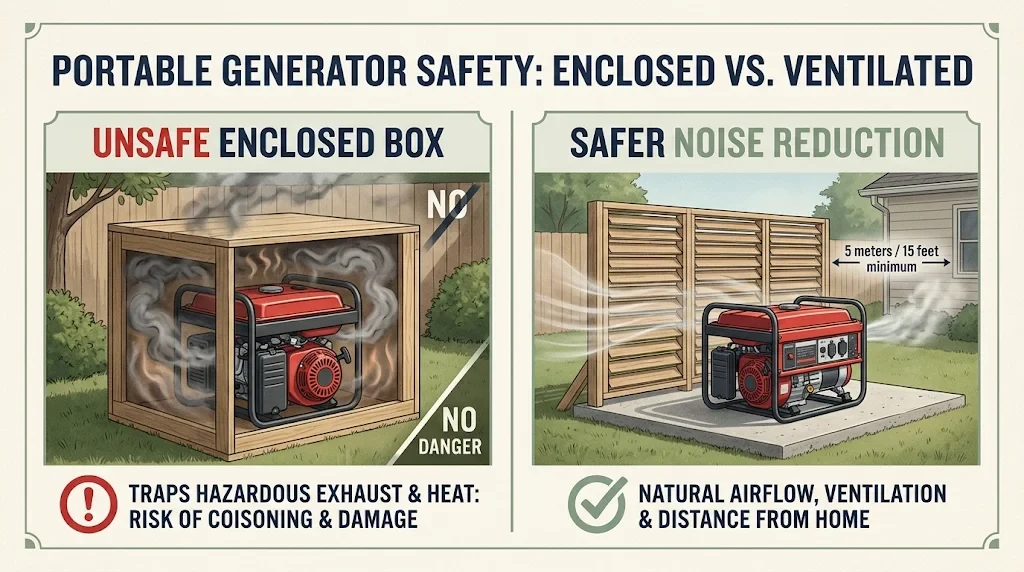
soundproof generator enclosure can help reduce the noise produced by a generator, but an enclosure must never compromise exhaust safety, engine cooling, or access to the equipment. A box that looks well insulated may still be dangerous if it traps carbon monoxide or causes the generator to overheat.
For ordinary portable gasoline generators, the safest starting point is to operate the generator outdoors in accordance with its manufacturer’s instructions and use noise-control methods that do not enclose the engine. This guide explains how generator noise reduction works, what makes DIY soundproof boxes risky, and which alternatives are worth considering for home backup and off-grid power.
Soundproof Generator Enclosure: Quick Answer
- Purpose: Reduce unwanted generator noise.
- Biggest danger: Carbon monoxide from engine exhaust.
- Other risks: Overheating, fire, electrical faults, and restricted ventilation.
- Portable generator placement: Outdoors, at least 20 feet from homes and buildings, with exhaust directed away from openings, according to CPSC guidance.
- DIY sealed boxes: Not a safe operating solution for ordinary portable fuel-burning generators.
- Safer noise control: Proper placement, compatible manufacturer-approved equipment, and freestanding sound barriers that preserve required clearances.
- Engineered enclosures: Require compatibility with the generator and a validated cooling, exhaust, and fire-safety design.
Carbon Monoxide Warning
Never operate a conventional portable fuel-burning generator in a garage, shed, basement, tent, enclosed box, or other partially enclosed space, even with doors or windows open. Carbon monoxide can build up to deadly levels.
Operate portable generators outside and follow CPSC placement guidance and the generator manufacturer’s instructions. Install working carbon monoxide alarms inside occupied buildings.


What Is a Soundproof Generator Enclosure?
A generator enclosure is a structure or housing designed to protect equipment or reduce noise. Some commercial generator sets are supplied with engineered acoustic enclosures that incorporate cooling airflow, exhaust arrangements, and service access.
These should not be confused with a homemade insulated box placed around an ordinary portable generator. The two arrangements can have very different safety characteristics.
A box lined with acoustic material may absorb some sound reflections while also trapping hot air and exhaust gases. Without a complete tested design, the reduction in noise does not establish that the generator is safe to operate inside it.
Why Are Generators So Loud?
Fuel-powered generators create noise from several sources. The engine produces combustion and mechanical noise, while exhaust flow, cooling fans, vibration, and surrounding surfaces also contribute.
- Engine noise: Mechanical movement and fuel combustion.
- Exhaust noise: Sound associated with engine exhaust pulses.
- Cooling noise: Fans and moving air.
- Vibration: Movement transmitted through the frame and supporting surface.
- Reflected noise: Sound bouncing from walls, fences, and other hard surfaces.
Effective noise reduction depends on which sources dominate. A solution that reduces one type of noise may do little to address another.
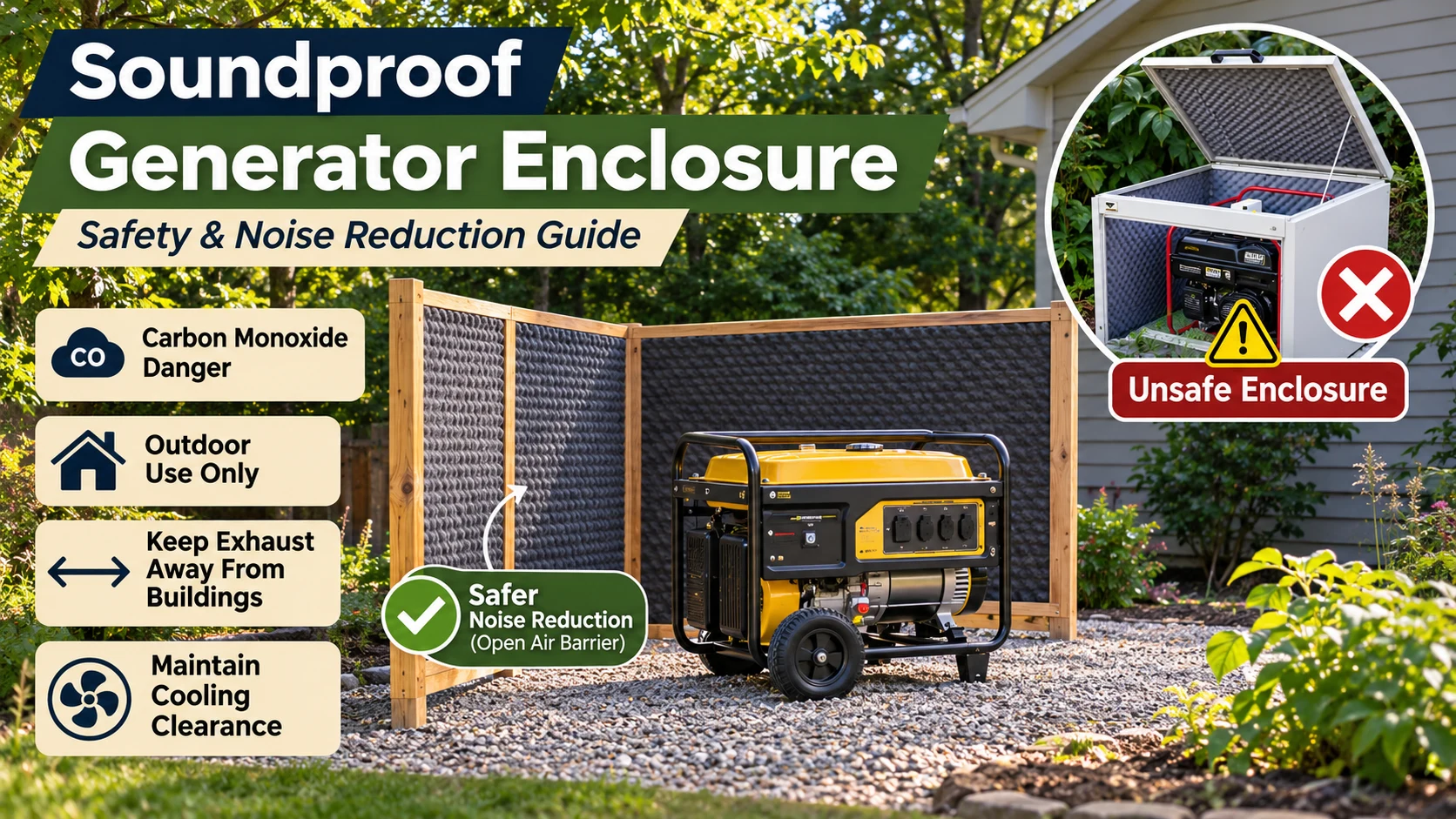
Why the DIY Generator Box in the Picture Is Risky
The reference image shows an insulated metal box with hinged access panels and what appears to be a fuel-powered generator inside.
However, the photograph does not establish the generator’s model, cooling requirements, exhaust routing, acoustic material fire rating, or whether the housing is manufacturer-approved.
| Visible Feature | What It Does Not Prove |
|---|---|
| Insulated walls | That the material is safe near engine heat |
| Hinged top | That exhaust gases can escape safely |
| Access door | That cooling airflow meets engine requirements |
| Metal exterior | That the structure is fire-resistant as a complete system |
| Small side opening | That sufficient combustion and cooling air is available |
| Outdoor location | That exhaust cannot reach nearby buildings |
The most serious hazard is carbon monoxide. Running an engine in a restricted space may create dangerous exhaust concentrations even when a lid or door is partly open.
The Consumer Product Safety Commission recommends operating portable generators outdoors, at least 20 feet from homes and buildings, with exhaust directed away from doors, windows, and vents.
Read the CPSC generator safety guidance before considering any noise-control modification.
Safer Ways to Make a Generator Quieter
1. Choose a Suitable Generator Location
Generator location influences how much noise reaches people inside or outside a home. Increasing the distance from occupied spaces may reduce perceived sound, depending on the surrounding environment.
However, noise reduction must never take priority over safety. Portable generators must remain outdoors in a location that meets required separation distances, exhaust direction, and manufacturer clearances.
Do not place a generator beneath windows, under a deck, near an air intake, or in a partially enclosed corner to hide the noise.
2. Consider a Freestanding Acoustic Barrier
A properly positioned freestanding sound barrier may interrupt the direct sound path between a generator and a listener.
Unlike a box that surrounds the engine, a barrier can leave the generator in an open outdoor area. But its position, size, material, wind stability, and separation from the equipment still require consideration.
A barrier must not block exhaust, cooling airflow, maintenance access, or required clearances. Never place combustible panels close to hot engine or exhaust components.
3. Follow the Generator Maintenance Schedule
Unexpected rattling, vibration, or unusually loud operation may indicate a maintenance problem.
Use the manufacturer’s instructions for routine maintenance and have damaged parts evaluated by a qualified technician. Do not remove exhaust components or modify the muffler to try to change the sound.
4. Evaluate Manufacturer-Approved Noise Controls
Some generator manufacturers offer models with integrated acoustic housings or accessories designed for specific equipment.
Check whether the manufacturer approves the exact sound-control accessory, installation arrangement, and operating conditions. Generic noise-reduction accessories are not automatically compatible with every generator.
5. Consider a Quieter Inverter Generator
Some inverter generators are designed for lower noise during lighter loads. Their engine speed and acoustic housing may differ from those of conventional open-frame generators.
Compare manufacturer-published sound measurements under equivalent loads and measurement distances. A single decibel figure is not enough if the test conditions differ.
Commercial Acoustic Enclosures vs. DIY Boxes
| Feature | Engineered Enclosure | Unverified DIY Box |
|---|---|---|
| Generator compatibility | Designed for specified equipment | Usually unknown |
| Cooling airflow | Must be engineered and validated | May be inadequate |
| Exhaust management | Part of the approved design | Often unclear |
| Fire considerations | Addressed through product design | Materials may be unsuitable |
| Noise performance | May have documented test results | Usually unmeasured |
| Service access | Designed for specific equipment | May be obstructed |
Professional acoustic design must balance noise reduction with combustion air, cooling air, exhaust management, environmental protection, and access for maintenance.
ASHRAE’s noise-control guidance identifies ventilation as a major design challenge for generator enclosures. This is one reason a sealed DIY box cannot be treated as an equivalent substitute.
Understanding Generator Noise in Decibels
Generator noise is usually reported in decibels, written as dB. Some specifications use dB(A), which applies a frequency weighting intended to reflect aspects of human hearing.
Decibels use a logarithmic scale. A change of 10 dB represents a tenfold change in sound intensity, but it does not mean the sound will always be perceived as exactly ten times louder.
When comparing generators or noise-reduction methods, check the measurement distance, engine load, test environment, and published measurement standard.
Do not assume an insulated box reduces noise by 10, 20, or 30 dB unless the complete system has been tested under documented conditions.
Why Generator Ventilation Is Essential
Fuel-burning generators need air for engine combustion and for removing waste heat. Some engines and alternators also depend on specific cooling airflow paths.
Restricting these paths can cause overheating, component damage, shutdown, and other hazards. Exhaust gases present an additional life-threatening risk.
Airflow requirements are model-specific. There is no universal number of vents or fan size that makes a homemade generator box safe.
Adding an ordinary fan does not establish adequate cooling or carbon monoxide protection. Any enclosed generator installation requires appropriate manufacturer approval and professional engineering.
Never test an improvised enclosure by starting the generator and waiting to see whether it overheats. Carbon monoxide can become dangerous before obvious overheating or visible smoke occurs.
Generator Enclosures for Off-Grid Solar Backup
In an off-grid solar system, a fuel-powered generator may provide backup electricity during long periods of poor sunlight or unusually high energy demand.
It may also supply a compatible battery charger or hybrid inverter, depending on the system design. However, generator location, electrical protection, transfer arrangements, grounding, and manufacturer compatibility all require careful planning.
Never connect a generator directly into a household outlet to backfeed electrical wiring. Use an approved transfer or interconnection arrangement installed by a qualified professional.
Could a Solar Battery Reduce Generator Noise?
A suitably sized solar battery system may reduce how often a fuel-powered generator needs to run. Batteries can supply some household loads quietly, with the generator reserved for extended outages or insufficient solar production.
This does not mean battery storage is always a complete replacement for generator backup. The correct arrangement depends on energy demand, battery capacity, charging options, cost, and weather conditions.
For general design principles, see our Off-Grid Solar System Sizing Guide.
Generator Noise Reduction: Planning Checklist
- Identify the generator model. Read its operating manual and required outdoor clearances.
- Confirm safe placement. Keep the generator outdoors, away from buildings and air openings, with exhaust directed away.
- Review current sound levels. Identify whether engine, exhaust, vibration, or reflected sound is the main concern.
- Choose non-enclosing options first. Consider suitable placement, open-air barriers, maintenance, or quieter generator equipment.
- Check manufacturer compatibility. Do not modify cooling, exhaust, or housing systems without approval.
- Assess fire and weather exposure. Keep combustible materials away and follow the required equipment clearances.
- Review electrical safety. Use proper cables, weather protection, and approved transfer equipment.
- Arrange professional review. Any proposed engineered enclosure must be evaluated for the exact generator and site.
Common Generator Soundproofing Mistakes
- Running a generator in a closed box: Can trap deadly exhaust gases.
- Using ordinary acoustic foam near hot parts: May create a fire or overheating hazard.
- Assuming an open lid is sufficient: Does not prove safe airflow or exhaust dispersal.
- Adding a fan without engineering: Does not establish adequate cooling or CO safety.
- Placing the unit beside an air intake: Can allow exhaust to enter occupied spaces.
- Blocking required clearances with barriers: Can interfere with cooling and maintenance.
- Modifying the muffler: Can introduce exhaust, heat, emissions, and warranty problems.
- Ignoring CO alarms: Removes an important additional layer of protection for occupants.
- Expecting a guaranteed decibel reduction: Noise performance must be measured under defined conditions.
Frequently Asked Questions
Can you soundproof a portable generator?
You can reduce some generator noise using suitable operating locations, approved accessories, and properly positioned non-enclosing sound barriers. Do not place a conventional portable fuel-powered generator inside a homemade sealed soundproof box.
Can a generator run inside a soundproof enclosure?
Only generator installations specifically designed and approved for an engineered enclosure should be considered. A generic DIY insulated box is not sufficient. Ordinary portable fuel-powered generators must be used outdoors according to the manufacturer and CPSC safety guidance.
Does acoustic foam stop generator noise?
Acoustic materials can absorb some sound, but they do not eliminate all engine, exhaust, and vibration noise. Their heat and fire properties must also be considered. Ordinary household acoustic foam should not be placed around hot generator equipment.
How far should a portable generator be from the house?
CPSC recommends operating portable generators outdoors at least 20 feet away from homes and buildings, with exhaust directed away from doors, windows, and ventilation openings. Follow the manufacturer’s instructions and any stricter applicable requirements.
Can I use a fan to ventilate a DIY generator box?
A fan does not automatically make an enclosed generator safe. Cooling airflow, combustion air, carbon monoxide, exhaust temperature, and fire safety all require a validated engineering design.
Are inverter generators quieter?
Some inverter generator models offer lower noise at certain operating loads. Compare manufacturer-published noise figures using equivalent measurement distances and load conditions.
Can solar batteries replace a noisy generator?
A properly sized solar and battery system can supply many loads without running a fuel-powered engine. However, extended backup requirements, charging capacity, and seasonal weather determine whether a generator is still useful.
Final Generator Safety Checklist
- Operate ordinary portable fuel-powered generators outdoors only.
- Maintain CPSC-recommended separation from buildings and openings.
- Direct exhaust away from occupied spaces.
- Never use a homemade sealed soundproof box while the engine is running.
- Keep manufacturer-required cooling and service clearances unobstructed.
- Avoid combustible materials near hot engine and exhaust parts.
- Use working carbon monoxide alarms inside occupied buildings.
- Follow safe shutdown, cooling, and refueling instructions.
- Use approved electrical transfer and protection equipment.
- Consult the generator manufacturer before using acoustic accessories.
- Obtain professional design review for specialized permanent enclosures.
The Best Way to Reduce Generator Noise
A soundproof generator enclosure may look like a simple workshop project, but safely enclosing a fuel-powered generator requires much more than insulation and metal panels.
Carbon monoxide, engine cooling, hot exhaust, fire protection, and electrical safety must all be addressed. For ordinary portable generators, focus first on safe outdoor placement and non-enclosing noise-reduction options.
If a fully enclosed generator installation is necessary, choose an engineered solution compatible with the exact equipment and have its installation professionally reviewed. A quieter generator is never worth compromising personal safety.
Technical sources: CPSC: Generator, Carbon Monoxide, and Fire Hazards; CPSC: Generators and Engine-Driven Tools; CDC: Power Outage Safety; ASHRAE: Noise and Vibration Control.