
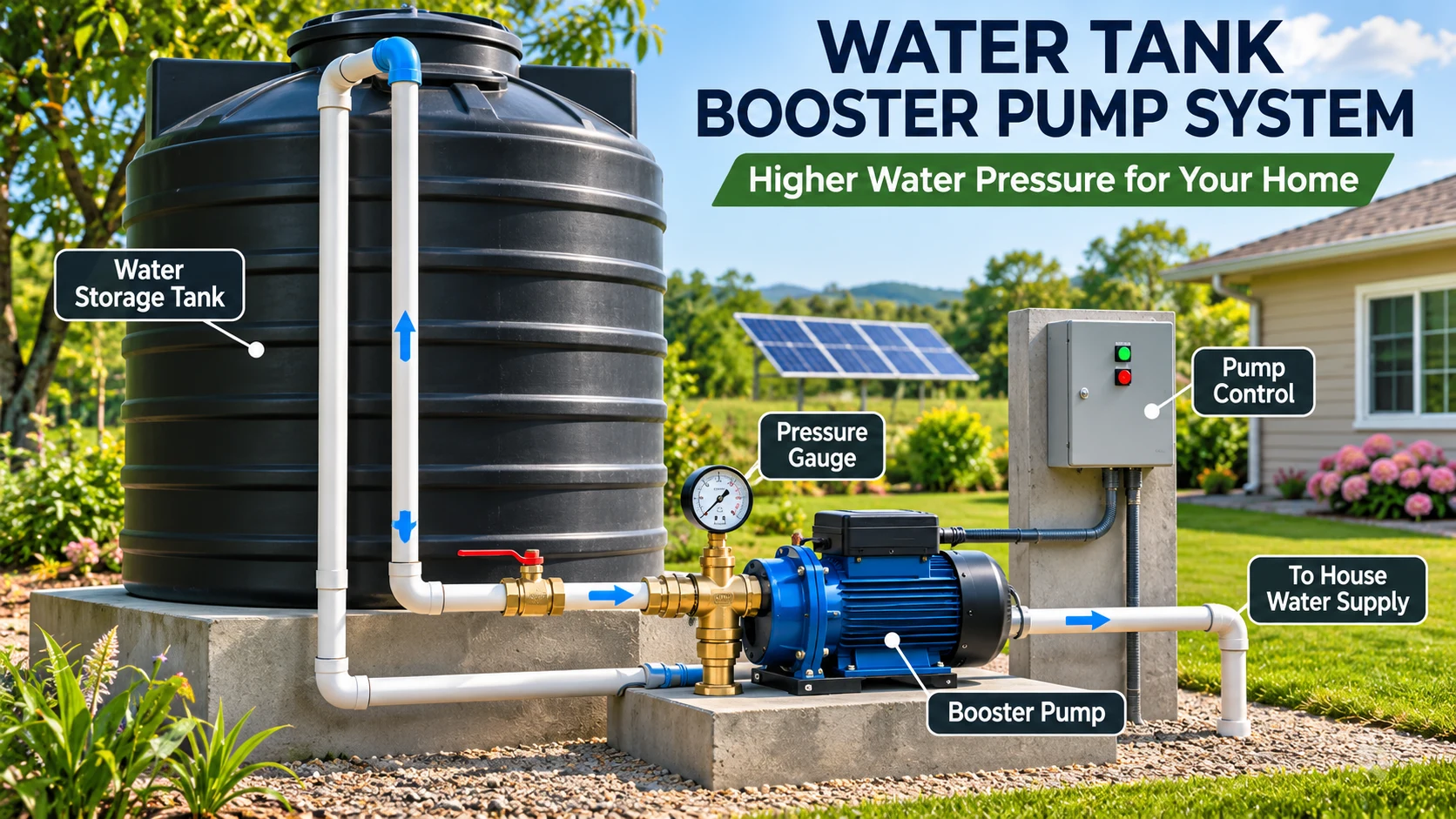
water tank pressure booster pump moves water from a storage tank into a pressurized plumbing system. It can improve water delivery to showers, faucets, garden irrigation, and other fixtures when gravity alone does not provide enough pressure.
For an off-grid home, a booster pump can also run from a properly sized solar-powered electrical system. The best setup depends on water demand, elevation, pipe losses, pump performance, electrical supply, and the safety controls needed to prevent dry running and excessive pressure.
Water Tank Booster Pump: Quick Facts
- Purpose: Increase water pressure and maintain adequate flow at fixtures.
- Water source: A compatible storage tank, cistern, or other approved supply.
- Booster pump: Adds hydraulic energy to move water through the plumbing.
- Pressure controller: Starts, stops, or regulates the pump according to the equipment design.
- Pressure tank: May reduce pump cycling in systems designed to use one.
- Dry-run protection: Prevents the pump from operating without sufficient water.
- Solar option: A suitable solar pump controller or solar-and-battery system can supply electricity.
Important: The large water storage tank and a small pressurized diaphragm tank serve different purposes. One does not automatically replace the other.
How Does a Water Tank Booster Pump Work?
Water stored in a tank has potential energy because of its elevation. If the tank is not high enough to produce adequate pressure, a booster pump adds the pressure needed to supply fixtures and appliances.


The pump draws water from a suitable inlet and delivers it into the distribution piping. A pressure sensor, pressure switch, or electronic controller operates the pump according to demand.
Some systems run at a fixed speed and cycle between preset pressures. Others use a variable-speed pump to regulate pressure more continuously as water demand changes.
Conceptual Water Flow
WATER STORAGE TANK
↓
SUITABLE SUCTION PIPING AND WATER-LEVEL PROTECTION
↓
BOOSTER PUMP
↓
PRESSURE CONTROL AND REQUIRED SAFETY DEVICES
↓
HOUSEHOLD FIXTURES OR IRRIGATION
This is a functional overview, not a terminal-by-terminal electrical drawing or an installation-ready plumbing schematic. Valve placement and components vary by manufacturer and application.
Understanding the Components in the Pinterest Diagram
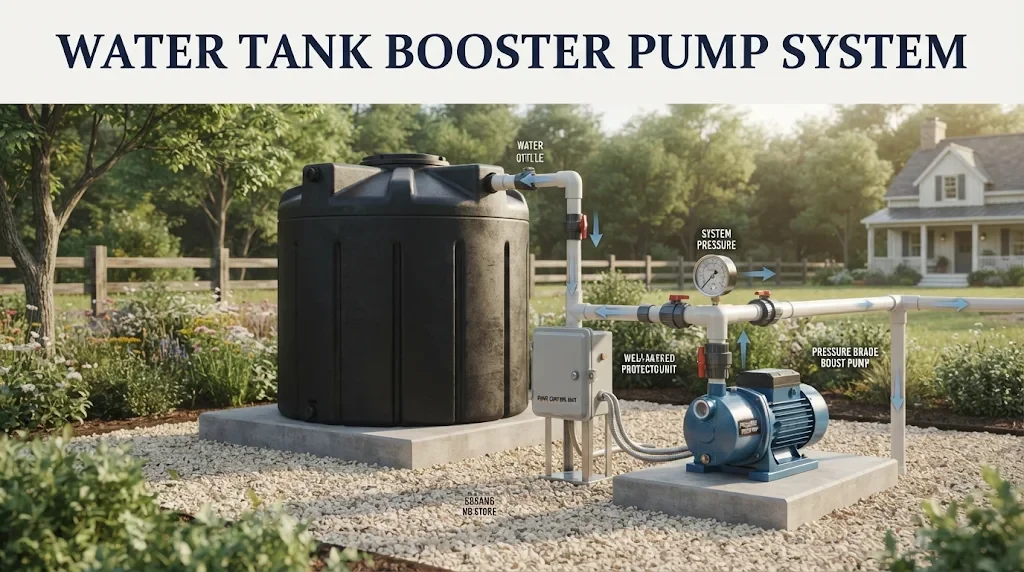
The reference illustration shows a large plastic water tank, a blue electric pump, a pressure gauge, and multiple pipes and fittings.
These are recognizable parts of water storage and pumping equipment, but the illustration does not show enough information to verify the complete system.
| Component | Function | What to Verify |
|---|---|---|
| Storage tank | Stores water | Capacity, outlet, material, and structural support |
| Electric pump | Adds pressure and moves water | Pump curve, power rating, and inlet conditions |
| Pressure gauge | Displays pressure | Measurement location and gauge rating |
| Pipework | Transfers water | Size, pressure rating, and routing |
| Valves | Control or prevent flow | Type, direction, and purpose |
| Electrical controller | Controls pump operation | Model and protection functions |
Do not assume the pictured valve arrangement is correct. The appropriate pump location, check valves, shutoff valves, pressure relief, and monitoring equipment depend on the actual design.
Water Storage Tank vs. Pressure Tank
A large water storage tank holds a supply of water. It may be vented or otherwise designed for atmospheric storage. Its capacity does not tell you how much water pressure will reach a faucet.
A pressure tank is different. It is a pressure-rated vessel that can store a smaller amount of water under pressure, often using a diaphragm or bladder to separate water from compressed air.
| Feature | Storage Tank | Pressure Tank |
|---|---|---|
| Main job | Store water volume | Support pressure management |
| Typical design | Large reservoir or cistern | Pressure-rated vessel |
| Pump cycling | Does not inherently control cycling | Can reduce cycling with suitable controls |
| Capacity | Usually larger | Often smaller |
| Required in every system? | Depends on water source | No; depends on pump and control design |
Some electronic constant-pressure pumps include integrated controls and have different external tank requirements. Always follow the pump manufacturer’s instructions.
How to Choose the Right Water Booster Pump
Booster pumps should be selected using both the required water flow and the total pressure or head needed at that flow.
A high advertised maximum pressure does not guarantee that the pump will deliver enough water when several fixtures are open.
Step 1: Estimate Flow Demand
Calculate how much water your fixtures may need at the same time. A home with multiple bathrooms may require a different pump from a small cabin with one faucet and a shower.
Use the fixtures’ actual flow ratings and realistic simultaneous-use assumptions. Do not simply add the maximum flow of every fixture if they will not all operate together.
Step 2: Calculate Required Head
Pump head represents the energy a pump adds to the water, expressed as an equivalent height of water.
Required head depends on elevation, desired fixture pressure, pipe friction, fittings, and available inlet pressure.
Approximate head required = Elevation head + Desired outlet pressure head + Pipe losses − Available inlet pressure head
For water, 1 bar of pressure is approximately equivalent to 10.2 meters of water head.
Example: A system needs 2 bar at an upper fixture, the fixture is 5 meters above the pump, pipe losses are estimated at 4 meters, and there is no useful inlet pressure credit.
Required pump head ≈ 20.4 + 5 + 4 = 29.4 meters.
This is an illustrative calculation, not a pump recommendation. The selected pump must provide the required flow at that head on its published performance curve.
Step 3: Check Pump Inlet Conditions
The pump must have an adequate water supply at its inlet. Insufficient inlet pressure or an overly restrictive suction line can contribute to cavitation, poor performance, or damage.
A pump placed below the water level in a suitable tank may have a flooded suction arrangement. A pump above the tank’s water level may need a different self-priming design and additional checks.
Refer to the manufacturer’s inlet pressure and net positive suction head requirements for the specific equipment.
Step 4: Verify Pressure Ratings
Pipe, fittings, tanks, controls, and fixtures must be suitable for the maximum pressure the system could produce, including applicable transient pressure conditions.
Have a qualified plumber evaluate pressure regulation, relief protection, backflow prevention, and other required safeguards.
Why Dry-Run Protection Matters
Dry running occurs when a pump operates without enough water passing through it. This can damage seals, overheat components, and shorten equipment life.
Water storage tanks can become empty because of low rainfall, high consumption, blocked inlets, or problems with the filling system.
Depending on the pump, dry-run protection may use a tank-level sensor, float switch, suction-pressure switch, or electronic monitoring built into the controller.
Never run a pump dry to test whether it works. Follow the manufacturer’s priming and commissioning instructions. If a dry-run alarm occurs, identify and correct the cause before restarting the equipment.
Can a Water Tank Booster Pump Run on Solar Power?
Yes. A booster pump can be powered by a suitably designed solar electrical system, but the arrangement depends on the pump’s motor, operating schedule, and power supply requirements.
Option 1: Solar Panels and a Compatible Pump Controller
Some purpose-built solar water pumps can operate through dedicated controllers that manage variable solar input. This is often practical for filling a storage tank during daylight.
However, a pump designed only for daytime tank filling may not provide constant household pressure on demand at night.
Option 2: Solar Panels, Battery, and Inverter
A conventional AC booster pump may run from a suitable battery-based solar system and inverter. This can make water pressure available when sunlight is low or unavailable.
The inverter must handle the motor’s running power and startup characteristics. The battery must support the required current and operating time.
Do not connect a conventional AC pump directly to a solar panel or assume that any inverter with a matching wattage label can start the motor.
Example Solar Pump Energy Calculation
Suppose a pump draws 500W while operating for two hours each day:
500W × 2 hours = 1,000Wh per day
With four peak sun hours and an illustrative 75% overall solar performance factor:
1,000Wh ÷ (4 × 0.75) ≈ 333W of solar nameplate capacity.
This is a mathematical energy estimate, not a complete solar pump design. Seasonal sunlight, battery losses, motor startup, inverter performance, and actual operating schedules may require additional capacity.
For related system planning, see our Solar Powered Well Pump Guide.
Electrical and Plumbing Safety
Water and electrical equipment must be installed with suitable protection against moisture, leakage, short circuits, and electric shock.
Use an appropriately rated motor circuit, electrical enclosure, disconnecting arrangement, grounding, and ground-fault protection as required by the equipment and local electrical code.
Pumps must also be installed in appropriate locations with adequate cooling, drainage, accessibility, and protection from flooding or freezing.
Never assume that a pump shown outside on a rooftop can be installed permanently in full sunlight and rain. Environmental ratings and the manufacturer’s installation conditions govern.
For plumbing safety, the design should address pressure limits, backflow protection, approved materials, leakage, and water quality.
Can You Use Harvested Rainwater With a Booster Pump?
A booster pump can distribute harvested rainwater for suitable uses, such as certain irrigation applications or approved nonpotable plumbing systems.
However, a pump only moves and pressurizes water. It does not remove pathogens, chemicals, or other contamination.
Rainwater may require pretreatment, filtration, disinfection, testing, and ongoing maintenance depending on the intended use.
Do not connect untreated rainwater directly to a drinking-water system. Approved physical separation and backflow protection are essential where water sources could otherwise mix.
Read the CDC rainwater safety guidance for more information.
Common Booster Pump Problems
| Symptom | Possible Causes | Safe Action |
|---|---|---|
| Low water pressure | Inadequate pump head, low supply, clogged piping | Check documentation and arrange inspection |
| Pump runs constantly | Leaks, demand, control fault | Stop use if abnormal and inspect professionally |
| Frequent starts | Leaks, control setting, pressure vessel issue | Have controls and vessel checked |
| Dry-run alarm | Empty tank or inadequate suction | Correct water supply problem before restarting |
| Unusual noise | Air, cavitation, wear, or vibration | Stop operation and investigate |
| Electrical breaker trips | Motor, wiring, or supply fault | Do not bypass protection; use a qualified electrician |
Planning a Water Tank Booster Pump System
- Identify the water source. Determine whether it is potable, harvested rainwater, or another approved supply.
- Estimate demand. Calculate required simultaneous flow at the fixtures.
- Assess elevation. Determine the vertical difference between the tank, pump, and highest outlet.
- Estimate friction losses. Consider pipe length, diameter, fittings, and required flow.
- Choose the pump. Match the required flow and head to its performance curve.
- Confirm inlet conditions. Check suction pressure, priming, and cavitation requirements.
- Choose controls. Select suitable pressure regulation and dry-run protection.
- Verify plumbing safety. Include approved pressure protection, backflow prevention, and suitable pipe materials.
- Plan electrical supply. Check motor startup power, wiring protection, and solar-system compatibility.
- Arrange qualified commissioning. Confirm pressure, flow, safety controls, and correct operation.
Frequently Asked Questions
Can a booster pump increase pressure from a storage tank?
Yes. A properly selected booster pump can increase pressure and provide suitable flow to fixtures when gravity-fed pressure is insufficient.
Do I need a pressure tank with my booster pump?
It depends on the pump and control system. Some installations use an external pressure vessel to reduce cycling. Others use electronic or integrated control arrangements with different requirements.
Can a booster pump run on solar power?
Yes, using suitable solar pumping equipment or a compatible solar battery and inverter system. Electrical sizing must account for running consumption and motor startup characteristics.
What happens if the water tank runs empty?
Without suitable protection, the pump may run dry and suffer damage. A properly selected control system can detect insufficient water and stop operation.
Is a pressure gauge enough to control a pump?
No. A typical pressure gauge only displays pressure. Pump operation requires an appropriate pressure switch, controller, sensor arrangement, or another manufacturer-approved system.
Can a booster pump make rainwater safe to drink?
No. The pump only moves water. Water used for drinking needs appropriate source protection, treatment, testing, and maintenance.
Should I install a water pump outside?
Only if the pump is rated for the proposed environmental conditions and installed according to the manufacturer’s instructions. Outdoor installations need suitable protection from water, heat, freezing, and electrical hazards.
Final Water Booster Pump Checklist
- Check tank capacity and support.
- Identify required water flow and pressure.
- Calculate elevation and friction losses.
- Read the pump performance curve.
- Verify suction conditions and priming needs.
- Include suitable dry-run protection.
- Choose compatible pressure controls.
- Confirm pressure ratings and required relief protection.
- Prevent unsafe connections between water supplies.
- Verify electrical installation and environmental ratings.
- Account for motor startup when using solar power.
- Have the complete system inspected and commissioned.
Is a Water Tank Booster Pump Worth Installing?
A water tank booster pump can make a stored-water system more useful by delivering suitable pressure to fixtures and irrigation equipment. It is especially relevant to off-grid homes, cabins, and properties that depend on storage tanks.
The best installation balances water demand, pump performance, pressure control, electrical consumption, and safety. A large pump is not automatically better, and the storage tank alone does not determine the available pressure.
Start with the required flow and head, then select compatible equipment and have the final electrical and plumbing design verified. For broader solar pumping applications, see our Solar Panel Installation Guide for Farm Irrigation.
Technical sources: Grundfos: Pump Selection and Sizing; Grundfos: Booster Pump Installation; US Department of Energy: Rainwater Harvesting Systems; CDC: Rainwater Safety; International Plumbing Code: Water Supply and Distribution. Use current equipment manuals and applicable local requirements.