
Connecting solar panels to a home is more than simply attaching panels to the roof and plugging them into an outlet. A residential solar system needs the right combination of solar panels, wiring, protection equipment, an inverter, and a connection to the home’s electrical system.
A typical system converts the DC electricity produced by solar panels into AC electricity through an inverter. The AC power can then supply household loads and, in grid-connected systems, may be connected to the home’s electrical panel and utility grid according to applicable requirements.
This guide explains solar panel connection for home, including how the components work together, series vs. parallel panel connections, inverter connections, batteries, electrical panels, grid connection, and important safety considerations.
Safety note: Solar PV wiring can contain hazardous DC voltage even when the system is not supplying household loads. Exact cable sizes, disconnects, breakers, grounding, overcurrent protection, inverter settings, and utility connections must be designed for the specific equipment and applicable electrical codes. Electrical and grid connections should be performed or verified by a qualified professional.
How Does a Solar Panel Connection for Home Work?
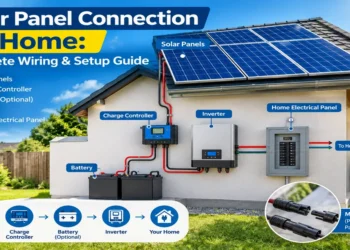
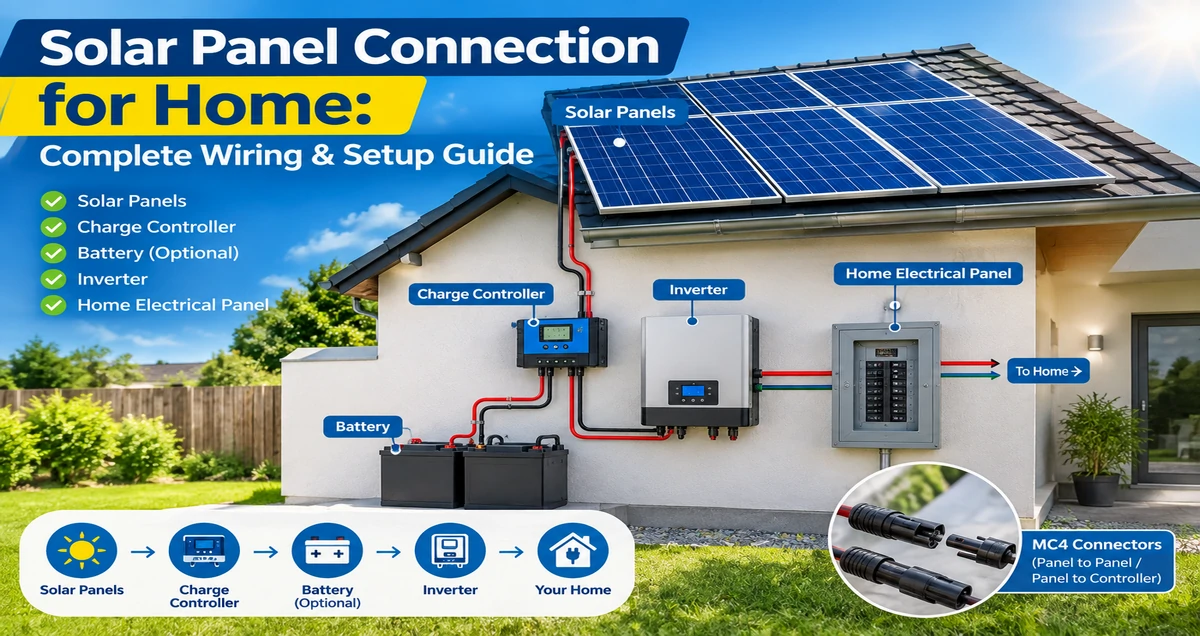
The basic energy path in a residential solar system looks like this:
Solar Panels → DC Wiring → Inverter → AC Wiring → Home Electrical Panel → Household Loads
For a system with battery storage, the configuration may look like:
Solar Panels → Hybrid Inverter ↔ Battery → Home Electrical Panel → Household Loads
In a grid-connected system, the home’s electrical panel can also connect to the utility grid.
Solar panels produce direct current (DC), while most household appliances use alternating current (AC). The inverter performs the important job of converting solar DC electricity into usable AC electricity.
Main Components of a Home Solar Connection
A typical residential solar installation can include:
- Solar panels
- PV cables and connectors
- String or microinverters
- DC disconnects or other required protection
- AC disconnects where required
- Circuit breakers
- Main electrical panel
- Grounding and bonding equipment
- Mounting and cable-management equipment
- Monitoring equipment
- Battery storage, if included
- Utility meter and interconnection equipment for grid-connected systems
The exact equipment depends on the type and size of the solar installation.
Solar Panel Connection Diagram for a Home
A simplified grid-connected arrangement is:
       SUNLIGHT
           ↓
     SOLAR PANELS
           ↓
      DC PV WIRING
           ↓
   DC PROTECTION /
     DISCONNECT
           ↓
        INVERTER
           ↓
       AC WIRING
           ↓
   HOME ELECTRICAL PANEL
        ↙       ↘
 HOUSEHOLD     UTILITY
   LOADS         GRID
This is a simplified conceptual diagram, not an installation drawing. Real systems can contain additional protection, disconnects, meters, monitoring equipment, and other components.
The U.S. Department of Energy describes residential PV systems as connecting inverter output to the home’s electrical service panel, with specific requirements for panel capacity, breakers, labeling, and utility interconnection.
Step 1: Connect the Solar Panels
Solar panels are electrically connected together to form one or more PV strings or arrays.
There are two common approaches:
Series Connection
In a series connection, the voltage of the panels increases while the current remains approximately at the level of one panel under comparable conditions.
For example, conceptually:
Panel 1 (+) → Panel 2 (-) → Panel 3 (-/+) → …
The exact arrangement depends on the module electrical characteristics and inverter’s allowable voltage range.
A string should never be designed simply by counting panels. The designer must consider parameters such as:
- Maximum PV voltage
- Operating voltage
- Short-circuit current
- Operating current
- Temperature effects
- Inverter MPPT voltage range
- Inverter maximum input current
Parallel Connection
In a parallel configuration, multiple strings are connected so that current can increase while voltage remains approximately at the string level.
Parallel configurations can be useful when a system needs additional current capacity, but they require appropriate protection and equipment designed for the resulting current.
Series vs. Parallel Solar Panels
| Feature | Series | Parallel |
|---|---|---|
| Voltage | Increases | Approximately remains at string voltage |
| Current | Approximately remains similar | Increases |
| Typical use | Reaching inverter voltage range | Increasing array current |
| Design concern | Maximum voltage | Maximum current |
| Important factor | Temperature-adjusted voltage | Wiring/protection current |
The correct configuration must always be checked against the solar panel and inverter manufacturer’s specifications.
Step 2: Connect the PV Wiring to the Inverter
The DC output from the solar array travels to the inverter.
Depending on the system design, the inverter may be:
- A string inverter
- A microinverter system
- A hybrid inverter
- An off-grid inverter
- Another approved inverter configuration
A string inverter receives power from a group of panels and converts it to AC. Microinverters are installed at the individual panel level and convert the DC output locally.
Before connecting a PV array to an inverter, the system designer must verify that the array’s voltage and current remain within the inverter’s specified limits.
Step 3: Connect the Inverter to the Home Electrical Panel
After converting DC electricity to AC, the inverter output can be connected to the home’s electrical system.
A simplified path is:
Solar Panels → Inverter → AC Protection → Electrical Panel → Home Loads
In a conventional grid-connected installation, solar power can be supplied to the home’s electrical panel. When solar production is greater than the home’s instantaneous demand, the excess may be exported to the utility grid if the system and utility arrangement allow it.
The electrical panel must be suitable for the planned solar connection. In some homes, particularly older properties, an electrical service or panel upgrade may be necessary.
Step 4: Connect the Solar System to the Utility Grid
A grid-connected solar system is not automatically allowed to operate simply because it is physically connected to a home’s electrical panel.
The utility and local authority may require:
- An interconnection application
- Equipment specifications
- Approved inverter equipment
- Electrical inspection
- Required labeling
- Meter changes or configuration
- Permission to operate
Requirements vary by location and utility.
The U.S. Department of Energy notes that utility interconnection requirements can vary significantly between utilities and local authorities.
If your home is outside the United States, follow the requirements of your local electricity distributor and applicable national electrical standards rather than assuming U.S. rules apply.
Solar Panel Connection With a Battery
A battery can be added to a solar system to store electricity for later use.
A simplified solar-plus-battery configuration is:
             SOLAR PANELS
                   ↓
             HYBRID INVERTER
              ↙          ↘
          BATTERY       AC POWER
                           ↓
                  HOME ELECTRICAL PANEL
                           ↓
                     HOME LOADS
Some systems use DC-coupled storage, while others use AC-coupled storage.
Batteries can allow solar energy generated during the day to be used later, such as at night. Properly designed solar-plus-storage systems can also provide backup power during outages.
Can Solar Panels Power a Home During a Blackout?
Solar panels alone generally cannot provide normal backup power during a grid outage.
Most grid-connected solar systems are designed to disconnect from the utility grid when the grid goes down. This helps protect utility workers and the electrical system.
For backup operation, a system generally needs an appropriately configured inverter and energy storage or another approved backup architecture.
A backup system may be designed for:
- Essential loads only
- Selected circuits
- Whole-home backup
The actual backup capability depends on the inverter, battery capacity, available solar generation, electrical loads, and system design.
Solar Panel Connection for Home Without a Battery
A home does not necessarily need a battery to use solar energy.
A typical grid-connected system without storage can operate like this:
Solar Panels → Inverter → Home Electrical Panel → Appliances
When solar production is insufficient, electricity can be supplied by the utility grid.
When solar production exceeds the home’s instantaneous demand, excess electricity may be exported if permitted under the applicable utility arrangement.
This configuration can be simpler than a solar-plus-battery system, but it normally does not provide standard backup power during a grid outage.
Solar Panel Connection for an Off-Grid Home
An off-grid home requires a different system architecture because there is no utility grid supplying electricity when solar production is insufficient.
A simplified configuration can be:
Solar Panels → Charge/Power Electronics → Battery → Inverter → Home Loads
An off-grid system usually needs enough battery capacity to supply electricity when solar production is low, such as at night or during periods of poor weather.
System sizing should consider:
- Daily energy consumption
- Peak electrical demand
- Solar resource
- Battery capacity
- Inverter capacity
- Seasonal production
- Backup generation requirements
- Future electricity use
What Size Wire Do You Need for Solar Panels?
There is no single wire size that is correct for every residential solar system.
Cable selection depends on factors including:
- Circuit current
- System voltage
- Cable length
- Voltage-drop requirements
- Installation environment
- Temperature
- Conduit conditions
- Cable insulation rating
- Applicable electrical code
- Manufacturer requirements
The wiring must be appropriately rated for the circuit and installation conditions.
Using an undersized cable can cause excessive voltage drop, heating, poor performance, or safety problems.
Do Solar Panels Need a Breaker?
Solar systems commonly require appropriate disconnecting and overcurrent protection based on system design and applicable electrical requirements.
The exact equipment and location depend on the system architecture.
For example, a PV system may include protection or disconnecting equipment between:
PV Array → Inverter
and between:
Inverter → Electrical Panel
DOE technical guidance describes PV disconnects and protection requirements as part of residential PV system design.
Do not choose a breaker simply from the solar panel wattage. The correct protection depends on the circuit design, equipment ratings, conductor ratings, and applicable code.
Solar Panel Connection: String Inverter vs. Microinverters
String Inverter
A string inverter connects multiple panels into one or more strings.
Advantages can include:
- Centralized equipment
- Generally simpler system architecture
- Potentially lower equipment cost
- Easier centralized servicing
However, the performance of a string can be affected when individual modules experience shading or other problems.
Microinverters
Microinverters are installed at individual panels.
Potential advantages include:
- Panel-level conversion
- Individual module monitoring
- Better flexibility when roof sections have different orientations
- Less dependence on one central inverter
DOE notes that microinverters can be useful where some modules may experience shading because the affected module does not necessarily limit the output of the other modules in the same way as a string configuration.
Common Solar Panel Connection Mistakes
Avoid these common problems when designing or installing a home solar system.
1. Connecting too many panels in series
Too many panels can push the PV voltage beyond the inverter’s permitted input range.
2. Ignoring temperature
PV voltage can change with temperature, so the design should account for the expected operating temperature range.
3. Using inappropriate cables
PV wiring must be suitable for the electrical and environmental conditions of the installation.
4. Mixing incompatible connectors
Connectors and components should be compatible and installed according to manufacturer instructions.
5. Ignoring shading
Shade can reduce solar production and may affect string performance.
6. Overlooking the electrical panel
The home’s existing electrical service may not be suitable for the planned solar connection.
7. Assuming solar automatically works during outages
A standard grid-connected solar installation may shut down when the grid fails. Backup requires an appropriately designed system.
8. Skipping permits and utility requirements
Grid-connected systems often require approval and inspection before operation.
How to Plan a Solar Panel Connection for Your Home
Before purchasing equipment, collect the following information:
- Monthly electricity consumption
- Annual electricity consumption
- Available roof area
- Roof orientation
- Roof shading
- Solar panel wattage
- Inverter specifications
- Battery requirements
- Existing electrical-panel rating
- Local electrical requirements
- Utility interconnection requirements
- Future loads such as EV charging or heat pumps
DOE recommends considering roof structure, shading, electrical-panel capacity, and wiring when planning residential solar.
How Many Solar Panels Do You Need?
The number of panels depends on the desired system capacity and panel wattage.
A basic calculation is:
Number of panels = Required solar capacity ÷ Panel wattage
For example, if a hypothetical system requires 8 kW and uses 400-watt panels:
8,000 W ÷ 400 W = 20 panels
This is only a capacity calculation. It does not determine the final system size because actual solar-system sizing must also consider electricity consumption, location, solar resource, shading, roof space, inverter limitations, and other design factors.
Should You Connect Solar Panels in Series or Parallel?
Neither connection method is universally better.
The appropriate configuration depends on:
- Panel electrical specifications
- Inverter MPPT range
- Maximum PV voltage
- Maximum PV current
- Number of MPPT inputs
- Roof orientation
- Shading
- String length
- Local requirements
A qualified designer should calculate the configuration before installation.
How Does Solar Power Reach Your Appliances?
The process is relatively straightforward:
1. Solar panels receive sunlight.
2. The panels produce DC electricity.
3. DC electricity travels through the PV wiring.
4. The inverter converts DC to AC electricity.
5. AC electricity reaches the home’s electrical panel.
6. Household appliances use the available electricity.
7. Depending on the system, excess electricity can charge a battery or be exported to the grid.
The inverter is therefore one of the central components connecting solar generation to a home’s AC electrical system.
Can You Connect Solar Panels Directly to a Home Outlet?
No—not as a general DIY connection method.
A rooftop PV system is designed as an integrated electrical system with appropriately rated equipment, protection, wiring, inverter technology, and connection arrangements.
Do not attempt to connect rooftop solar panels directly to a normal household wall outlet unless the equipment is specifically designed and approved for that application and installed according to applicable requirements.
Improper connections can create electrical hazards and can damage equipment.
Solar Panel Connection Safety
Solar PV systems require careful electrical and physical safety planning.
Important considerations include:
- DC electrical shock hazards
- Arc hazards
- Roof and ladder fall hazards
- Correct grounding and bonding
- Proper cable management
- Weather-resistant equipment enclosures
- Correct disconnecting equipment
- Appropriate overcurrent protection
- Manufacturer installation instructions
- Local electrical codes
DOE guidance emphasizes proper cable management and appropriate protection features for PV systems.
Never work on energized solar wiring unless you are properly trained and equipped to do so.
Frequently Asked Questions
What is the basic solar panel connection for a home?
A common configuration is:
Solar Panels → DC Wiring → Inverter → AC Wiring → Electrical Panel → Home Loads
A grid connection or battery can be added depending on the system design.
Can solar panels connect directly to the electrical panel?
The panels themselves produce DC electricity, while a typical home electrical panel distributes AC electricity. An appropriate inverter and required protection equipment are normally used between the PV array and the home’s AC electrical system.
Can I connect solar panels directly to a battery?
Only when the battery and charging equipment are specifically designed for the PV system. Many installations use a charge controller, hybrid inverter, or other power electronics between the panels and battery.
Can solar panels power my home without the grid?
Yes, with a properly designed off-grid system that includes suitable power electronics and energy storage. A standard grid-tied system is different and normally shuts down when the utility grid fails.
Can solar panels work during a power outage?
Solar panels can produce electricity during an outage, but a standard grid-connected system generally shuts down. A properly configured inverter and storage system can provide backup operation.
How many solar panels do I need for my house?
The answer depends on your electricity consumption, location, solar resource, panel wattage, roof space, shading, and desired solar offset. Panel count should be calculated from the required system capacity rather than home size alone.
Is a battery necessary for home solar?
No. A grid-connected solar system can operate without a battery. However, battery storage can provide additional energy-management and backup capabilities.
Do I need permission to connect solar to the grid?
In many jurisdictions, yes. Grid-connected solar installations may require utility approval, inspection, permits, and an interconnection process. Requirements vary by location.
Final Thoughts
A proper solar panel connection for home is a complete electrical system rather than simply connecting panels to a house.
The typical energy path is:
Solar Panels → DC Protection → Inverter → AC Protection → Electrical Panel → Home Loads
A battery can be added for energy storage and backup, while a grid connection can allow electricity to flow between the home and utility system when permitted.
The most important step is to design the system around the actual solar-panel specifications, inverter limits, household electricity requirements, electrical-panel capacity, local regulations, and utility requirements.
For safety, do not copy a generic wiring diagram as an installation plan. Use the manufacturer’s documentation and have the final electrical design and connections handled or verified by a qualified solar/electrical professional.
Sources
- U.S. Department of Energy — Solar Energy Guide for Homebuilders
- U.S. Department of Energy — Solar Integration: Inverters and Grid Services Basics
- U.S. Department of Energy — Solar and Resilience Basics
- U.S. Department of Energy — Solar Photovoltaic System Design Basics
- U.S. Department of Energy — PV System Installation and Commissioning Guidance