
Tesla Roadster 2026: The Futuristic Electric Supercar With SpaceX-Inspired Technology
The Tesla Roadster 2026 is attracting attention from electric vehicle enthusiasts after Tesla revealed its redesigned next-generation electric sports car in October 2026. With an aggressive new appearance, extraordinary performance claims, and experimental technology inspired by SpaceX, the Roadster aims to push the boundaries of what an electric supercar can do.
The latest reveal has reignited interest in a vehicle that has been anticipated for years. Tesla presented demonstrations involving specialized thrusters and an underbody suction system, while the company indicated that production is targeted for 2028.
But how much do we actually know about the new Tesla Roadster? What are its expected performance figures, how could its unusual technology work, and when might customers receive their cars? Here is a closer look at the latest developments, the advertised features, and the important questions that remain unanswered.
Latest update: October 17, 2026. Tesla has revealed the redesigned Roadster, but production is planned for 2028. Performance figures and capabilities described by the company should not be confused with independently verified production-car results.
1. Tesla Roadster 2026: What Is New?
Tesla’s next-generation Roadster has been one of the most anticipated electric sports cars since the original concept was introduced in 2017. After years of changing expectations and delayed timelines, the company finally presented its redesigned vehicle in October 2026.
The latest demonstration placed the Roadster’s performance and futuristic engineering at the center of attention. Tesla showcased a vehicle equipped with specialized technology intended to improve acceleration, aerodynamic performance, and certain experimental maneuvers.
One of the biggest talking points is the use of SpaceX-inspired thrusters on selected versions. The demonstration also featured an underbody suction system designed to generate substantial aerodynamic grip.
These features make the new Roadster different from a conventional electric sports car. However, it is important to distinguish demonstration capabilities from the specifications, reliability, safety approvals, and availability of the final production vehicle.
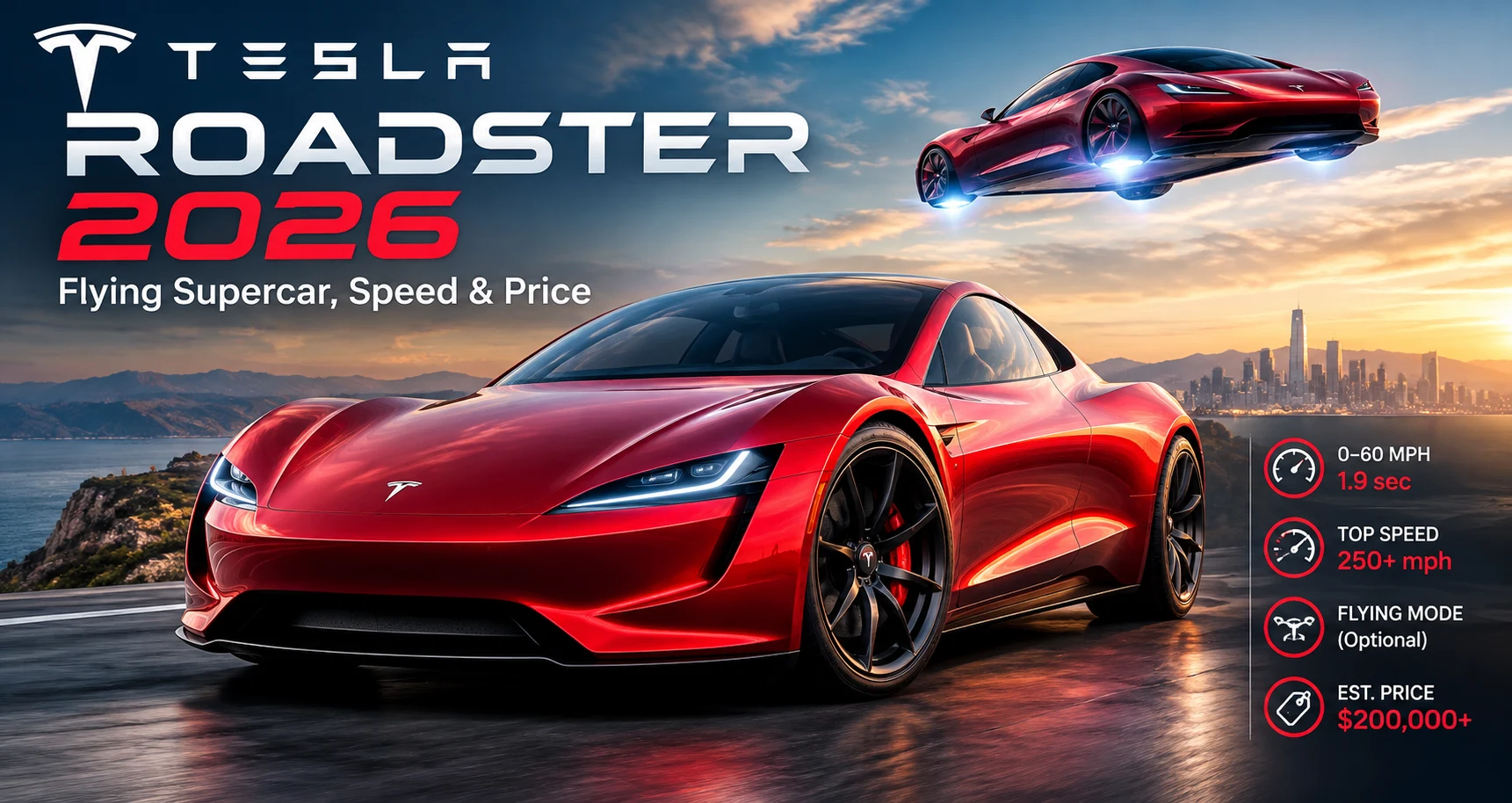
Tesla Roadster: Key Details at a Glance
- Vehicle type: All-electric performance sports car
- Latest reveal: October 15, 2026
- Reported range target: More than 300 miles
- Advertised top speed: More than 230 mph for the showcased configurations
- Acceleration claim: Under one second from 0 to 60 mph for a thruster-equipped version
- Special technology: SpaceX-inspired thrusters on selected versions
- Target production year: 2028
- Final purchase price: Not officially established in the reveal coverage
2. Exterior Design: A More Futuristic Tesla Roadster
The new Tesla Roadster adopts a more futuristic design than the earlier concept. Its low profile, sculpted bodywork, and streamlined shape emphasize speed while reflecting the evolution of Tesla’s wider design language.
The redesigned appearance incorporates influences associated with Tesla’s newer products and its broader interest in advanced engineering. The goal is to create an electric supercar that looks distinctive while supporting high-speed aerodynamic performance.
Aerodynamics and Exterior Details
At high speeds, aerodynamic drag and vehicle stability become increasingly important. Body shaping, airflow management, and active aerodynamic components can help improve performance when they are carefully engineered.
Tesla has also highlighted features intended to increase aerodynamic grip. The effectiveness of these systems will ultimately depend on their production specifications and real-world testing.
Interior and Driving Experience
The new Roadster has been presented as a two-seat performance car in its road-oriented configurations. Its interior concept emphasizes a futuristic driving environment rather than the practicality of a conventional family vehicle.
Final production details, including standard equipment, interior materials, storage space, and the availability of individual features, should be confirmed when Tesla publishes complete customer specifications.
3. Tesla Roadster Performance: How Fast Is It?
Performance is a central part of the Tesla Roadster’s appeal. Tesla has promoted exceptionally rapid acceleration and a top speed above 230 mph for the new vehicle’s advertised configurations. The most extreme acceleration claims concern versions equipped with specialized thruster technology.
These numbers would place the Roadster among the most ambitious performance cars ever announced. However, the specifications should be treated as manufacturer claims until the production vehicle is independently tested under clearly documented conditions.
Acceleration From 0 to 60 MPH
Tesla has promoted sub-one-second acceleration for a thruster-equipped version of the Roadster. Achieving such a result would require extraordinary acceleration forces and careful management of traction, stability, and safety.
Conventional electric performance cars rely on electric motors, tires, battery output, and traction-control systems. At launch, the available grip between the tires and road places important limits on how quickly a vehicle can accelerate.
Tesla’s proposed thruster technology is intended to go beyond some of those conventional limits. Still, a demonstration is not the same as an independently verified acceleration test performed with a customer-ready vehicle.
Top Speed and High-Speed Stability
Tesla has advertised a top speed exceeding 230 mph for the new Roadster configurations. Reaching such speeds safely requires more than powerful motors: tires, brakes, suspension, cooling, and aerodynamic stability all play critical roles.
The final verified top speed may depend on the specific version, equipment, operating conditions, and applicable limitations. Buyers should wait for final production specifications and independent testing before drawing conclusions about real-world performance.
4. SpaceX-Inspired Thrusters: Can the Tesla Roadster Really Fly?
One of the most unusual features associated with the new Tesla Roadster is its proposed use of cold-gas thrusters inspired by aerospace technology from SpaceX.
During the October 2026 demonstration, the thruster-equipped vehicle performed dramatic maneuvers that included lifting off the ground. The technology has generated interest because it goes far beyond the systems normally found in a road car.
How Do Cold-Gas Thrusters Work?
A cold-gas thruster produces thrust by releasing pressurized gas through a nozzle. As gas is expelled in one direction, the system generates force in the opposite direction.
In aerospace applications, thrusters can provide precise attitude or position control. Applying this concept to a performance vehicle introduces major engineering challenges, including pressure-vessel safety, control systems, structural loads, energy management, and safe operation near people.
Does This Make It a Flying Car?
Not in the conventional aviation sense. A demonstration involving a brief lift or controlled airborne maneuver does not automatically make a vehicle an aircraft capable of sustained flight.
The thruster-equipped versions raise important questions about road legality, operational restrictions, and the conditions under which these features could be used. Buyers should not assume that every advertised demonstration feature will be legal or available for everyday public-road driving.
Important Distinction
The Roadster’s experimental thruster demonstrations are not proof that every version can fly freely or operate those systems on public roads. Final capabilities, restrictions, and regulatory approvals must be established separately.
5. Tesla Roadster Battery, Range, and Charging
Battery capacity and driving range are essential considerations for any electric vehicle, including a high-performance supercar. Tesla has advertised more than 300 miles of range for the next-generation Roadster.
The final real-world range will depend on the production battery, driving speed, weather, tire configuration, road conditions, and how frequently the driver uses the car’s maximum performance.
Why Real-World Range Can Differ
Driving at very high speeds generally increases aerodynamic energy consumption. Rapid acceleration, cold temperatures, cabin climate control, and performance-oriented tires can also influence efficiency.
This means a driver traveling at moderate highway speeds may experience a different range from someone frequently accelerating hard or driving on a racetrack.
What About Charging Time?
A complete assessment of the Roadster’s charging performance requires confirmed battery specifications, charging power, charging-curve information, and compatibility details.
Until Tesla publishes comprehensive production specifications, exact charging times and battery capacity should not be treated as confirmed facts.
6. Tesla Roadster Versions: Performance, Thrust, and Rocket
Reporting following the October reveal describes three configurations: Performance, Thrust, and Rocket. They are intended to serve different purposes, ranging from road-oriented driving to more specialized high-performance demonstrations.
| Version | Intended Purpose | Key Distinction |
|---|---|---|
| Performance | Road-oriented performance | Active aerodynamics and an advanced suction system are among the advertised features. |
| Thrust | More extreme performance | Adds rear-mounted cold-gas thrusters according to the reveal coverage. |
| Rocket | Specialized experimental capability | Reported to use multiple thrusters and have restricted availability. |
These distinctions are based on information reported around the reveal. Final equipment, specifications, eligibility, and production availability should be checked against Tesla’s latest official documentation.
The most important question for potential buyers is whether they want a high-performance electric sports car for road use or a more specialized configuration with additional restrictions. The most extreme technology may not necessarily be the most practical choice for everyday driving.
7. How Much Will the Tesla Roadster 2026 Cost?
The final purchase price of the redesigned Tesla Roadster remains an important unanswered question. Reporting following the October 2026 reveal indicated that Tesla had not established a final retail price for the configurations.
Reservations are not the same as a completed vehicle purchase. A reservation payment, where available, may be subject to separate terms, additional payments, and changes before delivery.
What Should Potential Buyers Check?
- Official vehicle price and included equipment.
- Reservation payment and refund conditions.
- Additional charges, taxes, and delivery fees.
- Availability of each configuration in the buyer’s country.
- Warranty terms and service availability.
- Whether specialized performance features are permitted locally.
Because the Roadster is a premium performance vehicle with specialized technology, buyers should avoid relying on unofficial price estimates as though they were confirmed retail prices.
For the latest information, consult the official Tesla Roadster website and review the terms applicable to your location.
8. Tesla Roadster Release Date: When Will Production Begin?
Tesla has indicated that production of the next-generation Roadster is targeted for 2028. That target follows years of delays since the second-generation vehicle was first introduced as a concept in 2017.
A production target is not the same as a guaranteed delivery date. Final engineering validation, manufacturing preparation, safety requirements, supply chains, and regulatory approvals can all influence when a new vehicle reaches customers.
Why Has the Roadster Taken So Long?
Developing an advanced electric supercar requires coordination across battery engineering, electric motors, thermal management, software, chassis development, and manufacturing.
Adding unusual technologies such as cold-gas thrusters and specialized aerodynamic systems creates additional technical and regulatory challenges. Each feature must be validated before it can be offered reliably in a production vehicle.
Prospective buyers should therefore follow official announcements rather than assume that a target production year guarantees delivery at a particular time.
9. How Could the Tesla Roadster Compare With Other Electric Supercars?
The electric performance-car market includes vehicles designed around extreme acceleration, high power output, advanced aerodynamics, and rapid charging. The Roadster’s final position in this market will depend on its verified specifications, purchase price, availability, and real-world performance.
Tesla Roadster vs. Rimac Nevera
The Rimac Nevera is an established example of an electric hypercar built around high-performance electric propulsion. It provides a useful point of comparison for evaluating the Roadster’s eventual acceleration, handling, braking, and engineering.
Tesla’s proposed thruster technology makes the Roadster concept unusual, but comparisons should rely on independently verified performance rather than announcements alone.
Tesla Roadster vs. Conventional Electric Sports Cars
Many electric sports cars prioritize road handling, predictable performance, comfort, and charging convenience. The Roadster’s experimental features may offer a different experience, but they also raise questions about complexity, maintenance, and regulatory compliance.
For buyers, the best choice will depend on how the car is actually used. A track-focused enthusiast may prioritize performance, while another driver may care more about range, reliability, warranty coverage, and everyday usability.
10. Potential Advantages and Challenges of the New Roadster
Potential Advantages
- Ambitious electric performance targets.
- Distinctive and futuristic styling.
- Advanced aerodynamic concepts.
- Unusual aerospace-inspired technology.
- Potential to become a flagship Tesla performance car.
Key Challenges
- Long development history and changing timelines.
- Unconfirmed final retail pricing.
- Production specifications still to be finalized.
- Possible restrictions on experimental features.
- Need for independent real-world performance testing.
The Roadster has the potential to become one of the most talked-about electric performance cars. However, its success will depend on whether Tesla can translate its ambitious demonstrations into a practical, safe, and commercially available production vehicle.
11. Is the Tesla Roadster 2026 Worth Waiting For?
The new Tesla Roadster is an exciting development for electric vehicle enthusiasts. Its combination of extreme performance claims, futuristic styling, and aerospace-inspired technology gives it a distinctive position among announced electric sports cars.
However, excitement should be balanced with realistic expectations. The production target is 2028, final pricing has not been established, and some of the most unusual features require further clarification regarding availability and legal use.
If you are considering a reservation, carefully review the official terms, payment requirements, refund conditions, and expected delivery information. Do not make a financial decision based solely on demonstration videos or preliminary performance claims.
For readers who simply enjoy automotive technology, the Roadster is worth following as an example of how electric vehicle development continues to explore new approaches to speed, aerodynamics, and propulsion.
12. Frequently Asked Questions About the Tesla Roadster 2026
Has the new Tesla Roadster been revealed?
Yes. Tesla presented the redesigned next-generation Roadster on October 15, 2026. However, the reveal does not mean that customer deliveries have started.
When will the Tesla Roadster enter production?
Tesla has indicated a 2028 production target. This is a target, not a guarantee of a specific delivery date.
How fast is the new Tesla Roadster?
Tesla has advertised a top speed exceeding 230 mph for the showcased configurations and sub-one-second 0–60 mph acceleration for a thruster-equipped version. These claims should be distinguished from independently verified production-car test results.
Can the Tesla Roadster fly?
A thruster-equipped version demonstrated brief airborne maneuvers. This does not make it a conventional aircraft capable of sustained flight. The legal use and final capabilities of these systems remain important considerations.
What is the expected range of the Tesla Roadster?
Tesla has advertised a range of more than 300 miles for the next-generation Roadster. Actual range will depend on final specifications, driving conditions, speed, weather, and other factors.
How much will the Tesla Roadster 2026 cost?
A final retail price was not established in the reporting following the October reveal. Buyers should consult Tesla’s official website for current pricing and reservation terms.
Will the Tesla Roadster be available worldwide?
Availability will depend on Tesla’s production plans, local market arrangements, and applicable regulatory requirements. Buyers should confirm availability and vehicle specifications directly with Tesla for their country.
Is the Tesla Roadster fully autonomous?
The Roadster is presented as a performance vehicle. The existence of advanced software or experimental technologies does not mean that it is a fully autonomous vehicle. Drivers must follow the operating instructions and applicable laws.
13. Final Verdict: A Bold New Chapter for Tesla
The Tesla Roadster 2026 has returned to the spotlight with a redesigned appearance, ambitious performance claims, and SpaceX-inspired thruster technology. Its latest demonstration has created new interest in the future of electric supercars.
Yet the most important milestones are still ahead. Production is targeted for 2028, the final retail price remains unsettled, and independent testing will be necessary to establish how the production vehicle performs outside a demonstration setting.
For now, the new Roadster represents an ambitious vision of electric performance. Whether it becomes a practical automotive breakthrough will depend on production readiness, safety, reliability, price, and the experience delivered to actual owners.
One thing is clear: the next-generation Roadster is a vehicle worth watching as Tesla works toward its next chapter in high-performance electric mobility.