
SOLAR POWER GUIDE • 2026
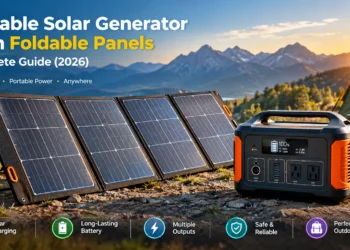
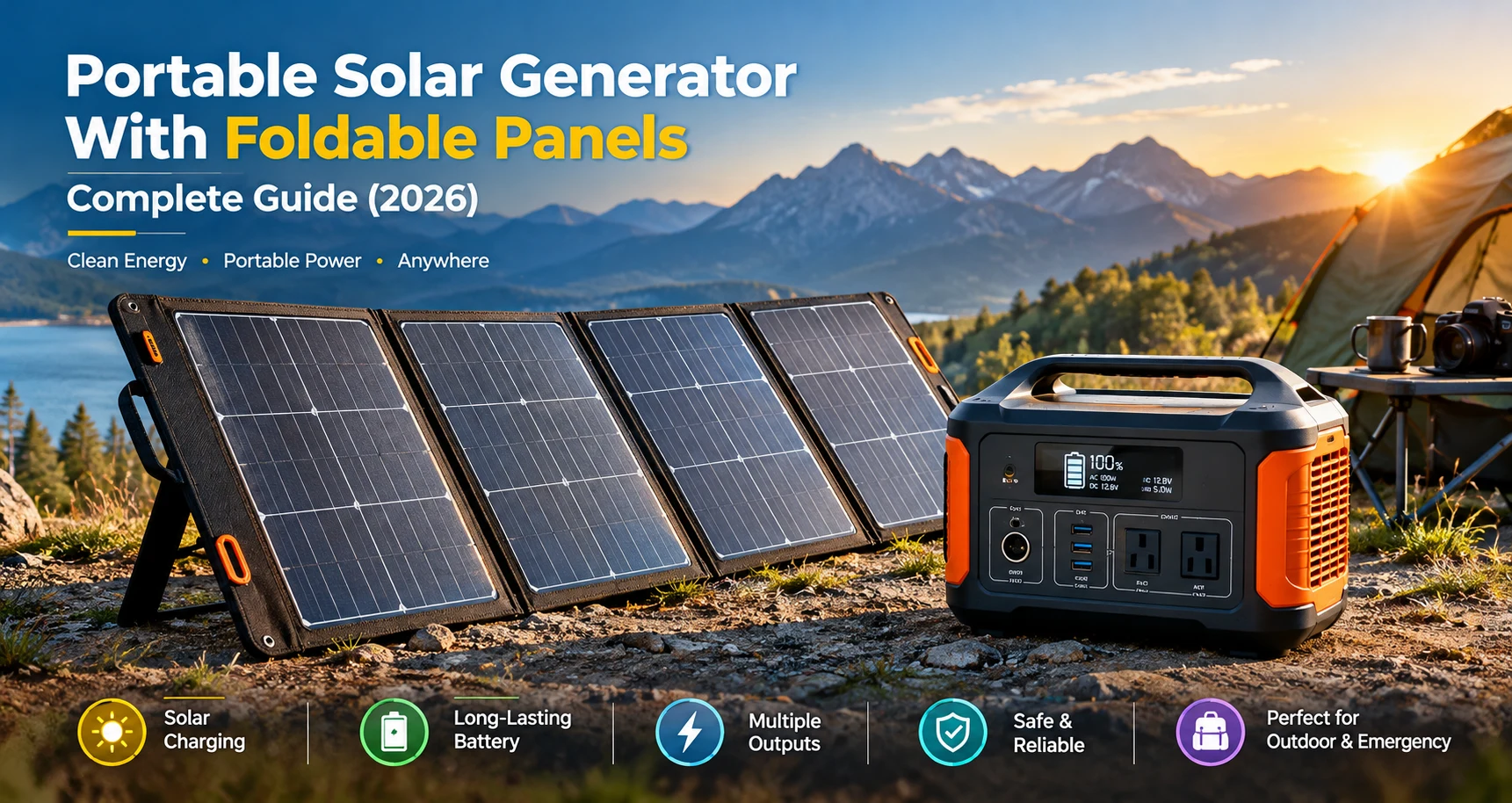
Portable Solar Generator With Foldable Panels: Complete Guide
Discover how portable solar generators work, how to choose the right battery capacity, and how foldable solar panels can provide convenient electricity for camping, RV travel, and emergency backup.
A portable solar generator with foldable panels gives you a convenient way to collect sunlight, store energy in a rechargeable battery, and power compatible devices when a traditional electrical outlet is unavailable.
Whether you enjoy camping, travel in an RV, work outdoors, or want backup electricity during a power outage, the right portable solar power system can help you manage your energy needs.
Related Post
Quick Answer
Choose a portable solar generator based on four essentials: battery capacity (Wh), continuous output power (W), compatible solar input, and portability. Calculate your daily energy use before deciding which power station and foldable panels to buy.
1. What Is a Portable Solar Generator?
A portable solar generator is generally a rechargeable battery power station paired with solar panels. The panels collect sunlight and convert it into electricity, while the power station stores that energy for later use.
Unlike a conventional fuel-powered generator, a battery power station does not burn fuel while supplying electricity. However, the available energy is limited by battery capacity and the amount of energy you can recharge.
☀️
Foldable Panels
Capture sunlight and generate electricity when properly positioned.
🔋
Battery Storage
Stores energy for use when sunlight is unavailable.
⚡
Power Output
Supplies compatible devices through AC or DC outputs.
2. How Does It Work?
A portable solar generator typically works through four stages:
Actual performance depends on sunlight, panel angle, shading, temperature, battery condition, conversion losses, and the power station’s maximum solar-input rating.
3. How to Choose the Right Battery Capacity
Battery capacity is measured in watt-hours (Wh). It indicates how much energy a battery can store, although the usable energy available to your devices may be lower.
| Battery Capacity | Potential Applications |
|---|---|
| 150–300 Wh | Phones, small lights, and selected electronics |
| 300–700 Wh | Laptops, cameras, and modest camping loads |
| 700–1,200 Wh | Multiple devices and selected backup loads |
| 1,200–2,000 Wh | Longer trips and compatible higher-energy appliances |
| 2,000 Wh or more | Larger portable loads and extended backup applications |
These categories are general planning examples, not guarantees of runtime. Check the actual output rating and usable battery capacity of each model.
Important Buying Tip
A large battery does not automatically mean a power station can run a high-power appliance. Check both the stored energy in Wh and the continuous output power in W.
4. How to Calculate Your Energy Needs
Before buying a portable solar generator, estimate how much energy your devices use each day.
Energy Calculation
Energy (Wh) = Power (W) × Time (hours)
For example, a 60 W laptop used for four hours consumes approximately:
60 W × 4 hours = 240 Wh
A 10 W light used for five hours consumes 50 Wh. Together, these devices use approximately 290 Wh before accounting for conversion losses and other system requirements.
Choose a power station with enough usable capacity to cover the calculated demand, plus an appropriate reserve. If the devices are essential or you cannot recharge regularly, consider additional capacity.
5. How Many Foldable Solar Panels Do You Need?
Solar panel sizing depends on your energy needs, local sunlight, expected losses, and the power station’s permitted solar input.
Estimated Daily Solar Energy
Panel Watts × Peak-Sun-Hours × Efficiency Factor
For example, a 200 W panel receiving four peak-sun-hours with an assumed 75% planning efficiency factor would provide an estimated:
200 × 4 × 0.75 = 600 Wh
This is an illustration, not a guaranteed production figure. Real output changes with weather, temperature, shading, panel angle, and equipment limitations.
| Panel Array | Rated Power | Illustrative Daily Energy* |
|---|---|---|
| One 100 W panel | 100 W | 300 Wh |
| One 200 W panel | 200 W | 600 Wh |
| Two 200 W panels | 400 W | 1,200 Wh |
*Illustrative calculations using four peak-sun-hours and a 75% planning efficiency factor. The power station may limit the amount of solar energy it accepts.
Electrical compatibility warning: Before connecting panels, verify the power station’s permitted solar input voltage, current, wattage, and connector requirements. Never exceed the manufacturer’s limits.
6. Foldable Solar Panels vs. Rigid Solar Panels
| Feature | Foldable Panels | Rigid Panels |
|---|---|---|
| Portability | Designed for transport | Less convenient to move |
| Installation | Usually temporary | Usually fixed |
| Typical use | Camping and RV travel | Rooftops and ground mounts |
| Storage | Folds into a packed shape | Requires more storage space |
Foldable panels are convenient for travelers who need portable charging. Rigid panels are often more suitable for permanent installations where portability is not important.
7. What Should You Check Before Buying?
Check the usable energy available for your intended devices.
Confirm the station can run your devices, including appliances with startup surges.
Verify panel voltage, current, connectors, and maximum accepted wattage.
Choose equipment you can realistically carry, store, and deploy.
Review the manufacturer’s warranty, temperature limits, and operating instructions.
8. Best Uses for a Portable Solar Generator
Camping and Outdoor Adventures
Use a suitable power station for phones, lights, cameras, and other compatible low-power devices. Estimate daily consumption before planning a multi-day trip.
RV and Van Travel
Foldable panels provide an additional charging option when the vehicle is parked in a sunny location. Check cable length, storage space, and the station’s solar-input limit.
Emergency Backup
A charged power station may keep selected essential devices operating during an outage. Runtime depends on battery capacity, device consumption, and available opportunities to recharge.
Outdoor Work
Photographers, content creators, and field workers may use portable solar power to recharge electronics when conventional outlets are unavailable.
9. Safety and Maintenance
- Use compatible panels, adapters, and charging cables.
- Never exceed the power station’s specified solar input limits.
- Inspect cables and connectors for visible damage before use.
- Keep equipment within the manufacturer’s operating-temperature limits.
- Protect the power station from moisture unless it is specifically rated for the conditions.
- Keep cooling vents unobstructed.
- Follow the manufacturer’s instructions for battery storage and charging.
- Never open the battery enclosure or attempt an internal repair.
10. Frequently Asked Questions
Final Verdict
A portable solar generator with foldable panels can be a practical source of electricity for camping, RV travel, outdoor work, and selected emergency-backup needs.
The best setup is not necessarily the one with the largest battery or the highest advertised panel wattage. It is the system that matches your actual energy requirements, supplies enough power for your devices, accepts compatible solar panels, and remains practical to transport.
Before You Buy
Calculate your daily energy consumption, check the power station’s continuous output, verify solar-input compatibility, and compare the real-world portability of the complete setup.
Disclaimer: This article is for general educational purposes. Always follow the manufacturer’s operating, charging, compatibility, and safety instructions for your specific equipment.