
Bifacial Solar Modules Explained: How They Work, Benefits, Efficiency & Installation
Discover how bifacial solar panels capture sunlight from both sides, improve solar energy production, and create new possibilities for residential and commercial solar installations.
Solar technology continues to evolve, giving homeowners and businesses more ways to generate clean electricity. One technology attracting increasing attention is bifacial solar modules, which are designed to capture sunlight from both the front and rear surfaces of a solar panel.
Unlike conventional monofacial panels, which primarily generate electricity from sunlight reaching their front surface, bifacial modules can also use reflected and diffuse light reaching the rear. This additional light can increase total electricity production when the panels are installed in suitable conditions.
However, the extra energy is not automatic. Ground reflectivity, panel height, mounting structure, tilt angle, spacing, and rear-side shading all influence how much additional electricity a bifacial system can generate.


In this guide, we explain how bifacial solar modules work, their advantages and disadvantages, installation requirements, performance factors, and whether they are a good investment for your solar project.
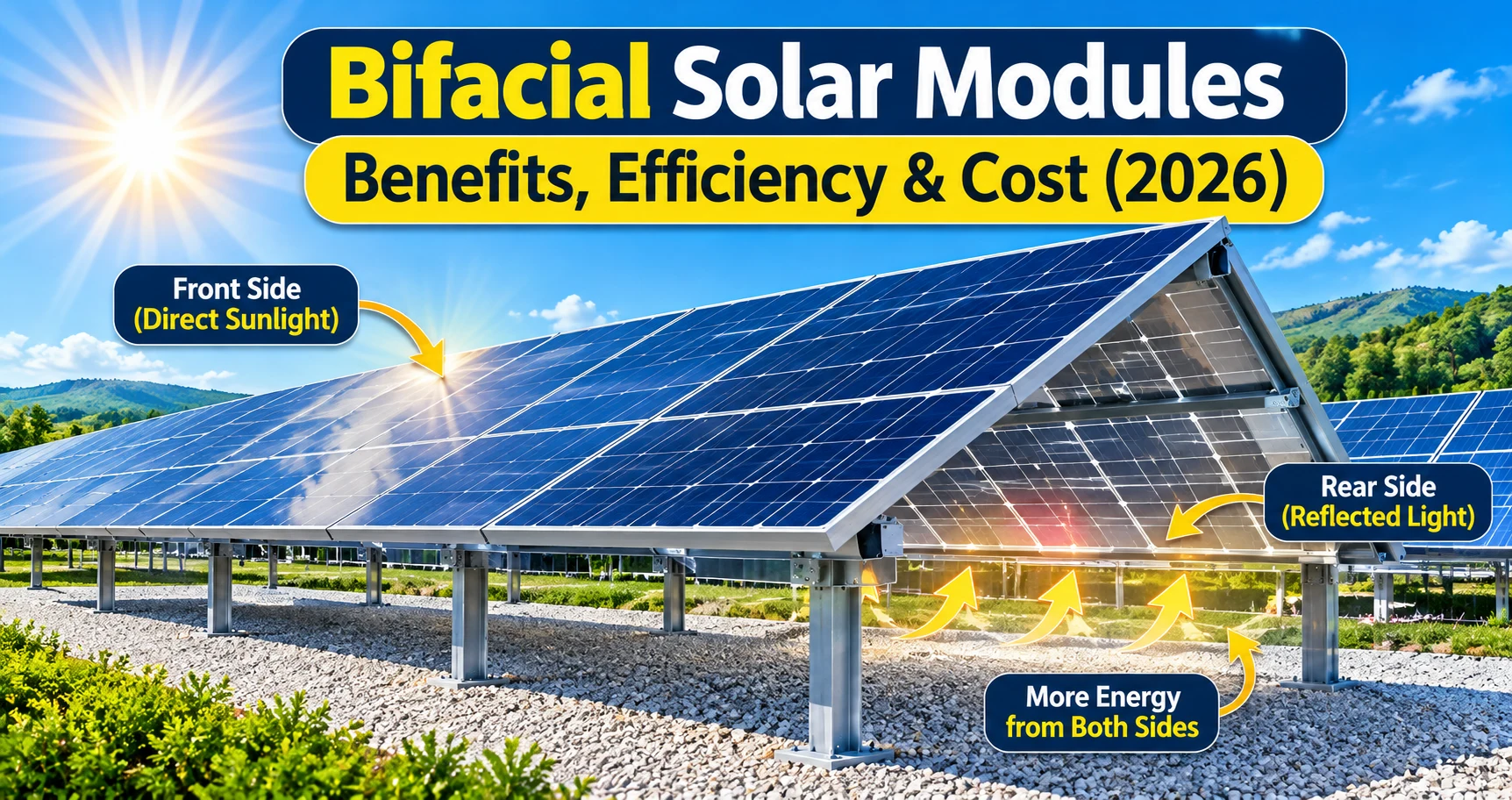
Insert a professional image showing a bifacial solar panel with sunlight reaching both its front and rear surfaces.
1. What Are Bifacial Solar Modules?
Bifacial solar modules are solar panels designed to collect sunlight from both their front and rear surfaces.
The front side receives direct sunlight and diffuse sunlight from the sky, just like a traditional solar panel. The rear side can capture additional light reflected from the ground, nearby surfaces, and surrounding structures.
This design allows the photovoltaic cells to use more available sunlight without necessarily increasing the physical footprint of the panel.
Many bifacial modules use a transparent rear construction, often with glass on both sides. This allows light to reach the rear-facing surfaces of the photovoltaic cells.
How Are Bifacial Panels Different from Traditional Solar Panels?
A conventional monofacial solar module is designed primarily to collect sunlight from its front surface. Its rear construction is generally opaque and does not provide the same rear-side energy-generation capability.
A bifacial module, by comparison, is designed to receive useful light from both directions.
| Feature | Monofacial Module | Bifacial Module |
|---|---|---|
| Front-side generation | Yes | Yes |
| Rear-side generation | Generally no | Yes |
| Rear construction | Usually opaque backsheet | Often transparent glass or another suitable design |
| Installation requirements | Generally flexible | Rear-side light access is important |
| Potential energy output | Front-side production | Front-side plus rear-side contribution |
2. How Do Bifacial Solar Panels Work?
Bifacial solar modules use photovoltaic cells to convert sunlight into electricity. The front side receives solar radiation directly, while the rear side can collect light that reaches it from the surrounding environment.
There are three important sources of light for the rear surface:
1. Reflected Sunlight
Sunlight reaches the ground or another nearby surface and is reflected upward toward the back of the panel.
This is one of the most important sources of additional rear-side energy. Bright surfaces generally reflect more sunlight than dark surfaces.
2. Diffuse Sunlight
Not all sunlight reaches the Earth as a direct beam. Some is scattered by clouds, dust, atmospheric particles, and other conditions.
This scattered light can reach the rear surface of a bifacial module, depending on its orientation and surrounding environment.
3. Reflections from Nearby Structures
In some installations, nearby reflective surfaces can contribute additional light to the rear side.
However, surrounding structures can also create shadows. Proper system layout is important to avoid blocking useful rear-side illumination.
How Bifacial Energy Generation Works
Direct and diffuse sunlight
Convert received sunlight into electricity
Captures reflected and diffuse light
Both sides contribute to total electrical production.
3. What Is Bifacial Gain?
Bifacial gain describes the additional electricity produced by a bifacial solar system compared with a suitable monofacial reference system under equivalent conditions.
It is normally expressed as a percentage.
((Bifacial Energy − Reference Energy) ÷ Reference Energy) × 100
The comparison should use equivalent system conditions and clearly defined assumptions.
Example of Bifacial Gain
Imagine two comparable solar systems installed under equivalent conditions:
- Monofacial reference system: 10,000 kWh per year.
- Bifacial system: 11,000 kWh per year.
- Additional annual production: 1,000 kWh.
The calculation is:
(11,000 − 10,000) ÷ 10,000 × 100 = 10%
In this simplified example, the bifacial system produces 10% more electricity than the reference system.
This is only an illustration, not a guaranteed performance figure. Actual bifacial gain can be much lower or higher depending on the site and installation design.
4. What Factors Affect Bifacial Solar Module Efficiency?
The rear-side performance of bifacial solar panels depends on several environmental and installation factors.
Ground Reflectivity (Albedo)
Albedo describes how much sunlight a surface reflects. It is one of the most important factors affecting bifacial performance.
For example:
- Dark asphalt generally reflects relatively little sunlight.
- Grass and ordinary soil provide moderate reflection.
- Light-colored concrete can reflect more sunlight.
- Bright sand and some white surfaces can provide stronger reflection.
- Fresh snow can have very high reflectivity.
A more reflective surface can increase the amount of light reaching the rear of the panels. However, the result also depends on the panel geometry and local conditions.
Panel Mounting Height
Mounting height affects how much of the surrounding ground and sky the rear surface can see.
Panels installed too close to the ground may have limited rear-side exposure. Increasing clearance can improve access to reflected light and may improve the uniformity of rear illumination.
However, higher mounting structures can increase material requirements, wind loading, and installation costs.
Panel Tilt Angle
The tilt angle affects sunlight reaching the front and rear surfaces.
The ideal angle depends on location, orientation, surrounding surfaces, and the project’s energy-production goals.
Row Spacing
When solar panels are installed in multiple rows, the distance between rows affects shading and the amount of light reaching the rear surfaces.
Insufficient spacing can reduce rear-side illumination. A professional layout should balance land use, front-side production, rear-side production, and structural requirements.
Mounting Structure
Metal rails, supports, cables, and other components can cast shadows on the back of bifacial modules.
Structures designed to reduce unnecessary rear-side obstruction can help improve the performance of the complete system.
Weather and Environmental Conditions
Cloud cover, dust, vegetation, snow, and seasonal changes can affect the amount of light reaching both sides of the panel.
For this reason, annual performance should be evaluated using local weather and site information rather than a single sunny-day measurement.
5. Best Installation Locations for Bifacial Solar Panels
Bifacial modules are especially interesting for installations where the rear surface can receive useful reflected light.
Ground-Mounted Solar Systems
Ground-mounted systems can provide better access to the rear side because the modules are elevated above the ground.
Installers can also select suitable row spacing and, where practical, manage the ground surface to improve light reflection.
Commercial and Industrial Solar Projects
Large solar installations may benefit from bifacial modules when the site layout and ground conditions support rear-side energy generation.
These projects can use detailed modeling to evaluate the relationship between land requirements, mounting costs, and additional electricity production.
Solar Carports and Parking Structures
Bifacial modules can be considered for some elevated solar carports and parking structures.
Their performance depends on the underside environment, structural design, and the amount of light reaching the rear surface.
Elevated Rooftop Installations
Bifacial modules may also be useful on elevated rooftop structures when sufficient light can reach the back of the panel.
However, panels mounted directly above a dark roof with little rear clearance may receive limited additional light.
Agrivoltaic Installations
Agrivoltaic systems combine solar electricity generation with agricultural activities.
Depending on the design, bifacial modules can be installed above crops or agricultural land to use available sunlight from both sides while allowing the land to serve more than one purpose.
6. Advantages of Bifacial Solar Modules
1. Additional Electricity Production
The rear side can generate additional electricity from reflected and diffuse sunlight, potentially increasing annual system output.
2. Better Use of Available Space
Bifacial technology can increase energy generation from an installation footprint when the rear surface receives useful sunlight.
3. Flexible Installation Possibilities
Bifacial modules can be used in suitable ground-mounted, elevated, commercial, and agricultural solar projects.
4. Potentially Better Project Economics
Where additional energy production outweighs the extra installation costs, bifacial modules may improve the financial performance of a solar project.
5. Useful in Reflective Environments
Sites with bright ground surfaces or other suitable reflective surroundings may offer better conditions for rear-side energy generation.
7. Disadvantages of Bifacial Solar Modules
Despite their advantages, bifacial solar modules are not automatically the best option for every solar installation.
Higher Installation Complexity
To benefit from rear-side generation, installers must consider panel elevation, ground reflectivity, row spacing, and structural shading.
Potentially Higher Mounting Costs
Some bifacial installations require elevated mounting structures or additional spacing. These choices can increase material and labor costs.
Limited Benefits on Certain Rooftops
When the rear surface is very close to a dark roof or blocked by structural elements, additional energy production may be small.
More Detailed System Design
Accurate energy estimates require consideration of rear-side irradiance, shading, electrical mismatch, and site geometry.
Not Every Module Has the Same Bifacial Performance
Different models have different bifaciality factors and construction characteristics. Buyers should compare technical datasheets rather than relying only on marketing descriptions.
8. Bifaciality Factor Explained
The bifaciality factor describes the ratio of a module’s rear-side electrical response to its front-side response under specified test conditions.
It is an important specification when comparing bifacial solar modules.
For example, a module with a bifaciality factor of 0.80 has a rear-side response equal to approximately 80% of its front-side response under the relevant measurement conditions.
This does not mean the module automatically produces 80% more electricity. The rear surface generally receives less irradiance than the front, and the actual additional energy depends on the installation.
Always check the manufacturer’s datasheet for:
- Rated front-side power.
- Bifaciality factor.
- Module efficiency.
- Power tolerance.
- Temperature coefficients.
- Mechanical load ratings.
- Product and performance warranties.
- Applicable certification information.
9. Bifacial vs. Monofacial Solar Panels: Which Is Better?
The best choice depends on the project rather than the technology alone.
| Comparison | Monofacial | Bifacial |
|---|---|---|
| Light collection | Primarily front | Front and rear |
| Rear-side contribution | Generally unavailable | Possible |
| Installation flexibility | Broad | Depends more on rear-side exposure |
| Ground-mounted applications | Suitable | Often attractive |
| Flush-mounted dark rooftop | Often practical | Rear-side benefit may be limited |
| Project evaluation | Standard PV modeling | Front and rear irradiance modeling |
General recommendation: Bifacial modules are worth evaluating for ground-mounted and elevated solar projects with good rear-side exposure. Monofacial modules may remain a sensible choice for installations where the rear surface receives little useful light.
10. Are Bifacial Solar Panels Worth the Extra Cost?
Whether bifacial solar modules are worth buying depends on their total installed cost and the additional electricity they are expected to generate.
A useful financial comparison should consider:
- Purchase price of the modules.
- Mounting structure and installation costs.
- Expected annual electricity production.
- Rear-side energy contribution.
- Inverter and electrical-system requirements.
- Maintenance and cleaning costs.
- Electricity prices and export compensation.
- Expected operating lifetime and warranties.
Simple Financial Example
Suppose a solar installation generates 10,000 kWh annually and electricity is valued at $0.15 per kWh.
The annual energy value is:
10,000 × $0.15 = $1,500
If a comparable bifacial installation generates 10% more electricity, its annual production becomes 11,000 kWh.
The additional annual energy value would be:
1,000 × $0.15 = $150
This simplified example does not include additional equipment costs, maintenance, financing, taxes, degradation, or changes in electricity prices. It shows why the installation’s actual energy gain matters when evaluating the investment.
11. Are Bifacial Solar Modules Suitable for Home Solar Systems?
Yes, bifacial modules can be used in residential solar projects, but the installation design is particularly important.
They may be worth considering for:
- Elevated ground-mounted home solar systems.
- Residential solar carports.
- Raised structures above reflective surfaces.
- Suitable pergola installations.
- Properties with enough space for well-designed panel rows.
However, a conventional rooftop installation with panels mounted close to a dark roof may not provide enough rear-side illumination to justify paying significantly more.
Homeowners should request an energy estimate comparing bifacial and monofacial options using the same location, system size, orientation, and other relevant assumptions.
12. How to Choose the Right Bifacial Solar Module
Before purchasing bifacial solar panels, compare the specifications and installation requirements carefully.
Check the Rated Power
Look at the module’s front-side rated power under standard test conditions. Do not confuse the rated front-side output with a possible bifacial energy gain.
Compare Bifaciality Factors
A higher bifaciality factor can be useful when the rear side receives sufficient light, but it should not be the only purchasing criterion.
Review the Module Construction
Check whether the module uses a glass-glass or another bifacial-compatible construction, and review its mechanical and environmental ratings.
Check Product Warranties
Review the product warranty, performance warranty, degradation terms, and the manufacturer’s support arrangements.
Evaluate the Mounting System
The mounting structure should allow appropriate rear-side exposure while meeting structural, wind-load, and local installation requirements.
Request a Site-Specific Energy Estimate
A reliable proposal should consider local solar resources, ground reflectivity, panel layout, rear-side shading, and expected system losses.
13. Bifacial Solar Modules for Off-Grid Systems
Bifacial solar modules can also be considered for off-grid solar systems that use batteries for energy storage.
In an off-grid installation, additional electricity generation may help recharge the battery bank and support household loads, especially when the rear side receives useful sunlight.
However, the complete system must be designed correctly.
Important components include:
- Bifacial solar modules.
- Compatible solar charge controller or hybrid inverter.
- Battery bank sized for the energy requirements.
- Appropriate DC and AC protection.
- Correctly rated cables and connectors.
- Monitoring equipment.
- Suitable mounting structures.
Remember that additional solar production does not automatically mean that a smaller battery is sufficient. Battery capacity should be based on energy consumption, autonomy requirements, charging conditions, and system design.
For off-grid projects, a professional designer should also check the higher potential current levels associated with bifacial generation when sizing electrical components.
14. Common Mistakes When Installing Bifacial Solar Panels
Blocking the Rear Surface
Installing modules too close to solid surfaces or using structures that heavily obstruct the rear can reduce the potential benefit.
Ignoring Ground Reflectivity
Ground material influences reflected sunlight. A design that assumes a highly reflective surface without verifying the actual site can overestimate production.
Using Unrealistic Energy-Gain Estimates
Do not assume that every bifacial panel will produce a fixed percentage more electricity. Rear-side gain must be evaluated for each project.
Ignoring Rear-Side Shading
Mounting rails, cables, nearby objects, and adjacent rows can reduce rear-side illumination.
Choosing Modules Only by Wattage
Rated power is important, but durability, warranties, mechanical ratings, bifaciality, and manufacturer reliability also matter.
Skipping Professional System Design
Bifacial systems require careful consideration of both sides of the module. Incorrect electrical and mechanical design can reduce performance and compromise safety.
15. The Future of Bifacial Solar Technology
Bifacial solar technology is an important part of the development of modern photovoltaic systems.
As solar manufacturers continue improving cell designs, module construction, and system integration, bifacial panels offer opportunities to increase energy production from available installation space.
They are particularly relevant to large ground-mounted projects, solar carports, elevated installations, and agrivoltaic systems.
Future improvements in mounting structures, solar tracking, system modeling, and rear-side performance measurement may help developers use bifacial technology more effectively.
Nevertheless, the most important factor will remain the quality of the complete installation. A well-designed monofacial system can be a better investment than a poorly designed bifacial one.
Final Thoughts: Are Bifacial Solar Modules the Right Choice?
Bifacial solar modules offer an interesting advantage over conventional solar panels by generating electricity from both their front and rear surfaces. When installed in an environment with good rear-side light exposure, they can increase total energy production.
However, their performance depends on more than the panel itself. Ground reflectivity, mounting height, row spacing, tilt angle, and shading all influence the final result.
Before investing in bifacial technology, compare the complete installation cost and expected annual electricity production with a similar monofacial system. A site-specific energy assessment is the best way to determine whether the additional investment makes sense.
Frequently Asked Questions About Bifacial Solar Modules
1. What are bifacial solar modules?
Bifacial solar modules are photovoltaic panels designed to generate electricity from both their front and rear surfaces by collecting direct, diffuse, and reflected sunlight.
2. How much more electricity can bifacial solar panels produce?
The additional energy varies with ground reflectivity, mounting height, tilt, row spacing, shading, and module characteristics. There is no universal percentage that applies to every installation.
3. Do bifacial panels work on cloudy days?
Yes. They can use diffuse sunlight as well as direct sunlight. The amount of electricity generated depends on the available irradiance and system conditions.
4. Are bifacial solar panels better than monofacial panels?
They can be better in installations where the rear surface receives useful light. For installations with little rear-side exposure, monofacial panels may offer better value.
5. What is the best ground surface for bifacial solar panels?
Bright, reflective surfaces generally provide more reflected sunlight than dark surfaces. The best option depends on the site’s albedo, drainage, maintenance, cost, and installation design.
6. Can bifacial solar panels be installed on rooftops?
Yes. However, they need suitable rear-side exposure to provide meaningful additional generation. Panels installed close to dark roofing may have limited bifacial benefits.
7. What does a bifaciality factor of 80% mean?
It means the module’s rear-side electrical response is approximately 80% of its front-side response under the specified test conditions. It does not mean the complete system automatically produces 80% more electricity.
8. Are bifacial solar panels suitable for off-grid systems?
Yes. They can be used in off-grid systems with compatible inverters, charge controllers, batteries, and electrical protection. The system must be designed for the expected output and energy demand.
9. Do bifacial panels need special maintenance?
They require normal solar-system inspection and cleaning according to the manufacturer’s guidance. Keeping the rear surface free from excessive dirt and obstruction can also help preserve its contribution.
10. Are bifacial solar modules worth buying in 2026?
They can be a worthwhile investment when the installation provides good rear-side exposure and the additional energy value justifies the extra project cost. A site-specific comparison is recommended.
Disclaimer: This article is for educational purposes only. Actual solar performance depends on module specifications, location, installation design, weather, shading, and system components. Consult a qualified solar professional before designing or installing a photovoltaic system.
Add Category