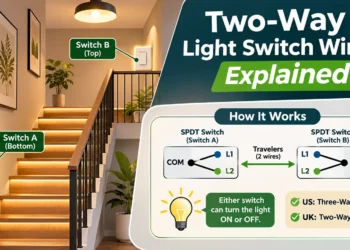

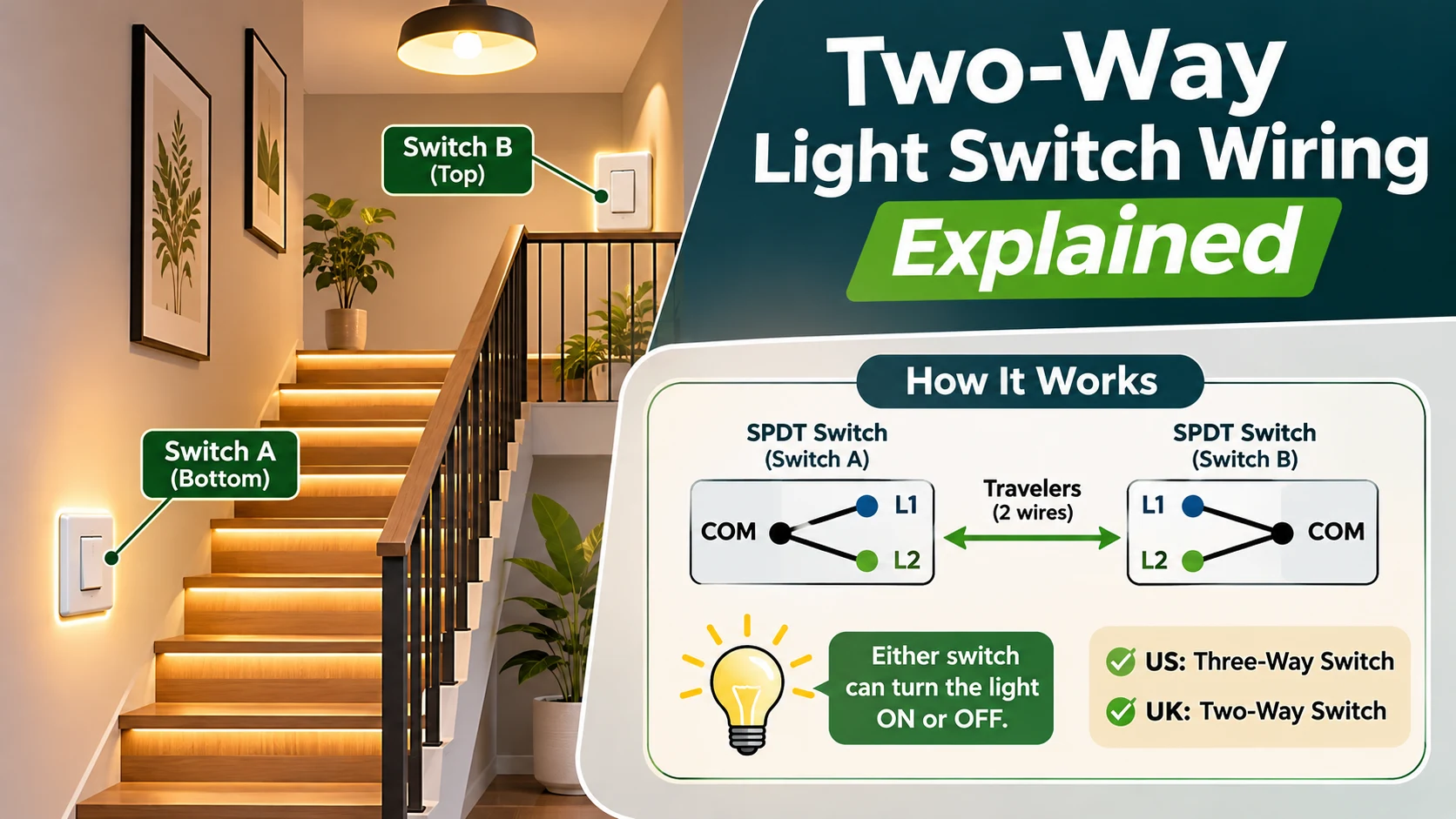
two way light switch wiring allows one light to be controlled from two locations, such as the top and bottom of a staircase. The traditional circuit uses two changeover switches and two traveler connections. Either switch can change whether the light is on or off.
In the United States, electricians usually call this a three-way switch circuit. In the UK and many other countries, it is called two-way switching. This guide explains how the system works, the difference between its terminals, and common problems to recognize before contacting an electrician.
Two-Way Staircase Switching: Quick Facts
- Purpose: Control one light from two different places.
- Traditional switch type: Two compatible changeover switches, also called SPDT switches.
- US name: Three-way light switching.
- UK name: Two-way light switching.
- Common terminal: The moving contact connects to one of two traveler terminals.
- Travelers: Two conductors provide alternative paths between the switches.
- Safety: Household AC wiring must follow local codes and manufacturer instructions.
Important: This guide explains the circuit’s operating principles. It is not a substitute for an approved, site-specific installation diagram.
FEATURED IMAGE: Insert a verified 1920 × 1080 educational illustration of a staircase with two wall switches and one ceiling light. A simplified conceptual inset can show two SPDT switches, but it should not present an unverified 220V installation pinout.


What Is a Two-Way Light Switch?
A two-way light switch is a changeover switch that can connect its common terminal to either of two other terminals. When two compatible switches are arranged in a traditional multi-location lighting circuit, changing either switch changes the available electrical path to the light.
This makes the arrangement useful wherever two entrances or positions need to control the same fixture.
- Staircases with switches at the top and bottom.
- Long hallways with switches at opposite ends.
- Bedrooms with switches near the door and bedside.
- Garages or workshops with two entrances.
- Utility rooms and other spaces with multiple access points.
The switch positions do not permanently represent ON and OFF. The light’s condition depends on the combined position of both switches.
Two-Way vs. Three-Way Light Switch: What’s the Difference?
The terminology can be confusing when comparing an American electrical guide with a UK diagram or an international Pinterest image.
| Feature | United States | UK Terminology |
|---|---|---|
| One light, one location | Single-pole switch | One-way switch |
| One light, two locations | Three-way switches | Two-way switches |
| One light, three locations | Three-way switches plus a four-way switch | Two-way switches plus an intermediate switch |
| Moving terminal | Common | Common / COM |
| Alternative paths | Travelers | Strappers |
In the United States, the word three-way does not mean that three separate switches are installed. A three-way switch is a particular type of changeover device used for controlling a light from more than one location.
Electrical supply voltage, conductor identification, product ratings, and installation requirements also vary by country. Never assume that an international wiring picture can be copied directly into a US installation.
How a Two-Way Staircase Light Circuit Works
The traditional system works by allowing each of two mechanical switches to select between two possible paths. The selected paths determine whether the circuit feeding the light is complete.
Conceptual Circuit Overview
SWITCH A (SPDT)
Selects Traveler 1 or Traveler 2
↓
TWO ALTERNATIVE TRAVELER PATHS
↓
SWITCH B (SPDT)
Selects Traveler 1 or Traveler 2
↓
LIGHT CHANGES STATE
Concept only. This is not a terminal-to-terminal wiring schematic and does not show all required supply, neutral, or grounding connections.
For a basic traditional circuit, the light is energized when the selected paths create a complete circuit. Moving either switch changes the selected path and reverses the light’s state.
Example Switching States
| Switch A Selects | Switch B Selects | Light |
|---|---|---|
| Traveler 1 | Traveler 1 | ON |
| Traveler 1 | Traveler 2 | OFF |
| Traveler 2 | Traveler 1 | OFF |
| Traveler 2 | Traveler 2 | ON |
The important result is that operating either switch changes the light’s current state. The physical position of a switch handle is not a reliable indicator of whether the light should be on.
Understanding COM, L1, L2, and Traveler Terminals
Electrical diagrams often use terminal labels rather than showing internal switching contacts. The exact labels depend on the switch manufacturer and country.
Common (COM)
The common terminal is the moving contact of a traditional changeover switch. Internally, it connects to one of two alternative terminals depending on the switch position.
On many US mechanical three-way switches, the common terminal is identified by a darker screw. However, its exact location varies by product.
L1 and L2
On some two-way switches, L1 and L2 identify the two alternative switched contacts. The common contact connects internally to one or the other.
Not every switch uses these exact labels. Always check the diagram printed on the specific product or supplied with its installation instructions.
Traveler Wires
Travelers provide alternative paths between traditional mechanical multi-location switches. In the UK, they are often called strappers.
The visible wire color alone does not prove that a conductor is a traveler. Cable arrangements and conductor identification differ between older and newer installations.
Neutral and Protective Ground
Neutral and protective grounding conductors serve different functions from the switch travelers.
Neutral is part of the normal electrical return path in many AC lighting circuits. Protective grounding is used for electrical safety and fault protection. Neither should be treated as an interchangeable traveler conductor.
Some modern smart switches also require a neutral connection in the wall box. A traditional mechanical switch does not necessarily have the same terminal requirements.
Safety warning: Do not identify live, neutral, or traveler conductors by color alone. Incorrect identification can create shock or fire hazards. Circuit modifications and conductor identification in household wiring should be handled by a qualified electrician.
How to Understand a Two-Way Light Switch Wiring Diagram
A useful wiring diagram should clearly identify the switching devices, circuit supply, light fixture, neutral, protective ground, and relevant terminals.
When reviewing a manufacturer’s diagram, look for the following information:
- Switch model: Confirm that both devices support the intended multi-location function.
- Terminal identification: Find the manufacturer’s markings for common and traveler contacts.
- Supply arrangement: Determine how the documented circuit identifies line and load.
- Neutral: Check how the fixture and any electronic controls are supplied.
- Protective grounding: Confirm that the design includes the required protective connections.
- Electrical ratings: Check voltage, current, lamp type, and compatibility.
- Applicable standards: Use electrical instructions approved for the installation’s country and equipment.
Manufacturer diagrams can differ because the supply and load may enter different boxes, or the product may use electronic controls rather than a simple mechanical switching arrangement.
For a verified US example, consult the Lutron explanation of common and traveler connections.
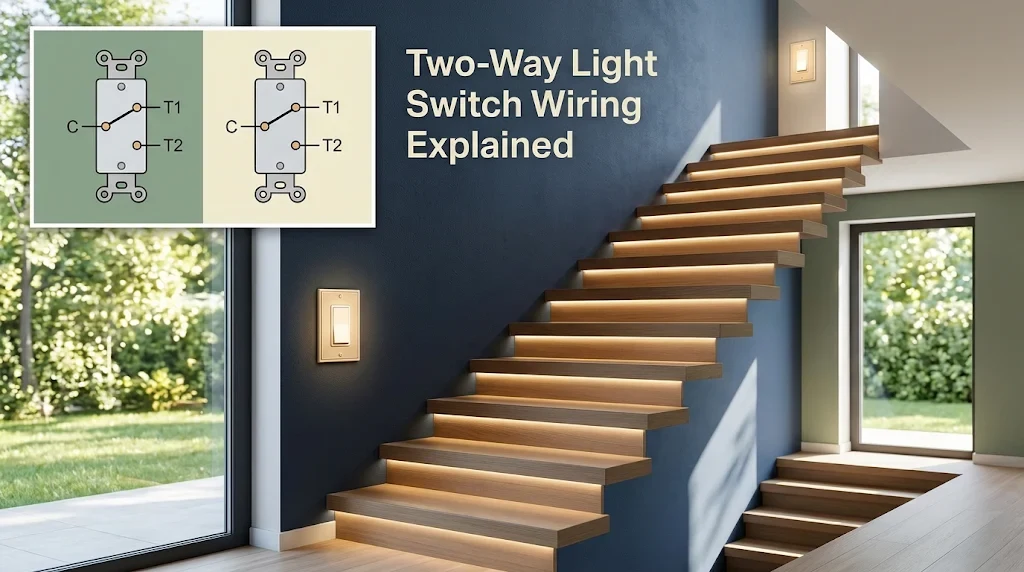
IMAGE 2: Insert a 1200 × 1500 educational infographic explaining the internal selection between COM, Traveler 1, and Traveler 2 on two SPDT switches. Keep it conceptual and do not show unverified household terminal wiring.
Is the Pinterest Staircase Wiring Picture Correct?
The reference picture shows a staircase, two switches, a bulb, and a 220V AC input. It illustrates the general idea of controlling a light from two locations.
However, the picture does not provide enough verified terminal and installation detail to serve as a safe wiring instruction.
- The switches are not identified by specific manufacturer models.
- The common and traveler contacts are not labeled clearly enough for installation.
- The drawing does not establish all required protective grounding and conductor identification details.
- The red and black paths cannot be assumed to represent approved conductor colors everywhere.
- The 220V AC label does not establish the applicable electrical code or installation method.
For those reasons, the Pinterest image should be treated as an introductory concept, not an installation-ready circuit drawing.
Common Staircase Lighting Problems
When a staircase light stops working correctly, the problem may involve a lamp, switch, connection, breaker, or electronic control. Several faults can create similar symptoms.
| Symptom | Possible Cause | Safe Next Step |
|---|---|---|
| Light never turns on | Failed lamp, interrupted supply, or control fault | Check accessible lamp and breaker status safely |
| Only one location works | Switch, traveler, or compatibility issue | Arrange electrician inspection |
| Light flickers | Loose connection, incompatible dimmer, or lamp issue | Stop using if fault persists |
| Switch feels hot | Possible overheating or connection fault | Stop using and contact an electrician |
| Breaker trips | Overload, short circuit, or fault | Do not repeatedly reset; arrange diagnosis |
| Smart switch behaves incorrectly | Wiring or device compatibility problem | Check model documentation and seek professional help |
Safe Troubleshooting Before Calling an Electrician
Some initial checks can be made without opening a switch box or touching wiring. These can help you describe the problem more clearly to a professional.
- Observe the symptom. Does the light fail completely, flicker, or respond to only one switch?
- Check the light source. If the fixture has a safely replaceable lamp, follow the manufacturer’s replacement instructions.
- Look for warning signs. Heat, burning smells, buzzing, cracks, and scorch marks require stopping use immediately.
- Review the breaker status. Do not repeatedly reset a breaker that trips or bypass any protective device.
- Record the device models. Note the light, switch, or dimmer model if it can be identified without opening electrical equipment.
- Contact a qualified electrician. Have the circuit tested and corrected using the appropriate electrical safety procedures.
If there is smoke, sparking, or an immediate fire risk, move away from the affected equipment and seek emergency assistance according to local procedures.
Never assume a switch box is safe because the light is off. Electrical conductors may remain energized. Before any permitted electrical work, a qualified person must isolate the correct supply, prevent accidental re-energization, and verify absence of voltage with appropriate test equipment.
Can You Use a Two-Way Switch With LED Lighting?
Many standard LED lamps can be controlled by compatible mechanical multi-location switches. However, the correct setup depends on the fixture, lamp, driver, and switching equipment.
LED lamps may flicker or behave incorrectly when used with an incompatible dimmer or electronic switch. Some smart switches also have minimum-load or neutral-connection requirements.
Check the LED lamp and switch manufacturer’s compatibility lists rather than assuming all devices work together.
Traditional Two-Way Switches vs. Smart Lighting Controls
Traditional mechanical switches and modern smart lighting controls can both provide multi-location operation, but they may use very different internal designs.
| Feature | Mechanical | Smart Control |
|---|---|---|
| Operating method | Changes physical contact path | Electronic control or communication |
| Typical controls | Two compatible changeover switches | Compatible master and accessories |
| Neutral requirement | Depends on circuit arrangement | Model-specific |
| Remote features | Normally none | May support apps or schedules |
| Installation guidance | Device-specific | Strictly product-specific |
Some electronic controls use a dedicated communication conductor or compatible accessory switch. These systems must not be assumed to follow the same traveler arrangement as a conventional mechanical circuit.
Lutron’s multi-location smart-switch guidance illustrates why the actual device model matters.
Two-Way Staircase Lighting in Off-Grid and Solar Homes
A house powered by a battery inverter may use conventional AC lighting switches, provided the inverter output, electrical distribution, protective devices, and switch ratings are compatible with the installation.
The wall switches do not directly control solar panel charging. They control a designated lighting circuit supplied by the home’s electrical system.
For example, a staircase with a 10W LED lamp operating for four hours uses approximately 40Wh of electrical energy at the lamp. The total energy drawn from the battery may be greater because of inverter losses and standby consumption.
Lighting energy savings come primarily from efficient lamps, reduced unnecessary operating time, and appropriate controls, not from the number of switch locations.
In an off-grid installation, inverter output characteristics, neutral-to-ground bonding, grounding systems, and protective devices require model-specific electrical design. These cannot be determined from a staircase light-switch picture.
Common Mistakes to Avoid
- Confusing US and UK terminology: A US three-way switch is commonly used for the same two-location purpose as a UK two-way switch.
- Assuming wire colors identify functions: Electrical conductor colors and historical installations differ.
- Using the wrong switch type: A basic single-pole switch does not serve the same purpose as a traditional three-way changeover switch.
- Misidentifying common and travelers: This is a frequent source of malfunction and requires proper testing and documentation.
- Ignoring protective grounding: Required safety connections must be maintained.
- Copying a Pinterest schematic: An unverified picture cannot establish a safe installation.
- Mixing smart-control systems: Electronic devices often have their own specific requirements.
- Working on energized wiring: Exposed household AC conductors can cause severe injury or death.
Frequently Asked Questions
Can two switches control one light?
Yes. A compatible multi-location lighting circuit can use two mechanical changeover switches or an approved electronic control system to operate one light from two locations.
What is the difference between a two-way switch and a three-way switch?
In common UK terminology, a two-way switch is a changeover switch. In the US, a similar mechanical device is called a three-way switch. The terminology differs, but both can be used for two-location control.
What does COM mean on a light switch?
COM means common. On a traditional changeover switch, the common contact connects internally to one of two alternative contacts depending on the switch position.
What are L1 and L2?
On many mechanical two-way switches, L1 and L2 label the alternative switched contacts. The exact terminal markings may differ, so use the instructions for the actual device.
Why does only one staircase switch work?
Possible causes include a failed switch, a wiring fault, an incorrectly identified terminal, or incompatible electronic equipment. Have the circuit diagnosed by a qualified electrician rather than guessing which wires to move.
Can I control one light from three places?
Yes. Conventional US installations commonly use two three-way switches with a four-way switch between them. Other countries may call the additional device an intermediate switch. Smart lighting systems can use other approved arrangements.
Can I use the Pinterest 220V diagram in my house?
Do not use an unverified diagram as installation instructions. The image does not fully identify the devices, conductor functions, and safety requirements. A qualified electrician should use manufacturer documentation and the electrical rules applicable to your location.
Final Staircase Lighting Safety Checklist
- Identify the actual switch type and manufacturer model.
- Use the appropriate US or international electrical documentation.
- Understand the difference between common and traveler contacts.
- Do not identify conductors from color alone.
- Never use neutral or protective ground as a substitute traveler.
- Check LED lamp and dimmer compatibility.
- Stop using any switch that overheats, sparks, or smells burnt.
- Do not open or modify energized electrical equipment.
- Have a qualified electrician verify isolation, wiring, and required safety protection.
- Keep an approved installation diagram for future maintenance.
Understanding Two-Way Light Switching
A two-way staircase lighting system makes a home more convenient by allowing the same light to be operated from two locations. Traditional mechanical switches do this by selecting between two alternative traveler paths.
Understanding the common terminal, traveler connections, and regional naming differences makes electrical diagrams easier to read. But a conceptual drawing cannot establish safe wiring for a particular house.
Use the correct manufacturer instructions, respect local electrical requirements, and leave circuit modifications or uncertain electrical faults to a qualified electrician.
Technical references: Lutron: Common and Traveler Connections, Lutron: Multi-Location Smart Controls, Leviton: Single-Pole and Three-Way Switch Instructions, and Electrical Safety First: DIY Electrical Safety.