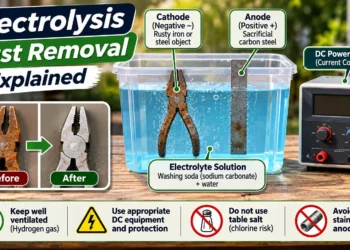

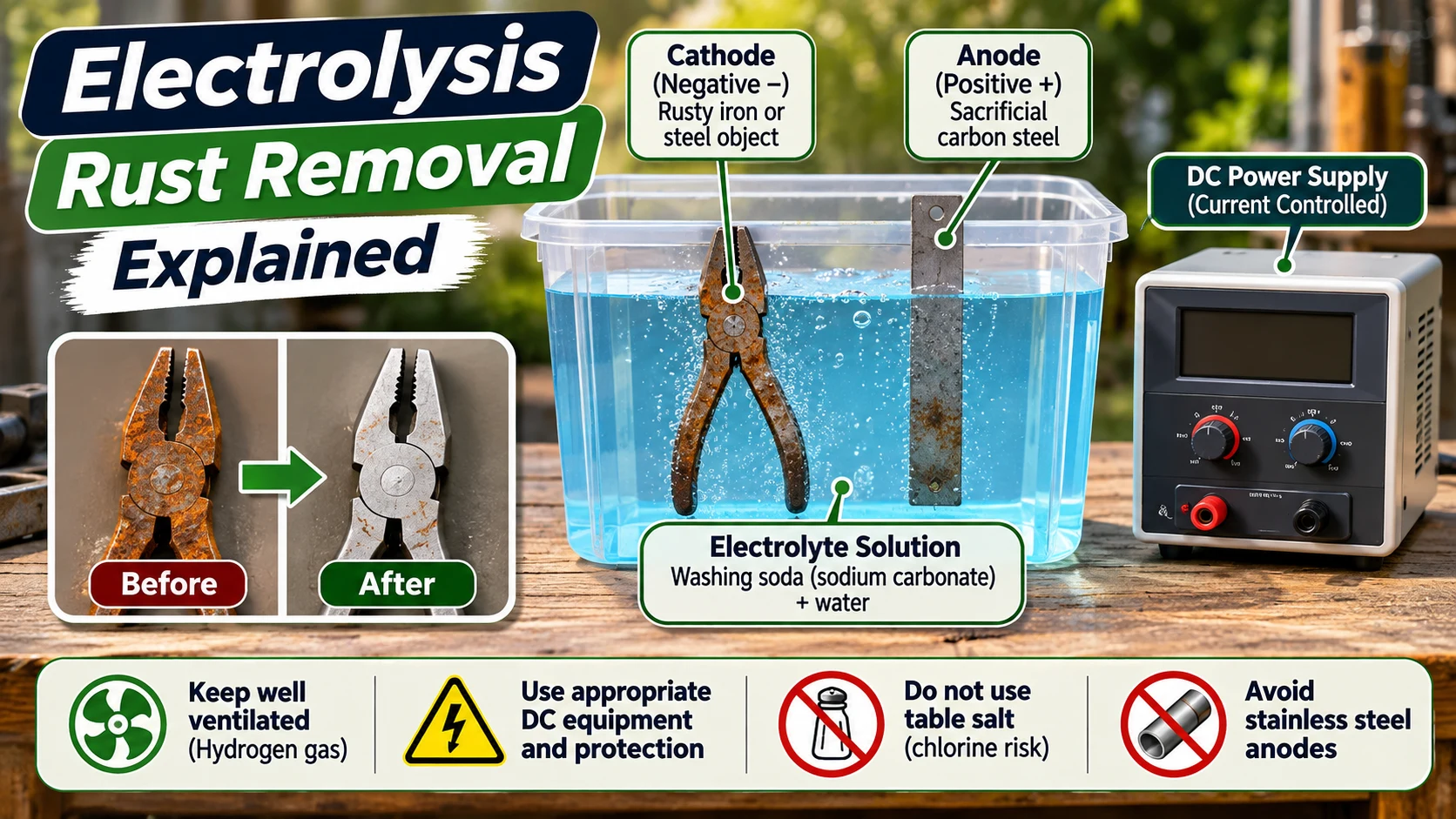
Electrolysis rust removal uses a controlled direct electrical current and a conductive water solution to loosen corrosion from certain iron and steel objects. It can help restore some rusty hand tools and metal parts without relying entirely on grinding or aggressive chemical rust removers.
The process is real, but it is not risk-free. Electrolysis produces flammable hydrogen gas, involves electricity near water, and can damage unsuitable or historically valuable metal objects. Not every car battery charger is approved for this application.
This guide explains how electrolytic rust removal works, what the negative and positive electrodes do, the purpose of washing soda, and the safety precautions to understand before considering this technique.
Electrolysis Rust Removal: Quick Facts
- Purpose: Loosen corrosion from suitable iron and steel objects.
- Rusty object: Acts as the negative electrode, or cathode.
- Other electrode: A suitable sacrificial anode, commonly plain carbon steel.
- Electrolyte: A conductive solution commonly made with washing soda (sodium carbonate) and water.
- Power: A properly controlled DC source specifically suitable for the procedure.
- Main hazards: Hydrogen gas, electric shock, short circuits, alkaline solution, and hazardous electrode byproducts.
- Best suited to: Selected noncritical iron or steel items assessed for compatibility.
Important: Electrolysis cannot replace metal already lost to corrosion or repair a structurally weakened component.


FEATURED IMAGE: Insert a verified 1920 × 1080 educational illustration showing a rusty steel tool, a nonconductive container, a conceptual cathode and anode arrangement, and a separate DC power source. Show no energized exposed clamps or unsafe electrical contact with liquid.
What Is Electrolysis Rust Removal?
Electrolysis is an electrochemical process that uses electrical energy to drive chemical reactions. In rust removal, the process can reduce some corrosion products and help separate rust layers from the metal beneath them.
Iron rust is not a single pure substance. It commonly contains different iron oxides and hydroxides formed when iron reacts with oxygen and moisture.
Under suitable conditions, electrolytic reduction changes some of these corrosion products while gas bubbles and other effects help loosen deposits. Remaining material may then be removed with appropriate cleaning methods.
The process does not return severely corroded steel to its original strength or thickness. Deep pits and missing metal remain after cleaning.
Conservation specialists also warn that electrolysis can damage fragile artifacts or remove historical surface details. An object should be assessed before treatment rather than assuming every rusty item is suitable.
How Does Electrolysis Remove Rust?
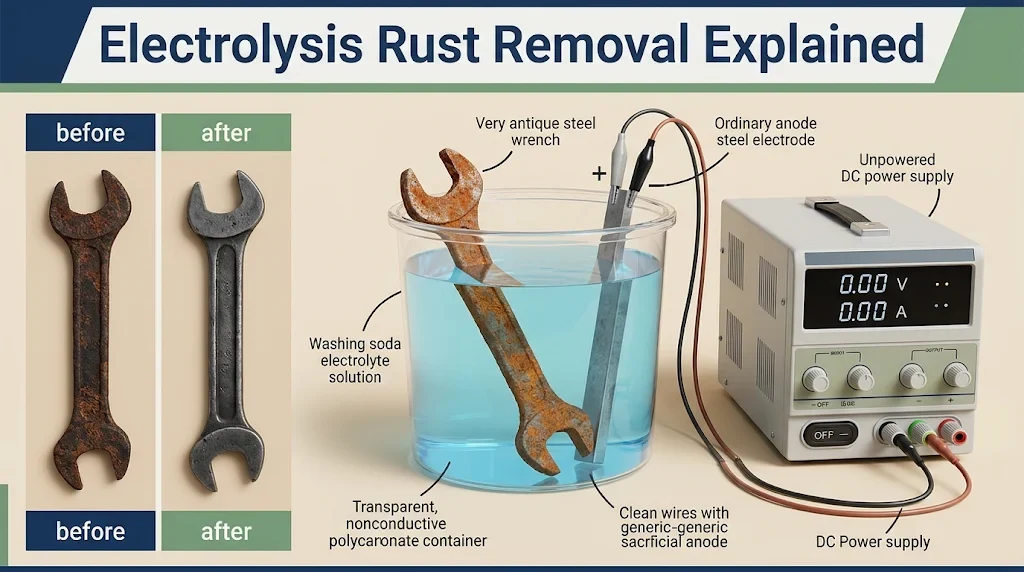
A basic electrolytic cleaning system uses two electrodes immersed in a conductive liquid, with an appropriate DC power source controlling the electrical process.
Conceptual Electrolysis System
CONTROLLED DC POWER SOURCE
Provides electrical energy to the process
↓
CATHODE (NEGATIVE)
Rusty iron or steel object
ANODE (POSITIVE)
Suitable sacrificial electrode
↓
CONDUCTIVE ELECTROLYTE
Allows ionic current through the solution
This explains component roles, not the physical construction or safe wiring of an electrolytic cleaning bath.
The Cathode: Where Rust Reduction Occurs
In the conventional electrolytic rust removal process, the iron or steel object being treated is the cathode, the negative electrode.
Electrochemical reactions occur at its surface. Hydrogen gas is also generated through the reduction of water, contributing to the bubbles often associated with this process.
These reactions can help loosen certain rust and corrosion layers. The results depend on the metal, surface condition, electrical conditions, and treatment duration.
The Anode: The Positive Electrode
The anode is the positive electrode. In many cleaning arrangements, ordinary carbon steel is used as a sacrificial electrode because it gradually corrodes or accumulates reaction products during treatment.
Electrode composition matters. Stainless steel is not a preferred general-purpose choice for an improvised cleaning bath because chromium-containing byproducts may contaminate the electrolyte and create additional handling and disposal hazards.
The Electrolyte: Why Washing Soda Is Used
Pure water conducts electricity poorly. Dissolved sodium carbonate, commonly called washing soda, adds ions that allow current to pass through the cleaning solution.
Washing soda is different from baking soda, which is sodium bicarbonate. It is also different from table salt, which is sodium chloride.
The exact concentration needs to come from a validated process and its operating instructions. Adding excessive washing soda does not guarantee faster or safer cleaning.
Never substitute table salt for washing soda. Electrolysis of chloride-containing solutions can generate hazardous chlorine-containing gases or byproducts. Avoid improvised chemical substitutions.
Can You Use a Car Battery Charger for Rust Removal?
Traditional rust removal demonstrations sometimes use basic DC battery chargers as their power source. This does not mean every modern car battery charger is suitable.
Many modern smart chargers are designed to recognize a connected battery before supplying charging current. An electrolytic bath does not behave electrically like a conventional battery.
A charger may refuse to operate, shut down, or behave outside its intended conditions. A battery charger may also lack appropriate control and protection for a non-battery load.
Do not modify a charger, bypass its protection, or defeat its safety interlocks to make it operate with an electrolysis bath.
The safer equipment choice for a professionally designed process is an appropriate current-limited DC power supply whose manufacturer permits the application, with suitable electrical protection and supervision.
Any mains-powered instrument must be kept protected from water and spills, and electrical connections must follow its manufacturer’s safety requirements.
What Materials Are Suitable for Electrolysis Rust Removal?
Electrolytic reduction is mainly discussed as a treatment for certain iron and steel items. It should not be treated as a universal cleaning method for every metal or assembled tool.
| Material or Item | General Suitability |
|---|---|
| Ordinary iron tools | Potential candidates after assessment |
| Cast iron components | May be suitable, depending on condition |
| Plain carbon steel parts | Potential candidates after assessment |
| Plated or coated objects | Risk of damage to the finish |
| Mixed-metal assemblies | Require specialist evaluation |
| Springs and high-strength steel | Not recommended for casual treatment |
| Antiques and valuable artifacts | Consult a conservation specialist |
| Electrical components or batteries | Not suitable for immersion cleaning |
Electrochemical processes can also introduce hydrogen-related material concerns for certain high-strength steels. Components that carry critical loads or have precise structural functions should not be treated as ordinary workshop scrap.
For valuable or historically important objects, professional assessment is especially important because electrolytic cleaning can permanently change the surface.
Electrolysis Rust Removal Safety: Five Major Risks
1. Flammable Hydrogen Gas
Hydrogen is produced at the cathode during water electrolysis. It is highly flammable and can form explosive mixtures with air.
Oxygen may also be generated at the anode, depending on the electrode and solution conditions. This makes uncontrolled gas accumulation especially concerning.
Never operate an electrolytic bath inside a closed cabinet, basement, or poorly ventilated room. Keep ignition sources away, and do not assume a small container eliminates the risk.
2. Electricity Near Water
Combining an electrically conductive solution with power equipment creates risks of shock, accidental short circuits, overheating, and equipment failure.
Never touch electrodes or adjust electrical connections while the system is energized. Power equipment must be suitable for the intended conditions and protected from liquids.
3. Irritating Alkaline Solution
Sodium carbonate solutions are alkaline and can irritate skin and eyes. Appropriate eye protection, chemical-resistant gloves, and careful handling are important.
Do not confuse washing soda with sodium hydroxide, sometimes sold as lye or caustic soda. Sodium hydroxide is substantially more hazardous to handle.
4. Hazardous Electrode Byproducts
Using unsuitable electrode materials may introduce hazardous metals or chemical compounds into the electrolyte.
In particular, chromium-containing electrodes such as stainless steel can complicate chemical safety and waste disposal. Avoid improvising with unknown plated or alloyed metals.
5. Damage to the Object
Electrolysis does not rebuild metal lost through corrosion. The cleaned object may reveal deep pitting, weakened sections, or cracks that were previously hidden by rust.
Uncontrolled treatment may also affect finishes, fragile details, and certain metal structures.
Stop and seek qualified guidance if you cannot control ventilation, electrical current, electrode materials, or chemical disposal. Do not operate a makeshift electrolysis bath unattended or near flames, sparks, children, or pets.
How Professionals Assess an Electrolytic Rust Removal Process
A controlled rust-removal treatment begins with evaluating the metal object and the risks of the method. Professionals do not rely solely on a generic diagram or one universal chemical recipe.
- Identify the metal. Confirm the object is made from a material appropriate for electrolytic treatment.
- Assess corrosion damage. Determine whether the remaining material is structurally sound and whether surface details must be preserved.
- Choose a validated procedure. Use instructions suitable for the object and approved electrical equipment.
- Control the environment. Plan for gas ventilation, chemical exposure, spills, and fire prevention.
- Verify equipment suitability. Confirm current limiting, protection, and electrode compatibility.
- Monitor the treatment. Watch for unexpected changes in the object, electrical equipment, or solution.
- Evaluate the result. Check whether corrosion has loosened and whether the metal has suffered any damage.
- Protect the cleaned surface. Apply suitable drying, finishing, and corrosion prevention methods for the particular material.
These are evaluation stages, not an instruction to assemble or energize a homemade chemical bath. The operating procedure must come from qualified guidance and equipment documentation.
IMAGE 2: Insert a 1200 × 1500 educational infographic showing cathode versus anode, washing soda as an electrolyte, hydrogen gas hazards, and the difference between a controlled power supply and an ordinary car battery charger.
Electrolysis vs. Other Rust Removal Methods
Electrolysis is one of several ways to treat rust. For everyday tools, simpler methods may provide a better balance of cost, time, and risk.
| Method | Advantages | Limitations |
|---|---|---|
| Hand brushing | Simple, low cost, no electrical bath | Can scratch surfaces and miss deep corrosion |
| Commercial rust remover | Convenient for some household tools | Requires chemical compatibility and safety checks |
| Citric acid treatment | May dissolve rust on suitable materials | Can attack some metals or finishes |
| Electrolysis | Can loosen corrosion without extensive grinding | Gas, electricity, chemistry, and equipment risks |
| Professional conservation | Material-specific evaluation | Higher cost and specialist involvement |
For a lightly rusted ordinary hand tool, gentle manual cleaning may be all that is needed. Electrolysis becomes more relevant when an appropriate metal object benefits from an electrochemical method and the process can be controlled safely.
What Happens After Rust Is Removed?
Removing corrosion leaves a surface that may be vulnerable to rusting again, especially when it is exposed to moisture and air.
The object may also have black residue or loose corrosion products remaining after treatment. Appropriate final cleaning depends on the metal and the chosen conservation method.
Thorough drying and a suitable protective finish are important for many ordinary steel tools. Depending on the intended use, protection may involve a compatible oil, wax, paint, or other approved coating.
Do not apply an oily coating to parts that require clean electrical contact, food-contact compatibility, precise friction characteristics, or a manufacturer-specified finish.
Structural damage and deep pitting should also be assessed before returning a previously rusted component to service.
Can Electrolysis Be Used on Solar Equipment?
The use of DC electricity in electrolysis may seem related to solar power systems, but rust removal is a separate maintenance process.
Do not immerse solar charge controllers, inverters, batteries, connectors, or electrical terminals in an electrolysis bath.
Solar mounting rails, fasteners, and structural components may have protective coatings or specific material requirements. Their corrosion should be evaluated under the relevant manufacturer’s maintenance instructions rather than treated with an improvised electrolysis process.
Do not connect a solar panel directly to an electrolytic cleaning bath. Solar output changes with sunlight, and solar panels are not substitutes for approved, appropriately controlled laboratory power equipment.
If rust or corrosion appears on safety-critical solar mounting hardware, consult a qualified installer about inspection and replacement.
Common Electrolysis Rust Removal Mistakes
- Using table salt: Chloride-based electrolytes may produce dangerous byproducts.
- Using stainless steel electrodes: Chromium contamination may create serious chemical disposal concerns.
- Assuming every car charger works: Modern chargers may be incompatible with a non-battery load.
- Ignoring hydrogen gas: Small-looking electrical processes can still generate flammable gases.
- Working near flames or sparks: Ignition sources must not be present around potentially flammable gas.
- Treating an unknown alloy: Plating and metal composition can change the risks.
- Using electrolysis on weakened parts: Removing rust does not restore structural strength.
- Ignoring waste disposal: The spent solution may contain metals and other contaminants.
- Leaving bare steel unprotected: Cleaned surfaces may rust again when exposed to moisture.
Frequently Asked Questions
Does electrolysis really remove rust?
Yes. Controlled electrolytic reduction can help loosen rust from suitable iron and steel objects. The results depend on the material, corrosion condition, and treatment method.
Which electrode is the rusty object?
In the conventional electrolytic rust removal method, the rusty object is the negative electrode, called the cathode. The other electrode is the positive anode.
Why is washing soda used?
Washing soda dissolves in water and provides ions that improve electrical conductivity. It is not the same chemical as table salt or baking soda.
Can I use any battery charger?
No. Some battery chargers are not intended for electrolysis and may not operate correctly without a battery. Use only equipment specifically suitable for the application and never bypass its protection features.
Is electrolysis rust removal safe indoors?
A confined or poorly ventilated indoor area is not appropriate because the process produces flammable hydrogen. Chemical handling and electrical protection also require careful control.
Can I use stainless steel for the anode?
It is best avoided in improvised rust removal setups because chromium-containing byproducts can contaminate the solution and complicate safe disposal.
Can electrolysis repair deep rust damage?
No. It can remove or alter corrosion products but cannot replace metal that has already been lost. Severely damaged parts may need replacement.
How do you dispose of the used electrolyte?
Disposal depends on the chemicals and metals present in the used solution. Do not assume it is safe to pour down a drain. Consult local waste-disposal guidance, especially if the treated item has coatings or unknown alloys.
Final Safety Checklist
- Confirm the object’s metal composition and structural condition.
- Use only a validated procedure appropriate for the object.
- Evaluate flammable gas generation and ventilation requirements.
- Keep electrical power equipment protected from liquids.
- Never defeat a charger’s electrical protection features.
- Do not substitute table salt or unknown chemicals.
- Avoid unsuitable electrode alloys and unknown coatings.
- Wear suitable eye and skin protection when handling alkaline liquids.
- Prevent accidental contact with energized electrodes.
- Plan for safe waste handling and disposal.
- Assess corrosion damage before putting the item back into service.
- Use a safer alternative when the process cannot be properly controlled.
Is Electrolysis the Right Way to Remove Rust?
Electrolysis can be a useful way to remove corrosion from selected iron and steel objects. It offers a different approach from abrasive cleaning and chemical rust removers, but it requires attention to electrical control, gas generation, chemical compatibility, and the condition of the metal.
For simple surface rust, manual cleaning or a suitable commercial rust remover may be easier and safer. For valuable artifacts, complex assemblies, or structurally important parts, specialist advice is the better choice.
The most important lesson from an electrolysis rust removal diagram is understanding the roles of the cathode, anode, electrolyte, and controlled DC source—along with the limits and hazards of the method.
Technical references: Society for Historical Archaeology: Conservation Treatments, Hand Tool Preservation Association: Rust Removal, Rust Removal Using Electrolysis: Safety and Chemistry, and Western Australian Museum: Conservation of Iron and Alloys.