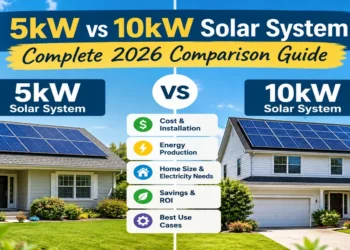

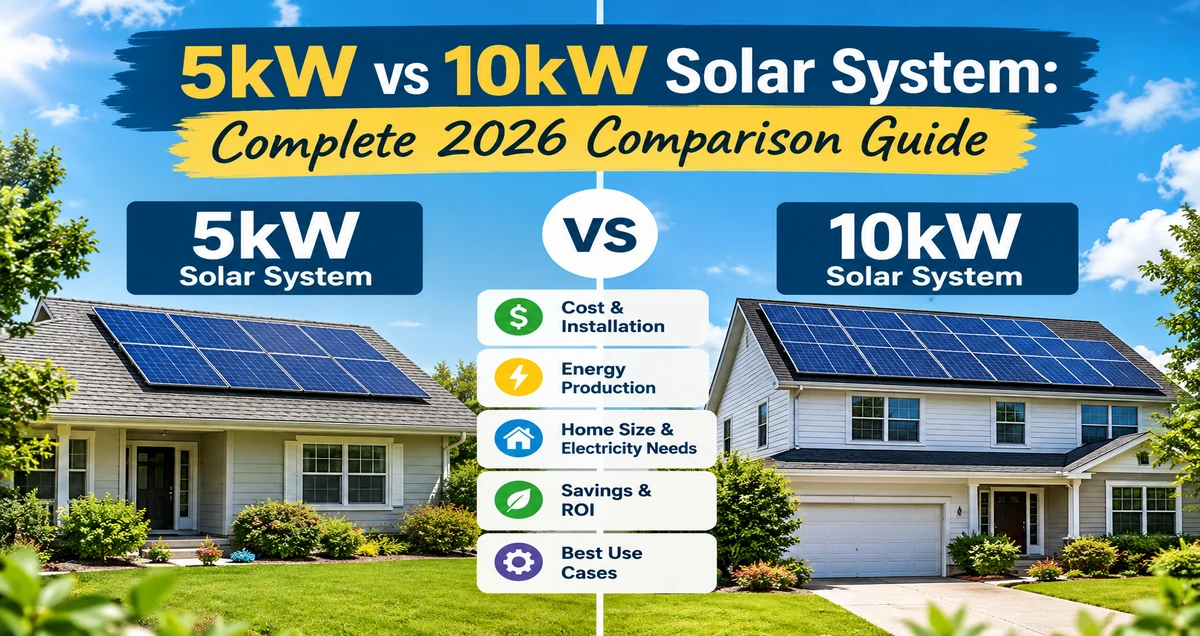
Choosing between a 5kW and 10kW solar system is one of the most important decisions homeowners make when planning solar power. A 5kW system can be a practical choice for a smaller or moderately powered home, while a 10kW system can provide substantially more electricity for larger homes, higher energy consumption, electric vehicles, air conditioning, heat pumps, or future electrical loads.
But bigger does not automatically mean better.
The right solar system depends on your electricity consumption, location, available sunlight, roof space, panel wattage, shading, utility rules, budget, and whether you plan to add battery storage.
In this guide, we compare 5kW vs 10kW solar systems so you can understand the difference in panel count, electricity production, roof space, cost, batteries, and long-term value.
Related Post


Quick answer: A 5kW solar system is generally better suited to moderate electricity consumption, while a 10kW system is more appropriate for homes with higher electricity usage. The best size should be based on your actual annual electricity consumption and local solar conditions—not simply the size of your house.
5kW vs 10kW Solar System at a Glance
| Feature | 5kW Solar System | 10kW Solar System |
|---|---|---|
| System capacity | 5kW | 10kW |
| Typical 400W panels | About 13 | About 25 |
| Typical 450W panels | About 12 | About 23 |
| Electricity production | Lower | About twice the system capacity |
| Roof space required | Less | More |
| Upfront equipment | Lower | Higher |
| Best for | Moderate electricity use | Higher electricity use |
| Battery compatibility | Yes | Yes |
| EV charging | Possible | Better suited to high usage |
| Large-home applications | Sometimes | Often more suitable |
| Future expansion | More limited | More capacity available |
The panel counts are approximate because the exact number depends on the wattage of the panels selected.
For example:
5,000W ÷ 400W = 12.5 panels
Since you cannot install half a panel, a real installation might use approximately 13 panels, depending on the final system design.
For a 10kW system:
10,000W ÷ 400W = 25 panels
These figures describe system capacity, not guaranteed daily or monthly energy production.
What Does 5kW Mean in a Solar System?
A 5kW solar system has approximately 5 kilowatts of installed solar panel capacity under the system’s rated conditions.
For example, you could build a 5kW array using:
- 13 × 400W panels = 5.2kW
- 12 × 420W panels = 5.04kW
- 12 × 450W panels = 5.4kW
- 10 × 500W panels = 5kW
The actual design depends on available equipment, roof dimensions, inverter specifications, electrical requirements, and local installation practices.
A 5kW system does not produce 5kWh of electricity every hour.
Solar production changes throughout the day because sunlight changes with:
- Time of day
- Season
- Weather
- Shading
- Roof orientation
- Roof angle
- Temperature
- Dirt and dust
- System losses
This is why system capacity and energy production should not be treated as the same thing.
What Does 10kW Mean in a Solar System?
A 10kW solar system has approximately twice the installed capacity of a 5kW system.
Depending on the panel wattage, a 10kW array might contain:
- 25 × 400W panels = 10kW
- 23 × 450W panels = 10.35kW
- 20 × 500W panels = 10kW
- 18 × 550W panels = 9.9kW
A 10kW system can therefore provide substantially more potential solar generation than a 5kW system when both systems are installed under comparable conditions.
However, twice the capacity does not necessarily mean exactly twice the electricity bill savings.
Your actual savings depend on how much electricity you use, when you use it, electricity rates, solar production, export rules, and whether you have battery storage.
How Many Solar Panels Do You Need?
One of the most common questions is:
How many solar panels are needed for a 5kW or 10kW system?
The answer depends primarily on the wattage of each panel.
5kW System
| Panel Wattage | Approximate Panel Count |
|---|---|
| 350W | 15 |
| 400W | 13 |
| 450W | 12 |
| 500W | 10 |
| 550W | 9 |
10kW System
| Panel Wattage | Approximate Panel Count |
|---|---|
| 350W | 29 |
| 400W | 25 |
| 450W | 23 |
| 500W | 20 |
| 550W | 19 |
These are simple capacity calculations. A professional installer may select a slightly different array size based on inverter design, roof layout, electrical requirements, and equipment specifications.
5kW vs 10kW Solar System: Which Produces More Electricity?
A 10kW system has approximately twice the installed capacity of a 5kW system.
If the two systems are installed in the same location with similar panel orientation, shading, equipment quality, and operating conditions, the 10kW system will generally have significantly greater potential annual production.
However, there is no universal number of kilowatt-hours that every 5kW or 10kW system will produce.
For example, a 5kW system in a location with strong solar resources can produce more electricity than a poorly positioned 10kW system in a location with substantial shading.
That is why solar system sizing should start with energy consumption and local solar production estimates, rather than using system capacity alone.
5kW vs 10kW: Which Is Better for a Home?
There is no single answer for every home.
A 5kW system may make sense if:
- Your annual electricity consumption is moderate
- Your roof has limited usable space
- Your budget is limited
- You want to offset a portion of your electricity consumption
- You do not have many high-power electrical appliances
- You are planning a smaller solar installation
A 10kW system may make more sense if:
- Your household uses significantly more electricity
- You have a larger home
- You use multiple air conditioners
- You have an electric vehicle
- You use electric heating
- You operate a heat pump
- You want greater solar production
- You expect electricity consumption to increase
- You have sufficient roof space
The important point is that home size alone should not determine solar system size.
Two houses with the same floor area can have completely different electricity consumption.
5kW Solar System: Who Is It Best For?
A 5kW solar system is often considered a practical middle-ground option for homeowners with moderate electricity consumption.
It can be suitable for homes that use electricity for common appliances such as:
- Refrigerators
- Lighting
- Televisions
- Computers
- Washing machines
- Dishwashers
- Pumps
- Moderate air conditioning
- Other household electronics
The system may be particularly attractive when roof space or budget is limited.
However, homeowners with very high electricity consumption should calculate their annual usage before deciding that 5kW is sufficient.
10kW Solar System: Who Is It Best For?
A 10kW solar system is designed for substantially greater solar capacity.
It can be attractive for households with:
- Higher annual electricity consumption
- Several air-conditioning systems
- Electric vehicles
- Electric water heating
- Heat pumps
- Larger electrical loads
- Home offices or workshops
- Plans for future electrification
For example, a household planning to purchase an electric vehicle may want to consider future electricity consumption rather than sizing the solar system only around today’s utility bills.
5kW vs 10kW Solar System for an Electric Vehicle
Electric vehicles can significantly increase household electricity consumption.
A 5kW solar system may still work with an EV, but the available solar production needs to be compared with the vehicle’s charging requirements and the home’s existing electricity consumption.
A 10kW system provides more solar capacity and may be a better fit for households combining:
Home electricity + EV charging + air conditioning + other large loads.
However, EV charging schedules matter.
If the vehicle is usually charged during the day while solar production is high, more solar electricity may be consumed directly.
If the vehicle is charged at night, battery storage or grid electricity may be needed depending on the system configuration.
5kW vs 10kW Solar System With Battery Storage
Solar panels and batteries perform different jobs.
Solar panels generate electricity.
A battery stores electricity for later use.
A battery can help shift solar energy from periods of high solar production to periods when solar production is low.
For example:
Daytime:
Solar panels → Home → Excess electricity → Battery
Night:
Battery → Home
The ideal battery size depends on your electricity consumption, desired backup duration, battery power rating, usable capacity, and system design.
A 10kW solar system does not automatically require a huge battery.
Similarly, a 5kW system does not automatically require a small battery.
The solar array and battery should be sized according to how the household actually uses electricity.
Can a 5kW Solar System Power a Whole House?
It depends on the home’s electricity consumption and the system configuration.
A 5kW solar array can generate a substantial amount of electricity, but that does not mean every appliance can operate simultaneously from the solar system.
For example, running several high-power appliances at the same time can create a large electrical load.
During a grid outage, the situation is even more important.
A standard grid-connected solar system generally cannot simply continue powering a home during an outage unless it has the appropriate equipment and configuration for backup operation.
A properly designed battery and inverter system can provide backup power for selected loads or, depending on the installation, potentially much of the home.
Can a 10kW Solar System Power a Whole House?
A 10kW solar system provides more solar capacity than a 5kW system, but the same principle applies.
The system must be designed around the home’s:
- Energy consumption
- Peak electrical demand
- Inverter capacity
- Battery capacity
- Backup requirements
- Electrical panel
- Local utility requirements
A 10kW solar array does not mean that a home can automatically operate every appliance at maximum power simultaneously.
Solar energy capacity and electrical power demand are different concepts.
5kW vs 10kW Inverter
The inverter is another important part of the comparison.
A solar inverter converts the electricity generated by solar panels into electricity that can be used by household electrical equipment and, where permitted, exported to the grid.
A 5kW solar system might use an inverter around the 5kW range, while a 10kW system may require a larger inverter.
But the relationship between panel capacity and inverter capacity is not always exactly 1:1.
Some solar system designs intentionally use more panel capacity than the inverter’s nominal AC rating. The correct configuration depends on equipment specifications, local regulations, system design, and expected solar conditions.
Never choose an inverter based only on the number of panels.
Roof Space: 5kW vs 10kW
Roof space can become a major consideration.
A 10kW system generally needs approximately twice the panel area of a similarly designed 5kW system.
Using 400W panels as a simple example:
5kW: about 13 panels
10kW: about 25 panels
Actual roof requirements depend on the physical dimensions of the selected panels and the layout.
You also need to account for:
- Roof edges
- Roof vents
- Chimneys
- Skylights
- Shading
- Walkways
- Equipment access
- Roof orientation
- Local installation requirements
A roof that technically has enough total area may not have enough usable area for the desired solar array.
5kW vs 10kW Cost
A 10kW system generally costs more than a 5kW system because it requires more solar modules and potentially larger electrical equipment and installation work.
However, the total installed price varies significantly by location and project.
Cost can be affected by:
- Solar panel brand
- Inverter type
- Battery storage
- Roof complexity
- Labor
- Electrical upgrades
- Permits
- Mounting equipment
- Monitoring equipment
- System design
- Local market conditions
Because of these differences, a fixed price should not be presented as universal.
Instead, compare quotes based on the total installed system, equipment warranties, expected production, installation quality, and what is included.
Is a 10kW Solar System Better Value Than a 5kW System?
Not necessarily.
A larger solar system can produce more electricity, but its value depends on whether you can use or economically export that additional electricity.
For example, if a household only consumes a relatively small amount of electricity, installing a much larger system may produce more energy than the home needs at certain times.
In that situation, the economics depend on factors such as:
- Electricity prices
- Net-metering or export arrangements
- Feed-in compensation
- Battery storage
- Self-consumption
- System cost
- Future electricity consumption
The best system is therefore not necessarily the largest one.
It is the system that fits your energy consumption, budget, roof, and long-term plans.
How to Choose Between 5kW and 10kW
Use this simple decision process.
Step 1: Check Your Electricity Bills
Look at your electricity bills from the last 12 months.
Find your annual electricity consumption in kWh.
This is much more useful than guessing based only on home size.
Step 2: Calculate Your Future Electricity Needs
Ask whether you will add:
- An electric vehicle
- Air conditioning
- Heat pumps
- Electric water heating
- A larger refrigerator
- A workshop
- Home appliances
- Battery storage
Future electricity consumption can affect the ideal solar system size.
Step 3: Check Your Roof
Determine how much usable roof area is available.
Look for:
- Shading
- Roof orientation
- Roof condition
- Available panel space
- Obstructions
Step 4: Estimate Solar Production
Solar production depends heavily on location and system conditions.
A professional solar assessment can provide a more accurate production estimate.
Step 5: Compare Total Costs
Do not compare only the price of solar panels.
Compare the complete system, including:
- Panels
- Inverter
- Mounting
- Electrical work
- Monitoring
- Installation
- Permits
- Batteries, if included
- Warranties
5kW vs 10kW: Common Mistakes to Avoid
Mistake 1: Choosing Based Only on House Size
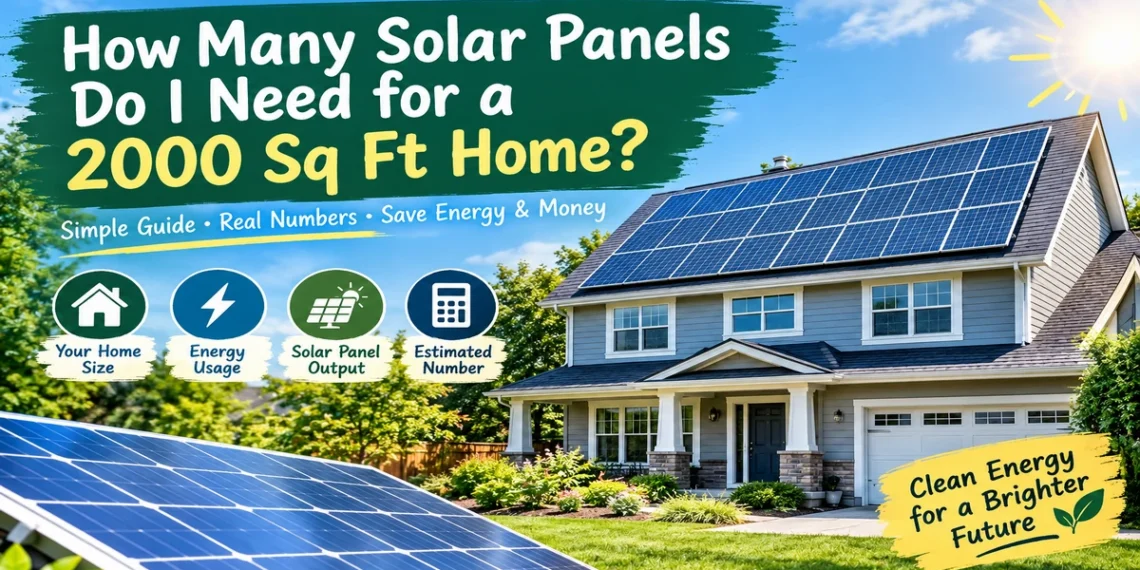
A 2,000-square-foot home does not automatically require a particular solar system.
Electricity consumption is more useful for sizing.
Mistake 2: Assuming 10kW Is Always Better
More capacity is useful only when it matches your electricity needs and project economics.
Mistake 3: Ignoring Future Electricity Consumption
Adding an EV or switching to electric heating can substantially change your energy requirements.
Mistake 4: Looking Only at Panel Wattage
Panel wattage matters, but the complete system includes the inverter, mounting system, electrical equipment, and installation.
Mistake 5: Forgetting Shading
A large solar array can underperform if significant portions of the array are shaded.
Mistake 6: Confusing kW and kWh
kW describes power.
kWh describes energy consumed or produced over time.
Understanding this difference is essential when comparing solar systems and batteries.
Mistake 7: Assuming Solar Automatically Works During a Blackout
Grid-connected solar systems require appropriate equipment and configuration to provide backup power during an outage.
5kW vs 10kW Solar System: Which One Should You Choose?
Choose a 5kW solar system if your household has moderate electricity consumption, your roof space is limited, or you want a smaller initial investment.
Choose a 10kW solar system if your household consumes substantially more electricity, has several high-power appliances, charges an EV, has plenty of usable roof space, or expects electricity consumption to increase.
The best decision should come from your electricity data rather than a generic panel-count recommendation.
A simple rule:
Moderate electricity use → consider 5kW
High electricity use → consider 10kW
Unsure → calculate your annual kWh consumption first
Frequently Asked Questions
Is 10kW twice as powerful as 5kW?
Yes, in terms of installed solar capacity, 10kW is twice the capacity of 5kW. Actual energy production will depend on location, sunlight, shading, orientation, temperature, equipment, and system losses.
How many panels are needed for 5kW?
With 400W panels, approximately 13 panels would provide around 5.2kW of nominal panel capacity. The final design may differ.
How many panels are needed for 10kW?
With 400W panels, 25 panels would provide 10kW of nominal panel capacity.
Is 5kW enough for a house?
It can be enough for a home with moderate electricity consumption, but the correct system size depends on annual electricity use and local solar conditions.
Is 10kW enough for a large home?
It can be suitable for many higher-consumption homes, but the actual requirement should be calculated from electricity consumption and expected solar production.
Can a 5kW system charge an electric car?
Yes, it can contribute to EV charging. Whether it provides enough energy depends on the home’s total electricity consumption, driving habits, charging schedule, and local solar production.
Can a 10kW system run an entire house?
It can generate substantial electricity, but whole-home operation depends on the home’s electrical loads and the system’s inverter, battery, backup configuration, and electrical design.
Should I get 5kW or 10kW solar?
Start with your last 12 months of electricity consumption. If your electricity demand is moderate, 5kW may be appropriate. If your consumption is much higher or you expect major future loads, 10kW may be more suitable.
Final Verdict: 5kW vs 10kW Solar System
The choice between a 5kW vs 10kW solar system is not simply about choosing the larger system.
A 5kW system can be a practical option for households with moderate electricity consumption and limited roof space. A 10kW system provides roughly twice the installed solar capacity and can be more appropriate for homes with higher electricity use, EV charging, electric heating, multiple air conditioners, or future energy needs.
Before buying, check your electricity consumption, roof conditions, local solar resource, available incentives or export arrangements, and complete installation costs.
The right solar system is the one that matches how much electricity your home actually uses—not simply how large your house is.