
Portable Solar Power Guide
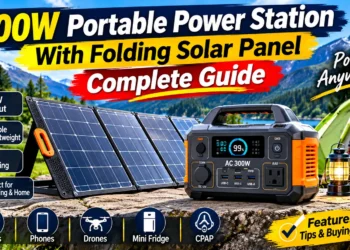
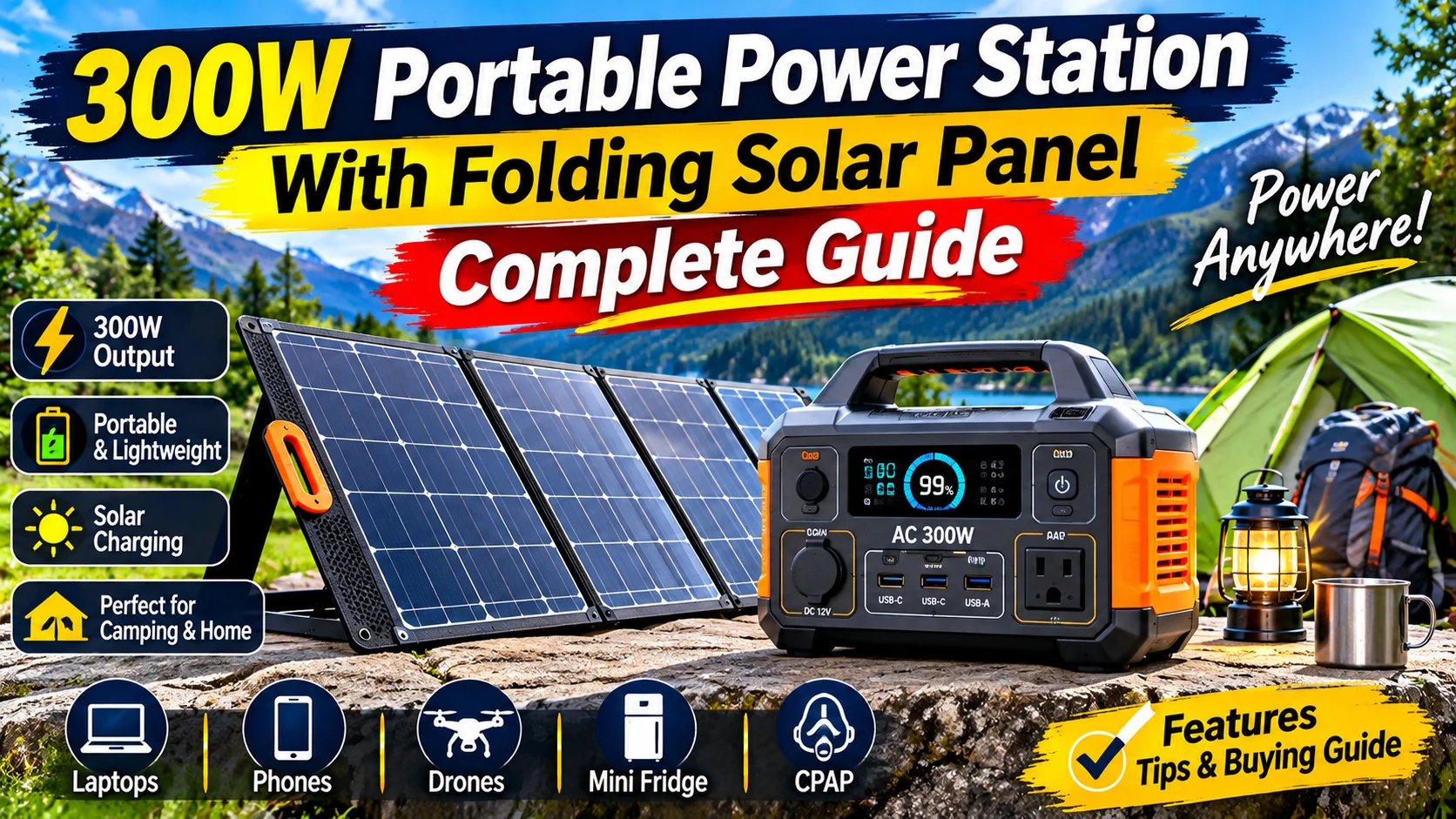
300W Portable Power Station With Hidden Folding Solar Panel: Complete Guide
Discover how a compact portable power station with AC, DC, USB, and USB-C PD outputs can support camping, outdoor activities, mobile work, and everyday backup power.
- Rated output: 300W, as indicated by the product title.
- Power sources: AC charging and potentially compatible solar charging, depending on the model.
- Output types: AC, DC, USB, and USB-C PD are indicated in the product description.
- Solar panel: A hidden or integrated folding panel is suggested by the product name; verify its actual design and wattage.
- Best uses: Small electronics, mobile devices, selected low-power equipment, and outdoor activities within the unit’s specifications.
- Important limitation: A 300W rating describes output power, not battery capacity or operating time.
What Is a 300W Portable Power Station?
A 300W portable power station is a compact electricity supply designed to power compatible electronic devices without requiring a permanent connection to a household outlet. Unlike a conventional fuel generator, a battery-based power station can operate silently during normal use and produces no exhaust fumes at the point of use.
The product title describes a portable power station or solar generator with multiple connection options, including AC, DC, USB, and USB-C Power Delivery. It also refers to a hidden folding solar panel, which may provide a convenient way to recharge the battery using sunlight.
However, product titles do not always provide enough information to confirm the exact design. Before purchasing, check whether the solar panel is built into the power station, folds out from the casing, or is supplied as a separate accessory.
It is also important to distinguish between output power measured in watts (W) and stored energy measured in watt-hours (Wh). The first indicates how much power the unit can deliver at a given moment. The second helps determine how long it can run your devices.
A 300W power station with a small battery may run out of energy quickly, while another model with the same output rating may operate a small device for considerably longer. Always compare both watts and watt-hours.
How Does the Hidden Folding Solar Panel Work?
A folding solar panel converts sunlight into electricity. When connected to a compatible power station, that electricity passes through the unit’s charging circuitry and replenishes its battery.
The phrase “hidden folding solar panel” suggests a compact design intended to reduce storage space and make the product easier to transport. The actual mechanism, panel size, and rated solar input should be confirmed using the manufacturer’s specifications.
1. Unfold the Panel
If the panel is integrated into the device, follow the manufacturer’s instructions to open and position it. If the panel is a separate accessory, connect it using the specified cable and connector.
2. Position It in Direct Sunlight
Place the panel where it receives strong sunlight with as little shading as possible. Trees, buildings, clouds, and even small shadows can reduce solar production.
3. Check the Charging Input
Confirm that the panel’s voltage, current, connector, and power rating are compatible with the station. A panel that physically fits a connector may still be electrically incompatible.
4. Monitor the Charging Status
If the station has a display or charging indicator, use it to check whether solar charging is working and how much power is entering the battery.
Important: Never assume that the solar panel can fully recharge the power station in a particular number of hours without checking its rated wattage, the battery capacity, and the manufacturer’s charging specifications.
Understanding AC, DC, USB, and USB-C PD
Multiple output types can make a portable power station useful for different devices. The exact ports, voltage, and power limits vary by model.
AC Output
AC outlets may power compatible small appliances and electronic equipment. Check the outlet voltage, frequency, continuous wattage, and surge rating before connecting a device.
DC Output
DC connections may support compatible 12V equipment, selected portable accessories, and certain vehicle-style devices. Connector type and voltage must match the load.
USB-A
USB-A ports can charge compatible phones, small electronics, and accessories. Charging speed depends on the port’s supported protocols and the connected device.
USB-C PD
USB-C Power Delivery can provide faster charging for supported phones, tablets, and some laptops. Confirm the maximum USB-C output wattage before relying on it for a particular device.
Having several types of ports does not mean every output can operate at its maximum rating simultaneously. Manufacturers may specify a combined output limit for the entire power station.
What Can You Power With a 300W Generator?
A 300W power station is generally best suited to small electronics and selected low-power devices. Whether a particular appliance will work depends on its running wattage, startup surge, connection type, and the power station’s specifications.
| Device | Typical Power Range | Suitability |
|---|---|---|
| Smartphone charger | 5–30W | Usually suitable |
| LED light | 5–20W | Usually suitable |
| Laptop | 30–100W | Depends on charger and output |
| Wi-Fi router | 5–25W | Usually suitable if voltage matches |
| Portable cooler | Varies by model | Check running and startup power |
| Electric kettle | Often 1,000W or more | Generally unsuitable |
| Space heater | Often 750–1,500W or more | Generally unsuitable |
These are illustrative ranges, not specifications for the advertised product. Check the label on each appliance and the power station manual before use.
Useful for Camping and Outdoor Activities
A compact solar power station can be helpful for charging phones, powering LED lights, operating compatible small electronics, and supporting selected low-power equipment at a campsite.
Its suitability for longer trips depends on battery capacity, daily energy use, available sunlight, and whether the solar panel can generate enough energy to replace what the devices consume.
Helpful for Short Power Outages
During a brief outage, the unit may provide backup power for communication devices, lighting, and other small electronics. It should not be treated as a whole-house backup system.
Do not connect the station to household wiring or attempt to power a home through a wall outlet. Use only approved connections and follow the manufacturer’s instructions.
How Long Will the Battery Last?
Battery runtime depends primarily on usable battery capacity and the power consumed by the connected devices. The product’s 300W output rating does not reveal its total energy storage.
For an estimate, use this formula:
Estimated Runtime = Usable Battery Energy (Wh) ÷ Device Power (W)
For example, consider a hypothetical power station with a 300Wh battery. If approximately 85% of that energy is available to an AC-powered device after conversion losses, the usable energy would be about 255Wh.
- 10W device: approximately 25.5 hours.
- 30W device: approximately 8.5 hours.
- 60W device: approximately 4.25 hours.
- 100W device: approximately 2.55 hours.
These examples are mathematical estimates, not guaranteed operating times for the advertised product. Actual results vary with battery capacity, inverter efficiency, temperature, battery condition, and changing device power consumption.
Devices that cycle on and off may consume different amounts of energy over time. Startup surges can also prevent some appliances from operating even when their average power consumption appears low.
Charging Methods and Solar Performance
Wall Charging
If the model includes an AC charging adapter, a household outlet may offer a convenient way to recharge the battery. Charging time depends on the adapter’s output, battery capacity, and the station’s charging limits.
Solar Charging
Solar charging can provide electricity away from the grid. Actual performance depends on panel wattage, sunlight intensity, shading, temperature, orientation, and the maximum solar input accepted by the power station.
Vehicle Charging
Some power stations support charging from a vehicle’s 12V outlet. This capability should be confirmed in the product manual, including any voltage, current, or connector requirements.
USB-C Charging
Some models accept power through a USB-C PD input, while others use USB-C only for output or support bidirectional charging. Do not assume that the USB-C port can recharge the station unless the manufacturer confirms it.
A panel’s advertised wattage is a laboratory-rated maximum under specified conditions. It does not represent continuous real-world output. Estimate charging time using the battery’s watt-hours and realistic solar energy production rather than assuming the panel always operates at full power.
Main Benefits of a Portable Solar Power Station
1. Compact and Portable Design
A compact unit can be easier to carry and store than a larger backup power system. If the folding solar panel is integrated into the design, it may also reduce the number of separate accessories required.
2. Multiple Charging Connections
AC, DC, USB-A, and USB-C PD outputs can make the station useful for several types of compatible electronics. This can reduce the need to carry multiple separate power banks.
3. Solar Recharging Potential
With a compatible solar panel and adequate sunlight, users may recharge the battery without relying entirely on a wall outlet. The amount of energy collected depends on the actual panel and environmental conditions.
4. Quiet Operation
Battery-based power stations generally operate without the engine noise associated with conventional fuel generators. Cooling fans may still operate during charging or heavy use.
5. Useful for Mobile Work
For photographers, remote workers, travelers, and campers, a small power station can provide convenient electricity for compatible equipment when a mains connection is unavailable.
Limitations to Consider Before Buying
A 300W portable power station is not designed to replace a large home battery or a high-output generator. Several limitations should be considered before purchasing.
- Limited output power: Appliances requiring more than the unit’s rated output may not operate.
- Limited energy storage: A small battery may require frequent recharging when powering devices for long periods.
- Variable solar performance: Cloudy weather, shade, and short winter days can reduce charging energy.
- Uncertain integrated-panel capacity: A folding design does not guarantee a high solar wattage.
- Connector compatibility: Voltage, polarity, current, and connector type must match the device being powered.
- Battery aging: Capacity may decline as the battery is used and ages.
For a fridge, medical device, computer workstation, or other essential load, confirm its starting power, continuous consumption, required runtime, and any backup-power requirements before relying on a compact station.
What to Check Before Buying a 300W Solar Generator
Battery Capacity
Look for the battery capacity in watt-hours. A product advertised only in milliamp-hours can be difficult to compare unless the battery voltage is also provided.
Continuous and Peak Output
Check the continuous AC output and any peak or surge rating. The surge rating may apply only for a short period and should not be confused with continuous output power.
Actual Solar Panel Wattage
Ask for the panel’s rated power, voltage, current, connector type, and whether the panel is included in the package. These details help determine whether solar charging is practical.
USB-C PD Power
Check the maximum USB-C output. A port advertised as USB-C PD may provide 20W, 45W, 60W, 100W, or another rating, depending on the model.
Battery Chemistry and Warranty
Confirm the battery type, expected cycle life, warranty terms, and replacement or service options. Cycle-life claims should specify the conditions under which they were measured.
Safety and Certifications
Review the manufacturer’s safety documentation, applicable certifications, over-temperature protection, overcurrent protection, short-circuit protection, and charging instructions.
Package Contents
Check whether the box contains the power station, folding solar panel, charging adapter, cables, and instruction manual. Product photographs do not always show everything included in the price.
Portable Power Station Comparison
The following table explains how to evaluate a 300W unit against other portable power options. It is a general comparison, not a verified specification sheet for the advertised product.
| Feature | Compact 300W Station | Larger Power Station |
|---|---|---|
| Output power | Designed for loads within its 300W rating | May support higher-power appliances |
| Battery capacity | Depends on the specific model | Often available in higher capacities |
| Portability | Generally easier to transport | May be heavier and bulkier |
| Typical role | Small electronics and outdoor activities | Longer runtime and larger loads, within specifications |
| Solar charging | Limited by compatible input and panel size | May support larger panels and higher input power |
The best option depends on your actual power needs. A smaller station may be sufficient for phones and lights, while longer backup periods or more demanding equipment may require a higher-capacity model.
Frequently Asked Questions
Is a 300W portable power station worth buying?
It can be useful for charging small electronics, powering selected low-wattage devices, camping, and short outages. Whether it offers good value depends on its battery capacity, solar input, build quality, warranty, and price.
Can a 300W power station run a refrigerator?
Some small refrigerators may operate within a station’s limits, but others require more power or a startup surge that exceeds the inverter rating. Check the refrigerator’s specifications and the station’s continuous and surge ratings first.
Can the folding solar panel recharge the station?
Only if the panel is electrically compatible with the power station and connected according to the manufacturer’s instructions. The actual charging speed depends on panel wattage, sunlight, battery capacity, and input limits.
Does 300W tell me how long the power station will last?
No. Watts describe power output, while watt-hours describe stored energy. To estimate runtime, divide usable battery energy by the device’s power consumption and account for conversion losses.
Can I charge a laptop using USB-C PD?
Potentially. Confirm that the power station’s USB-C port supports Power Delivery at a wattage suitable for the laptop and that the laptop supports charging through that connection.
Can I use this product indoors?
Battery power stations do not produce engine exhaust during normal battery operation, but you should still follow the manufacturer’s ventilation, temperature, and charging instructions. Do not operate a fuel-powered generator indoors or use a power station in wet conditions unless its specifications expressly allow it.
Is the solar panel included with the product?
The product title refers to a hidden folding solar panel, but the exact package contents should be confirmed with the seller. Check whether the panel is integrated, detachable, or sold separately.
Can this power station run an entire home?
No. A compact 300W station is intended for limited loads rather than whole-house backup. Choose a properly sized backup system for larger appliances or essential household circuits.
Final Verdict
The 300W Portable Power Station With Hidden Folding Solar Panel may be a practical option for users who need compact, portable electricity for outdoor activities, mobile devices, and selected low-power equipment.
Its real value depends on details that should be verified before purchase: battery capacity, continuous AC output, USB-C PD rating, solar panel wattage, supported charging methods, safety protections, and warranty coverage.
Rather than choosing a product based on its title alone, compare the manufacturer’s specification sheet with the devices you plan to power. That approach will help you decide whether a compact solar generator meets your needs or whether a larger system would be more appropriate.
Disclosure: This article is an informational product guide. Exact specifications, package contents, performance, and warranty details must be confirmed with the seller or manufacturer. No hands-on testing is claimed.