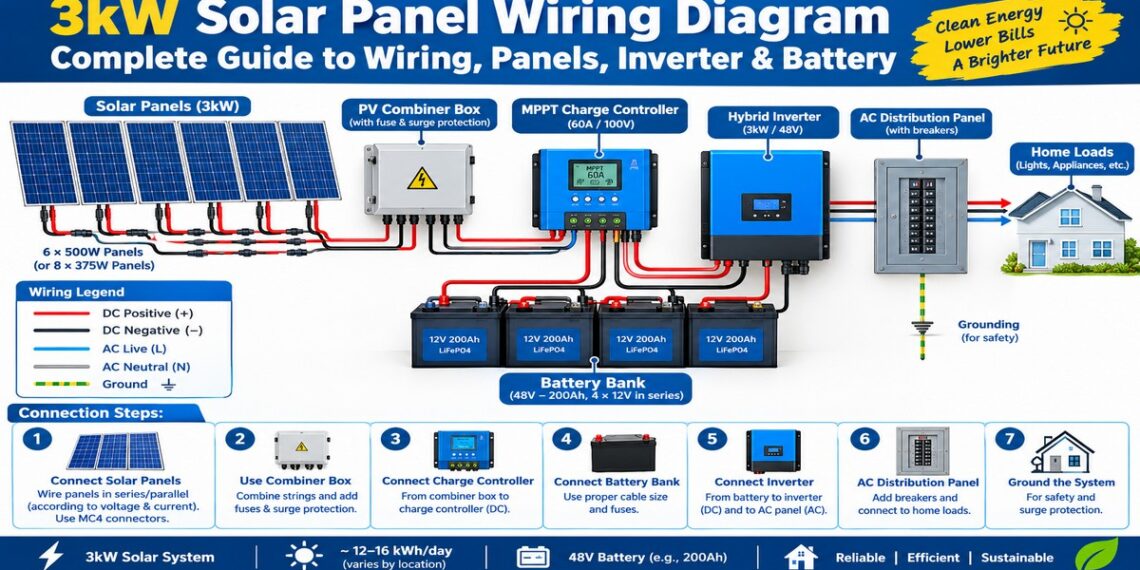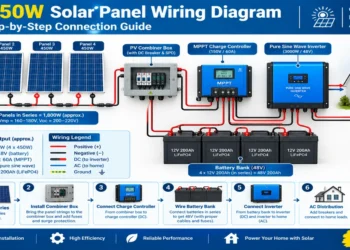

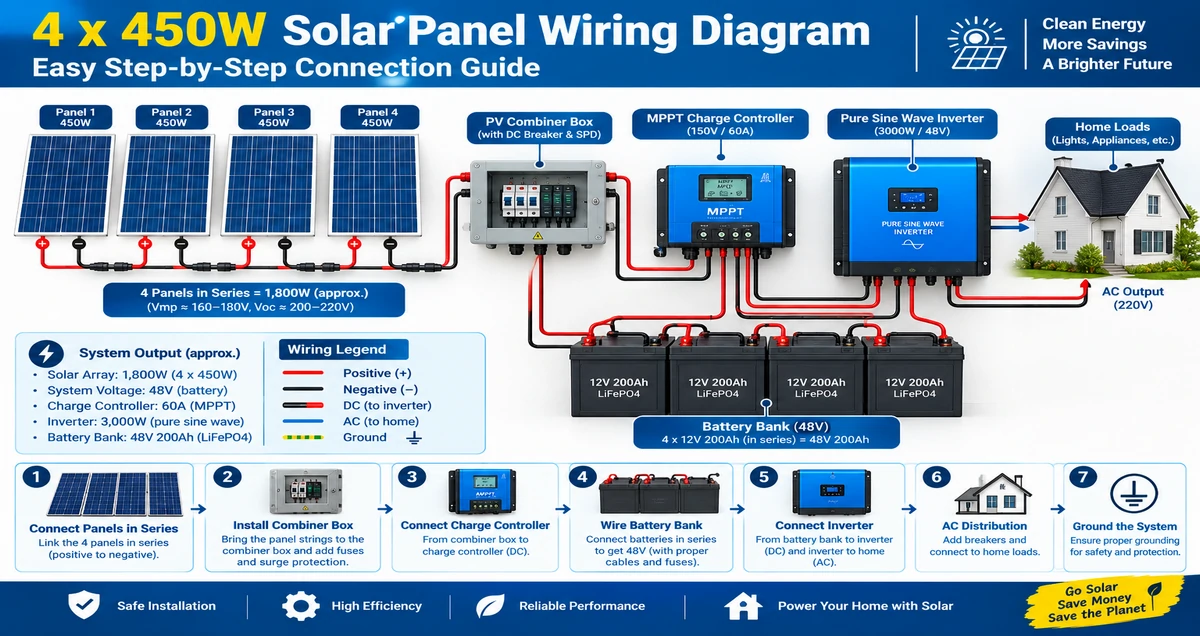
If you have 4 × 450W solar panels, your solar array has a total rated capacity of 1,800 watts, or 1.8kW.
But how should four 450W panels be connected?
Should you wire all four panels in series? Should you use two series strings in parallel? What voltage and current will the array produce? What inverter can you use? And how does the wiring change if you add a battery?
This complete guide explains the 4x 450W solar panel wiring diagram step by step, including series and parallel connections, inverter compatibility, battery systems, cable considerations, common mistakes, and safety requirements.
Related Post
Important safety note: This article provides educational examples. The correct string configuration cannot be determined from panel wattage alone. You must use the actual panel datasheet and inverter specifications, including Voc, Vmp, Isc, Imp, maximum system voltage, MPPT range, and maximum input current. PV systems can contain hazardous DC voltage, so final installation and electrical protection should be verified by a qualified professional according to applicable local requirements.
How Many Watts Is 4 × 450W Solar Panels?
The first calculation is simple:
4 × 450W = 1,800W
Therefore:
4 × 450W solar panels = 1.8kW of nominal solar capacity
This does not mean the panels will continuously produce 1,800W.
Actual solar production changes with sunlight, temperature, shading, panel orientation, dirt, weather, system losses, and other conditions.
Solar panels are only one part of a complete photovoltaic system. A working system also requires appropriate electrical equipment such as an inverter, wiring, mounting equipment, and protection devices.
4x 450W Solar Panel Wiring Diagram
A simplified solar system can look like this:
                 SUNLIGHT
                    ↓
        ┌───────────────────────┐
        │    450W SOLAR PANEL   │
        ├───────────────────────┤
        │    450W SOLAR PANEL   │
        ├───────────────────────┤
        │    450W SOLAR PANEL   │
        ├───────────────────────┤
        │    450W SOLAR PANEL   │
        └───────────┬───────────┘
                    │
                 DC POWER
                    ↓
          ┌─────────────────┐
          │ DC PROTECTION / │
          │ DISCONNECT      │
          └────────┬────────┘
                   │
                   ↓
          ┌─────────────────┐
          │     INVERTER    │
          └────────┬────────┘
                   │
                  AC
                   ↓
          ┌─────────────────┐
          │   AC PROTECTION │
          └────────┬────────┘
                   │
                   ↓
          ┌─────────────────┐
          │ HOME ELECTRICAL │
          │     PANEL       │
          └────────┬────────┘
                   │
             ┌─────┴─────┐
             ↓           ↓
          HOME LOADS   GRID*
*Grid connection depends on system design, utility requirements, and applicable electrical rules.
An inverter converts the DC electricity generated by PV modules into AC electricity used by typical household electrical systems.
What Does 4 × 450W Mean?
The 450W rating is the nominal power rating of each panel under specified test conditions.
With four panels:
450W + 450W + 450W + 450W = 1,800W
So the array is:
1.8kW DC
However, the array’s voltage and current depend on the electrical specifications of the particular 450W panels.
For example, a panel datasheet may specify:
- Voc = open-circuit voltage
- Vmp = voltage at maximum power
- Isc = short-circuit current
- Imp = current at maximum power
You need these values before deciding how the four panels should be wired.
4 × 450W Panels in Series
One common configuration is connecting all four panels in series.
The basic concept is:
       450W PANEL 1
       +          -
       │          │
       │          └──────────────┐
       │                         │
       │     450W PANEL 2        │
       └──────── +          - ───┘
                         │
                         │
                         └──────────────┐
                                        │
                         450W PANEL 3   │
                         +          -   │
                         │          └───┘
                         │
                         └──────────────┐
                                        │
                         450W PANEL 4   │
                         +          -   │
                         │          │
                         └──────────┘
                              │
                              ↓
                           INVERTER
In a series string:
Voltage adds together.
The current remains approximately the same as the current of the individual modules, subject to the actual electrical characteristics and operating conditions.
For example, if a hypothetical 450W panel had:
- Vmp = 40V
- Imp = 11.25A
Four panels in series would have an approximate operating point of:
40V × 4 = 160V
and approximately:
11.25A
The resulting power would be approximately:
160V × 11.25A = 1,800W
This is only an illustration. Do not assume your 450W panels have these exact specifications.
4 × 450W Panels in Parallel
Another possible configuration is connecting the panels in parallel.
The simplified concept is:
450W PANEL 1 ───────┐
                    │
450W PANEL 2 ───────┤
                    │
450W PANEL 3 ───────┼────── + DC
                    │
450W PANEL 4 ───────┘


450W PANEL 1 ───────┐
                    │
450W PANEL 2 ───────┤
                    │
450W PANEL 3 ───────┼────── - DC
                    │
450W PANEL 4 ───────┘
With panels in parallel:
- Voltage remains approximately at the panel/string voltage.
- Current increases.
- Protection and conductor requirements must be considered carefully.
For example, if each hypothetical panel operated at 40V and 11.25A, four parallel panels could theoretically operate around:
40V and 45A
with approximately:
40V × 45A = 1,800W
Again, these numbers are only an example. Use the actual panel specifications.
4 × 450W: Series vs. Parallel
The choice between series and parallel depends primarily on the inverter and the electrical characteristics of the modules.
| Configuration | Voltage | Current | Main consideration |
|---|---|---|---|
| 4 in series | Adds | Approximately one panel’s current | Check inverter voltage limits |
| 4 in parallel | Approximately one panel’s voltage | Adds | Check inverter current limits |
| 2S2P | Two-panel string voltage | Two string currents | Check both voltage and current |
There is no universal “best” configuration for every four-panel system.
The inverter’s MPPT operating range, maximum DC voltage, maximum input current, panel specifications, temperature, shading, and cable layout all matter.
2S2P Wiring for 4 × 450W Solar Panels
A 2S2P arrangement means:
- 2 panels connected in series
- Another 2 panels connected in series
- The two strings are then connected in parallel
Conceptually:
             STRING 1
      ┌────────────────────┐
      │                    │
  450W PANEL 1 → 450W PANEL 2
      │                    │
      └──────────┬─────────┘
                 │
                 │
                 ├──────────────→ INVERTER
                 │
      ┌──────────┴─────────┐
      │                    │
  450W PANEL 3 → 450W PANEL 4
      │                    │
      └────────────────────┘
             STRING 2
The approximate electrical relationship is:
String voltage ≈ 2 × panel voltage
and:
Array current ≈ 2 × string current
The total nominal power remains:
4 × 450W = 1,800W
This configuration can be useful in some systems, but it should only be used when the inverter and protection equipment are designed for it.
Which Wiring Configuration Should You Use?
Do not choose between series, parallel, and 2S2P simply because one diagram looks easier.
Instead, compare the actual specifications.
Check the solar panel datasheet
Find:
- Voc
- Vmp
- Isc
- Imp
- Maximum system voltage
- Temperature coefficients
Check the inverter datasheet
Find:
- Maximum PV voltage
- MPPT voltage range
- Minimum MPPT voltage
- Maximum PV input current
- Maximum short-circuit current
- Maximum PV input power
- Number of MPPT inputs
The final string arrangement should satisfy all applicable limits.
Why Voc Matters When Wiring Panels in Series
One of the most important mistakes beginners make is looking only at Vmp.
When designing a PV string, open-circuit voltage (Voc) also matters.
Solar-module voltage changes with temperature. The string must remain within the inverter’s maximum permitted DC voltage under the relevant design conditions, including cold-weather conditions.
For example, suppose a hypothetical panel has:
Voc = 50V
Four panels would have a nominal series Voc of:
4 × 50V = 200V
But the actual design voltage under cold conditions can be different.
Therefore, do not simply multiply the number printed on the panel label and assume that is the maximum real-world design voltage.
How to Connect 4 × 450W Panels to an Inverter
A simplified connection sequence is:
Solar panels → PV string → DC protection/disconnect where required → inverter → AC protection → electrical panel
The inverter converts the panels’ DC electricity into AC electricity.
A conceptual diagram:
        4 × 450W SOLAR ARRAY
                │
                ↓
        PV STRING / ARRAY
                │
                ↓
       DC PROTECTION*
                │
                ↓
           INVERTER
                │
                ↓
        AC PROTECTION*
                │
                ↓
       ELECTRICAL PANEL
                │
          ┌─────┴─────┐
          ↓           ↓
        LOADS        GRID*
*Exact equipment depends on the system architecture and applicable requirements.
What Size Inverter for 4 × 450W Panels?
Four 450W panels have a combined rated DC capacity of:
1,800W
That does not automatically mean you must buy an inverter labeled exactly 1,800W.
The inverter must be selected according to its:
- Maximum PV input power
- MPPT voltage range
- Maximum DC voltage
- Maximum input current
- AC output requirements
- Battery compatibility, if applicable
- Grid requirements, if applicable
- Manufacturer-approved PV configurations
A suitable inverter may have a nominal AC rating different from the exact 1.8kW DC array rating.
The correct relationship depends on the equipment and system design.
Can You Connect 4 × 450W Panels to a 2kW Inverter?
Potentially, but the wattage numbers alone are not enough to answer this safely.
You must verify:
- The inverter’s maximum PV input power.
- The inverter’s maximum DC voltage.
- The inverter’s MPPT operating range.
- The maximum input current.
- The short-circuit current limit.
- The manufacturer’s allowed PV array configuration.
If all specifications are compatible, the combination may be possible.
If they are not compatible, the configuration should not be used.
4 × 450W Solar Panels With a Battery
If you want battery storage, the architecture changes.
A simplified system could look like this:
             4 × 450W
           SOLAR PANELS
                │
                ↓
         HYBRID INVERTER
           ┌────┴────┐
           │         │
           ↓         ↓
        BATTERY     AC
                     │
                     ↓
              HOME ELECTRICAL
                  PANEL
                     │
                HOME LOADS
Depending on the system, the battery may be connected using a hybrid inverter or other compatible power electronics.
Batteries store solar energy so it can be used later, including when sunlight is unavailable.
Do 4 × 450W Panels Need a Battery?
No.
A battery is optional for many grid-connected solar systems.
A system can be designed as:
Grid-tied solar
Solar → Inverter → Home → Grid
Solar + battery
Solar → Hybrid Inverter → Home
                     ↓
                   Battery
Off-grid
Solar → Inverter/Controller → Battery → Loads
The appropriate architecture depends on your energy requirements and whether grid power is available.
4 × 450W Solar Panels for an Off-Grid System
For an off-grid application, the battery becomes particularly important because solar production changes throughout the day and may be unavailable at night.
A simplified system might look like:
        4 × 450W PV ARRAY
                │
                ↓
       CHARGE CONTROLLER /
        HYBRID INVERTER
                │
                ↓
             BATTERY
                │
                ↓
          OFF-GRID INVERTER
                │
                ↓
           LOADS PANEL
                │
       ┌────────┼────────┐
       ↓        ↓        ↓
     Lights   Fridge   Other Loads
The actual design must account for battery capacity, inverter power, daily energy consumption, solar resource, and the loads you need to operate.
How Much Energy Can 4 × 450W Panels Produce?
The array’s nominal capacity is:
1.8kW
A simplified planning calculation can be written as:
Daily energy ≈ 1.8kW × equivalent peak-sun hours × system efficiency factor
For example, using a hypothetical 5 peak-sun-hour assumption and an 80% overall system factor:
1.8 × 5 × 0.80 = 7.2 kWh/day
This is an illustrative calculation, not a guaranteed production figure.
Actual production depends on local solar conditions, panel orientation, shading, temperature, equipment losses, and other factors.
How Many Appliances Can 4 × 450W Solar Panels Run?
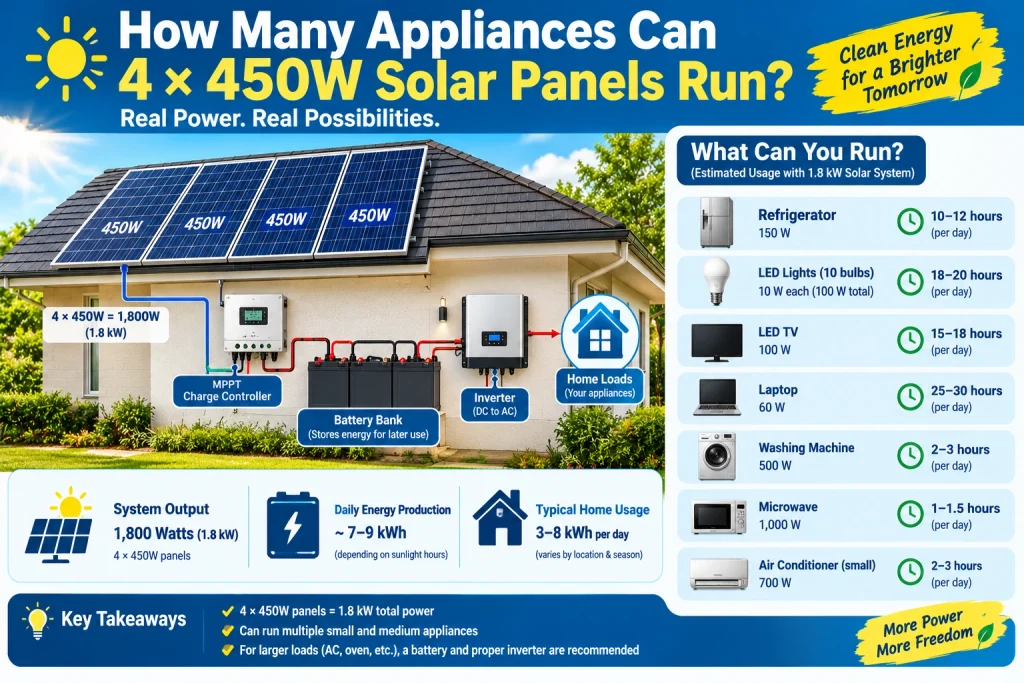
The answer depends on:
- Instantaneous load
- Daily energy consumption
- Solar production
- Inverter size
- Battery capacity
- Appliance startup power
- Time of day
- Weather
For example, a 450W panel does not mean you can automatically run a 450W appliance continuously.
The array’s output changes throughout the day.
Also, the inverter must be capable of handling the connected loads.
Can 4 × 450W Solar Panels Run a Refrigerator?
Potentially, yes.
But the refrigerator’s:
- Running power
- Startup surge
- Daily energy use
must be considered.
If the refrigerator is connected to an off-grid or backup system, the inverter should also be capable of handling its startup requirements.
A battery can provide additional support when solar production is temporarily below the load.
Can 4 × 450W Panels Run an Air Conditioner?
It depends on the air conditioner’s electrical requirements.
Air conditioners can require substantially more power than small household appliances, especially during startup depending on the compressor and equipment design.
You need to consider:
- Running watts
- Starting/surge requirements
- Inverter capacity
- Battery capacity
- Solar production
- Other loads operating at the same time
Therefore, 1.8kW of solar panels does not automatically mean an air conditioner can be operated from the system.
What Cable Size Do 4 × 450W Solar Panels Need?
There is no universal cable size for every four-panel 450W installation.
Cable selection depends on:
- Circuit current
- Cable length
- Voltage
- Conductor material
- Installation method
- Temperature
- Voltage-drop requirements
- Local electrical requirements
- Equipment specifications
Do not choose a cable size simply because another 4 × 450W installation used it.
The actual current and installation conditions must be calculated.
Do You Need a Combiner Box?
Not every four-panel system needs a separate combiner box.
For example, a simple single-string configuration may connect directly to compatible inverter inputs without a traditional external combiner box.
A combiner becomes more relevant when multiple PV strings need to be combined.
The exact requirement depends on the inverter, string configuration, protection equipment, and applicable electrical rules.
4 × 450W Solar Panel Wiring: Common Mistakes
Mistake 1: Assuming 1,800W determines the voltage
It doesn’t.
Power is:
P = V × I
The same 1,800W array can have different voltage/current combinations depending on how the panels are wired.
Mistake 2: Choosing an inverter based only on wattage
An inverter may have an appropriate power rating but an incompatible PV voltage or current range.
Always check the complete datasheet.
Mistake 3: Ignoring Voc
Series-connected panels can produce a much higher voltage than one module.
Maximum PV voltage must be checked under the relevant temperature conditions.
Mistake 4: Using panels with incompatible specifications
When building strings, module characteristics and inverter limits must be considered.
Mistake 5: Connecting a battery directly to the panels
A battery system needs appropriate charging and control equipment.
Do not assume a solar panel can simply be connected directly to a battery.
Mistake 6: Using ordinary indoor electrical cable
PV wiring needs appropriately rated conductors and connectors for the environment and system.
Mistake 7: Copying a diagram without checking the equipment
Two 450W solar panels from different manufacturers can have different voltage and current specifications.
The same four-panel diagram may therefore not work for both.
Step-by-Step: How to Plan a 4 × 450W Solar Array
Step 1: Confirm the panel specifications
Write down:
- 450W rated power
- Voc
- Vmp
- Isc
- Imp
- Temperature coefficients
- Maximum system voltage
Step 2: Check your inverter
Find:
- Maximum PV voltage
- MPPT operating range
- Maximum PV input current
- Maximum short-circuit current
- Maximum PV power
- Number of MPPT inputs
Step 3: Compare possible configurations
Evaluate:
- 4S
- 2S2P
- 4P
Do not assume one configuration is automatically correct.
Step 4: Check temperature effects
PV voltage varies with temperature.
The maximum expected string voltage must remain within the inverter’s permitted range.
Step 5: Calculate conductor requirements
Consider:
- Current
- Distance
- Temperature
- Voltage drop
- Installation method
- Applicable electrical requirements
Step 6: Design protection
Depending on the system, this may include:
- DC disconnect
- AC disconnect
- Overcurrent protection
- Surge protection
- Grounding/bonding
- Other required safety equipment
Step 7: Verify the final design
Before installation, verify the complete design against:
- Panel datasheets
- Inverter manual
- Battery manufacturer’s requirements
- Electrical code
- Utility requirements
- Local installation requirements
Simple 4 × 450W Solar Wiring Example
Let’s use a hypothetical panel for illustration.
Assume each 450W panel has:
- Vmp = 40V
- Imp = 11.25A
- Voc = 48V
Four panels in series would have approximately:
Vmp = 40 × 4 = 160V
Imp ≈ 11.25A
Power = 160 × 11.25 = 1,800W
The nominal open-circuit voltage would be:
Voc = 48 × 4 = 192V
But this is only a simplified calculation. Actual design must account for temperature effects and the real specifications of the equipment.
What Is the Difference Between 4 × 450W and a 2kW Solar System?
Four 450W panels produce:
1.8kW
A 2kW array has:
2,000W
The difference is:
2,000W − 1,800W = 200W
So four 450W panels are 200W below a nominal 2kW array.
You could, for example, use five 400W panels for a nominal 2,000W array:
5 × 400W = 2,000W
But panel count should always be based on the actual system design, available roof space, inverter compatibility, and energy requirements.
4 × 450W Solar Panels: Frequently Asked Questions
Is 4 × 450W equal to 2kW?
No. Four 450W panels equal 1,800W, or 1.8kW.
Can four 450W panels be connected in series?
Potentially, yes, if the resulting string voltage and current are compatible with the inverter and other equipment.
Can four 450W panels be connected in parallel?
Potentially, yes, if the resulting current and voltage are compatible with the inverter and protection equipment.
Can I use a 2S2P configuration?
Potentially. Two pairs of series-connected panels can be connected in parallel, but the inverter must support the resulting voltage and current.
What inverter do I need for four 450W panels?
The array is 1.8kW DC. The appropriate inverter depends on its PV input voltage, current, MPPT range, maximum PV power, AC requirements, and system architecture.
How many batteries do I need?
There is no answer based solely on the 1.8kW solar array. Battery sizing depends on daily energy use, backup duration, battery chemistry, usable capacity, inverter power, and desired loads.
Can four 450W panels power a house?
They can provide useful solar energy, but whether they can meet a home’s electricity demand depends on consumption, sunlight, system design, and whether battery or grid support is available.
Do I need a charge controller?
It depends on the system architecture. Some systems use a separate solar charge controller, while many modern hybrid inverters integrate the necessary charging functions.
Can I install the system myself?
The mechanical and electrical requirements depend on the system and location. PV circuits can contain dangerous DC voltage, and grid-connected installations may require specific permits, inspections, utility approval, and qualified electrical work.
Final Checklist for 4 × 450W Solar Panel Wiring
Before finalizing the system, verify:
☐ Four panels are actually rated at 450W each
☐ Total array power is 1,800W
☐ Panel Voc is known
☐ Panel Vmp is known
☐ Panel Isc is known
☐ Panel Imp is known
☐ Inverter maximum PV voltage is known
☐ Inverter MPPT range is compatible
☐ Inverter maximum input current is not exceeded
☐ Maximum PV power is within the inverter specification
☐ Cold-weather string voltage has been considered
☐ Correct PV-rated wiring is used
☐ Appropriate protection is included
☐ Grounding/bonding is correctly designed
☐ Battery specifications are compatible if storage is included
☐ Local electrical requirements have been checked
☐ The final installation has been reviewed by a qualified professional
Conclusion
A 4x 450W solar panel wiring diagram starts with a simple fact:
4 × 450W = 1,800W = 1.8kW
From there, the correct wiring configuration depends on the electrical characteristics of the panels and the inverter.
You may encounter:
- 4S ; four panels in series
- 4P : four panels in parallel
- 2S2P : two series strings connected in parallel
The correct choice depends on voltage, current, MPPT range, maximum inverter input limits, temperature, shading, wiring, protection, and the complete system design.
The most important rule is not to choose the configuration based on wattage alone.
Check the actual panel and inverter datasheets before connecting anything. A properly designed PV system combines the solar array with appropriate mounting, wiring, inverter, protection, and when needed battery storage.
Safety: Solar modules can produce dangerous DC voltage whenever they are exposed to light. Never assume that disconnecting the utility grid makes the PV side safe. Follow the equipment manufacturer’s instructions and applicable electrical requirements, and use qualified professionals for electrical installation where required.