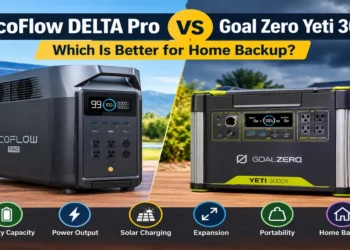

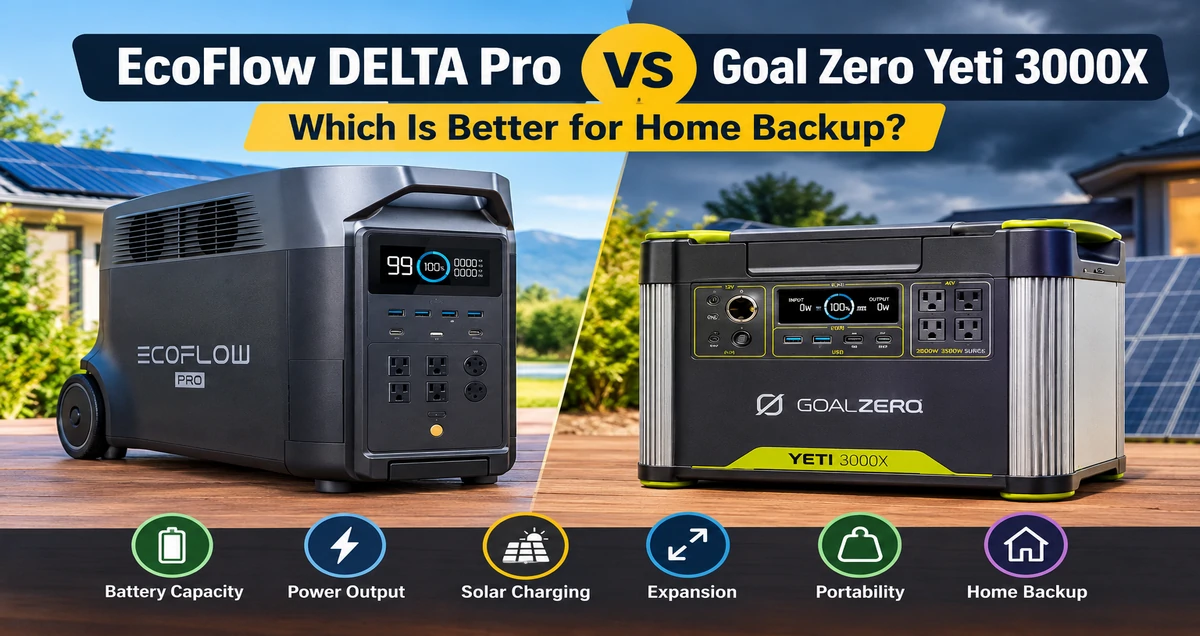
If you are looking for a powerful portable power station for emergency home backup, two models that often come up are the EcoFlow DELTA Pro and the Goal Zero Yeti 3000X.
Both are large-capacity battery power stations designed to provide electricity during outages, camping trips, off-grid projects, and other situations where conventional grid power is unavailable.
But they are not identical.
The EcoFlow DELTA Pro has a 3,600Wh battery, a 3,600W AC output, 1,600W maximum solar input, and an LFP battery chemistry. The Goal Zero Yeti 3000X has a 3,032Wh battery, a 2,000W AC inverter, up to 3,500W surge output, and an NMC lithium-ion battery.
So which one makes more sense for home backup?
The answer depends on your appliances, backup duration, solar setup, portability requirements, and how often you expect to cycle the battery.
EcoFlow DELTA Pro vs Goal Zero Yeti 3000X at a Glance
| Feature | EcoFlow DELTA Pro | Goal Zero Yeti 3000X |
|---|---|---|
| Battery capacity | 3,600Wh | 3,032Wh |
| Battery chemistry | LFP | Lithium-ion NMC |
| AC continuous output | 3,600W | 2,000W |
| Surge output | Up to 7,200W | Up to 3,500W |
| Maximum solar input | 1,600W | 600W through high-power input |
| Expandable | Yes | No chainable expansion |
| Weight | About 45 kg / 99 lb | About 31.65 kg / 69.78 lb |
| App control | Wi-Fi/Bluetooth | Goal Zero Power App |
| Home backup integration | Smart Home Panel available | Home Integration Kit available |
| Best suited to | High-power home backup and solar storage | Portable backup and moderate loads |
Specifications can vary by regional version and configuration, so check the manufacturer documentation for the version you intend to purchase.
1. Battery Capacity: DELTA Pro Has More Stored Energy
Battery capacity is measured in watt-hours (Wh).
A larger Wh rating generally means more stored energy, although the actual runtime depends on the appliance load, inverter losses, battery-management limits, and operating conditions.
The EcoFlow DELTA Pro has a 3,600Wh capacity, while the Yeti 3000X has 3,032Wh.
That gives the DELTA Pro roughly:
3,600Wh − 3,032Wh = 568Wh
of additional nominal battery capacity.
For example, if a refrigerator and networking equipment together averaged 200W, a simplified calculation would be:
3,600Wh ÷ 200W = 18 hours
versus:
3,032Wh ÷ 200W = 15.16 hours
However, these are theoretical calculations.
Real-world runtime will be lower because appliances do not always consume a constant amount of electricity and power stations have conversion losses.
Why capacity matters
More capacity can be useful when you want to keep:
- Refrigerators running
- Wi-Fi equipment online
- Lights operating
- Phones and laptops charged
- Medical or essential equipment powered
- Small appliances running during an outage
For longer outages, the difference between 3.0kWh and 3.6kWh can become meaningful.
2. Output Power: DELTA Pro Has a Major Advantage
Battery capacity tells you how much energy is stored.
Output power tells you how much electricity the power station can deliver at a given moment.
The EcoFlow DELTA Pro is rated for 3,600W of AC output, with up to 7,200W surge capability according to EcoFlow’s specifications. The Yeti 3000X provides 2,000W continuous AC output with a 3,500W surge rating.
This difference matters when you want to operate higher-power appliances.
Example loads
A home backup system might need to operate:
- Refrigerator
- Freezer
- TV
- Internet router
- Lights
- Laptop
- Fans
- Small kitchen appliances
Many of these loads can be handled by either system.
But appliances with high starting or operating power can make the inverter rating much more important.
Examples include:
- Microwaves
- Power tools
- Pumps
- Larger refrigerators
- Some air conditioners
- Electric cooking equipment
The DELTA Pro also includes EcoFlow’s X-Boost feature, which the manufacturer says can support certain devices up to 4,500W. X-Boost does not mean the inverter produces 4,500W of conventional output for every appliance, so compatibility should be checked before relying on it.
3. Solar Charging: DELTA Pro Is Better Suited to Larger Solar Arrays
If you plan to recharge your battery using solar panels, solar-input capacity becomes extremely important.
The EcoFlow DELTA Pro supports up to 1,600W of solar input, with an input range of 11–150V and a maximum current of 15A according to EcoFlow’s published specifications.
The Yeti 3000X’s published specifications list a 600W maximum high-power charging input, with additional 8mm charging inputs available depending on the configuration.
This means the DELTA Pro can accept a significantly larger solar array.
For someone building a serious solar backup system, that can reduce the time required to recharge the battery when sunlight is available.
Example
Suppose you have a solar array capable of producing 1,200W under favorable conditions.
A DELTA Pro can accept up to its published 1,600W solar-input limit, assuming the panel voltage and current stay within the input specifications.
A Yeti 3000X has a much lower high-power solar-input limit.
Actual solar production will vary because of:
- Cloud cover
- Panel orientation
- Temperature
- Shading
- Dust
- Time of day
- Season
- Solar-panel specifications
Never connect a solar array based only on its wattage. Voltage and current limits must also be checked.
4. Battery Chemistry: LFP vs NMC
One of the biggest technical differences is battery chemistry.
EcoFlow DELTA Pro
The DELTA Pro uses LFP (lithium iron phosphate) battery cells.
EcoFlow lists approximately 3,500 cycles to 80%+ capacity for the DELTA Pro.
Goal Zero Yeti 3000X
The Yeti 3000X uses lithium-ion NMC chemistry.
Goal Zero lists 500 cycles to 80% capacity under its stated testing conditions.
This does not mean that every Yeti 3000X will suddenly stop working after exactly 500 cycles.
Battery cycle-life specifications are test-based ratings, and real-world battery aging depends on temperature, depth of discharge, charging habits, storage conditions, and usage.
Nevertheless, the published cycle ratings show a significant difference in the intended battery-life characteristics of these two products.
For frequent home backup use, this specification deserves serious consideration.
5. Portability: Yeti 3000X Is Lighter
The Yeti 3000X weighs approximately 69.78 lb (31.65 kg).
The DELTA Pro weighs approximately 99 lb (45 kg).
That makes the Yeti 3000X approximately:
29.22 lb / 13.35 kg lighter.
This is a significant difference.
If you frequently move your power station between:
- Garage
- Workshop
- RV
- Camping location
- Vehicle
- Home office
the lighter Yeti can be easier to handle.
The DELTA Pro does have a suitcase-style design with wheels and a telescoping handle, but its weight still makes it a substantial piece of equipment.
6. Home Backup: What Can They Actually Power?
Neither power station should be treated as an unlimited whole-house battery.
The correct approach is to identify your essential loads.
For example:
Essential backup loads
A typical emergency circuit might include:
- Refrigerator
- Wi-Fi router
- LED lighting
- Phone chargers
- Laptop
- Television
- Small fan
A system with around 3kWh of nominal storage can potentially provide useful backup for these types of loads.
High-power loads
More demanding equipment may include:
- Electric heaters
- Large air conditioners
- Electric ovens
- Water heaters
- Large pumps
- Clothes dryers
These devices can consume a large amount of electricity.
A 3,600Wh battery can be depleted quickly when a high-power heating appliance runs continuously.
For example:
3,000W × 1 hour = 3,000Wh
That is already most of the DELTA Pro’s nominal 3,600Wh capacity before accounting for conversion losses.
This is why battery capacity and inverter output must both be considered.
7. Which One Is Better for Refrigerator Backup?
Both products can be used for refrigerator backup.
Goal Zero specifically states that the Yeti 3000X’s 2,000W inverter can handle refrigerators and other appliances, including devices with startup surges.
EcoFlow lists refrigerators among the devices the DELTA Pro can power and provides example runtime information on its product page.
The key issue is not simply whether the power station can run the refrigerator.
You should also consider:
- Refrigerator running wattage
- Startup surge
- Daily energy consumption
- Battery capacity
- Ambient temperature
- Other appliances connected at the same time
A refrigerator that averages 100W over time does not necessarily draw 100W continuously.
8. Which One Is Better for Solar Backup?
For a solar-powered emergency backup setup, the DELTA Pro has several important advantages.
It supports:
- 1,600W maximum solar input
- 3,600Wh base capacity
- LFP battery chemistry
- Expandable storage
- High AC output
EcoFlow says the DELTA Pro can be expanded as part of its ecosystem and describes configurations reaching up to 25kWh depending on the combination of units, extra batteries and other equipment.
The Yeti 3000X supports solar charging and includes an integrated MPPT charge controller, but its published high-power charging input is considerably lower.
For someone planning a larger residential solar-storage setup, this difference can be important.
9. Expandability
One of the strongest features of the DELTA Pro is its expandable ecosystem.
EcoFlow states that the DELTA Pro starts at 3.6kWh and can be expanded with additional batteries and compatible equipment.
This allows the system to grow if your energy requirements increase.
For example, you might start with:
3.6kWh
and later add compatible storage for longer backup periods.
The Yeti 3000X is not chainable according to Goal Zero’s published specifications.
That makes the two products fundamentally different if you are planning a scalable home-energy system.
10. Smart Features and Apps
Both systems offer app-based monitoring.
The DELTA Pro supports Wi-Fi and Bluetooth and can be monitored through EcoFlow’s ecosystem.
The Yeti 3000X works with the Goal Zero Power App, which Goal Zero says can provide remote control, power-consumption information, and charging-profile management.
For everyday use, app connectivity can make it easier to:
- Check battery percentage
- Monitor power consumption
- Review charging status
- Control settings
- Track usage
However, app availability and features can change with software updates.
11. Home Integration
A portable power station can be connected directly to individual appliances.
But if you want to use it as part of a home’s electrical system, the installation requirements are different.
EcoFlow offers its Smart Home Panel for integrating the DELTA Pro with selected home circuits.
Goal Zero also offers a Home Integration Kit for integrating the Yeti 3000X with selected circuits.
Home electrical integration should be installed according to local electrical codes and manufacturer instructions.
Do not connect a portable power station to a home’s wiring by improvising a connection or backfeeding a wall outlet.
A qualified electrician should handle fixed electrical connections.
12. EcoFlow DELTA Pro vs Goal Zero Yeti 3000X: Pros and Cons
EcoFlow DELTA Pro Pros
- 3,600Wh capacity
- 3,600W AC output
- Up to 7,200W surge
- LFP battery chemistry
- Higher published cycle-life rating
- Up to 1,600W solar input
- Expandable storage ecosystem
- Strong option for larger solar backup systems
- Smart-home integration options
EcoFlow DELTA Pro Cons
- Approximately 99 lb / 45 kg
- Heavy for frequent manual carrying
- Larger initial investment can be significant
- Some advanced home-integration features require additional equipment
- Actual regional specifications can differ
Goal Zero Yeti 3000X Pros
- 3,032Wh battery capacity
- 2,000W continuous AC output
- 3,500W surge
- Significantly lighter than DELTA Pro
- Multiple AC, USB and 12V outputs
- Integrated MPPT solar controller
- Goal Zero app support
- Home Integration Kit available
Goal Zero Yeti 3000X Cons
- NMC battery chemistry
- Published cycle rating of 500 cycles to 80%
- Lower AC output than DELTA Pro
- Lower high-power solar input
- Not chainable according to published specifications
- Current manufacturer page lists the product as sold out, so availability should be checked before purchasing.
13. EcoFlow DELTA Pro vs Yeti 3000X: Which Should You Choose?
There is no single answer for every household.
Your choice should depend on what you are trying to accomplish.
Choose the EcoFlow DELTA Pro if:
You need a higher-power home backup system and want:
- More battery capacity
- Higher AC output
- Larger solar charging capability
- LFP battery chemistry
- More expansion options
- A system designed around larger solar-storage applications
The DELTA Pro’s specifications make it particularly relevant for homeowners who want to build beyond a basic portable battery.
Consider the Goal Zero Yeti 3000X if:
Your priorities are:
- Lower weight
- Portable emergency power
- Moderate household loads
- Camping or RV use
- Workshop applications
- A simpler approximately 3kWh-class battery system
The Yeti 3000X’s lower weight can be an important practical advantage if portability matters more than maximum output.
14. Runtime Calculation: How Long Will 3,000Wh Last?
You can estimate runtime with a simple formula:
Runtime ≈ Battery Capacity × Efficiency ÷ Appliance Load
For example, assume a power station has 3,000Wh of nominal storage and the connected equipment averages 300W.
Using a simplified 85% usable-energy assumption:
3,000Wh × 0.85 = 2,550Wh
Then:
2,550Wh ÷ 300W = 8.5 hours
This is only an estimate.
Real runtime can be different because of inverter efficiency, battery temperature, battery-management limits, standby consumption, and changes in appliance demand.
15. Can You Use Solar Panels With These Power Stations?
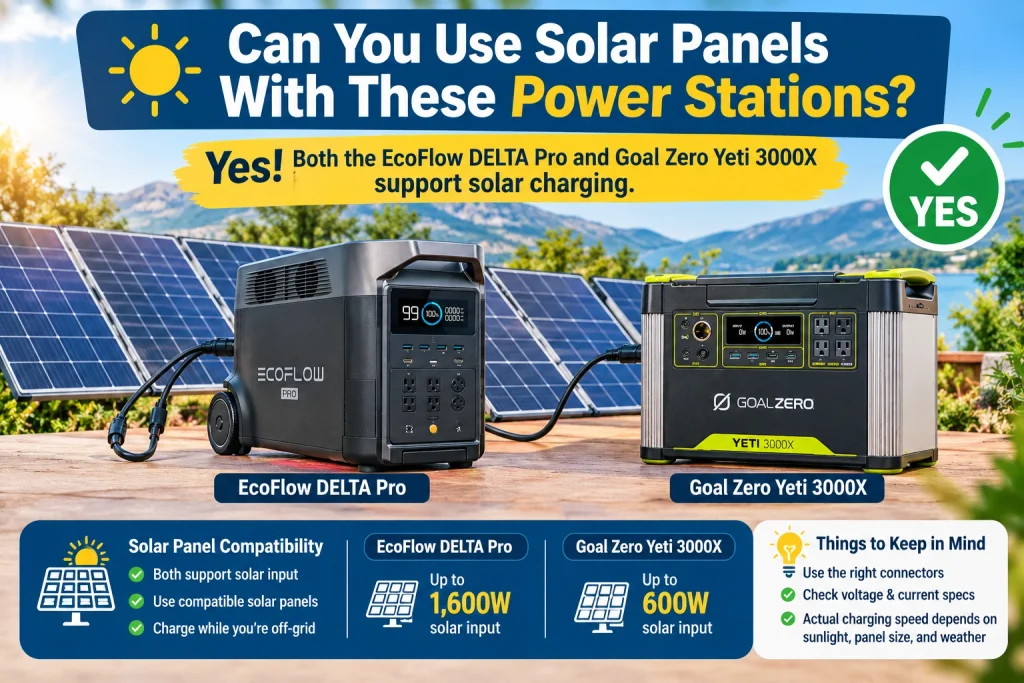
Yes, both systems can be recharged from solar panels.
However, solar-panel compatibility is not determined by wattage alone.
Before connecting panels, check:
- Maximum solar voltage
- Maximum solar current
- Maximum solar wattage
- Panel Voc
- Panel Vmp
- Temperature effects
- Series/parallel configuration
- Connector compatibility
For example, connecting several panels in series increases voltage, while connecting panels in parallel increases current.
The final configuration must stay inside the power station’s published electrical limits.
Never assume that a panel labeled “400W” is automatically compatible with every portable power station.
16. Is a Portable Power Station Enough for Whole-Home Backup?
Usually, a single 3kWh-class power station is better thought of as an essential-load backup system rather than unlimited whole-home power.
Your home’s total electricity consumption can be much higher than the energy stored in a portable battery.
Instead of attempting to power everything, identify critical loads.
A practical backup list might include:
Priority 1
- Refrigerator
- Medical equipment where appropriate
- Internet equipment
Priority 2
- Lighting
- Phones
- Computers
- Fans
Priority 3
- TV
- Small kitchen appliances
- Other convenience loads
Large electric heating and cooling appliances can consume the battery quickly.
17. Battery Safety Tips
Large lithium battery systems should be treated as serious electrical equipment.
Follow these basic practices:
- Use the manufacturer’s approved charging equipment.
- Keep the unit away from water.
- Do not operate it outside its specified temperature range.
- Do not modify the battery pack.
- Do not use damaged cables.
- Keep ventilation requirements clear.
- Follow the manufacturer’s storage instructions.
- Inspect the unit after significant physical damage.
- Do not attempt unauthorized battery repairs.
- Use qualified electrical professionals for home wiring integration.
For permanent home electrical connections, follow local electrical codes and manufacturer instructions.
18. Final Comparison
The EcoFlow DELTA Pro and Goal Zero Yeti 3000X are both substantial portable battery systems, but they target somewhat different priorities.
The DELTA Pro offers more battery capacity, substantially higher AC output, higher solar-input capability, LFP chemistry, and an expandable ecosystem.
The Yeti 3000X offers lower weight, a 3,032Wh battery, 2,000W continuous AC output, multiple output ports, solar charging, and home-integration options.
For a homeowner designing a more expandable solar-plus-battery backup system, the DELTA Pro’s specifications are particularly relevant.
For someone who places greater importance on portability and moderate backup loads, the Yeti 3000X remains a capable option, although its current manufacturer listing shows it as sold out.
The most important step is to calculate your actual household loads before purchasing. A power station should be selected based on both battery capacity (Wh) and inverter output (W), not simply the advertised battery size.
Frequently Asked Questions
Is the EcoFlow DELTA Pro more powerful than the Yeti 3000X?
Yes, in terms of rated AC output. The DELTA Pro is rated at 3,600W continuous output, while the Yeti 3000X is rated at 2,000W.
Which has the larger battery?
The EcoFlow DELTA Pro has a 3,600Wh battery compared with 3,032Wh for the Yeti 3000X.
Which battery lasts longer?
The DELTA Pro uses LFP chemistry and EcoFlow lists 3,500 cycles to 80%+ capacity. The Yeti 3000X uses NMC lithium-ion and Goal Zero lists 500 cycles to 80% capacity under its stated test conditions. Actual battery life depends on use and environmental conditions.
Which is easier to carry?
The Yeti 3000X is lighter at approximately 31.65kg, compared with approximately 45kg for the DELTA Pro.
Can the DELTA Pro be expanded?
Yes. EcoFlow describes an expandable ecosystem that can increase storage substantially with compatible batteries and equipment.
Can the Yeti 3000X be used for home backup?
Yes. Goal Zero describes the Yeti 3000X as suitable for emergency home backup and offers a Home Integration Kit for connecting selected home circuits.
Can both power stations use solar panels?
Yes. Both support solar charging, but the solar-panel voltage, current, wattage, and connection configuration must remain within the manufacturer’s specifications.
Can either power a refrigerator during an outage?
Both are designed to handle refrigerator loads, but actual runtime depends on the refrigerator’s energy consumption, startup surge, other connected loads, and battery state.
Important Buying Note
Specifications, availability, accessories, warranties, and regional versions can change. Always verify the exact model and current manufacturer documentation before purchasing.