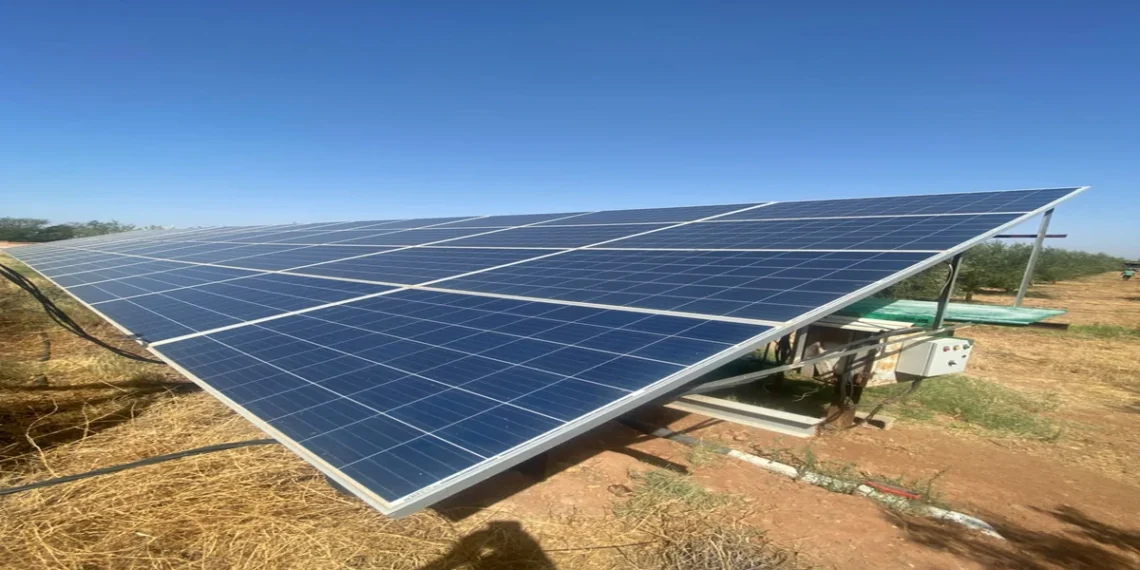

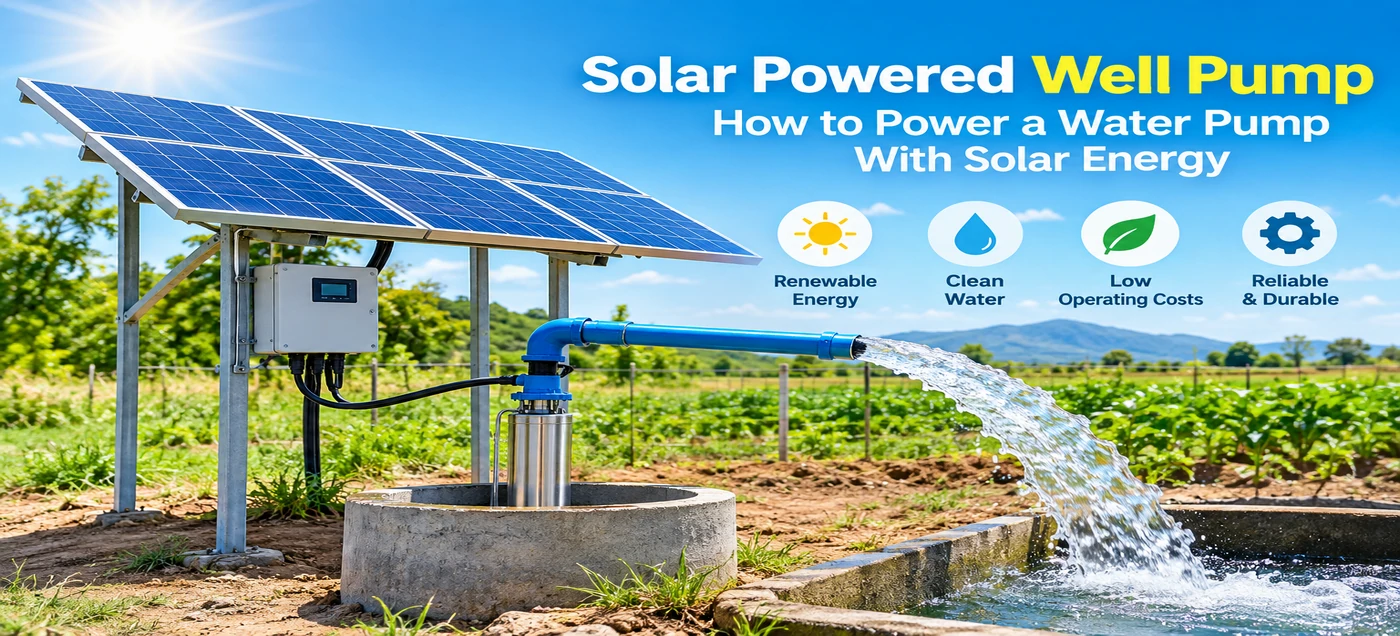
A solar powered well pump can provide water for a home, farm, livestock, irrigation system, or remote property without relying entirely on utility electricity or a fuel-powered generator.
Instead of connecting the pump directly to the electrical grid, a solar water pumping system uses solar panels to generate electricity that powers a pump. Depending on the design, the system can also use a controller, batteries, a water storage tank, or a backup power source.
But there is an important detail many people miss:
Sizing a solar well pump is not simply about choosing enough solar panels to match the pump’s horsepower.
You need to consider the amount of water required, the well depth, the water level while pumping, the vertical height to the storage tank or outlet, pipe losses, pump efficiency, available sunlight, and the required pumping schedule.
NREL guidance on photovoltaic water pumping identifies daily water demand and total pumping head as major factors in system sizing and recommends considering seasonal solar-resource conditions when designing the system.
This complete guide explains how solar powered well pumps work, how many solar panels you may need, whether batteries are necessary, how to size the system, what affects performance, and what to consider before installation.
Quick Answer: Can Solar Panels Power a Well Pump?
Yes.
Solar panels can power a well pump when the solar array, pump, controller, electrical equipment, and water system are properly matched.
A typical solar water pumping system can include:
- Solar panels
- Solar pump controller
- Submersible or surface pump
- Well or water source
- Pipes
- Water storage tank
- Electrical protection
- Optional battery storage
- Optional backup generator or grid connection
For many applications, storing water in a tank can be more practical than storing large amounts of electricity in batteries.
Solar pumping systems can operate when sunlight is available and pump water into a tank. The stored water can then be used later, including after sunset.
NREL notes that water storage requirements for photovoltaic pumping systems depend not only on daily demand but also on the variability of the renewable energy resource and local weather conditions.
What Is a Solar Powered Well Pump?
A solar powered well pump is a water pump that receives electrical energy generated by solar photovoltaic panels.
The basic process is:
Sunlight → Solar Panels → Pump Controller → Water Pump → Water Tank/Home/Irrigation
The solar panels produce electricity during daylight hours. The controller manages the electrical power supplied to the pump.
If the system uses a storage tank, the pump can move water from the well into the tank during the day.
The stored water can then be used for:
- Household water
- Livestock
- Irrigation
- Gardens
- Farms
- Remote cabins
- Off-grid properties
- Emergency water supplies
How Does a Solar Well Pump Work?
A solar well pumping system generally works in several stages.
1. Solar panels generate electricity
Solar photovoltaic panels convert sunlight into DC electricity.
2. The controller manages the power
A solar pump controller regulates the electrical supply and can help the pump operate efficiently as solar conditions change.
Some controllers are designed specifically for variable solar input.
3. The pump moves water
A pump draws water from the well or other water source and pushes it through the piping system.
4. Water is stored or delivered
Water can be pumped directly to a point of use or into a storage tank.
5. Water is used later
A storage tank can provide water when the solar panels are producing little or no electricity.
This is one reason solar water pumping can work well for remote locations.
Main Components of a Solar Water Pumping System
A reliable system usually requires more than solar panels and a pump.
Solar Panels
The PV array supplies the electrical energy required by the pump.
The required array size depends on the pump’s electrical demand, daily water requirement, pumping head, solar resource, and system efficiency.
Solar Pump Controller
The controller is an important part of the system.
Depending on the equipment, it can:
- Manage variable solar power
- Control pump operation
- Protect the pump
- Optimize available solar energy
- Monitor operating conditions
Always use equipment designed for the specific pump and electrical configuration.
Water Pump
The pump must be selected according to:
- Required flow rate
- Total dynamic head
- Well characteristics
- Water source
- Duty cycle
- Electrical supply
Water Storage Tank
A tank can act as the system’s energy buffer.
Instead of storing all excess solar electricity in batteries, the system stores water that has already been pumped.
Pipes
Pipe diameter, length, fittings, elevation, and flow rate affect hydraulic losses.
Electrical Protection
Depending on the installation, the system may require appropriate:
- Disconnects
- Circuit protection
- Grounding
- Surge protection
- Overload protection
- Weather-resistant enclosures
Electrical requirements depend on the equipment and local regulations.
Why Water Storage Can Be Better Than Battery Storage
One of the most useful concepts in solar pumping is that you don’t necessarily have to store electricity.
Imagine a farm needs water throughout the day and evening.
Instead of:
Solar → Battery → Pump → Water
you could use:
Solar → Pump → Water Tank
The tank stores the useful output: water.
This can simplify the system and reduce dependence on large battery banks.
NREL’s photovoltaic water-pumping guidance specifically discusses the importance of water-tank sizing because solar energy availability varies with weather and seasons.
However, batteries can still be useful when the pump must operate at times when solar power is unavailable or when the system has additional electrical loads.
How Many Solar Panels Do You Need for a Well Pump?
There is no single number that works for every well pump.
The number of panels depends on the pump’s electrical power and the amount of water you need to move.
A simplified starting point is:
Solar array power ≈ Pump electrical power ÷ system performance factor
For example, suppose a pump requires approximately 1,000 watts while operating.
A designer might choose an array larger than 1 kW to provide additional operating margin because solar output varies during the day.
But this is only a starting point.
A proper design should consider:
- Daily water volume
- Pump operating hours
- Pump efficiency
- Total dynamic head
- Solar radiation
- Temperature
- Panel orientation
- Seasonal conditions
- Controller requirements
- Wiring losses
NREL’s PV pumping guidance uses water demand, pumping head, subsystem efficiency, and solar radiation to determine an appropriate PV array size.
Solar Well Pump Sizing: The Most Important Calculation
The most important question is not:
“How many watts is my pump?”
It is:
“How much water do I need, and how high and far must I pump it?”
Two pumps with the same electrical rating can produce very different water flow depending on the pumping head.
Step 1: Determine Your Daily Water Requirement
Start by estimating how much water you need each day.
For example:
| Application | Example Daily Requirement |
|---|---|
| Small cabin | 100–300 L/day |
| Small household | 300–1,000+ L/day |
| Livestock | Depends on animals and climate |
| Garden | Depends on area and irrigation method |
| Farm irrigation | Can be thousands of liters/day |
| Large agricultural operation | May require substantially more |
These are illustrative ranges, not universal design requirements.
Actual water demand depends on the number of people, animals, crop, climate, irrigation method, season, and local practices.
For irrigation, calculate water demand based on the land area and crop requirements rather than using a household estimate.
NREL guidance similarly identifies population, livestock, and irrigated area/crop requirements as important inputs when determining water demand.
Step 2: Determine the Total Pumping Head
This is one of the most important parts of solar well pump sizing.
The pump must overcome the total dynamic head, not simply the well depth.
Total head can include:
Static water level + drawdown + elevation + pipe friction + fittings and other losses
For a groundwater well, the water level can change while pumping.
NREL defines pumping head for a borehole application using the static water level plus drawdown, while total pumping head also accounts for friction and discharge elevation.
Example
Suppose:
- Static water level = 40 m
- Drawdown = 10 m
- Height to tank = 8 m
- Pipe/friction losses = 5 m
Then:
Total head = 40 + 10 + 8 + 5
Total head = 63 m
The pump must be capable of delivering the required flow at approximately this operating head.
Step 3: Determine Required Flow Rate
Suppose you need:
5,000 liters/day
and you want to pump water for approximately:
5 effective pumping hours/day
Then:
5,000 ÷ 5 = 1,000 liters/hour
That is approximately:
16.7 liters/minute
This gives you a starting point for selecting a pump.
However, actual solar pumping performance changes throughout the day, so pump selection should be based on the manufacturer’s pump curve and the site’s expected operating conditions.
Step 4: Calculate Hydraulic Energy
Moving water requires energy.
A simplified hydraulic-energy relationship is:
E = ρ × g × V × H
Where:
- E = hydraulic energy
- ρ = water density
- g = gravitational acceleration
- V = water volume
- H = total pumping head
The real electrical requirement will be higher because the pump, motor, controller, wiring, and other components are not 100% efficient.
This is why pump sizing should not rely only on horsepower.
Step 5: Account for Pump and System Efficiency
A real solar pumping system experiences losses.
Potential losses include:
- Solar panel conversion losses
- Temperature effects
- Wiring losses
- Controller losses
- Motor losses
- Pump losses
- Pipe friction
- Mechanical losses
A simplified design relationship is:
Required electrical energy = Hydraulic energy ÷ overall efficiency
For example, if the hydraulic requirement is 3 kWh/day and the overall planning efficiency is 60%:
3 ÷ 0.60 = 5 kWh/day
This is only an illustrative calculation.
Actual engineering calculations should use the efficiency data for the specific pump, motor, controller, and system.
Step 6: Consider Solar Resource
Solar production varies during the day and across seasons.
A system designed using only the best summer conditions may not provide enough water during periods with lower solar availability.
NREL recommends considering the worst seasonal combination of solar resource and water demand when sizing photovoltaic pumping systems.
This is especially important for:
- Agricultural irrigation
- Livestock water
- Remote homes
- Critical water supplies
Solar Well Pump Example
Let’s consider an illustrative system.
Suppose a property needs:
5,000 liters/day
The total pumping head is:
60 meters
The system is expected to have approximately:
5 effective solar hours/day
Assume a simplified overall system efficiency of:
60%
First, determine the approximate hydraulic energy requirement.
For water:
E = ρ × g × V × H
Using:
- ρ ≈ 1,000 kg/m³
- g ≈ 9.81 m/s²
- V = 5 m³
- H = 60 m
The hydraulic energy is approximately:
2.94 MJ
Converting to kWh:
2.94 MJ ÷ 3.6 ≈ 0.82 kWh
If the overall efficiency were 60%:
0.82 ÷ 0.60 ≈ 1.37 kWh/day
This simplified calculation demonstrates why head and water volume matter.
However, real pump-system sizing must also account for the pump’s operating point, friction losses, controller behavior, solar availability, and manufacturer performance data.
Do Solar Well Pumps Work at Night?
A solar panel system without energy storage generally cannot produce normal solar power at night.
There are three common solutions.
Option 1: Store Water
Pump water during daylight into a storage tank.
This is often the simplest solution for water-only applications.
Option 2: Use Batteries
Solar electricity can charge batteries during the day, allowing the pump to operate later.
This adds battery cost, maintenance, conversion losses, and additional equipment.
Option 3: Use Grid or Generator Backup
A hybrid system can use solar during suitable conditions and another power source when required.
The appropriate option depends on how critical the water supply is.
Solar Pump With Battery vs. Water Tank
| Feature | Battery Storage | Water Tank |
|---|---|---|
| Stores | Electricity | Water |
| Night operation | Yes | Yes, if enough water is stored |
| Complexity | Higher | Often simpler |
| Maintenance | Battery-dependent | Tank/plumbing maintenance |
| Useful for water-only systems | Sometimes | Often very useful |
| Backup duration | Based on battery size | Based on stored water |
For many water-pumping applications, it makes sense to investigate water storage before automatically adding a large battery.
Submersible vs. Surface Solar Water Pump
Submersible Pump
A submersible pump is installed inside the well or water source.
It can be appropriate for deeper wells because the pump pushes water upward.
Advantages can include:
- Suitable for deeper wells
- No suction-lift limitation at the surface
- Compact installation
However, installation and maintenance may require removing equipment from the well.
Surface Pump
A surface pump stays outside the water source.
It can be appropriate for shallow sources and certain tanks or reservoirs.
The choice depends heavily on water-source depth and the pump’s operating characteristics.
Can Solar Power a Deep Well Pump?
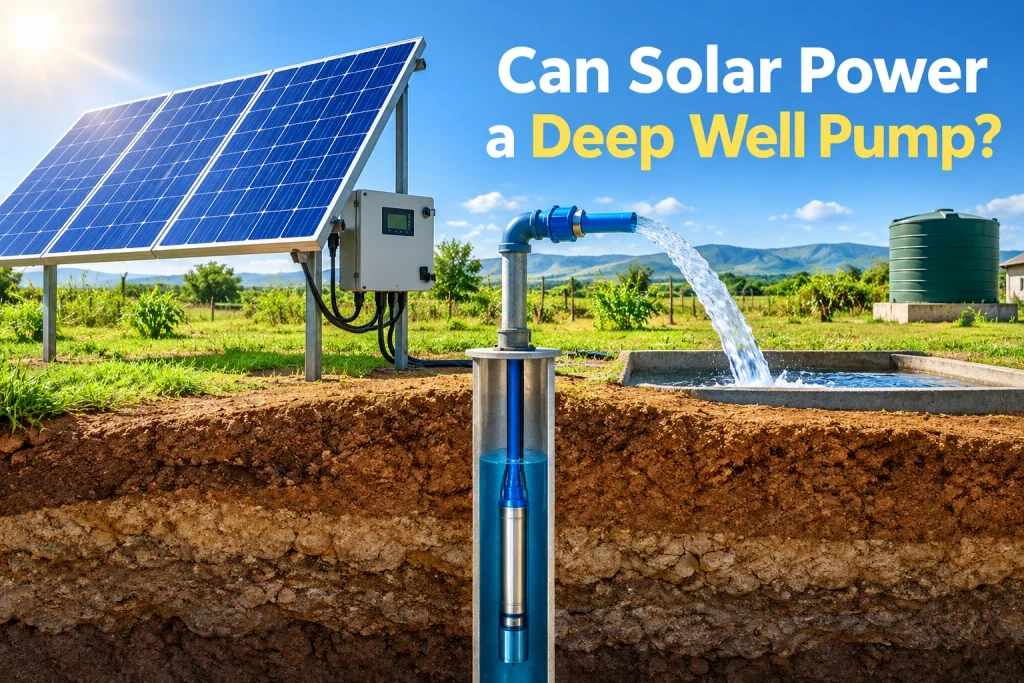
Yes, but deep wells require careful system design.
As well depth increases, the pump must generally overcome a greater vertical head.
However, well depth is not always the same as pumping head.
You need to know:
- Static water level
- Dynamic water level
- Drawdown
- Desired discharge elevation
- Pipe friction
- Required flow
A professional well test can provide important information about the available water and changing water levels.
Solar Well Pump for Irrigation
Solar pumping can be useful for agricultural irrigation because water demand often occurs during daylight hours when solar energy is available.
A typical agricultural system may look like:
Solar panels → Pump controller → Pump → Irrigation system
or:
Solar panels → Pump → Storage tank → Irrigation
The correct design depends on:
- Crop
- Irrigated area
- Soil
- Irrigation method
- Daily water requirement
- Seasonal demand
- Well yield
- Pumping head
- Solar resource
For large irrigation projects, professional hydraulic and solar design is recommended.
Solar Powered Well Pump for Livestock
Livestock watering can be an excellent application for solar pumping.
The system can pump water from a well into a storage tank.
Animals then access the water through:
- Troughs
- Float valves
- Pressure systems
- Distribution pipes
The tank provides a reserve when clouds temporarily reduce solar production.
When sizing the system, account for:
- Number of animals
- Animal type
- Seasonal water consumption
- Climate
- Distance to troughs
- Elevation changes
- Storage capacity
Do not size the pump solely according to the pump’s horsepower.
How Large Should the Water Tank Be?
There is no universal tank size.
A basic approach is:
Tank capacity = required water reserve × desired backup days
For example, if a property requires:
2,000 liters/day
and you want:
2 days of water storage
then a simple planning calculation is:
2,000 × 2 = 4,000 liters
You may need additional capacity depending on:
- Seasonal solar conditions
- Pump availability
- Well recovery
- Water demand peaks
- Emergency requirements
NREL notes that PV-powered water systems can require larger water storage than conventional systems because solar availability is intermittent and varies with weather.
What Happens on Cloudy Days?
Solar panels continue producing electricity during cloudy weather, but output can be significantly lower than under strong sunlight.
If the system is designed only around perfect sunny conditions, water production may fall during prolonged periods of poor solar resource.
Possible solutions include:
- Larger solar array
- Larger water tank
- Battery storage
- Backup generator
- Grid connection
- Reduced pumping demand
The best solution depends on how critical the water supply is.
Should You Oversize the Solar Array?
Some additional solar capacity can provide useful operating margin.
However, simply installing a huge number of panels is not always the best solution.
The pump controller must be compatible with the array.
The pump also has operating limits.
A properly designed system should match:
Solar array + controller + motor + pump + hydraulic system
NREL research emphasizes matching the PV array and motor-pump subsystem to local solar conditions to improve system performance.
Solar Pump Controller: Why It Matters
The controller is often the bridge between the solar array and pump.
A suitable controller may provide:
- Maximum power point tracking
- Pump protection
- Dry-run protection
- Variable-speed operation
- Overvoltage protection
- Overcurrent protection
- Monitoring
Features differ by manufacturer.
Always verify the controller’s voltage, current, power, and motor compatibility.
What Size Solar Pump Do You Need?
Do not choose a pump based only on horsepower.
Instead, identify the required:
Flow rate
How much water must be delivered?
Total dynamic head
How high and how far must the water travel?
Operating schedule
How many hours per day should the pump operate?
Water source
Is it a deep well, shallow well, tank, pond, or surface reservoir?
Solar resource
How much solar energy is available during the critical season?
Storage
Will water be stored in a tank?
This information allows the pump to be selected according to its performance curve.
Horsepower vs. Kilowatts
Pump specifications may be listed in horsepower.
A simplified conversion is:
1 horsepower ≈ 746 watts
So:
1 HP ≈ 0.746 kW
But remember:
This does not mean a 1 HP pump necessarily consumes exactly 746 watts from the solar system.
Real electrical consumption depends on:
- Motor efficiency
- Pump efficiency
- Operating point
- Controller
- Pump load
Always use the manufacturer’s electrical specifications when sizing the PV array.
How Much Does a Solar Well Pump System Cost?
The cost can vary significantly.
Major cost factors include:
- Solar panel capacity
- Pump type
- Pump power
- Well depth
- Pumping head
- Controller
- Mounting structure
- Wiring
- Water tank
- Pipework
- Trenching
- Installation labor
- Electrical protection
- Battery storage
- Backup equipment
A small shallow-water system can be dramatically less expensive than a large agricultural well system.
Because project conditions vary so much, avoid relying on a single generic price when planning an installation.
The best approach is to obtain a detailed quote based on your actual water demand and well characteristics.
How to Reduce Solar Well Pump Costs
1. Use Water Storage
A properly sized tank can reduce the need for large battery storage.
2. Improve Irrigation Efficiency
Drip irrigation can reduce water demand compared with less efficient irrigation methods in suitable applications.
3. Reduce Pipe Losses
Proper pipe sizing can reduce unnecessary friction losses.
4. Choose the Correct Pump
A pump that operates efficiently near the required flow and head can improve the overall system.
5. Compare Multiple Quotes
Ask installers to provide:
- Pump model
- Controller model
- Solar array size
- Expected daily water production
- Design head
- Flow rate
- Tank size
- Warranty
- Installation cost
Common Solar Well Pump Mistakes
Mistake 1: Sizing Only by Pump Horsepower
Horsepower does not tell you how much water the pump will deliver at a particular head.
Mistake 2: Ignoring Drawdown
The water level can fall while the well is being pumped.
Mistake 3: Ignoring Pipe Friction
Long or undersized pipes can increase head losses.
Mistake 4: Designing for Perfect Sunlight
Solar output varies with weather and seasons.
Mistake 5: Forgetting Water Storage
A system may produce enough water on sunny days but struggle during poor solar conditions without sufficient storage.
Mistake 6: Using an Incompatible Controller
The controller must match the PV array and pump motor.
Mistake 7: Ignoring Well Yield
A pump can be correctly sized electrically but still exceed the sustainable yield of the well.
Mistake 8: No Backup Plan for Critical Water
If water is essential for a home, livestock, or irrigation operation, consider how the system will operate during prolonged poor weather or equipment failure.
Is a Solar Powered Well Pump Worth It?
A solar well pump can be particularly useful when:
- Grid electricity is unavailable
- The property is remote
- Fuel delivery is difficult
- Water is needed during daylight
- A storage tank can be used
- Solar resources are suitable
- Long-term operating costs matter
The economics depend on the complete project rather than the pump alone.
Compare:
Solar equipment + installation + maintenance
against:
Grid electricity + fuel + generator operation + maintenance
for your specific location and water requirements.
Solar Well Pump System Checklist
Before buying equipment, collect these numbers:
Water
- Daily water requirement
- Peak water demand
- Well yield
- Static water level
- Dynamic water level
- Drawdown
Hydraulic system
- Required flow
- Total pumping head
- Pipe length
- Pipe diameter
- Elevation to tank
- Friction losses
Solar
- Solar resource
- Critical season
- Panel orientation
- Shading
- Required PV capacity
Electrical
- Pump voltage
- Pump power
- Controller compatibility
- Wiring
- Protection equipment
- Grounding
Storage
- Water tank capacity
- Battery requirement, if any
- Backup power requirement
This information gives an installer or system designer the data needed to build a much more accurate system.
Frequently Asked Questions
Can I run a well pump directly from solar panels?
Yes, if the pump and controller are designed for the available solar power. A dedicated solar pump controller can manage changing PV output.
Can a solar pump work without batteries?
Yes. A system can pump water during daylight and store the water in a tank. Batteries are optional depending on the application’s requirements.
How many solar panels do I need for a 1 HP well pump?
There is no universal panel count. A 1 HP label does not provide enough information to determine the correct PV array. You need the pump’s electrical specifications, operating point, daily water requirement, pumping head, solar resource, and controller requirements.
Can solar power a deep well pump?
Yes. Deep wells can be powered by solar, but the system must be designed around the actual pumping head, water level, required flow, pump curve, and available solar energy.
Can solar pumps work on cloudy days?
Yes, but reduced sunlight can reduce pump output. A water tank, larger PV array, battery, grid connection, or backup generator can provide additional resilience.
Is a solar water pump better than a generator?
It depends on the application. Solar can reduce fuel use and ongoing operating requirements, while generators can provide power when solar production is unavailable. A hybrid design may be appropriate for critical applications.
Can a solar pump fill a water tank?
Yes. Pumping water into a storage tank is one of the common ways to use solar water pumping.
Can I use a normal AC well pump with solar panels?
It may be possible with the appropriate inverter and system design, but a pump specifically designed for solar operation can simplify the system. Compatibility must be checked before connecting equipment.
How long does a solar water pump last?
Lifespan depends on the pump, motor, operating conditions, water quality, maintenance, duty cycle, and installation quality. Follow the manufacturer’s maintenance and replacement recommendations.
Final Thoughts
A solar powered well pump can turn sunlight into a practical source of water for homes, farms, livestock, irrigation, and remote properties.
The key to a successful installation is proper sizing.
Don’t start with the number of solar panels.
Start with:
How much water do I need?
Then determine:
How deep is the water?
How much does the water level change while pumping?
How high must the water be lifted?
How much pipe friction is present?
How much water must the pump deliver each day?
Finally, match the pump, controller, solar array, piping, and water storage to those requirements.
For many applications, a water storage tank can provide an efficient way to deal with the intermittent nature of solar energy. NREL’s solar pumping guidance emphasizes water demand, total pumping head, system efficiency, solar resource, and seasonal conditions as key design considerations.
A well-designed system can therefore be much more than simply solar panels + pump. It is a complete water-and-energy system that should be sized around the property’s real needs.