
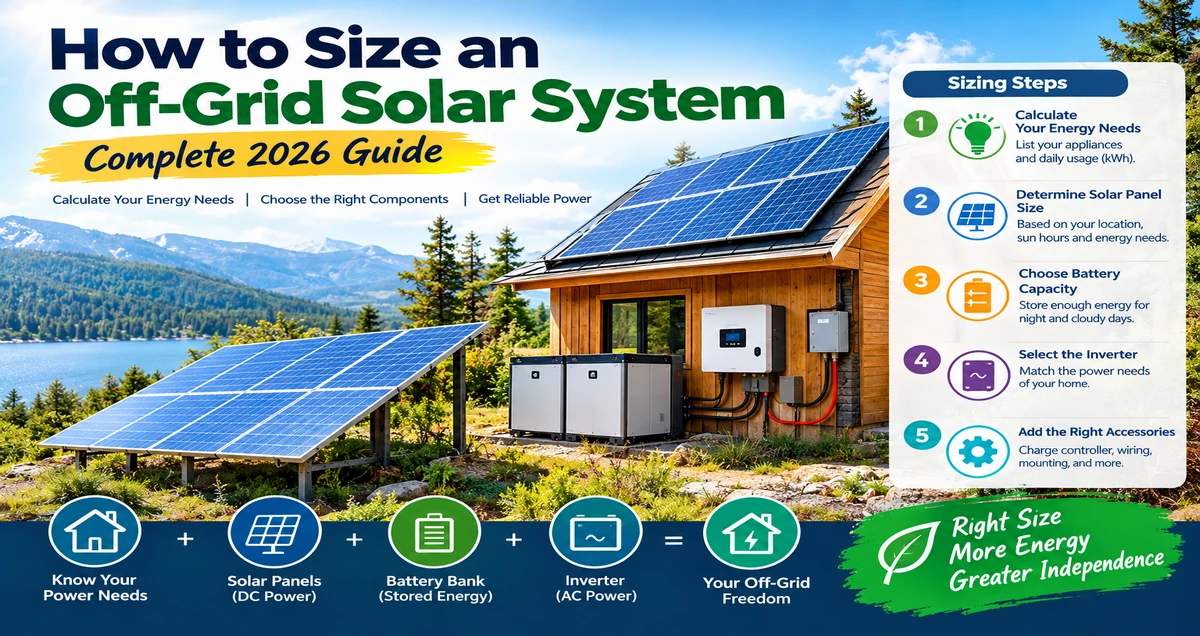
Sizing an off-grid solar system correctly is one of the most important steps when designing a home solar setup that does not depend on the utility grid.
Unlike a typical grid-connected solar system, an off-grid system must be designed to produce and store enough electricity for the home’s actual needs. That means you need to consider not only solar panels, but also battery capacity, inverter power, daily energy consumption, sunlight availability, system losses, seasonal changes, and backup requirements.
If the system is too small, you may run out of stored energy. If it is unnecessarily large, you may spend more money than needed.
So, how do you calculate the right size?
This guide explains how to size an off-grid solar system step by step, including solar panels, batteries, inverters, charge controllers, energy consumption, cloudy days, and practical examples.
Quick answer: Start with your daily electricity consumption in kWh, then estimate the solar resource at your location, account for system losses and battery needs, and size the inverter according to your peak electrical loads. An off-grid system should be designed around actual energy use rather than simply choosing a standard 5kW or 10kW package.
What Is an Off-Grid Solar System?
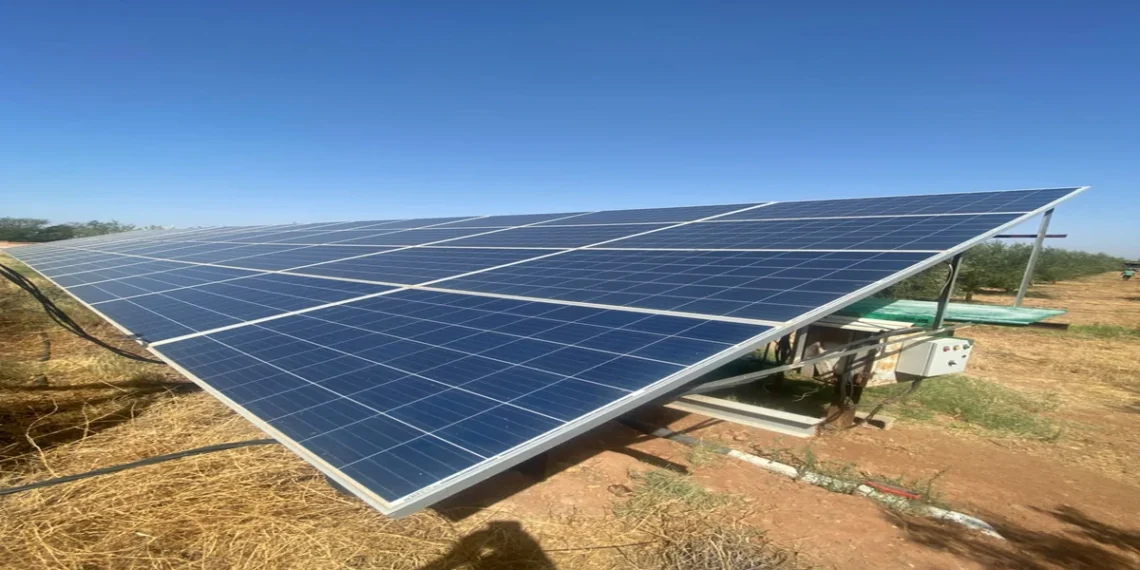
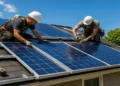
An off-grid solar system is a solar power system designed to operate independently of the utility grid.
A typical system can include:
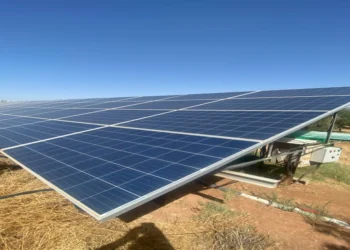
- Solar panels
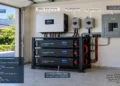
- Battery storage
- Solar inverter
- Charge controller or integrated charging electronics
- Mounting equipment
- Electrical protection
- Monitoring equipment
- Backup generator, in some installations
The solar panels generate electricity during daylight hours, while the batteries store energy for later use.
This is particularly important because solar production changes throughout the day and is unavailable from normal photovoltaic generation at night. Energy storage allows electricity generated earlier to be used later.
A simplified system looks like this:
Sunlight → Solar panels → Inverter → Home
and:
Solar panels → Battery → Home when needed
Why Off-Grid Solar System Sizing Is Different
A grid-connected system can often draw electricity from the utility when solar production is insufficient.
A truly off-grid home does not have that option.
Your system therefore needs to account for:
- Daily energy consumption
- Peak power demand
- Solar production
- Battery storage
- System losses
- Weather
- Seasonal changes
- Required backup days
- Future electricity consumption
This is why simply saying “I need a 5kW solar system” is not enough.
You need to understand both:
Power — kW
and:
Energy — kWh
kW vs kWh: The Most Important Difference
Understanding this distinction makes solar sizing much easier.
kW = Power
Kilowatts describe how much electrical power is being used or supplied at a particular moment.
For example:
- Refrigerator: relatively low power
- Microwave: higher power
- Electric heater: high power
- Well pump: potentially high starting demand
kWh = Energy
Kilowatt-hours describe how much electricity is consumed or stored over time.
For example, a home using 20 kWh per day needs substantially more energy than a home using 8 kWh per day.
Battery storage is commonly described in kWh, while inverter output is commonly described in kW.
The U.S. Department of Energy also distinguishes storage energy capacity from power capacity: energy capacity describes how much energy can be stored, while power capacity describes how much power can be delivered at a given time.
Step 1: Calculate Your Daily Electricity Consumption
The first step is determining how much electricity your home uses every day.
Create a list of your appliances and estimate:
Power × hours of use = daily energy
For example:
| Appliance | Power | Daily Use | Approx. Daily Energy |
|---|---|---|---|
| Refrigerator | 150W | 10 hours equivalent | 1.5 kWh |
| Lights | 100W | 5 hours | 0.5 kWh |
| TV | 100W | 4 hours | 0.4 kWh |
| Laptop | 60W | 5 hours | 0.3 kWh |
| Pump | 750W | 1 hour | 0.75 kWh |
| Other loads | — | — | 2.0 kWh |
| Total | — | — | 5.45 kWh/day |
This is an illustrative example. Actual appliance consumption can be very different.
The best starting point is your real electricity bills if you have them. If the home has never been connected to the grid, estimate each load individually.
Step 2: Add Future Electricity Loads
Don’t size your off-grid system only for today’s appliances.
Think about what you may add later:
- Air conditioning
- Freezer
- Electric water heater
- Washing machine
- Well pump
- Electric cooking
- EV charging
- Workshop tools
- Larger refrigerator
- Heating
- Internet equipment
- Security systems
For an off-grid property, adding a major electrical load later can require additional solar, battery capacity, or inverter capacity.
Planning ahead can be cheaper than redesigning the entire system.
Step 3: Determine Your Daily kWh Requirement
Suppose your estimated household consumption is:
8 kWh/day
You should then account for energy losses.
Solar systems have losses associated with components and operating conditions, and batteries are not 100% efficient. The DOE notes that energy storage involves losses when energy is converted and retrieved.
For a simplified planning calculation, you might use a system-efficiency assumption such as 80%.
Then:
8 kWh ÷ 0.80 = 10 kWh/day
This means the solar system may need to generate roughly 10 kWh of useful energy to reliably support an 8 kWh daily load under the stated assumption.
This is an example—not a universal design factor.
Actual system losses depend on the equipment and operating conditions.
Step 4: Find Your Peak Sun Hours
The next question is:
How much useful sunlight does your location receive?
Solar production varies by:
- Location
- Season
- Cloud cover
- Panel orientation
- Tilt
- Shading
- Temperature
- Dust and dirt
- Weather
- System losses
The DOE notes that solar production can vary because of season, time of day, clouds, dust, haze, rain, snow, dirt, and shadows.
For an initial calculation, you can use your location’s estimated peak sun hours per day.
For example, suppose your planning value is:
5 peak sun hours/day
Step 5: Calculate Solar Panel Capacity
A simplified formula is:
Required solar capacity = daily energy requirement ÷ peak sun hours
Using our example:
10 kWh ÷ 5 hours = 2 kW
That gives a basic solar capacity of approximately:
2kW
However, an off-grid system often needs additional margin because solar conditions are not identical every day.
For a real design, you should consider the lower-production season rather than relying only on an annual average.
Step 6: Add a Solar Production Margin
Off-grid systems need to deal with periods when solar production is lower.
Clouds, storms, shorter winter days, shading, snow, dust, and other conditions can reduce solar generation.
For example, if your basic calculation produces:
2kW
you might investigate a larger array such as:
2.5–3kW
depending on the location, battery strategy, desired reliability, and seasonal production.
There is no universal percentage that should be added to every off-grid system.
The appropriate margin depends on the design objective.
How Many Solar Panels Do You Need?
Once you know the approximate solar capacity, panel count is straightforward.
Formula
Number of panels = required solar capacity ÷ panel wattage
For example, if you need approximately:
3,000W
and use:
400W panels
then:
3,000 ÷ 400 = 7.5
You would need approximately 8 panels to exceed 3kW of nominal panel capacity.
Actual system design may use a different number based on panel specifications, inverter limits, roof or ground layout, and electrical configuration.
Off-Grid Solar Panel Sizing Example
Let’s build a more complete example.
Suppose a small off-grid home uses:
8 kWh/day
Assume:
- System efficiency: 80%
- Planning solar resource: 5 peak sun hours/day
First:
8 ÷ 0.80 = 10 kWh
Then:
10 ÷ 5 = 2kW
The basic calculation suggests approximately:
2kW of solar capacity
But because this is an off-grid system, the designer may increase the array to provide additional production during less favorable conditions.
For example, a system around 2.5–3kW could be investigated as a planning range.
The final size should be based on location-specific production data and the desired level of reliability.
Step 7: Size the Battery Bank
Solar panels produce energy during the day.
Your home also needs electricity when the sun is weak or unavailable.
That’s where the battery comes in.
Battery sizing depends on:
- Daily energy consumption
- Required backup duration
- Battery chemistry
- Usable depth of discharge
- Temperature
- System efficiency
- Desired reserve
- Seasonal solar production
What Is Battery Backup Duration?
Backup duration describes how long your battery can supply your loads without sufficient solar production.
For example:
1 day of autonomy
means the battery is intended to cover approximately one day’s energy requirement under the specified assumptions.
2 days of autonomy
means approximately two days.
Some off-grid systems are designed around more than one day of stored energy because weather can reduce solar production for extended periods.
The appropriate autonomy depends on the location and how much backup reliability is required.
Battery Sizing Formula
A simplified formula is:
Battery nominal capacity = daily energy use × days of autonomy ÷ usable battery fraction
Suppose:
- Daily use = 8 kWh
- Autonomy = 2 days
- Usable battery fraction = 80%
Then:
8 × 2 ÷ 0.80 = 20 kWh
A battery bank of approximately 20 kWh nominal capacity would be a starting calculation under these assumptions.
Real-world design should also consider charging losses, temperature, battery specifications, inverter efficiency, and reserve requirements.
Usable Battery Capacity vs Rated Capacity
This is an important detail when comparing batteries.
A battery might have a stated capacity of:
10 kWh
but the usable energy available to your home may be lower depending on the manufacturer’s operating limits and system settings.
Always distinguish between:
Rated capacity
and:
Usable capacity
The manufacturer’s specifications should be used for the actual battery model.
Lithium vs Lead-Acid for Off-Grid Solar
Common battery technologies include lithium-ion and lead-acid, among others.
Lithium Batteries
Lithium-based batteries are widely used in modern solar storage systems.
Potential advantages include:
- High energy density
- Good cycling performance
- Lower maintenance requirements for many systems
- Flexible installation options depending on the product
Lithium iron phosphate, or LiFePO4, is one lithium chemistry commonly used in stationary storage.
Lead-Acid Batteries
Lead-acid batteries have been used in off-grid systems for many years.
They can still be suitable for some applications, but their charging requirements, usable capacity, weight, and maintenance characteristics need to be considered.
The best battery is the one that fits the system’s technical requirements and operating conditions.
Step 8: Size the Inverter
Solar panels and batteries determine how much energy the system can produce and store.
The inverter determines how much AC power can be supplied to your appliances at a given time.
This means inverter sizing is based on power, not simply daily energy.
How to Calculate Inverter Size
Make a list of appliances that might operate simultaneously.
For example:
| Appliance | Power |
|---|---|
| Refrigerator | 150W |
| Lights | 150W |
| TV | 100W |
| Computer | 150W |
| Pump | 750W |
| Microwave | 1,200W |
| Total | 2,500W |
If all of these loads operate simultaneously, the continuous demand could approach:
2.5kW
You would then need an inverter capable of handling the expected continuous load, with appropriate headroom.
Don’t Forget Starting Surge
Some appliances require more power when they start.
Common examples can include:
- Pumps
- Refrigerators
- Freezers
- Compressors
- Certain power tools
- Air-conditioning equipment
An appliance that runs at 750W may require substantially more power briefly during startup.
Therefore, the inverter should be checked for both:
Continuous power
and:
Surge/peak power
The actual starting requirement should come from the appliance or motor specifications whenever possible.
What Size Inverter for an Off-Grid Home?
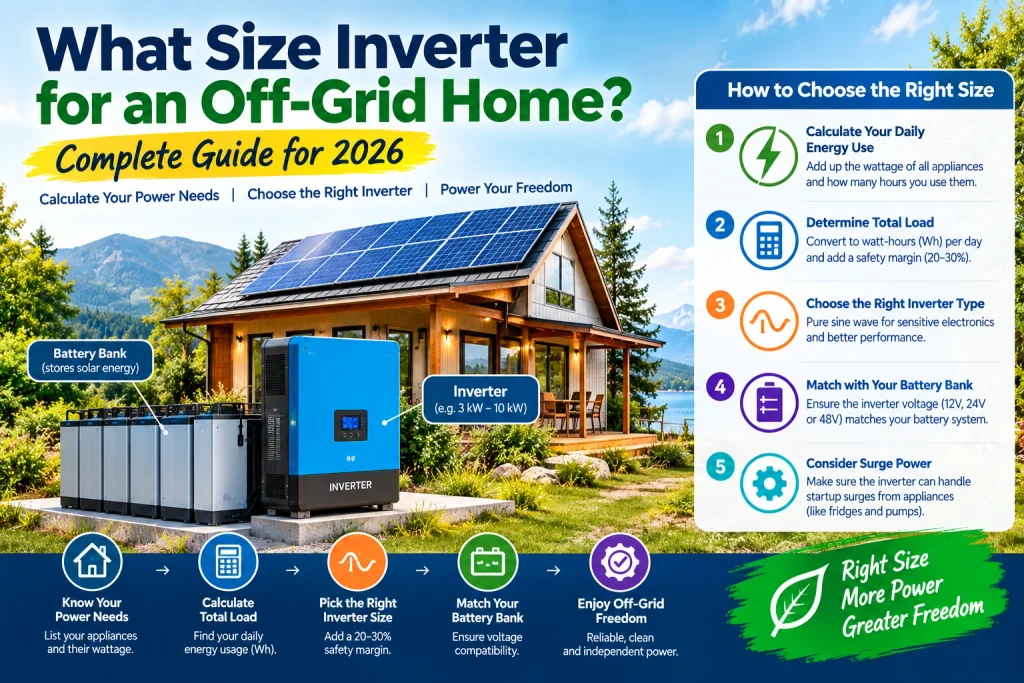
There is no universal inverter size.
A small cabin with efficient appliances might need only a few kilowatts.
A larger off-grid home with electric cooking, pumps, air conditioning, and power tools may require significantly more.
For example:
- Small loads → around 2–3kW may be considered
- Moderate loads → around 3–6kW may be considered
- Higher loads → 6kW or more may be appropriate
These are planning examples, not universal recommendations.
Your actual inverter should be selected from the calculated continuous and surge loads and the manufacturer’s specifications.
Step 9: Size the Charge Controller
If your system uses a separate solar charge controller, it must be compatible with:
- Solar array voltage
- Solar array current
- Battery voltage
- Maximum charging current
- Panel configuration
Modern hybrid/off-grid inverters may integrate MPPT solar charge controllers, eliminating the need for a separate standalone controller.
Always follow the equipment manufacturer’s voltage and current limits.
Step 10: Consider the Worst Solar Conditions
This is one of the most important steps in off-grid solar sizing.
A system that performs well on a sunny summer day may struggle during:
- Winter
- Extended cloudy periods
- Storms
- Snow
- Heavy rain
- Dust events
- Short daylight periods
The DOE emphasizes that solar production changes with weather, season, time of day, and environmental conditions.
For an off-grid home, designing around only the best solar month can create reliability problems.
How Many Days of Battery Backup Do You Need?
There is no single answer.
A system in a location with reliable sunshine may use a different storage strategy from a system in an area that regularly experiences several cloudy days.
Consider:
- Local weather
- Winter solar production
- Critical loads
- Generator availability
- Battery cost
- Desired reliability
- Ability to reduce consumption
Some homeowners may choose one day of autonomy, while others may want multiple days.
A backup generator can also be used as part of an off-grid energy strategy.
Off-Grid Solar System Sizing Example
Let’s put everything together.
Suppose an off-grid home consumes:
10 kWh/day
Assume:
- 5 peak sun hours/day
- 80% overall planning efficiency
- 2 days of battery autonomy
- 80% usable battery fraction
Solar requirement
First:
10 ÷ 0.80 = 12.5 kWh/day
Then:
12.5 ÷ 5 = 2.5kW
A basic calculation therefore produces:
2.5kW solar capacity
A real off-grid design may use a larger array to improve charging capability and account for seasonal production.
Battery requirement
10 × 2 ÷ 0.80 = 25 kWh
So approximately:
25kWh nominal battery capacity
would be the starting point under these assumptions.
Inverter
If the calculated simultaneous appliance load is:
4kW
with significant motor-starting loads, the inverter needs to be selected based on both continuous output and surge capability.
This example demonstrates why solar panels, batteries, and inverters must be sized together.
Should You Oversize an Off-Grid Solar Array?
Sometimes.
A larger solar array can provide benefits such as:
- Faster battery charging
- Better winter production
- More energy during cloudy conditions
- More available energy for daytime loads
- Greater ability to recover after several low-solar days
But oversizing also increases:
- Equipment cost
- Installation cost
- Required space
- Electrical design requirements
The goal is not to install the biggest possible system.
The goal is to install a system that provides the desired energy and reliability at a reasonable total cost.
What About a Backup Generator?
A generator can be useful in an off-grid system, especially in areas with extended periods of poor solar production.
A hybrid strategy can look like:
Solar → Home
Solar → Battery
Battery → Home
Generator → Battery/Home when required
A generator may reduce the amount of battery and solar capacity needed for extreme weather periods.
However, fuel availability, operating cost, maintenance, noise, emissions, and local requirements should be considered.
Off-Grid Solar for Different Types of Homes
Small Cabin
A cabin using efficient lighting, refrigeration, electronics, and occasional appliances may require a relatively small system.
Tiny Home
A tiny home can have low energy consumption, but electric heating, water heating, or cooking can dramatically increase demand.
Full-Time Off-Grid Home
A full-time home usually requires much more careful sizing because electricity is needed every day and throughout the year.
Farm or Rural Property
Pumps, workshops, electric fencing, refrigeration, and agricultural equipment can create large loads.
Remote Vacation Property
A seasonal property may have different requirements from a full-time residence because electricity use changes depending on occupancy.
How to Reduce the Size of an Off-Grid Solar System
Energy efficiency can sometimes be more cost-effective than simply adding more panels and batteries.
Consider:
Efficient Lighting
LED lighting generally consumes much less electricity than older lighting technologies.
Efficient Refrigeration
A high-efficiency refrigerator can reduce daily energy consumption.
Efficient Water Pumping
Pump efficiency and operating schedules can make a significant difference.
Reduce Standby Loads
Electronics that remain powered continuously can add up over time.
Use High-Power Appliances During Solar Hours
Running certain appliances when solar production is high can reduce battery cycling.
Avoid Unnecessary Electric Heating
Electric resistance heating can create very large loads in an off-grid system.
Common Off-Grid Solar Sizing Mistakes
Mistake 1: Sizing Only the Solar Panels
The battery and inverter are equally important.
Mistake 2: Using Monthly Electricity Consumption Without Converting It
Divide monthly kWh by the appropriate number of days to estimate daily use.
Mistake 3: Ignoring Winter
Annual averages can hide low-production periods.
Mistake 4: Forgetting Surge Loads
Motors and compressors can require high startup power.
Mistake 5: Using the Battery’s Full Rated Capacity
Always check usable capacity.
Mistake 6: Ignoring Future Loads
An EV or electric heating system can dramatically change energy requirements.
Mistake 7: Assuming More Panels Solve Everything
If the battery or inverter is undersized, additional panel capacity may not solve the actual problem.
Mistake 8: Ignoring Shading
Even partial shading can affect solar production. PV energy yield is influenced by environmental factors including heat, dirt, and shade.
Off-Grid Solar Sizing Formula Cheat Sheet
Daily energy
Daily kWh = appliance watts × hours of use ÷ 1,000
Solar array
Solar kW ≈ daily energy requirement ÷ peak sun hours ÷ system efficiency
Battery
Battery kWh ≈ daily energy × autonomy days ÷ usable battery fraction
Panel count
Panel count = solar array watts ÷ panel wattage
Inverter
Inverter size should cover expected simultaneous continuous loads plus appropriate surge capacity.
These formulas are useful for preliminary planning, but a complete system design should use actual equipment specifications and location-specific solar data.
Is a Larger Off-Grid Solar System Always Better?
No.
A larger system can generate and store more energy, but it also costs more.
The best design balances:
Energy needs + reliability + equipment cost + available space + future loads
For example, someone living in a small cabin may not benefit from a huge residential solar array.
A full-time home with electric heating, an EV, pumps, and several high-power appliances may need considerably more capacity.
Solar Panels Alone vs Solar + Battery
For a truly off-grid home, battery storage is usually a central part of the system because solar production and household demand occur at different times.
Solar panels produce energy when sunlight is available.
The battery allows stored energy to be used later.
The DOE explains that storage allows solar-generated energy to be used when the sun is not shining and can support resilience when appropriately configured.
Can an Off-Grid Solar System Run an Entire House?
Yes, an appropriately designed off-grid system can supply a home, but the system must be sized for the home’s energy and power requirements.
The most difficult loads are often those with high energy consumption or high startup power, such as:
- Electric heating
- Central air conditioning
- Water heaters
- Large pumps
- Electric ovens
- EV chargers
- Workshops
Efficient appliances and careful load management can significantly reduce the required system size.
Final Off-Grid Solar Sizing Checklist
Before purchasing equipment, determine:
- Daily electricity consumption
- Annual electricity consumption
- Peak simultaneous load
- Motor/startup loads
- Peak sun hours
- Winter solar production
- Solar panel capacity
- Panel count
- Battery capacity
- Battery usable capacity
- Required autonomy
- Inverter continuous rating
- Inverter surge rating
- Charge controller requirements
- Future electricity loads
- Backup generator requirements
- Shading
- Roof or ground space
- Electrical protection
- Local installation requirements
Frequently Asked Questions
What is the easiest way to size an off-grid solar system?
Start with your daily electricity consumption in kWh. Then estimate local solar production, account for system losses, size the battery for the desired autonomy, and select an inverter based on peak and continuous electrical loads.
How many solar panels do I need for an off-grid home?
It depends on your daily energy consumption, panel wattage, solar resource, system losses, and seasonal requirements. There is no universal number.
How much battery storage do I need for off-grid solar?
Battery capacity depends on daily electricity use, desired backup days, usable battery capacity, and system losses.
Is 5kW enough for an off-grid house?
It can be enough for some homes, but not others. The answer depends on daily kWh consumption and peak electrical loads.
Is 10kW enough for an off-grid home?
A 10kW solar array provides substantial generation capacity, but whether it is sufficient depends on the home’s energy consumption, location, battery storage, and seasonal solar conditions.
How many batteries do I need for an off-grid solar system?
The number depends on the battery’s usable capacity and your required total storage. Calculate the required kWh first, then determine how many compatible batteries provide that capacity.
Do I need a generator for off-grid solar?
Not necessarily, but a generator can provide additional backup during extended periods of low solar production.
Can an off-grid solar system work during cloudy weather?
Yes, but solar production can be significantly lower during cloudy conditions. Battery storage, additional solar capacity, energy efficiency, or backup generation can help maintain reliability.
What is the biggest mistake when sizing an off-grid solar system?
One of the biggest mistakes is sizing the solar panels without properly calculating battery storage and peak electrical loads. The entire system needs to be designed together.
Final Thoughts
Learning how to size an off-grid solar system starts with one simple number:
How many kWh does your home actually use each day?
From there, you can estimate solar panel capacity based on local solar production, account for system losses and seasonal conditions, calculate battery storage based on the desired autonomy, and select an inverter that can handle your continuous and startup loads.
The key is to size the solar array, battery bank, inverter, and other components as one system.
A good off-grid design does not simply maximize the number of solar panels. It balances energy production, storage, power requirements, reliability, efficiency, available space, and total cost.
If your system must operate year-round, pay particular attention to the lowest-solar periods of the year. Solar production changes with season, weather, shading, and other environmental conditions, so a design based only on ideal sunny days can underestimate the capacity required.
For complex or high-power residential systems, use the calculations in this guide as planning estimates, then have the final electrical design checked against the actual equipment specifications and applicable local requirements.