
A power outage can happen without warning. Storms, grid failures, extreme weather, and rising electricity costs have made home energy storage increasingly attractive to homeowners who want more control over their electricity.
A DIY solar battery storage system can be an affordable way to store electricity and use it later, especially when combined with solar panels. But building a battery backup system is not simply a matter of connecting a battery to an inverter. Battery chemistry, capacity, inverter compatibility, electrical protection, ventilation, local codes, and backup-load requirements all matter.
In this guide, we explain how to choose the best DIY solar battery storage system for home backup in 2026, how much battery capacity you may need, which battery chemistry makes sense, what components are required, and which parts of the installation should be handled by a qualified professional.
Safety note: A home battery can contain a large amount of stored electrical energy. Incorrect wiring or installation can cause electric shock, fire, equipment damage, or dangerous backfeeding into the utility grid. DIY planning and assembly should never replace applicable electrical codes, manufacturer instructions, permits, inspections, or professional installation where required.
Quick Answer: What Is the Best DIY Solar Battery System in 2026?
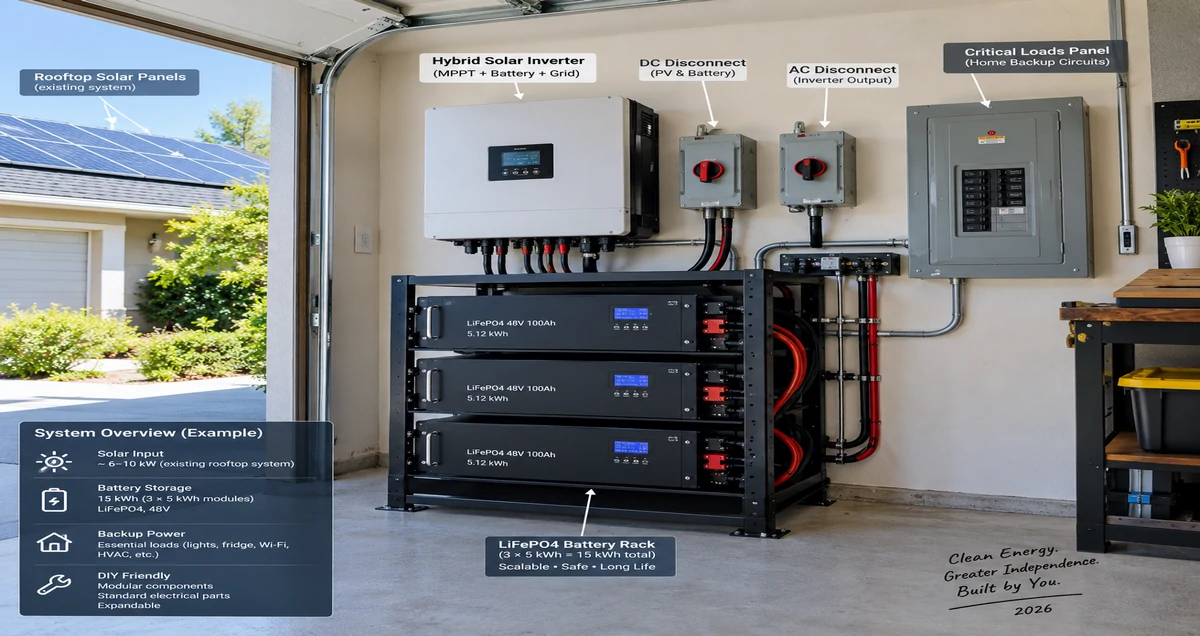
For many homeowners, a LiFePO4 (lithium iron phosphate) battery paired with a compatible hybrid inverter and properly configured battery-management system (BMS) is one of the most practical architectures to investigate for a DIY-oriented home backup system.
However, there is no single battery that is best for every home.
The right system depends on:
- Your average daily electricity consumption
- Which appliances you want to keep running during an outage
- Whether you already have solar panels
- Your solar inverter type
- Desired backup duration
- Battery capacity
- Inverter power rating
- Battery voltage
- Available installation space
- Local electrical requirements
- Your budget
- Whether you need whole-home or essential-load backup
The U.S. Department of Energy explains that energy storage allows electricity generated at one time to be stored and used later, while also distinguishing energy capacity, measured in kWh, from power capacity, measured in kW.
What Is a DIY Solar Battery Storage System?
A DIY solar battery storage system is a home energy-storage setup assembled or configured by the homeowner rather than purchased as a fully installed package.
A typical system may contain:
- Solar panels
- Solar charge controller or compatible solar inverter
- Battery bank
- Battery-management system (BMS)
- Hybrid or battery inverter
- Main disconnects
- Fuses or circuit protection
- Battery cables and appropriately rated connections
- Monitoring equipment
- Backup-load panel or transfer equipment
- Grounding and other required electrical protection
The battery stores energy in chemical form and releases electrical energy when needed.
With solar panels, the basic process looks like this:
Solar panels → inverter/charger → battery → inverter → home loads
During an outage, the system can supply selected loads if the equipment is designed and installed to provide backup power.
Why Homeowners Are Choosing Battery Backup in 2026
Solar panels produce electricity when solar energy is available, but household electricity demand does not always match solar production.
You may generate the most electricity around midday while using more electricity in the evening.
Battery storage helps move that energy from one time of day to another.
A battery can also provide backup power during a grid outage when the system is properly designed for backup operation. The Department of Energy notes that storage can improve resilience and allow stored solar energy to be used when needed.
Major benefits include:
- Backup electricity during outages
- Better use of excess solar production
- Reduced dependence on the grid
- Potential electricity-bill savings
- Energy shifting
- Greater energy independence
- Ability to prioritize essential appliances
But batteries are not automatically a money-saving investment. Economics depend heavily on electricity prices, utility rules, solar production, battery costs, incentives, and how often the battery is cycled.
DIY Solar Battery Storage: LiFePO4 vs. Other Battery Types
Battery chemistry is one of the most important decisions.
LiFePO4 Batteries
LiFePO4 stands for lithium iron phosphate.
This chemistry has become popular for stationary energy-storage applications because it offers useful characteristics for home storage, including high usable energy density and long cycle-life potential when properly managed.
For a DIY-oriented project, LiFePO4 is often one of the first chemistries homeowners investigate.
Advantages
- Long cycle-life potential
- Good usable capacity
- No routine watering
- Compact compared with lead-acid
- Suitable for repeated cycling
- Widely available in modular battery configurations
Disadvantages
- Higher upfront cost than some basic lead-acid systems
- Requires appropriate battery management
- Charging and operating temperatures must be respected
- Installation still requires proper electrical protection
LiFePO4 vs. Lead-Acid for Home Backup
Lead-acid batteries can still work for certain backup applications, but they have important limitations.
Traditional lead-acid batteries are generally heavier and may provide less usable energy for the same nominal capacity compared with modern lithium-based systems.
For frequent daily cycling, many homeowners will find LiFePO4 more attractive.
For occasional emergency backup where low initial cost is the priority, lead-acid can still have a place.
The important point is to compare the usable energy and lifetime cost, not simply the battery’s advertised price.
How Much Battery Storage Does a Home Need?
This is one of the most important questions.
A battery’s capacity is normally expressed in kilowatt-hours (kWh).
For example:
- 5 kWh = smaller backup system
- 10 kWh = medium home backup
- 15 kWh = larger backup
- 20+ kWh = extended or higher-load backup
But battery size alone does not determine how long your home will run.
Your actual runtime depends on:
Battery capacity ÷ average load = approximate runtime
For example, a 10 kWh battery supplying an average 500-watt load would theoretically provide around:
10 kWh ÷ 0.5 kW = 20 hours
Real-world runtime will be lower because of inverter losses, battery operating limits, temperature, reserve capacity, and changing household loads.
How to Calculate Your DIY Battery Size
Start by listing the appliances you want to operate during a power outage.
Typical essential loads might include:
| Appliance | Approximate Power |
|---|---|
| LED lights | 10–100 W |
| Wi-Fi router | 10–30 W |
| Laptop | 30–100 W |
| Refrigerator | Variable |
| TV | 50–200 W |
| Small electronics | Variable |
| Furnace/boiler controls | Variable |
| Well pump | Potentially high |
| Microwave | Often 800–1,500+ W |
| Air conditioner | Potentially several thousand watts |
These numbers are only examples. Always check the actual rating plate or manufacturer specifications for your equipment.
Step 1: Identify essential loads
You probably don’t need to run every appliance during an outage.
Prioritize:
- Refrigerator
- Freezer
- Internet equipment
- Lighting
- Medical equipment where applicable
- Security systems
- Heating controls
- Selected kitchen appliances
Step 2: Estimate daily energy consumption
Add the expected wattage multiplied by operating hours.
For example:
500 W × 10 hours = 5 kWh
Do this for your essential appliances and add the results.
Step 3: Add a practical reserve
Don’t design a battery system to operate continuously at its absolute limits.
Allow room for:
- Inverter losses
- Startup surges
- Battery reserve
- Unexpected loads
- Temperature effects
- Future expansion
Power Rating vs. Battery Capacity: Don’t Confuse Them
This is a common mistake.
kWh tells you how much energy the battery stores.
kW tells you how much power the system can deliver at a given time.
A battery could have plenty of energy but still fail to run a high-power appliance if the inverter cannot supply enough instantaneous power.
For example, a large refrigerator, pump, air conditioner, or power tool may have a substantial startup surge.
That means you should evaluate both:
Battery capacity + inverter power
The Department of Energy specifically distinguishes storage capacity from power capacity when describing energy-storage systems.
The Best DIY Solar Battery System Architecture
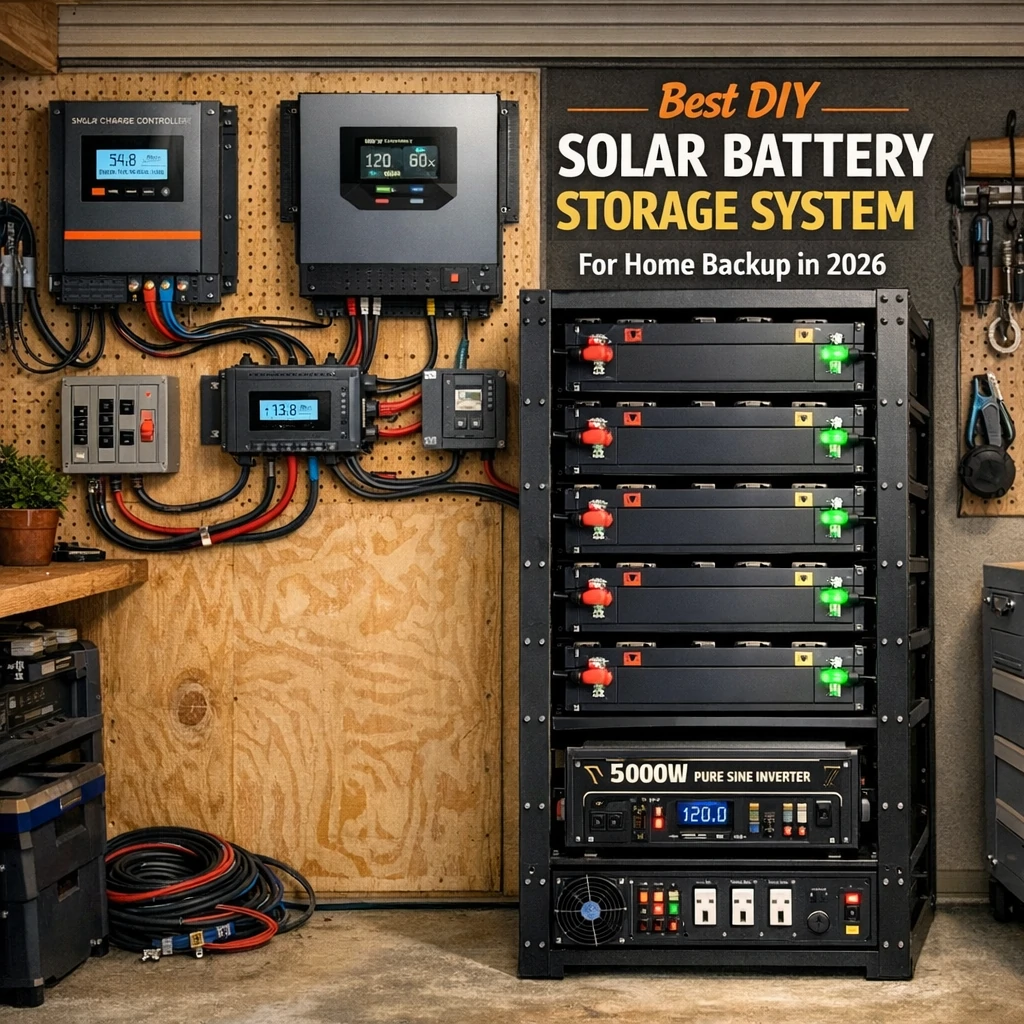
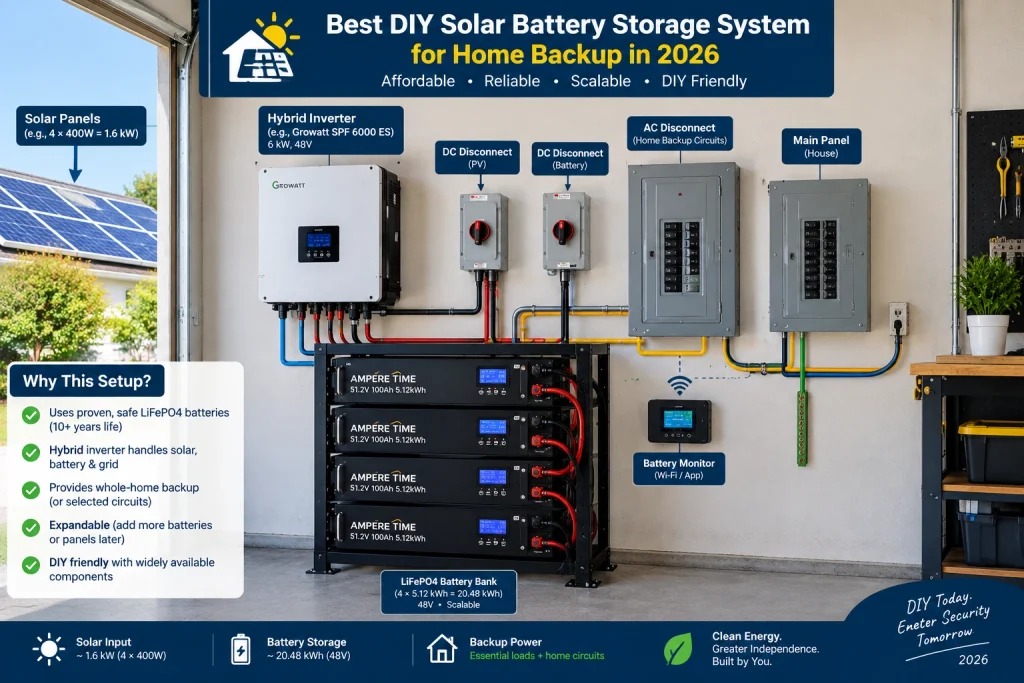
For many residential projects, a practical architecture looks like this:
Solar Panels
↓
Solar/Hybrid Inverter
↓
LiFePO4 Battery Bank
↓
Battery Management System
↓
Backup Distribution Panel
↓
Essential Home Loads
A more advanced system may integrate solar input, grid charging, battery charging, monitoring, and automatic backup switching into a single hybrid inverter.
The exact architecture depends on your existing solar system.
AC-Coupled vs. DC-Coupled Battery Storage
AC-Coupled Storage
In an AC-coupled system, the battery has its own battery inverter and connects on the AC side of the electrical system.
Advantages
- Can work well with existing solar installations
- Potentially easier to add to an existing system
- Flexible architecture
Disadvantages
- Additional conversion steps can reduce efficiency
- More components may be required
DC-Coupled Storage
In a DC-coupled configuration, solar generation and battery storage share part of the DC-side architecture.
Advantages
- Can reduce unnecessary conversion steps
- Efficient integration with compatible systems
- Useful for new solar-plus-storage installations
Disadvantages
- More complex compatibility requirements
- Not always practical for retrofits
The best choice depends on the solar inverter and battery equipment you already have.
What Components Do You Need for a DIY Solar Battery Backup?
A reliable system requires more than a battery.
1. Battery
Choose a battery with appropriate:
- Voltage
- Capacity
- Continuous current rating
- Peak current rating
- Operating temperature
- Communication compatibility
- Safety certifications
- Warranty
2. Battery Management System
A BMS monitors and protects lithium battery cells.
Depending on the system, it may monitor:
- Cell voltage
- Temperature
- Current
- Overcharge
- Over-discharge
- Short-circuit conditions
- Cell balancing
3. Inverter
The inverter converts DC electricity from the battery into AC electricity used by household appliances.
Check:
- Continuous output power
- Surge power
- Input voltage range
- Battery compatibility
- Solar input
- Backup functionality
- Efficiency
- Communication protocols
4. Battery Protection
Appropriate fuses, disconnects, breakers, cables, and other protective equipment are essential.
The exact equipment depends on the system design and applicable electrical requirements.
5. Monitoring
Good monitoring can show:
- Battery state of charge
- Solar production
- Household consumption
- Grid consumption
- Charging and discharging
- Fault conditions
Monitoring makes troubleshooting much easier.
How to Build a DIY Solar Battery Storage System
A DIY project should be approached as a design and planning project first, not a wiring project.
Step 1: Measure Your Electricity Use
Review your electricity bills and, if possible, use an energy monitor to identify your actual consumption.
Don’t guess your battery size based only on the size of your house.
A 2,000-square-foot home can have completely different electricity needs from another 2,000-square-foot home.
Step 2: Choose Your Backup Loads
Decide whether you want:
Essential-load backup
Only selected circuits remain powered.
This is generally easier to size and can significantly reduce the required battery and inverter capacity.
Whole-home backup
The battery system is designed to support a much larger portion of the home.
This can require substantially more battery capacity and inverter power.
Step 3: Select Battery Capacity
Use your expected essential-load consumption and desired backup duration.
For example:
5 kWh/day × 2 days = 10 kWh
Then account for system losses and reserve capacity.
This is only a planning example, not a universal sizing recommendation.
Step 4: Select the Inverter
Make sure the inverter can support:
- Battery voltage
- Continuous household load
- Startup surge
- Solar input
- Backup operation
- Required communication protocols
Never assume that any inverter can safely operate with any lithium battery.
Step 5: Verify Compatibility
Before purchasing anything, confirm compatibility between:
Battery ↔ BMS ↔ inverter ↔ solar equipment ↔ monitoring system
Compatibility problems can turn a seemingly inexpensive DIY project into an expensive troubleshooting exercise.
DIY Battery Storage Safety: What You Should NOT Do
This is the most important section of the guide.
A DIY battery system is not the place to experiment with improvised wiring.
Do not:
- Use damaged batteries
- Mix incompatible batteries
- Bypass the BMS
- Ignore manufacturer limits
- Use undersized cables
- Remove required protective devices
- Install batteries in inappropriate locations
- Place batteries near ignition sources
- Modify safety equipment
- Connect a battery system to household wiring without proper transfer/isolation equipment
- Backfeed the utility grid
- Ignore local electrical codes
- Assume a battery is safe simply because it is labeled “solar”
The U.S. Department of Energy emphasizes the need to consider electrical requirements, building codes, utility requirements, and potentially applicable fire-code requirements for residential battery storage.
Battery energy-storage systems also introduce safety considerations because large amounts of stored energy can create serious hazards if systems fail or are improperly handled.
When should you hire an electrician?
Use a qualified professional for work involving:
- Main electrical panels
- Utility connections
- Transfer switches
- Grid-interactive systems
- Service upgrades
- Permits
- Required inspections
- Final electrical connections
- Any work you are not legally permitted or qualified to perform yourself
A sensible DIY approach is to research, size, compare components, and plan the system yourself while having regulated electrical work completed and inspected by qualified professionals.
How Long Can a Solar Battery Power a House?
There is no universal answer.
Runtime depends on:
- Battery size
- Household load
- Inverter efficiency
- Battery reserve
- Weather
- Solar production
- Temperature
- Appliance startup loads
A 10 kWh battery could last many hours with carefully managed essential loads but much less time if the home is running air conditioning, electric heating, ovens, pumps, or other high-power appliances.
This is why load management can be just as important as battery capacity.
Can Solar Panels Charge the Battery During a Power Outage?
Yes—if the solar-plus-storage system is specifically designed and configured for backup operation.
A normal grid-tied solar system generally shuts down when the utility grid fails because of anti-islanding requirements.
A properly designed backup system can isolate the home from the grid and coordinate solar generation with battery storage.
This is one reason simply adding a battery to an existing solar installation is not always a plug-and-play project.
How Much Does a Home Solar Battery Cost in 2026?
Battery prices vary dramatically depending on capacity, chemistry, inverter equipment, installation requirements, location, and electrical upgrades.
For context, EnergySage reported an average installed solar-battery cost of about $15,647 for 13.5 kWh in its July 2026 data, before available incentives.
Local prices can differ substantially. For example, EnergySage’s 2026 California data showed average storage-system costs of approximately $10,737 for 10 kWh and $13,958 for 13 kWh in its marketplace data.
DIY equipment-only costs can be lower because you may avoid some installation labor and contractor markup, but that does not mean a DIY system should skip professional electrical work or safety equipment.
The cheapest battery is not necessarily the cheapest system over its lifetime.
What Makes a Good DIY Solar Battery in 2026?
When comparing batteries, don’t focus only on price.
Look at:
1. Usable capacity
A battery advertised at a certain nominal capacity may not provide all of that energy for normal operation.
2. Cycle life
A battery designed for frequent cycling may offer better long-term value.
3. Battery chemistry
LiFePO4 is a popular option for stationary storage, but suitability depends on the application.
4. BMS quality
A reliable BMS is critical for battery protection and monitoring.
5. Inverter compatibility
A battery should work correctly with the selected inverter.
6. Warranty
Review:
- Years
- Cycle limits
- Capacity-retention guarantees
- Conditions
- Installation requirements
7. Safety certifications
Look for equipment that complies with applicable safety standards and local requirements.
8. Expandability
If you may need more storage later, make sure the system supports expansion.
Best Battery Size for Different Home Backup Needs
| Backup Goal | Possible Starting Point |
|---|---|
| Wi-Fi, lights, electronics | 3–5 kWh |
| Refrigerator + lights + electronics | 5–10 kWh |
| Essential home circuits | 10–15 kWh |
| Larger essential-load backup | 15–20 kWh |
| Whole-home/high-load backup | 20+ kWh |
These are planning ranges, not engineering recommendations. Actual sizing should be based on your measured loads, inverter capability, battery specifications, and required backup duration.
How to Make Your Battery Last Longer
Battery life depends on many factors, including temperature, charging behavior, operating limits, cycling, and battery chemistry.
Good practices include:
- Follow the manufacturer’s operating limits
- Avoid extreme temperatures
- Use the correct charger/inverter settings
- Don’t bypass battery protections
- Monitor battery health
- Keep electrical connections maintained
- Avoid unnecessary deep cycling when your system doesn’t require it
- Follow the battery manufacturer’s installation instructions
Is DIY Solar Battery Storage Worth It in 2026?
For technically capable homeowners, a DIY-oriented battery project can be attractive.
It may provide:
- Lower equipment costs
- Greater system customization
- Expandability
- Energy independence
- Better use of solar generation
- Backup power during outages
However, DIY isn’t automatically better.
If the system is incorrectly sized, incompatible, poorly protected, or improperly installed, the initial savings can disappear quickly.
For many homeowners, the best approach is DIY system research + professional electrical installation.
That gives you control over the equipment-selection process while reducing the risks associated with high-energy electrical work.
DIY Solar Battery Storage Checklist
Before purchasing anything, ask:
Battery
- What chemistry is being used?
- What is the usable capacity?
- What is the continuous current rating?
- Does it have an appropriate BMS?
- What is the warranty?
- Is it certified for the intended application?
Inverter
- Is it compatible with the battery?
- What is its continuous output?
- What is its surge rating?
- Can it operate during a grid outage?
- Does it support the required solar input?
Installation
- Where will the battery be installed?
- Is the location suitable?
- What temperature range will it experience?
- Are permits required?
- Are there local fire-code requirements?
- Is professional installation required?
Backup
- Which appliances must remain operational?
- How many hours of backup do you need?
- Will solar recharge the battery during an outage?
- Do you need whole-home or essential-load backup?
Frequently Asked Questions
What is the best battery chemistry for DIY solar storage?
For many stationary residential applications, LiFePO4 is a popular choice because of its combination of usable capacity, cycle-life potential, and suitability for repeated energy storage. However, battery selection should also consider certification, BMS quality, inverter compatibility, warranty, temperature requirements, and local regulations.
Is a 10 kWh battery enough to power a house?
It can be enough for essential loads, but it may not power a high-consumption home for a full day. Runtime depends on the home’s actual electricity demand.
Can I build a solar battery system myself?
You can research, design, and in some cases assemble parts of a system yourself, but electrical installation requirements vary by location. Grid-connected and whole-home systems often require permits, inspections, qualified electrical work, and specific equipment.
How many solar batteries do I need?
That depends on your daily energy consumption, desired backup duration, battery capacity, inverter power, and the appliances you want to operate.
Can I use a DIY battery with my existing solar panels?
Possibly, but compatibility must be verified. Your existing solar inverter may not support battery storage or backup operation.
Are DIY solar batteries cheaper?
They can reduce some equipment and labor costs, but the total cost depends on the battery, inverter, protection equipment, enclosure, wiring, permits, professional labor, and installation requirements.
Can a battery run an air conditioner during a blackout?
Possibly, but air conditioners can require substantial continuous and startup power. You need an inverter and battery system specifically sized for the air conditioner’s electrical requirements.
How long does a home battery last?
Battery life varies by chemistry, operating conditions, temperature, cycling, and manufacturer specifications. Instead of assuming a fixed lifespan, compare the manufacturer’s cycle-life and warranty information.
Can solar panels charge a battery during an outage?
Yes, when the solar-plus-storage system is designed for islanded backup operation and properly separates the home from the utility grid.
Final Verdict: The Best DIY Solar Battery Storage System for 2026
The best DIY solar battery storage system isn’t necessarily the cheapest battery you can find.
For many homeowners, a well-designed system built around a LiFePO4 battery, quality BMS, compatible hybrid or battery inverter, appropriate protection equipment, and properly sized backup loads can provide an excellent foundation for home energy storage.
The most important step is to size the system around your actual electricity needs.
Start with your loads.
Then determine your required backup time.
Then choose the battery.
Then select a compatible inverter.
And finally, make sure the complete installation complies with local electrical, building, fire, and utility requirements.
A good home battery system should be safe, compatible, expandable, properly protected, and realistically sized—not simply marketed as the biggest or cheapest DIY battery available.
Sources & Further Reading
- U.S. Department of Energy — Solar Integration and Energy Storage Basics.
- U.S. Department of Energy — Solar Energy Guide for Homebuilders.
- U.S. Department of Energy — Lithium-Ion Battery Storage Technical Specifications.