
How Long Will a 10 kWh Home Battery Last During a Power Outage?
A 10 kWh home battery can provide backup electricity for many household appliances during a power outage. However, its actual runtime depends on how much energy your appliances consume, how much of the battery capacity is usable, and how efficiently your inverter converts stored electricity into usable AC power.
For example, a 10 kWh battery may power a small group of essential appliances for many hours. However, running an air conditioner, refrigerator, television, lighting, and other equipment at the same time can use stored energy much faster.
In this guide, you will learn how to estimate 10 kWh battery runtime, compare common household appliances, calculate backup time, and understand what you can realistically operate during an outage.
Quick answer: A nominal 10 kWh battery could provide approximately 8.1 kWh of AC electricity in the illustrative example used in this guide. At a constant 500-watt load, that represents about 16.2 hours of theoretical runtime. Your actual result will vary with equipment, battery settings, and usage.

1. How Much Usable Energy Does a 10 kWh Battery Provide?
A battery advertised as 10 kWh does not necessarily deliver all 10 kWh to your appliances. Some energy may be unavailable because of the battery’s operating limits, reserve settings, and inverter conversion losses.
To make the calculations easier, consider this illustrative example:
| Specification | Example Value |
|---|---|
| Nominal battery capacity | 10 kWh |
| Assumed usable battery fraction | 90% |
| Energy available before inverter losses | 9 kWh |
| Assumed inverter efficiency | 90% |
| Estimated AC energy available | 8.1 kWh |
Calculation: 10 kWh × 0.90 × 0.90 = 8.1 kWh.
These percentages are assumptions for an example, not specifications for every battery. Always check the manufacturer’s usable capacity, discharge limits, and inverter efficiency before estimating your own backup time.
2. 10 kWh Battery Runtime Calculator
The basic formula for estimating battery runtime is:
Battery Runtime (hours) = Usable AC Battery Energy (Wh) ÷ Average Appliance Load (W)
For this example, 8.1 kWh equals 8,100 watt-hours (Wh).
Runtime = 8,100 Wh ÷ Appliance Load in Watts.
For example, if your appliances consume an average of 500 watts:
- Available AC energy: 8,100 Wh
- Average load: 500 W
- Estimated runtime: 8,100 ÷ 500 = 16.2 hours
This is a simplified estimate. It assumes a constant load and does not account for additional standby consumption, changing appliance demand, or other system-specific limitations.
3. How Long Can a 10 kWh Battery Run Different Appliances?
The following table uses an estimated 8,100 Wh of AC energy. The appliance wattages are illustrative average loads for calculation purposes, not guaranteed consumption figures for specific models.
| Appliance or Load | Example Average Power | Estimated Runtime |
|---|---|---|
| LED lighting | 50 W | 162 hours |
| Wi-Fi router | 15 W | 540 hours |
| LED television | 100 W | 81 hours |
| Laptop | 60 W | 135 hours |
| Refrigerator | 100 W average | 81 hours |
| Small fan | 50 W | 162 hours |
| Water pump | 500 W | 16.2 hours |
| Microwave | 1,200 W | 6.75 hours |
| Air conditioner | 1,000 W average | 8.1 hours |
| Electric heater | 1,500 W | 5.4 hours |
Important: These figures represent continuous operation at the stated average power. They are not predictions of normal daily appliance usage. Refrigerators cycle on and off, air conditioners change power as they operate, and motors can require additional startup power.
4. How Long Will a 10 kWh Battery Run a Refrigerator?
A refrigerator is often one of the most important appliances to keep running during a blackout. Fortunately, it usually does not consume its full rated power continuously because the compressor switches on and off to maintain the internal temperature.
For an illustrative calculation, assume a refrigerator uses an average of 100 watts over time.
Example refrigerator calculation
8,100 Wh ÷ 100 W = 81 hours.
This equals approximately 3.4 days under the stated assumptions, if the refrigerator is the only load connected to the battery.
Actual refrigerator consumption depends on its size, age, efficiency, room temperature, door openings, thermostat settings, and compressor operation. Check its energy label or measure its consumption with a suitable energy monitor for a more reliable estimate.
5. Can a 10 kWh Battery Run an Air Conditioner?
Yes, a properly configured 10 kWh battery system may run an air conditioner, but the runtime can be much shorter than it would be for smaller appliances.
Air conditioner consumption varies considerably depending on cooling capacity, inverter technology, outdoor temperature, insulation, room size, and thermostat settings. A unit’s rated input power is not always the same as its average operating power.
| Illustrative Average AC Load | Estimated Runtime |
|---|---|
| 500 W | 16.2 hours |
| 800 W | 10.1 hours |
| 1,000 W | 8.1 hours |
| 1,500 W | 5.4 hours |
| 2,000 W | 4.05 hours |
These estimates assume the air conditioner continuously draws the listed average power and that the full 8.1 kWh example energy budget is available to it. If other appliances are connected, their energy use must also be included.
6. Example: Running Multiple Appliances During a Power Outage
Most households need more than one appliance during an outage. A useful way to estimate backup duration is to add the average power of the appliances that operate at the same time.
Consider this example of an essential-load setup:
| Appliance | Assumed Average Load |
|---|---|
| Refrigerator | 100 W |
| LED lights | 50 W |
| Television | 100 W |
| Wi-Fi router | 15 W |
| Laptop | 60 W |
| Total | 325 W |
Estimated runtime = 8,100 Wh ÷ 325 W = approximately 24.9 hours.
Under these assumptions, the battery could theoretically support this group of essential loads for about one day. Real-world results may be lower, particularly if the refrigerator cycles heavily or additional equipment is connected.
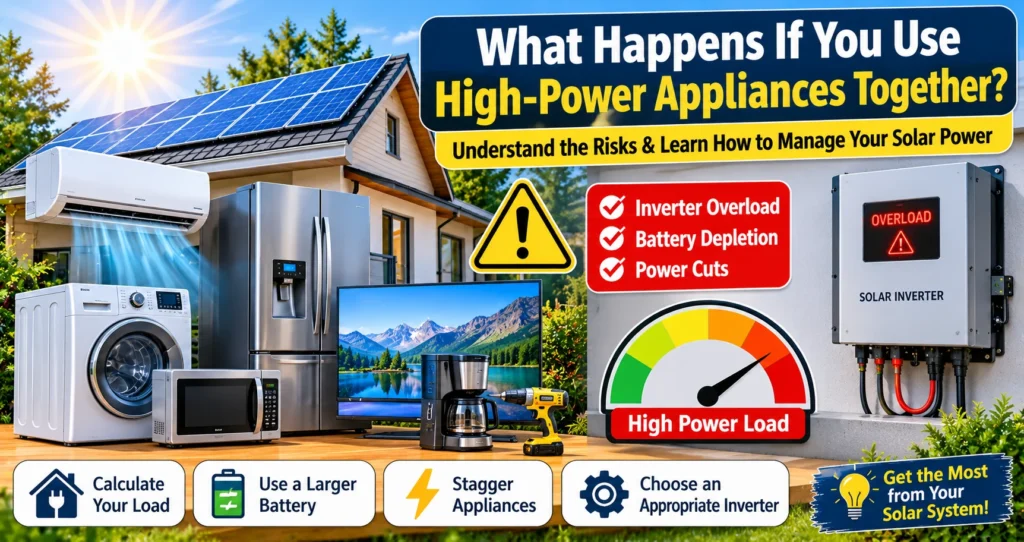
7. What Happens If You Use High-Power Appliances Together?
Running several high-power appliances simultaneously can reduce backup time dramatically. It can also exceed the inverter’s maximum output, even when the battery still has plenty of stored energy.
For example, consider this hypothetical combination:
| Appliance | Example Power |
|---|---|
| Air conditioner | 1,000 W |
| Microwave | 1,200 W |
| Refrigerator | 100 W average |
| Lighting and electronics | 150 W |
| Total | 2,450 W |
Estimated runtime = 8,100 Wh ÷ 2,450 W = approximately 3.3 hours.
This example assumes all listed loads operate at the stated power throughout the calculation period. Actual usage will vary, and the microwave’s rated input power may differ from its advertised cooking output.
Warning: Check inverter capacity. Before operating large appliances together, confirm that the inverter can handle their combined continuous power and the startup surge of motors and compressors. Battery energy capacity alone does not guarantee that the system can supply the required power.
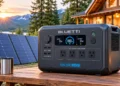
10 kWh Battery Runtime Calculator: How Long Will It Power Your Refrigerator, AC, TV & More? – Image 4
8. How to Calculate Your Own Battery Runtime
You can estimate your home’s backup time using a simple four-step method.
Step 1: Find Your Battery’s Usable Capacity
Check the battery manufacturer’s documentation. Look for nominal capacity, usable capacity, recommended depth of discharge, and any reserve settings configured in the system.
Step 2: Identify Your Appliance Loads
Check the appliance labels or manufacturer documentation for electrical input power. For equipment that cycles on and off, use measured average consumption when possible rather than assuming its rated power is continuous.
Step 3: Add the Loads That Operate Together
Add the average power of appliances that will run at the same time. If some devices operate only occasionally, estimate their energy use separately instead of treating them as continuous loads.
Step 4: Divide Usable Energy by Average Power
Convert usable energy into watt-hours if necessary, then divide it by the average load in watts. The result is an approximate runtime in hours.
9. How to Make a 10 kWh Battery Last Longer
During a long power outage, managing electricity use can make a major difference. These practical steps can help extend backup time:
- Prioritize essential appliances: Keep the refrigerator, communication equipment, and necessary lighting running first.
- Limit air conditioning: Use efficient settings and cool only the rooms you need.
- Turn off unnecessary devices: Disconnect equipment that consumes standby power.
- Use LED lighting: LED bulbs generally require less electricity than traditional lighting.
- Avoid simultaneous high-power loads: Schedule appliances such as microwaves, pumps, and other large loads when possible.
- Monitor battery charge: Use the battery monitoring system to track remaining energy.
- Use solar charging when available: A compatible backup system may recharge from solar panels during daylight.
10. Does Solar Charging Extend Battery Runtime During an Outage?
Yes, solar panels can extend backup operation when they are connected to a system designed to operate during a grid outage. The inverter, battery, controls, and electrical isolation equipment must all support backup operation.
Solar production changes throughout the day. Weather, shading, panel orientation, temperature, and system configuration all affect how much energy is available to recharge the battery.
Do not assume that an ordinary grid-tied solar installation will continue supplying household electricity during a blackout. Many standard grid-connected systems shut down during an outage unless they have suitable backup equipment and configuration.
11. Important Factors That Affect Real-World Runtime
The calculations in this guide are useful starting points, but several factors can change actual performance:
- Battery age and condition: Available capacity can decrease as a battery ages.
- Temperature: Battery performance and permitted charging or discharging can vary with temperature.
- Inverter efficiency: Some stored energy is lost during DC-to-AC conversion.
- Battery reserve: The system may stop discharging before reaching zero state of charge.
- Startup surge: Motors and compressors can briefly demand more power when starting.
- Standby consumption: Inverters and connected equipment may consume energy even when appliance loads are small.
- Changing appliance demand: Air conditioners, refrigerators, and pumps do not necessarily draw constant power.
12. Frequently Asked Questions
Can a 10 kWh battery power a refrigerator for 24 hours?
In many cases, it may. For example, an illustrative refrigerator averaging 100 W would use 2.4 kWh over 24 hours. However, actual consumption depends on the refrigerator, room temperature, usage, and the battery’s usable energy.
Can a 10 kWh battery run an air conditioner overnight?
It depends on the air conditioner’s average power consumption and how many hours it operates. A unit averaging 1,000 W would theoretically use 8 kWh in eight hours, before accounting for other connected loads and any additional system limitations.
How many hours will a 10 kWh battery last at 1,000 watts?
Using the illustrative 8.1 kWh of available AC energy in this guide, a constant 1,000 W load would run for approximately 8.1 hours. The actual result depends on system settings and operating conditions.
Can a 10 kWh battery power an entire house?
It may power selected household circuits or even a home with relatively low consumption, but it will not necessarily support every appliance. Whole-home backup depends on energy demand, inverter capacity, battery output limits, and the duration of the outage.
Does a 10 kWh battery provide 10 kWh of usable electricity?
Not always. Nominal capacity, usable capacity, reserve settings, and conversion losses are different considerations. Check the manufacturer’s specifications to determine how much energy can actually reach your appliances.
Can solar panels recharge a 10 kWh battery during a blackout?
Yes, if the solar-plus-storage system is specifically designed and configured to operate during grid outages. The available charging energy depends on sunlight, panel capacity, system limits, and household consumption.
Conclusion: Is a 10 kWh Battery Enough for Your Home?
A 10 kWh home battery can provide useful backup electricity during a power outage, especially when you prioritize essential appliances and manage your energy consumption carefully.
Under the illustrative assumptions in this guide, approximately 8.1 kWh of AC energy is available. That could support a 500 W average load for about 16.2 hours, or a 325 W essential-load group for approximately 24.9 hours.
The most important step is to calculate your actual appliance consumption and check your inverter’s power limits. With realistic load estimates and good energy management, you can make a better decision about whether a 10 kWh battery meets your home’s backup needs.
Related reading: Explore our guides to solar electric battery storage, residential battery storage, and DIY solar battery backup systems.