
Charred fence posts are wooden posts with a burned, blackened surface, usually around the part intended to sit underground. The traditional idea is simple: turn the outer layer into charcoal to help protect the wood against moisture, insects, and decay.
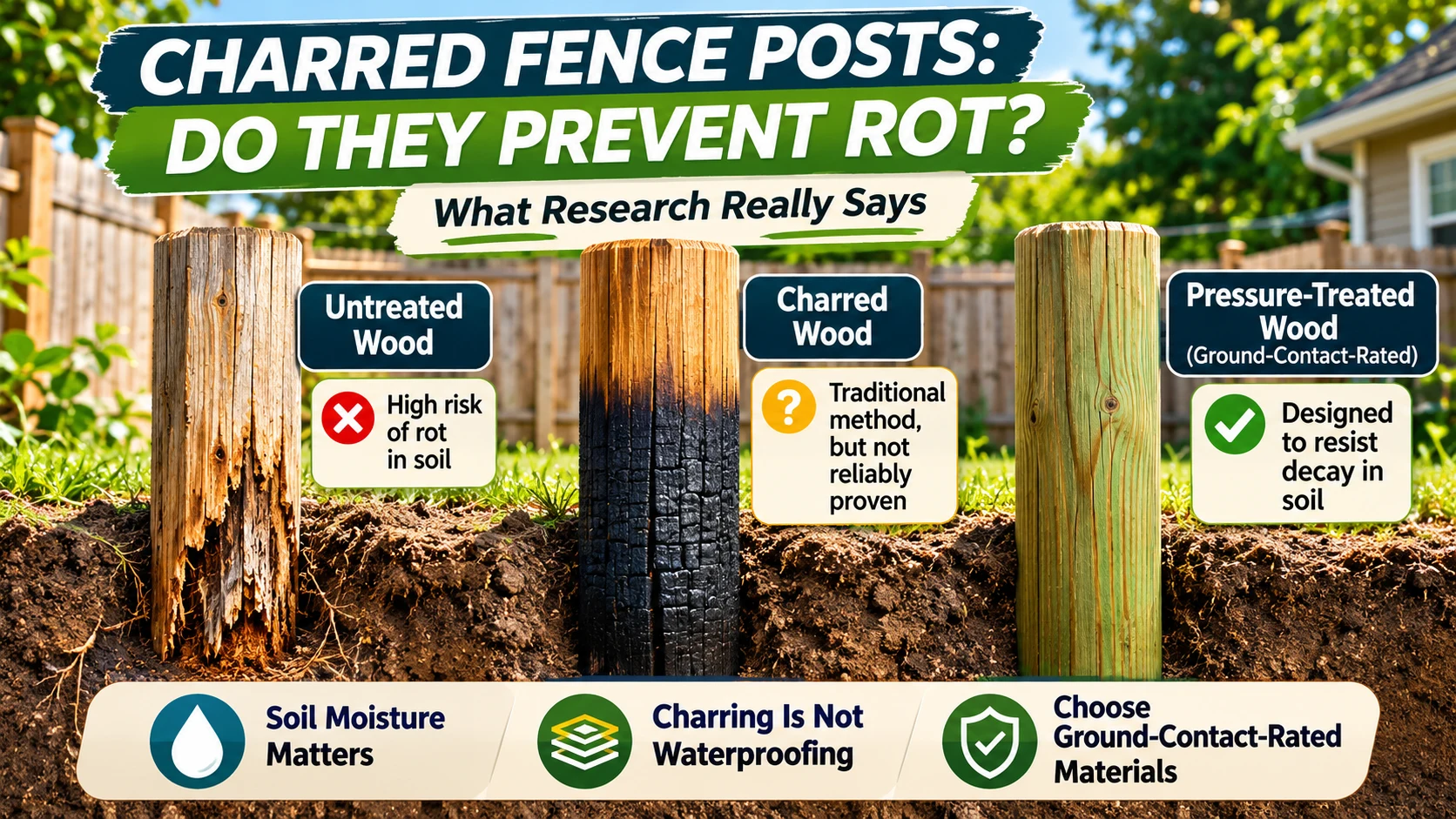
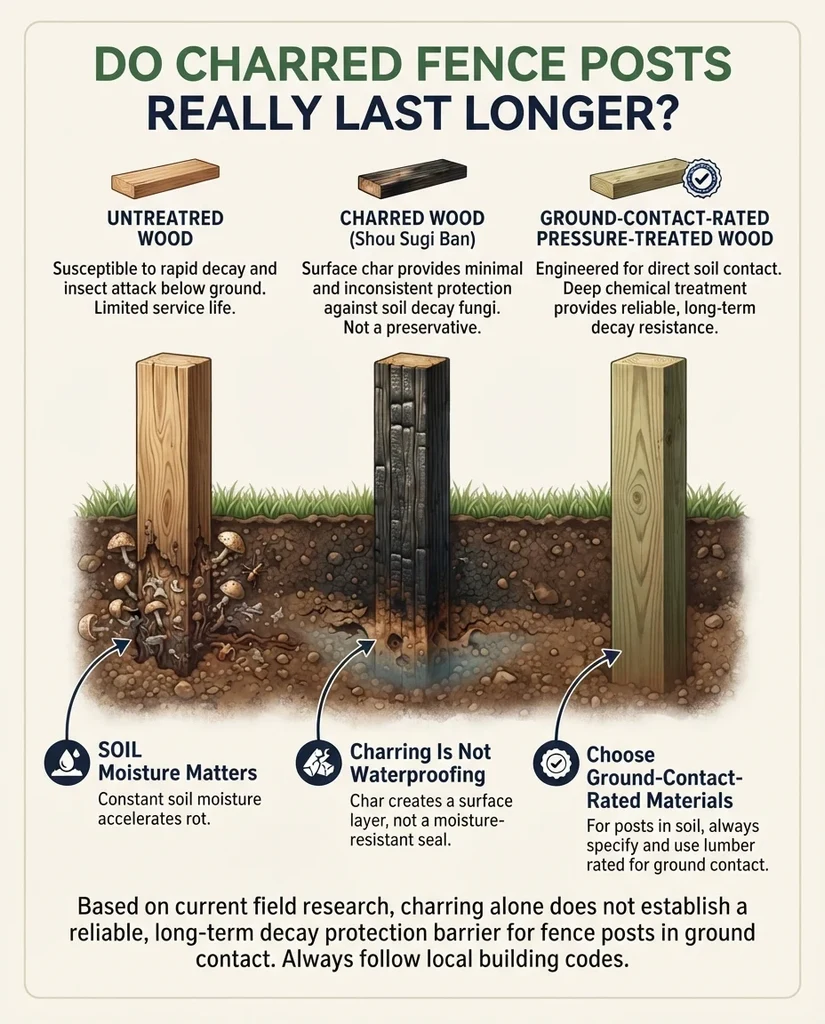
But does burning the bottom of a fence post actually make it last longer? Research suggests that charring alone is not a reliable replacement for properly selected ground-contact wood. In some field tests, charred posts performed no better than untreated posts.
Before building a garden fence, off-grid enclosure, or backyard structure, it helps to understand what charring changes, why wood rots underground, and which preservation methods have stronger evidence behind them.
Quick Answer: Does Charring Fence Posts Prevent Rot?
Not reliably. Charring changes the surface of wood, but it does not guarantee protection against decay when the post remains buried in damp soil.


- Traditional technique: Burning the outside of the post to create a dark carbonized surface.
- Moisture resistance: Some charred surfaces behave differently around water, but performance varies.
- Ground-contact durability: Long-term field evidence does not support charring alone as a dependable treatment.
- Termite resistance: Surface charring is not a verified substitute for appropriate termite protection.
- Better-established options: Ground-contact-rated preservative-treated wood or suitable naturally durable heartwood.
- Structural applications: Use materials and connections approved for the intended loads and exposure.
What Are Charred Fence Posts?
Charred fence posts are posts that have been heated enough to form a black carbon-rich surface. The treatment is usually applied to the lower section, including the portion expected to contact soil.
This practice has been used in various traditional woodworking and fencing methods. The theory is that a carbonized exterior will help limit deterioration of the underlying wood.
However, a fence post experiences different conditions from a decorative charred wood wall or exterior siding. Underground wood can remain damp for long periods, and decay organisms may attack the unmodified interior through cracks, ends, and damaged areas.
Why Do Wooden Fence Posts Rot?
Wood decay is caused mainly by fungi that break down the material under suitable environmental conditions. Moisture plays a central role, especially when wood remains damp over time.
The area around ground level can be particularly vulnerable because it is repeatedly exposed to water, oxygen, temperature changes, and soil organisms.
Decay risk depends on several factors:
- Wood species and natural durability.
- Heartwood and sapwood content.
- Soil moisture and drainage.
- Climate and exposure.
- Preservative treatment quality.
- Construction details and ongoing maintenance.
Burning only the outer layer does not remove all these risk factors.
What Does Science Say About Burning Fence Posts?
Scientific results depend on how the wood is charred, which species is used, and whether the material is exposed above ground or buried in soil.
Long-Term Fence Post Field Tests
Swedish field testing compared traditional wood fence posts, charred post ends, and preservative-treated materials under real outdoor exposure.
The reported findings showed that charring the buried ends did not improve post durability in those trials. The charred posts performed similarly to untreated posts, while the appropriately preservative-treated materials performed substantially better.
This evidence matters because real ground contact involves moisture, weather, soil organisms, and years of exposure rather than a short laboratory experiment.
Laboratory Studies on Charred Wood
Research on carbonized spruce and birch surfaces has found that certain charring methods can reduce fungal damage compared with untreated samples in controlled laboratory conditions.
However, researchers also observed fungal activity beneath the charred layer. Results varied according to the charring method and surface structure.
These findings should not be interpreted as proof that a burned fence post will last longer underground. Laboratory performance and real-world buried-post durability are different questions.
Research takeaway: Charring can change how a wood surface responds to water and fungi, but evidence does not establish that a charred base reliably protects an ordinary fence post in soil.
Why the Charred Layer May Fail Underground
A charred surface can be porous, cracked, or brittle, depending on the process. Moisture and microorganisms may reach wood beneath the outer layer, especially through exposed end grain or damaged areas.
Burning also consumes some wood. Excessive charring can reduce the remaining cross-section of a post, which matters for the strength of a loaded fence or support.
Even when the blackened exterior looks intact, the underlying wood may still be vulnerable. The visible color of a post is not a reliable measure of its remaining structural strength or decay resistance.
Charred Posts vs. Pressure-Treated Wood
Pressure-treated wood uses preservative systems intended to resist deterioration from fungi and insects. Products are classified for specific exposure conditions, including ground contact.
| Feature | Charred Untreated Post | Ground-Contact-Rated Treated Post |
|---|---|---|
| Preservation method | Surface heating | Specified preservative treatment |
| Ground-contact durability | Not reliably improved | Designed for rated exposure |
| Termite protection | Not verified | Depends on approved treatment |
| Consistency | Varies widely | Controlled product specifications |
| Structural suitability | Must be evaluated | Must match grade and application |
| Recommended use | Not a standalone preservation method | Appropriate when correctly rated and installed |
The USDA Forest Service recommends deeply preservative-treated fence posts, preferably pressure-treated for below-ground exposure, when maximum protection against decay and termites is needed.
Choosing the Right Wood for Ground Contact
When buying posts for a backyard fence, check whether the product is specifically rated for ground contact rather than only above-ground outdoor use.
In the United States, wood preservation use categories help identify suitable exposure applications. UC4A is commonly associated with general ground-contact use, while more demanding exposure or critical applications may require higher categories.
Natural wood durability can also vary. Certain species have more decay-resistant heartwood, but sapwood from the same tree may have much less natural resistance.
Check regional recommendations and local building requirements before choosing a species or treatment.
Better Ways to Help Fence Posts Last Longer
- Choose the correct ground-contact rating. Use preservative-treated wood suitable for the soil and service conditions.
- Consider naturally durable heartwood. Check species-specific performance in your climate.
- Manage water around the fence. Avoid avoidable pooling and prolonged wetting where practical.
- Protect exposed cuts as specified. Follow the treated-wood manufacturer’s instructions for approved field treatment.
- Use suitable fasteners. Select corrosion-resistant hardware compatible with the wood treatment.
- Inspect the ground line. Look for soft spots, movement, fungal growth, or loss of strength.
- Consider above-ground supports where appropriate. Properly designed post bases can reduce direct soil contact for suitable structures.
The right design depends on whether the post supports a lightweight garden fence, a gate, a deck, or a load-bearing building element. These applications do not have identical structural requirements.
Can You Use Charred Wood Above Ground?
Charred wood can be used as an architectural finish for suitable above-ground applications. The Japanese tradition often called yakisugi is associated with surface-charred exterior wood cladding.
But decorative cladding performance is different from fence post performance in wet soil. Above-ground charred surfaces may still need suitable detailing, maintenance, and compliance with applicable fire and building requirements.
Do not treat the success of a charred decorative board as evidence that the same process protects an underground structural post.
Fire and structural safety: Do not burn installed fence posts, structural supports, pressure-treated lumber, or wood with unknown coatings. Burning treated wood can release hazardous substances. Do not use an improvised fire treatment to qualify a post for structural or ground-contact service.
Common Fence Post Preservation Mistakes
- Assuming black means waterproof: The surface can still admit moisture through cracks and gaps.
- Using untreated wood underground: Many species decay rapidly in damp soil.
- Burning away too much material: Excessive charring can reduce the wood cross-section.
- Ignoring wood grade: Decorative wood is not automatically suitable for structural loads.
- Choosing above-ground-rated lumber: Outdoor exposure and soil contact require different protection levels.
- Ignoring drainage: Persistent moisture accelerates deterioration.
- Using incompatible metal fasteners: Some preservative systems require specific corrosion-resistant hardware.
- Assuming all wood species behave alike: Natural durability varies considerably.
Frequently Asked Questions
Does burning fence posts make them last longer?
Not reliably. Field tests have found that charring buried post ends did not consistently improve durability compared with untreated wood. Ground-contact-rated materials are a better-supported choice.
Does charring make wood waterproof?
No. Charring changes surface properties, but it does not create a guaranteed waterproof barrier. Cracks, exposed ends, and wear can allow moisture to reach the underlying wood.
Does charred wood resist termites?
Surface charring should not be relied upon as a proven termite protection treatment for buried fence posts. Choose suitable preservation methods for the local pest exposure.
What is better than charring fence posts?
Properly rated pressure-treated wood or suitable naturally decay-resistant heartwood generally provides a stronger basis for selecting ground-contact fence posts.
Is charred wood the same as pressure-treated wood?
No. Charring alters a surface through heat, while pressure treatment introduces specified preservatives into the wood. The two methods are not equivalent.
Can charred fence posts be used for a pergola?
Do not assume a charred post is suitable for a load-bearing pergola. Structural wood selection, post dimensions, foundations, connectors, and decay protection require a design appropriate to the actual loads.
Final Fence Post Checklist
- Check whether the wood is rated for direct soil contact.
- Choose a suitable species or preservative treatment.
- Confirm structural requirements for the fence or gate.
- Evaluate local moisture, soil, and termite conditions.
- Follow approved installation and field-treatment guidance.
- Use compatible corrosion-resistant connectors.
- Keep vulnerable wooden parts away from unnecessary moisture.
- Inspect posts regularly, especially near ground level.
- Never rely on surface burning as a guaranteed rot treatment.
Final Verdict: Are Charred Fence Posts Worth It?
Charring wood is an interesting traditional technique, and research shows that carbonized surfaces can behave differently from untreated wood. But that does not mean burning the bottom of a fence post will reliably prevent decay underground.
For a long-lasting fence, prioritize a suitable wood species, documented ground-contact protection, appropriate structural design, and regular inspection. These decisions have stronger practical support than relying on a blackened surface alone.
Technical references: USDA Forest Service: Protecting Wood Fences for Yard and Garden; Decay Resistance of Surface Carbonized Wood; USDA Wood Handbook: Wood Preservatives; Swedish Fence Post Field Testing. Always follow applicable product instructions and local construction requirements.