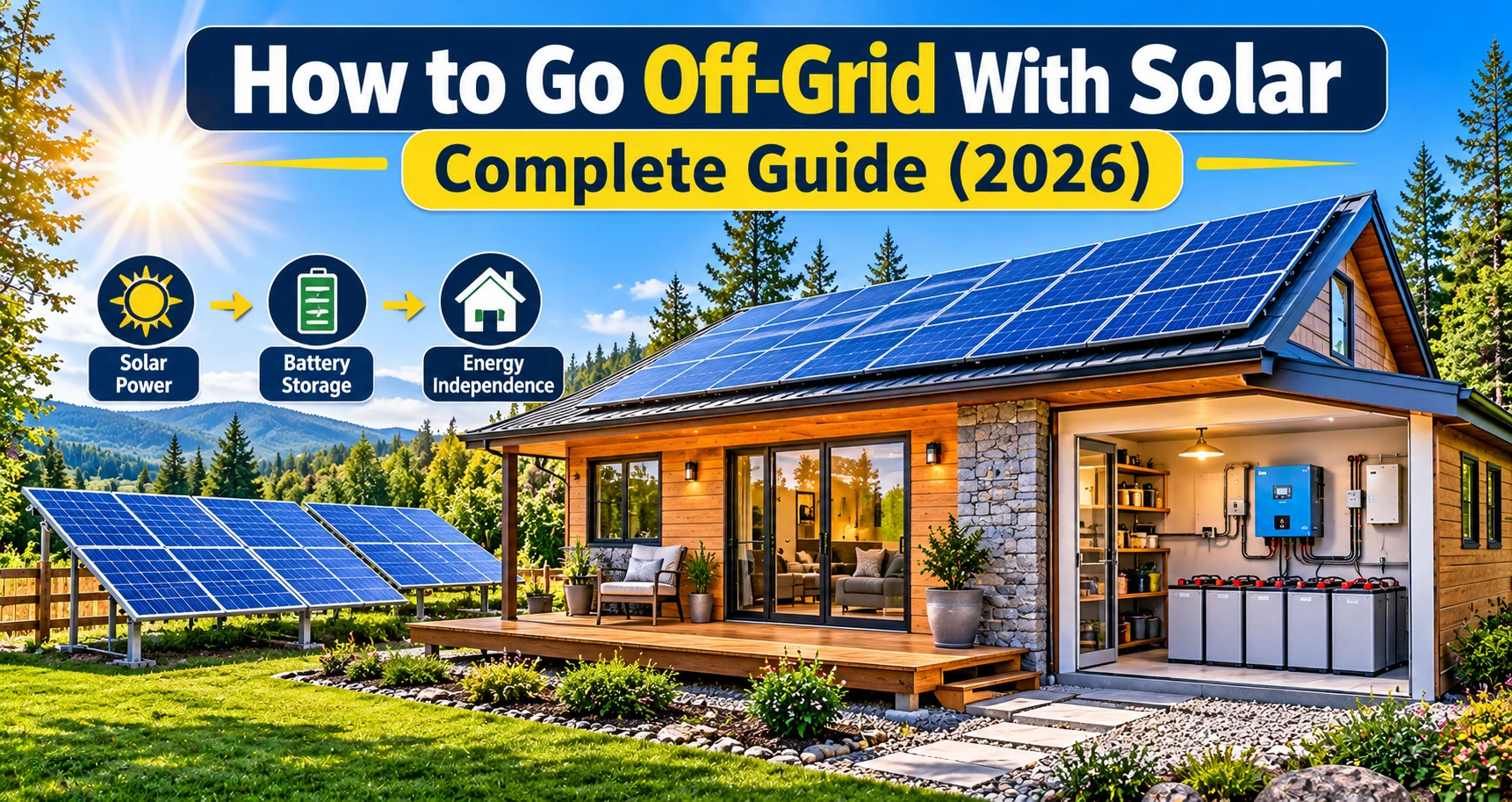
How to Go Off-Grid With Solar: A Complete Step-by-Step Guide
Imagine living in a home where your electricity comes directly from the sun. You can power your lights, refrigerator, appliances, water pump, and essential electronics without depending on a traditional utility connection. This is the idea behind off-grid solar living.
Going off-grid with solar energy is becoming an attractive option for homeowners, rural properties, cabins, farms, and people looking for greater energy independence. However, disconnecting from the electricity grid requires more than installing a few solar panels. You need a properly designed system that can generate enough electricity, store energy for nighttime use, and provide reliable power during cloudy weather.
In this guide, you will learn how to go off-grid with solar, what equipment you need, how to calculate your energy requirements, how to choose batteries and inverters, and how to prepare your home for independent electricity production.
- Solar panels to generate electricity.
- Battery storage to supply power at night and during cloudy periods.
- An inverter to convert battery DC electricity into household AC electricity.
- A solar charge controller to manage battery charging.
- Electrical protection, disconnects, cables, and grounding.
- A backup power plan for extended periods of poor weather.
1. What Does It Mean to Go Off-Grid With Solar?
An off-grid solar system is an independent electricity installation that operates without relying on the public electricity network. It generates electricity from sunlight and stores excess energy in batteries for later use.
Unlike a traditional grid-connected solar system, an off-grid installation must provide enough energy to meet your needs even when sunlight is limited.
A typical off-grid solar system works through the following process:
- Solar panels capture sunlight and generate DC electricity.
- A solar charge controller regulates electricity going into the batteries.
- The batteries store energy for nighttime and periods of low solar production.
- An inverter converts DC electricity into AC electricity for household appliances.
- Your home uses the stored or newly generated solar energy.
This arrangement can provide electricity to remote homes, cabins, tiny houses, farms, workshops, and properties where a utility connection is unavailable or expensive.
2. Decide How Much Electricity Your Home Needs
The first step toward energy independence is understanding your electricity consumption.
Before buying solar equipment, make a list of every appliance you want to operate. Record its power consumption in watts and estimate how many hours it will run each day.
Use this simple formula:
Watts × Hours Used = Watt-Hours (Wh)
Divide the result by 1,000 to convert watt-hours into kilowatt-hours (kWh).
Example: Daily Electricity Consumption
| Appliance | Power | Daily Use | Energy |
|---|---|---|---|
| Refrigerator | 100 W average | 10 hours equivalent | 1,000 Wh |
| LED lighting | 60 W | 5 hours | 300 Wh |
| Television | 100 W | 4 hours | 400 Wh |
| Laptop | 60 W | 5 hours | 300 Wh |
| Water pump | 500 W | 1 hour | 500 Wh |
| Total | 2,500 Wh | ||
In this example, the estimated daily consumption is 2.5 kWh.
These figures are illustrative. Refrigerators and pumps cycle on and off, so their actual daily consumption should ideally be measured or taken from reliable manufacturer energy data. Also account for inverter losses, standby consumption, and appliances that may operate simultaneously.
Knowing your daily energy consumption helps you determine the appropriate solar panel capacity and battery storage.
3. Choose the Right Solar Panels
Solar panels are the main electricity-producing component of an off-grid system. They convert sunlight into DC electricity, which can be used to charge batteries and supply household loads through an inverter.
The number of panels you need depends on:
- Your daily electricity consumption.
- The available sunlight at your location.
- Seasonal changes in solar production.
- Panel orientation and installation angle.
- Shading from trees, buildings, and other obstacles.
- System losses and battery charging requirements.
Example: Estimating Solar Panel Capacity
Suppose your home uses 2,500 Wh of electricity daily and your design location receives an average of 4 peak sun hours during the critical design period.
Using an illustrative overall performance factor of 0.75:
2,500 ÷ (4 × 0.75) = 833 W
The preliminary result is approximately 833 watts of solar panels. A larger array may be needed to cover winter conditions, battery recovery, additional loads, and periods of poor weather.
For example, three 400 W solar panels provide a combined rated capacity of 1,200 W. Whether this is sufficient depends on the actual solar resource and system design.
Use location-specific solar data rather than assuming that summer sunshine represents year-round production.
4. Select a Battery Bank for Energy Storage
Solar panels generate electricity during daylight hours, but your home also needs power at night and during cloudy weather. This is why batteries are essential in most fully off-grid solar systems.
The battery bank stores excess electricity generated during the day and makes it available when solar production is low.
Which Battery Is Best for Off-Grid Solar?
Several battery technologies are available, but lithium iron phosphate (LiFePO4) and lead-acid batteries are common choices.
| Feature | LiFePO4 | Lead-Acid |
|---|---|---|
| Usable capacity | Often higher | Usually lower for long service life |
| Weight | Generally lighter | Generally heavier |
| Maintenance | Generally low | Depends on battery type |
| Cold-weather charging | Temperature protection required | Also affected by temperature |
| Initial cost | Usually higher | Often lower |
LiFePO4 batteries are attractive for many modern off-grid installations because of their usable capacity, cycle life, and low routine maintenance requirements. However, they must be installed and charged according to the manufacturer’s specifications.
How Much Battery Storage Do You Need?
Battery capacity should be based on daily electricity consumption, the number of backup days required, usable depth of discharge, and system efficiency.
For a preliminary estimate, consider this formula:
Battery Capacity (Wh) =
Daily Energy × Autonomy Days ÷ (Usable DoD × Efficiency)
For example, a home using 2.5 kWh per day with two days of autonomy, an assumed 80% usable depth of discharge, and 90% system efficiency would require:
2,500 × 2 ÷ (0.80 × 0.90) = 6,944 Wh
This is approximately 6.95 kWh of nominal battery capacity.
The final battery selection must also account for maximum discharge current, inverter surge requirements, BMS limits, temperature, and manufacturer recommendations.
5. Choose an Off-Grid Solar Inverter
The inverter is responsible for converting the DC electricity stored in the battery into AC electricity used by common household appliances.
When choosing an inverter, do not focus only on its advertised wattage. Consider the total power required by appliances that may operate at the same time.
Important inverter specifications include:
- Continuous output power.
- Surge or peak output power.
- Battery voltage compatibility.
- Pure sine wave output.
- Efficiency.
- Battery charging compatibility.
- Protection features and monitoring options.
Motors, refrigerators, air conditioners, and water pumps may require significantly more power when starting than when running. Check their starting requirements before selecting an inverter.
12V, 24V, or 48V: Which System Voltage Is Best?
Small solar installations may use 12V or 24V systems. Larger residential off-grid installations commonly use 48V battery systems because higher voltage reduces current for the same power.
For example, a 2,400 W load requires approximately:
- 200 A at 12V.
- 100 A at 24V.
- 50 A at 48V.
These are idealized figures before accounting for inverter losses and actual battery voltage. The battery, inverter, controller, cables, and protection devices must all be compatible with the chosen system voltage.
6. Install a Solar Charge Controller
A solar charge controller regulates the electricity produced by the panels before it reaches the battery bank.
There are two common types:
PWM Charge Controllers
Pulse Width Modulation controllers are generally simpler and may be suitable for smaller systems where the panel voltage is compatible with the battery bank.
MPPT Charge Controllers
Maximum Power Point Tracking controllers adjust their operating point to harvest available solar power efficiently. They are widely used in larger off-grid systems and can accommodate suitable panel string voltages.
Before choosing an MPPT controller, verify:
- Maximum PV input voltage.
- Maximum PV input current.
- Maximum permitted solar array power.
- Battery voltage compatibility.
- Maximum battery charging current.
- Cold-weather correction of panel open-circuit voltage.
Never exceed the controller’s electrical limits. Solar panel string voltage can increase in cold weather, so the design must account for the lowest expected site temperature.
7. Understand How the Complete Off-Grid System Connects
A properly designed off-grid solar installation combines generation, storage, power conversion, and electrical protection.
Basic Off-Grid Solar System Layout
This is a simplified functional diagram, not an installation wiring plan. Actual installations require correctly rated fuses, breakers, disconnects, grounding, cable sizing, and other protective equipment. Follow the equipment manufacturers’ wiring diagrams and applicable electrical regulations.
8. How to Install Solar Panels for an Off-Grid Home
Solar panel placement has a major influence on electricity production.
Before installation, evaluate the roof, available land, orientation, shading, and structural conditions.
Roof-Mounted Solar Panels
Roof-mounted panels can save ground space and provide a convenient installation for many homes. However, the roof must be structurally suitable, and the mounting system must be designed for local wind and weather conditions.
Ground-Mounted Solar Panels
Ground-mounted systems offer more flexibility when choosing panel orientation and tilt. They can also provide easier access for inspection and maintenance.
Solar Panel Orientation
The ideal direction and tilt depend on your location and energy requirements throughout the year. In the Northern Hemisphere, south-facing panels often provide strong annual production, but local shading and seasonal energy needs must also be considered.
9. Prepare for Cloudy Days and Winter
One of the biggest differences between grid-connected and off-grid solar is that an independent home cannot automatically rely on the utility network when solar production falls.
During cloudy weather or winter, solar generation may decrease while household electricity consumption remains similar or increases.
To improve reliability:
- Design the solar array using the site’s less favorable solar season.
- Choose sufficient battery autonomy.
- Reduce unnecessary electricity consumption.
- Keep solar panels clean and free from avoidable shading.
- Monitor battery state of charge.
- Consider a compatible backup generator for extended periods of poor weather.
A backup generator is not essential in every installation, but it can provide additional security where several days of low solar production are possible.
10. How Much Does It Cost to Go Off-Grid With Solar?
The cost of an off-grid solar system depends on the size of the installation, battery capacity, equipment quality, installation complexity, and local labor costs.
Major expenses include:
- Solar panels and mounting structures.
- Battery storage.
- Off-grid inverter.
- Solar charge controller.
- Electrical protection and wiring.
- Installation and commissioning.
- Backup generator, if required.
A small cabin with limited electricity requirements will generally need a smaller system than a full-time family home using electric cooking, heating, cooling, and large appliances.
For an accurate budget, obtain quotations based on a completed energy assessment rather than choosing equipment based only on advertised solar panel wattage.
11. Reduce Electricity Consumption Before Going Off-Grid
Reducing electricity demand can make an off-grid solar system more affordable and easier to maintain.
Consider these practical improvements:
- Replace inefficient lighting with LED bulbs.
- Choose energy-efficient refrigerators and appliances.
- Improve home insulation to reduce heating and cooling demand.
- Use natural daylight whenever possible.
- Install timers for suitable electrical loads.
- Avoid running several high-power appliances simultaneously.
- Consider solar water heating instead of using electricity for all hot water needs.
Energy efficiency is often one of the most effective ways to reduce the required solar panel and battery capacity.
12. Common Mistakes When Going Off-Grid With Solar
Mistake 1: Buying Solar Panels Before Calculating Energy Needs
Start with daily electricity consumption. Otherwise, you may buy too few panels or spend money on unnecessary capacity.
Mistake 2: Choosing a Battery That Is Too Small
A small battery bank may run out of energy overnight or during cloudy weather. Calculate autonomy requirements before purchasing batteries.
Mistake 3: Ignoring Appliance Starting Power
Refrigerators, pumps, and compressors can require substantial starting power. Check inverter surge ratings and battery discharge limits.
Mistake 4: Designing Only for Summer
A system that works well in summer may struggle during winter. Use location-specific seasonal solar data.
Mistake 5: Ignoring Electrical Protection
Incorrect wiring, undersized cables, or missing protective devices can create serious hazards. Have the installation designed and checked by a qualified professional.
13. Step-by-Step Checklist for Going Off-Grid
Your Off-Grid Solar Planning Checklist
- Calculate your daily electricity consumption.
- Identify essential and nonessential appliances.
- Evaluate your location’s seasonal solar resource.
- Calculate the required solar panel capacity.
- Determine the battery storage and autonomy needed.
- Select a compatible off-grid inverter.
- Choose an appropriately rated charge controller.
- Plan the electrical protection and grounding system.
- Check local building, electrical, and permitting requirements.
- Arrange professional installation and commissioning.
- Test the system under normal operating conditions.
- Prepare a backup plan for extended cloudy periods.
14. Is Going Off-Grid With Solar Worth It?
Going off-grid can be worthwhile for people who want greater control over their electricity supply, live in remote locations, or face high costs for connecting to a utility network.
However, energy independence requires careful planning and a realistic understanding of electricity consumption.
The advantages include:
- Greater independence from utility electricity supplies.
- Electricity access in remote locations.
- Reduced exposure to grid outages.
- Better control over energy consumption.
- Potential long-term savings depending on installation costs and local electricity prices.
There are also challenges, including initial equipment costs, battery replacement over time, system maintenance, and reduced solar production during unfavorable weather.
Final Thoughts: Build Your Own Energy Independence
Learning how to go off-grid with solar starts with one important step: understanding how much electricity your home actually uses.
Once you know your daily energy requirements, you can choose the right combination of solar panels, battery storage, inverter capacity, and charging equipment.
Do not rush into purchasing equipment. A properly designed system should account for seasonal solar production, cloudy days, battery autonomy, appliance starting power, and electrical safety.
With careful planning and the right equipment, solar energy can provide a dependable foundation for a more independent lifestyle.
Frequently Asked Questions
Can I run an entire house off-grid with solar panels?
Yes. A properly designed off-grid solar system can supply an entire home. The required equipment depends on electricity consumption, solar conditions, battery storage, and the appliances being used.
How many solar panels do I need to go off-grid?
The number depends on daily energy consumption, panel wattage, local sunlight, seasonal conditions, and system losses. Calculate your energy needs before deciding how many panels to install.
How many batteries are needed for an off-grid home?
The number depends on the total battery capacity required and the capacity of each battery. Calculate daily energy consumption and the number of backup days you want before selecting a battery bank.
Can off-grid solar work during cloudy weather?
Yes, solar panels can still produce electricity in cloudy conditions, although output is generally reduced. Battery storage and an appropriately sized solar array help maintain electricity availability.
Is a 48V system better for an off-grid home?
A 48V battery system is often practical for larger residential installations because it reduces current compared with lower-voltage systems at the same power level. Equipment compatibility and system design remain essential.
Can I go off-grid without batteries?
A conventional fully off-grid home generally needs energy storage or another reliable electricity source to supply power when solar production is unavailable. A solar-only system without storage cannot normally provide continuous household electricity overnight.
Do I need a generator with off-grid solar?
Not always. However, a compatible backup generator can be useful during extended periods of poor weather or unusually high electricity consumption.
How long does an off-grid solar system last?
Different components have different service lives. Solar panels can operate for decades, while batteries, inverters, and controllers may require replacement sooner. Maintenance and operating conditions affect their lifespan.
Safety note: This guide is for educational purposes and is not a substitute for a site-specific electrical design. Solar DC circuits and battery systems can carry dangerous voltages and currents. Use correctly rated protection devices, follow manufacturer instructions, and have installation and commissioning completed or checked by qualified professionals. Verify local permitting and electrical requirements before disconnecting from the utility grid.