
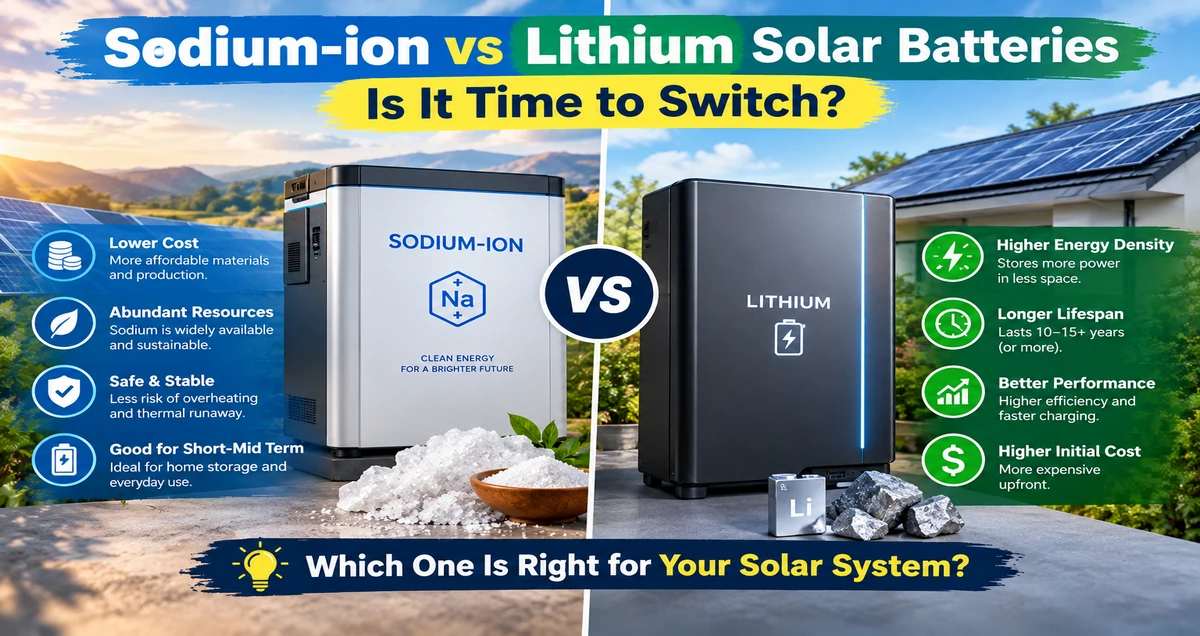
Sodium-Ion vs. Lithium Solar Batteries: Is It Time to Switch?
Solar batteries have come a long way, and things are getting interesting. For years, lithium batteries have been the go-to choice for homeowners who want to store solar energy. But now, sodium-ion batteries are entering the conversation. They use sodium instead of lithium, and some people believe they could change the way we store electricity at home.
So, should you choose a sodium-ion battery for your solar system, or stick with lithium? I wanted to understand what really matters before spending money on a battery. Let’s compare the two in plain English, including cost, cold-weather performance, lifespan, safety, and everyday home use.
The quick answer: Lithium iron phosphate (LFP) batteries are still a strong choice for many home solar systems because they offer proven performance, good efficiency, and a well-established market. Sodium-ion batteries are worth watching, especially for cold-weather applications and buyers interested in alternative battery materials. However, the best choice depends on the specific battery, its warranty, installed price, and real-world performance.
What Is a Sodium-Ion Solar Battery?
A sodium-ion battery stores electricity using sodium ions moving between its electrodes during charging and discharging. That sounds technical, but you don’t need an engineering degree to understand the idea.

Think of it as another way to store the electricity produced by your solar panels. During sunny hours, your panels generate power. Your home uses some of it, and the battery stores the extra energy for later, such as after sunset or during a power outage when your system is designed for backup.
The big attraction is sodium itself. It is widely available and can be obtained from abundant resources. Depending on the battery design, sodium-ion technology may also reduce dependence on certain materials used in other battery chemistries.
But there is one important detail: sodium-ion batteries are not all the same. Their chemistry, energy density, charging limits, temperature range, and cycle life can differ between manufacturers. You should never assume every sodium battery has the same performance.
What Is a Lithium Solar Battery?
Lithium batteries store energy by moving lithium ions between electrodes. They are widely used in home energy storage, portable power stations, electric vehicles, and many other devices.
When shopping for a home solar battery, you will often see two major lithium-based options: lithium iron phosphate (LFP or LiFePO4) and nickel manganese cobalt (NMC).
- Lithium iron phosphate (LFP): Popular for stationary energy storage because it generally offers good cycle life and thermal stability.
- Nickel manganese cobalt (NMC): Known for higher energy density in many designs, although its thermal behavior and material requirements differ from LFP.
For most homeowners comparing a modern solar battery with sodium-ion technology, LFP is the most useful comparison. It is an established option with many residential products, installers, and warranties already available.
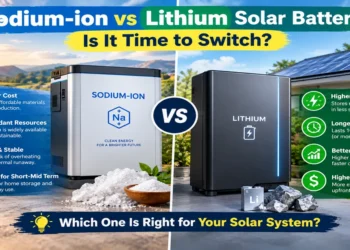
Sodium-Ion vs. Lithium Solar Batteries: Quick Comparison
Here is a simple side-by-side comparison. Remember that these are general technology-level observations, not guarantees for every battery model.
| Feature | Sodium-Ion | Lithium Iron Phosphate (LFP) |
|---|---|---|
| Main material | Sodium | Lithium and iron phosphate |
| Market maturity | Emerging and expanding | Well established |
| Energy density | Generally lower | Generally higher |
| Weight and size | May require more space | Often more compact for the same usable energy |
| Cold-weather potential | Some designs perform well in cold conditions | Performance varies; charging may be restricted below freezing |
| Cycle life | Depends heavily on chemistry and model | Often offers a long cycle life |
| Fire safety | Depends on cell chemistry and system design | Generally good thermal stability compared with many other lithium chemistries |
| Product availability | More limited in many residential markets | Broad residential product selection |
| Price | Future cost reductions are possible | Pricing is more established and varies by system |
My takeaway: Don’t choose a battery just because its chemistry sounds newer or cheaper. The complete system matters more than the name on the box.
1. Which Solar Battery Is Cheaper?
Price is usually the first thing homeowners want to know about. If sodium is widely available, wouldn’t sodium-ion batteries automatically be cheaper?
Not necessarily. The raw materials are only part of the final price. Manufacturing capacity, production scale, battery controls, shipping, installation, warranties, and retailer margins all affect what you pay.
Sodium-ion technology has the potential to reduce costs in certain applications as production grows. However, that doesn’t mean every sodium-ion solar battery is cheaper than a comparable LFP system today.
Compare the total installed cost
When comparing two batteries, look at more than the advertised price. Check the usable capacity, inverter compatibility, installation fees, monitoring equipment, warranty, and whether you need additional hardware.
For example, a battery advertised as 10 kWh may not provide the same usable energy as another 10 kWh battery. The usable amount depends on the manufacturer’s specifications and operating limits.
A simple buying tip
Compare the price per usable kilowatt-hour (kWh), then consider the warranty and expected service life. A lower upfront price does not always mean lower long-term cost.
2. Which Battery Lasts Longer?
A solar battery is a long-term investment, so lifespan matters. Nobody wants to buy a battery today and discover that it needs replacing much sooner than expected.
LFP batteries have a strong track record in residential energy storage. Many products are designed for thousands of charge and discharge cycles, but the exact rating depends on the model and the conditions used for testing.
Sodium-ion batteries can also be engineered for long cycle life. Some models show promising results, but the technology is less established across the residential market. It is important to look at independently supported specifications rather than assuming sodium-ion batteries always last longer.
Check these three things
- Cycle-life rating: Find out how many cycles the manufacturer claims under specified conditions.
- Warranty period: Check the number of years, throughput limits, and remaining-capacity guarantee.
- Operating temperature: Excessive heat or unsuitable charging temperatures can affect battery life.
One more thing: cycle life isn’t the same as calendar life. A battery can age over time even if you don’t use it every day. Ask the manufacturer about both whenever possible.
3. Are Sodium-Ion Batteries Better in Cold Weather?
This is one of the most interesting areas of sodium-ion technology. Some sodium-ion chemistries are designed to maintain useful performance at low temperatures, which may make them attractive for homes in colder parts of the United States and Canada.
But don’t assume that every sodium-ion battery can be charged and discharged at any temperature. The permitted operating range depends on the exact cell chemistry and battery management system.
LFP batteries can also work in cold climates when the system is designed properly. Many batteries restrict charging below freezing to protect the cells. Some models include heating systems that warm the battery before charging, but that feature can add cost and consume energy.
What should cold-climate homeowners do?
- Check the minimum charging and discharging temperatures in the official manual.
- Find out whether the battery includes internal heating.
- Ask whether cold-weather operation affects the warranty.
- Install the battery in an approved location protected from extreme temperatures.
If your battery will sit in an unheated garage or outbuilding, temperature performance deserves serious attention. A sodium-ion battery could be worth considering, but only if its published specifications fit your actual climate.
4. Which Battery Is Safer for Home Solar?
Battery safety should never be an afterthought. Both sodium-ion and lithium batteries store a large amount of energy, so proper installation and protection are essential.
LFP batteries are known for good thermal stability compared with many nickel-rich lithium-ion chemistries. Sodium-ion batteries may also offer favorable safety characteristics, depending on their chemistry. However, neither technology should automatically be considered risk-free.
A safe home battery system needs more than a good cell chemistry. It also needs suitable battery management, electrical protection, correct wiring, appropriate ventilation and clearances where required, and installation that follows local codes and manufacturer instructions.
Before installing a solar battery
- Choose a system certified for the intended use and accepted by your local authority.
- Use a qualified installer when required by local codes and the equipment manufacturer.
- Follow the specified indoor or outdoor installation requirements.
- Keep the battery away from prohibited heat sources and protect it from physical damage.
- Never modify battery cells or bypass built-in safety protections.
For a home installation, a well-designed and properly installed system is much more important than choosing a battery based on a single safety claim in an advertisement.
5. Energy Density: Does Battery Size Matter?
Energy density tells you how much energy a battery can store relative to its weight or volume. This matters when space is limited.
In general, sodium-ion batteries have lower energy density than many lithium-ion alternatives. That means a sodium-ion battery may need more space or weigh more to store the same amount of electricity. The difference depends on the exact products being compared.
If you have a large garage, a utility room, or a dedicated energy-storage area, the extra size may not be a big deal. But if you want to fit a battery into a tight space, an LFP system may offer a more convenient package.
Always compare the complete battery dimensions, weight, mounting requirements, and required service clearances. Do not judge the system by its cell specifications alone.
6. Efficiency: How Much Solar Energy Can You Use?
When your solar panels charge a battery, not all the electricity you put in comes back out. Some energy is lost during charging, storage, and discharging.
This is why round-trip efficiency matters. It measures how much energy you can retrieve compared with how much energy you used to charge the battery, under the stated test conditions.
LFP batteries commonly offer strong round-trip efficiency, but sodium-ion performance varies by design. Don’t assume one chemistry always wins. Look for the manufacturer’s efficiency rating and check whether it applies to the battery alone or the complete system, including the inverter.
Efficiency can make a difference if you cycle your battery every day. Still, usable capacity, electricity rates, backup needs, and the total system price are also important parts of the decision.
7. Environmental Impact: Is Sodium More Sustainable?
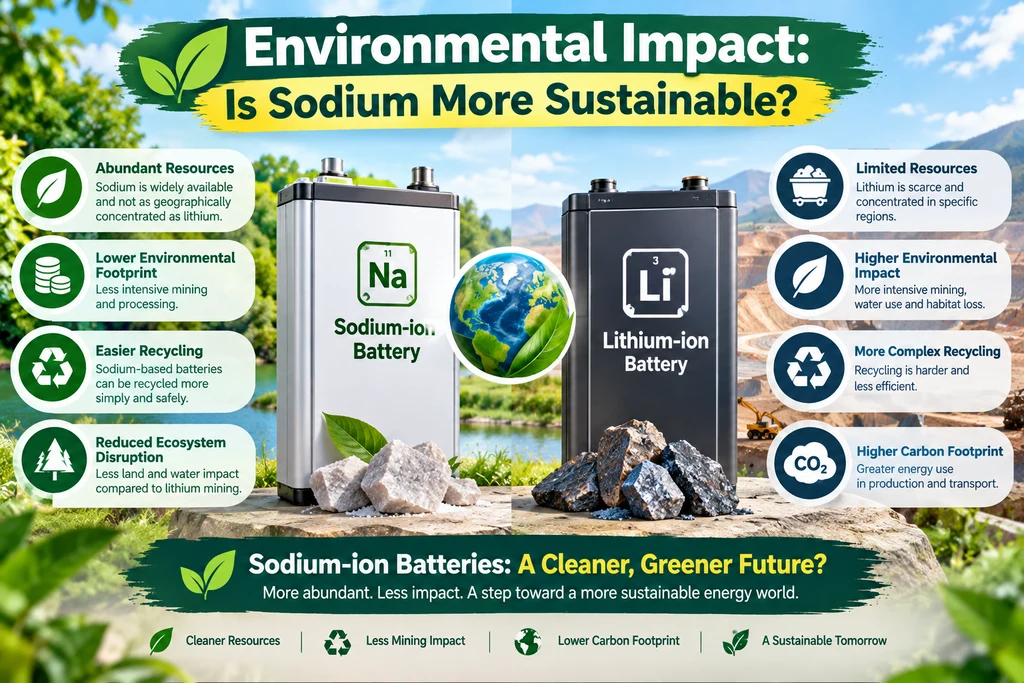
Sodium is abundant in nature, and its availability could help diversify battery supply chains. Some sodium-ion designs may also avoid certain critical materials used in other battery chemistries.
That sounds like a win for the environment, but there is more to the story. Mining and processing materials, manufacturing cells, transporting batteries, and managing them at the end of their useful life all have environmental impacts.
It is also worth remembering that LFP batteries already avoid cobalt and nickel in their cathode chemistry. So the comparison between sodium-ion and LFP is not as simple as sodium being sustainable and lithium being harmful.
If environmental impact is a priority, look for credible life-cycle assessments, responsible manufacturing information, and available recycling programs. A long-lasting battery that meets your needs can be a sensible choice regardless of chemistry.
8. Can You Use a Sodium-Ion Battery With Your Existing Solar Panels?
Possibly, but compatibility is something you must verify before buying. Solar panels produce electricity, while the battery system needs suitable charging controls, voltage limits, communications, and protection.
If your existing solar setup already uses a hybrid inverter, check the manufacturer’s approved battery list. Many inverters support only specific battery models or chemistries, even when the voltage looks compatible.
If you use a separate battery inverter, the system may offer more flexibility, but the equipment still needs to be designed and configured for the chosen battery.
Use this compatibility checklist
- Confirm that the inverter supports the exact battery model and chemistry.
- Check the battery voltage range and maximum charge and discharge current.
- Verify communications between the battery management system and inverter.
- Confirm that the system supports your backup and grid-interconnection requirements.
- Ask about the effect on your existing equipment warranty.
Do not connect a new battery simply because its terminals fit. The voltage, charging profile, protection system, and manufacturer approval all matter.
9. Who Should Consider Sodium-Ion Solar Batteries?
Sodium-ion technology may be worth a closer look if you want to explore alternatives to lithium-based storage and can find a suitable product with dependable support.
- Homeowners in cold regions: Consider sodium-ion models with verified low-temperature performance.
- Buyers with flexible installation space: A larger battery may be acceptable if the price and specifications are attractive.
- People comparing emerging technology: Sodium-ion may be interesting if you’re comfortable evaluating newer products and their warranties.
- Off-grid property owners: Consider it only after confirming compatibility, cycle life, cold-weather behavior, and local technical support.
There is no need to switch just because a new technology has arrived. If your existing solar battery works well, meets your energy needs, and still has useful life remaining, replacing it early may not make financial sense.
10. Who Should Stick With Lithium Iron Phosphate?
For many homeowners, LFP remains the practical option today. It has an established place in residential energy storage, and there is a broad range of batteries, installers, and system configurations to compare.
- You want a battery from a well-established residential product line.
- You need broad installer and service availability.
- You have limited installation space.
- You want a well-documented warranty and published performance specifications.
- Your existing inverter already supports a suitable LFP battery.
This doesn’t mean LFP is automatically the right choice for everyone. Compare the actual products, not just their chemistry. A well-supported sodium-ion battery could suit a particular application, while a poorly matched LFP battery could be the wrong purchase.
How to Choose the Right Solar Battery for Your Home
Before spending thousands of dollars on energy storage, take a little time to work out what you need. This simple process can help you avoid paying for capacity you rarely use.
- Check your daily electricity use. Look at your utility bills or energy-monitoring data to understand how much electricity you use after sunset.
- Decide what the battery must power. Backup for a refrigerator, lights, and internet requires less capacity than running most of an entire house.
- Choose usable capacity. Compare usable kWh rather than relying only on the headline capacity.
- Check continuous power. A battery may store plenty of energy but still struggle to run several large appliances at the same time.
- Compare installed prices. Include the inverter, installation, electrical work, permits, and any additional equipment.
- Read the warranty carefully. Check the term, capacity retention, energy-throughput limit, and service conditions.
- Think about your climate. Make sure the operating temperature range fits the place where you will install the battery.
A little planning now can save a lot of frustration later. The best solar battery is the one that fits your home, your budget, and the way you actually use electricity.
Frequently Asked Questions
Are sodium-ion batteries better than lithium batteries for solar?
Not in every situation. Sodium-ion batteries may offer advantages in some cold-weather applications and could benefit from abundant raw materials. LFP batteries currently have a more established residential market and often provide a strong combination of efficiency, cycle life, and product availability. Compare the exact models before deciding.
Will sodium-ion batteries replace lithium solar batteries?
They may become an important alternative in some applications, but a complete replacement is not guaranteed. Different battery technologies suit different needs, and LFP remains a strong option for many home solar installations.
Can I replace my lithium solar battery with a sodium-ion battery?
Only if the new battery is compatible with your inverter, charging controls, voltage limits, and system design. Check the equipment documentation and consult a qualified installer before making the change.
Are sodium-ion batteries safe for home use?
Some sodium-ion batteries are designed for stationary energy storage, but safety depends on the specific cells, battery management system, certifications, and installation. Buy a product intended for your application and follow the manufacturer’s safety instructions.
Should I wait for sodium-ion batteries before buying solar storage?
If you need backup power now, compare suitable batteries that are available in your area today. If your current system meets your needs and you’re not in a hurry, watching sodium-ion prices and product development may make sense. Don’t delay a worthwhile purchase based only on the promise of future price reductions.
Final Verdict: Is It Time to Switch?
Sodium-ion batteries are an exciting development in energy storage. Their use of abundant sodium and the potential for useful cold-weather performance make them worth watching. As manufacturing grows, they could become an attractive option for more homes and off-grid systems.
Still, I wouldn’t switch from a good LFP solar battery just because sodium-ion technology is getting attention. Today, lithium iron phosphate remains a practical choice for many homeowners because it has an established market, a wide range of products, and a solid track record in residential storage.
My advice is simple: compare usable capacity, installed cost, warranty, efficiency, temperature limits, and inverter compatibility. If a sodium-ion battery checks those boxes and offers better value for your situation, it deserves serious consideration. Otherwise, there is no shame in sticking with a proven LFP system.
What about you? Would you try a sodium-ion solar battery, or would you rather stick with lithium iron phosphate? The technology is changing quickly, and I’d love to hear what matters most to you when choosing a home energy storage system.
Keep Learning About Solar Energy
Want to make smarter decisions about home solar power? Explore more solar guides on our website to learn about solar panels, battery storage, inverters, and ways to use your energy more efficiently.