
Choosing between a string inverter vs microinverter is one of the most important decisions when designing a residential solar power system.
Both technologies convert the direct-current (DC) electricity produced by solar panels into alternating-current (AC) electricity that can be used by your home. The major difference is where the conversion happens.
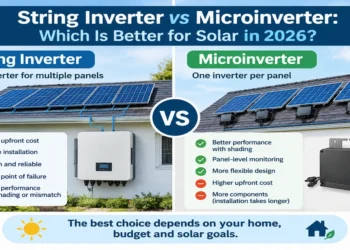
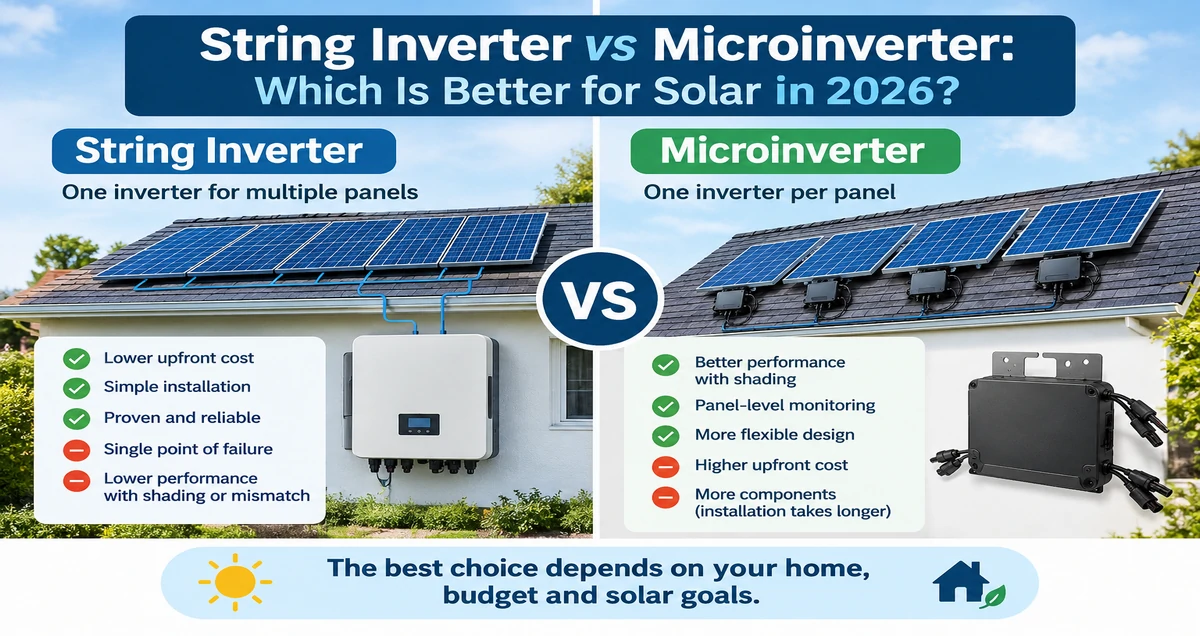
A string inverter is installed in a central location and typically handles electricity from a group of solar panels connected in a string. A microinverter is installed at the individual solar-panel level, allowing each panel to convert its own DC electricity into AC.
So which one should you choose?
Related Post
The answer depends on your roof design, shading, panel orientation, system size, budget, monitoring requirements, battery plans, and installation conditions.
In this guide, you’ll learn:
- How string inverters work
- How microinverters work
- String inverter vs microinverter differences
- Which performs better with shade
- Which is easier to maintain
- Cost considerations
- Battery-storage compatibility
- Monitoring differences
- Roof orientation considerations
- Pros and cons
- Which option may be better for different homes
- Common installation mistakes
- Questions to ask your solar installer
What Is a String Inverter?
A string inverter is a centralized solar inverter that converts DC electricity from a group of solar panels into AC electricity.
Solar panels are connected together in one or more strings.
A simplified system looks like this:
Solar Panel → Solar Panel → Solar Panel → Solar Panel
↓
String Inverter
↓
Home Electrical Panel
The inverter is normally installed away from the roof, such as on an exterior wall, garage, utility area, or other suitable location.
DOE describes string inverters as systems where a set of panels is connected to one inverter that performs the DC-to-AC conversion.
How Does a String Inverter Work?
Each solar panel produces DC electricity.
When several panels are connected into a string, their electrical characteristics are combined according to the wiring configuration.
The string then sends DC electricity to the central inverter.
The inverter:
- Receives DC electricity from the solar array
- Tracks the available solar power
- Converts DC electricity into AC electricity
- Supplies AC power to the home’s electrical system
- Can communicate with monitoring equipment and, depending on the system, batteries or the utility grid
String inverters have been used for many years and remain a common solution for residential solar systems.
What Is a Microinverter?
A microinverter is a small inverter installed at or near an individual solar panel.
Instead of sending DC electricity from multiple panels to one central inverter, each panel has its own inverter.
The basic configuration looks like:
Panel → Microinverter
Panel → Microinverter
Panel → Microinverter
Panel → Microinverter
The AC outputs are then combined and sent toward the home’s electrical system.
DOE explains that microinverters are attached to individual solar modules, allowing the modules to operate independently.
How Does a Microinverter Work?
Each solar panel produces DC electricity.
The microinverter attached to that panel converts the DC electricity into AC electricity.
This means the solar array has multiple smaller inverters rather than one large centralized inverter.
One important advantage is that problems affecting one panel do not necessarily reduce the output of every other panel in the same way.
For example, if one panel experiences shading, the other panels can continue operating independently.
NREL identifies this panel-level behavior as one of the major differences between microinverter and traditional string-inverter architectures.
String Inverter vs Microinverter: The Main Difference
The simplest way to understand the difference is:
String inverter
Many solar panels → one central inverter
Microinverters
Each solar panel → its own inverter
This architectural difference affects shading, monitoring, system design, maintenance, expansion, and cost.
String Inverter vs Microinverter Comparison
| Feature | String Inverter | Microinverter |
|---|---|---|
| Inverter location | Central location | At/near each panel |
| DC-to-AC conversion | Centralized | Panel level |
| Shading performance | More affected by string configuration | Better isolation between panels |
| Panel-level monitoring | Usually limited without additional equipment | Typically available |
| Complex roofs | Less flexible | More flexible |
| Simple roof | Often excellent choice | Can work well |
| Upfront equipment cost | Usually lower | Usually higher |
| Roof electronics | Fewer | More |
| Central inverter replacement | Possible during system life | No single central inverter |
| Maintenance access | Easier for central unit | Roof access may be required |
| Expansion | Depends on inverter capacity and design | Often flexible, but equipment compatibility still matters |
| Battery integration | Depends on architecture | Depends on battery/AC-coupling design |
The exact result depends on the equipment selected and system design. NREL’s comparison identifies string inverters as lower-cost relative to microinverters, while microinverters generally provide better performance on shaded or irregular roofs and panel-level monitoring.
Which Is Better for a Shaded Roof?
If your roof receives significant shade during the day, microinverters may have an advantage.
Consider a roof with four panels:
- Panel 1: Full sunlight
- Panel 2: Full sunlight
- Panel 3: Partial shade
- Panel 4: Full sunlight
With a traditional string configuration, the electrical behavior of the panels is interconnected.
A poorly performing panel can reduce the useful output of the string.
With microinverters, each panel operates through its own inverter.
The shaded panel can be affected while the other panels continue operating independently.
DOE specifically notes that shading or damage to an individual panel does not affect the other panels in the same way when microinverters are used.
Important clarification
This does not mean a microinverter makes a shaded panel produce full power.
A shaded panel still receives less sunlight.
The advantage is that its reduced output is more isolated from the rest of the array.
String Inverter vs Microinverter for Different Roof Directions
Roof orientation can be another important factor.
Imagine a house with panels installed on:
- South-facing roof
- East-facing roof
- West-facing roof
The panels may experience different sunlight conditions throughout the day.
Microinverters allow each panel to operate independently, which can make them attractive for roofs with multiple orientations.
NREL identifies microinverters as having higher performance potential for various directions and irregular roof configurations compared with traditional string-inverter systems.
For a simple roof with one dominant orientation and little shade, a string inverter may be a more economical solution.
Which Is More Efficient?
This question needs careful explanation.
It is tempting to say:
“Microinverters are more efficient.”
But that is too broad.
Real-world solar-system performance depends on many variables, including:
- Panel orientation
- Shading
- Temperature
- Wiring
- Inverter efficiency
- Panel mismatch
- System design
- Dirt and debris
- Equipment availability
- Installation quality
A microinverter’s major advantage is independent panel-level operation, not simply a universal efficiency advantage.
On a completely unshaded, simple roof, a properly designed string inverter system can perform very well.
On a complex roof with shade or multiple orientations, panel-level electronics can provide a meaningful design advantage.
String Inverter vs Microinverter for Monitoring
Monitoring is another major difference.
String inverter monitoring
A standard string inverter generally provides information about the inverter or string-level system.
Depending on the manufacturer and additional equipment, more detailed monitoring may be available.
Microinverter monitoring
Microinverter systems can provide panel-level monitoring.
This means you may be able to identify differences between individual panels.
For example:
Panel 1: 1.8 kWh
Panel 2: 1.7 kWh
Panel 3: 0.9 kWh
Panel 4: 1.8 kWh
A significant difference could indicate:
- Shade
- Dirt
- A wiring problem
- Panel degradation
- A microinverter issue
- Different sunlight exposure
NREL identifies module-level monitoring and troubleshooting as a major advantage of microinverter-based systems.
Which Is Easier to Maintain?
This is one area where the answer isn’t simply “microinverters.”
A string inverter has fewer inverter units.
If a central inverter needs replacement, however, the central unit can take the entire PV system offline until it is repaired.
The benefit is that the inverter is normally located somewhere accessible.
With microinverters, there are many individual electronic devices distributed across the array.
If one fails, the rest of the system can continue producing power.
However, accessing a failed microinverter may require roof work.
Therefore:
String inverter
Fewer inverter components + easier central access
Microinverter
More inverter components + panel-level redundancy
DOE notes that string inverters can be easier to service, while microinverters operate at the individual-module level.
String Inverter vs Microinverter Lifespan
The expected service life depends on the specific manufacturer, model, installation environment, and warranty.
DOE’s consumer guidance notes that string inverters commonly have shorter lifetimes than the solar panels themselves and may need replacement during the PV system’s life, while microinverters can have lifetimes closer to the panels depending on the equipment.
This makes the warranty especially important.
When comparing quotes, don’t look only at the inverter’s purchase price.
Check:
- Product warranty
- Labor warranty
- Replacement policy
- Monitoring warranty
- Installer warranty
- Equipment availability
- Transferability of warranties
Which Costs More: String Inverter or Microinverter?
In general, microinverter systems tend to have higher equipment costs than basic string-inverter systems.
NREL classifies traditional string inverter solutions as lower relative product cost and microinverter solutions as higher relative cost.
However, the cheapest equipment does not always produce the lowest lifetime cost.
For example, paying more for panel-level electronics could make sense if your roof has:
- Significant shade
- Multiple orientations
- Multiple roof planes
- Complex architecture
- Difficult string configurations
Conversely, a simple, unshaded roof may not justify paying substantially more for microinverters.
What About Solar Battery Storage?
Both system architectures can be used with battery storage, but the exact battery architecture matters.
A solar system can use:
- DC-coupled storage
- AC-coupled storage
- Hybrid inverter systems
- Dedicated battery inverters
The compatibility depends on the equipment.
DOE notes that solar-plus-storage systems use advanced inverters and that batteries can store solar energy for later use.
If you already know that you want batteries, tell the installer before selecting your inverter.
The inverter architecture should be designed around the entire system rather than adding storage as an afterthought.
String Inverter vs Microinverter for Off-Grid Solar
For an off-grid system, the decision becomes even more important because the inverter must work with:
- Solar panels
- Batteries
- Loads
- Battery-management systems
- Generator backup, if applicable
- Charge-control architecture
- Off-grid electrical requirements
Many off-grid systems use specialized hybrid or inverter/charger equipment.
Microinverters can be used in certain battery-based architectures, but compatibility must be checked carefully.
For a DIY or off-grid system, don’t select an inverter simply because its power rating looks correct.
Check:
- DC voltage range
- Maximum PV current
- AC output
- Battery voltage
- Battery communication
- Surge capability
- Generator compatibility
- Operating mode
- Certifications
- Local electrical requirements
Are Microinverters Better for Expanding Solar Later?
Microinverters can make certain expansions more straightforward because new panels can be equipped with compatible microinverters.
However, expansion is not automatically unlimited.
You still need to consider:
- Electrical service capacity
- Branch circuit limits
- Utility interconnection limits
- Roof space
- Panel compatibility
- Microinverter compatibility
- Cable configuration
- Monitoring equipment
- Local code
A string inverter may also allow expansion if there is sufficient inverter capacity and the electrical design supports it.
Always plan future expansion before the initial installation.
What Happens If One Microinverter Fails?
If one microinverter fails, the corresponding solar panel may stop producing normally.
The other microinverter-equipped panels can continue operating.
This is one of the major architectural differences between microinverters and centralized string systems.
However, the failed device still needs diagnosis and replacement.
Because the microinverter is normally located at the panel, accessing it may require roof access.
What Happens If a String Inverter Fails?
If the central string inverter fails, the solar production associated with that inverter can be interrupted.
For a system with one central inverter, this could mean the entire PV array stops producing AC power until the issue is resolved.
The advantage is that there is one main inverter to diagnose and service.
This creates an important trade-off:
String inverter: fewer central components but greater single-point dependence.
Microinverters: more distributed components but less dependence on one central inverter.
String Inverter vs Microinverter for a Simple Roof
Suppose you have:
- One large roof plane
- Minimal shade
- Panels facing the same direction
- No unusual roof geometry
- A standard residential solar system
A string inverter can be an excellent option.
Why?
Because the panels have similar operating conditions.
You may not need panel-level electronics to solve a major shading or orientation problem.
In this situation, a string inverter may provide a simpler and more economical design.
String Inverter vs Microinverter for a Complex Roof
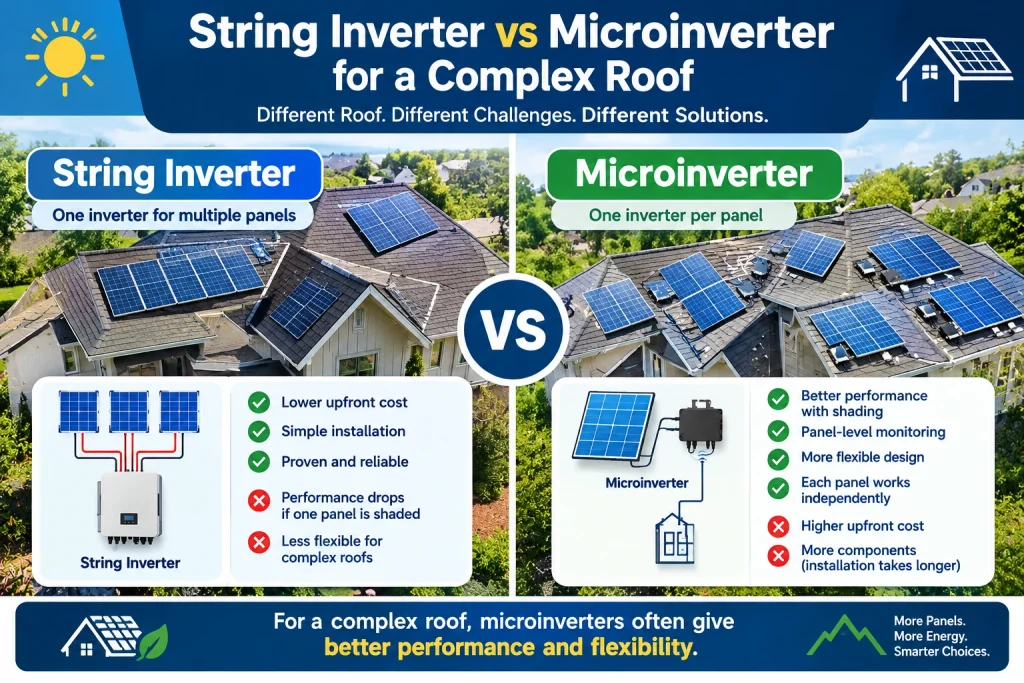
Now consider a roof with:
- Several roof planes
- Trees causing afternoon shade
- Panels facing different directions
- Chimneys
- Dormers
- Uneven sunlight
Microinverters may become much more attractive.
Each panel can operate more independently.
This can help reduce the effect of different sunlight conditions across the array.
String Inverter vs Microinverter: Pros and Cons
String Inverter Pros
- Usually lower equipment cost
- Proven architecture
- Centralized maintenance
- Easier access to the inverter
- Fewer inverter units
- Good choice for simple roofs
- Suitable for many large residential systems
String Inverter Cons
- More sensitive to string-level mismatch
- Shading can affect string performance
- Less flexible for complex roof layouts
- Central inverter can be a single point of failure
- Panel-level monitoring may require additional equipment
Microinverter Pros
- Panel-level conversion
- Better suited to complex roofs
- Good option for multiple orientations
- Better isolation of shaded panels
- Panel-level monitoring
- No single central solar inverter for the PV array
- Can simplify certain system expansions
Microinverter Cons
- Usually higher equipment cost
- More electronic components
- Electronics are installed near the panels
- Roof access may be required for some repairs
- Battery architecture needs careful planning
NREL’s comparison similarly identifies higher relative cost and more electronic components for microinverters, while highlighting their advantages for shading, irregular roofs, and module-level monitoring.
String Inverter vs Microinverter: Which One Should You Choose?
Use this quick decision guide.
Choose a string inverter if:
✓ Your roof is simple
✓ There is little or no shade
✓ Most panels face the same direction
✓ You want to minimize upfront equipment cost
✓ You prefer a centrally located inverter
✓ Your installer has a strong string-inverter design
Consider microinverters if:
✓ Your roof has multiple orientations
✓ You have meaningful shading
✓ You want panel-level monitoring
✓ Your roof is architecturally complex
✓ You value distributed inverter operation
✓ You may expand the system later
What About Power Optimizers?
There is a third option that homeowners often overlook:
Power optimizers + string inverter
Power optimizers are module-level electronics installed with individual panels.
They optimize DC power at the panel level, but the final DC-to-AC conversion still happens in a central inverter.
So there are three major architectures:
Traditional string inverter
Panels → String inverter
Power optimizers + string inverter
Panels → Optimizers → String inverter
Microinverters
Panels → Microinverters
Power optimizers can therefore provide some panel-level benefits while retaining a centralized inverter.
NREL classifies power optimizers and microinverters as module-level power electronics and distinguishes them from traditional string-inverter systems.
A Simple Example
Imagine a 6 kW solar system with 15 panels.
Option A: String inverter
15 panels → string(s) → central inverter → home
Option B: Microinverters
15 panels → 15 microinverters → home
Option C: Power optimizers
15 panels → 15 optimizers → central inverter → home
All three can be valid designs.
The best choice depends on the roof and system requirements rather than simply choosing the technology with the most features.
Common Mistakes When Choosing an Inverter
Mistake 1: Choosing Based Only on Price
The cheapest inverter may not be the best long-term solution.
Mistake 2: Ignoring Shade
A roof that looks sunny at noon may have substantial morning or afternoon shade.
Mistake 3: Ignoring Roof Orientation
Different roof planes can have very different production profiles.
Mistake 4: Forgetting Battery Plans
Adding a battery later can be more complicated if the original inverter architecture wasn’t selected with storage in mind.
Mistake 5: Comparing Only Wattage
A 6 kW inverter isn’t automatically equivalent to another 6 kW inverter.
Compare:
- Voltage range
- MPPT inputs
- Maximum current
- Efficiency
- Surge capability
- Battery compatibility
- Monitoring
- Warranty
- Certifications
Mistake 6: Ignoring Installer Quality
A good inverter with poor installation can still produce a poor solar system.
Questions to Ask Your Solar Installer
Before signing a solar contract, ask:
- Why are you recommending a string inverter or microinverter?
- How much shade does my roof receive throughout the day?
- Will different roof orientations use separate MPPT inputs?
- How will panel-level performance be monitored?
- What happens if one inverter fails?
- What is the equipment warranty?
- What is the labor warranty?
- Can I add batteries later?
- Can I expand the solar array later?
- What are the maximum DC voltage and current limits?
- Does the system comply with local electrical requirements?
- What happens during a grid outage?
- Is backup power included, or would additional equipment be required?
That last question is especially important.
A normal grid-connected solar system does not automatically provide backup power during an outage. Backup operation requires an appropriately designed inverter, storage and controls. DOE explains that solar-plus-storage systems can provide outage operation when properly configured.
Final Verdict: String Inverter vs Microinverter
There is no universal winner in the string inverter vs microinverter debate.
A string inverter may be the better choice when:
- The roof is simple
- Shade is minimal
- Panels have similar orientation
- Cost is a major consideration
- Centralized maintenance is preferred
A microinverter may be the better choice when:
- The roof has multiple orientations
- Shading is significant
- You want panel-level monitoring
- The roof is complex
- Independent panel operation is important
The most important lesson is this:
Choose the inverter architecture based on the roof and the complete solar system—not because one technology is universally “better.”
For a simple, unshaded roof, a well-designed string inverter system can be an excellent solution.
For a complex or shaded roof, microinverters can provide valuable panel-level control and monitoring.
The best solar system is the one that matches your roof, sunlight conditions, electrical requirements, budget, battery plans, and long-term goals.
Frequently Asked Questions
Is a string inverter better than a microinverter?
Not universally. String inverters can be excellent for simple, unshaded roofs, while microinverters can be advantageous for shaded or complex roofs.
Are microinverters worth the extra cost?
They can be, particularly when panel-level operation, shading management, multiple roof orientations, or monitoring provides meaningful value. For a simple unshaded roof, the additional cost may not be necessary.
Which is better for shade: string inverter or microinverter?
Microinverters generally handle panel-level shading effects better because each panel operates independently. They cannot eliminate the energy loss caused by shade itself.
Do microinverters produce more electricity?
They can improve system-level performance in situations involving shading, different orientations, or panel mismatch, but they do not automatically produce more energy on every roof.
How long do string inverters last?
Lifespan varies by model and environment. DOE notes that string inverters commonly have shorter lifetimes than solar panels and may require replacement during the PV system’s lifetime.
Do microinverters fail more often?
The answer depends on the specific equipment and installation. Microinverter systems contain more individual inverter devices, while a string system concentrates conversion in fewer devices. NREL identifies the greater number of electronic components as a consideration when comparing architectures.
Can microinverters work with batteries?
Yes, but the battery architecture and equipment compatibility must be checked. AC-coupled and other storage configurations are possible depending on the equipment.
Are string inverters cheaper?
Traditional string-inverter systems generally have lower relative equipment costs than microinverter systems, although total installed cost varies by project.
Can I add more panels later?
Potentially, but the ability to expand depends on inverter capacity, electrical service, equipment compatibility, utility rules, roof space, and local requirements.
Safety and Installation Disclaimer
Solar PV systems involve potentially hazardous DC and AC voltages. Inverter selection, string configuration, grounding, overcurrent protection, rapid-shutdown requirements, battery integration, and grid connection should be designed and installed according to applicable electrical codes and manufacturer instructions. Have a qualified solar/electrical professional verify the final system design.