
What if you could generate your own electricity without installing a full rooftop solar system?
Balcony solar panels offer apartment residents, renters, and homeowners another way to use solar energy, even when they do not have access to a private roof.
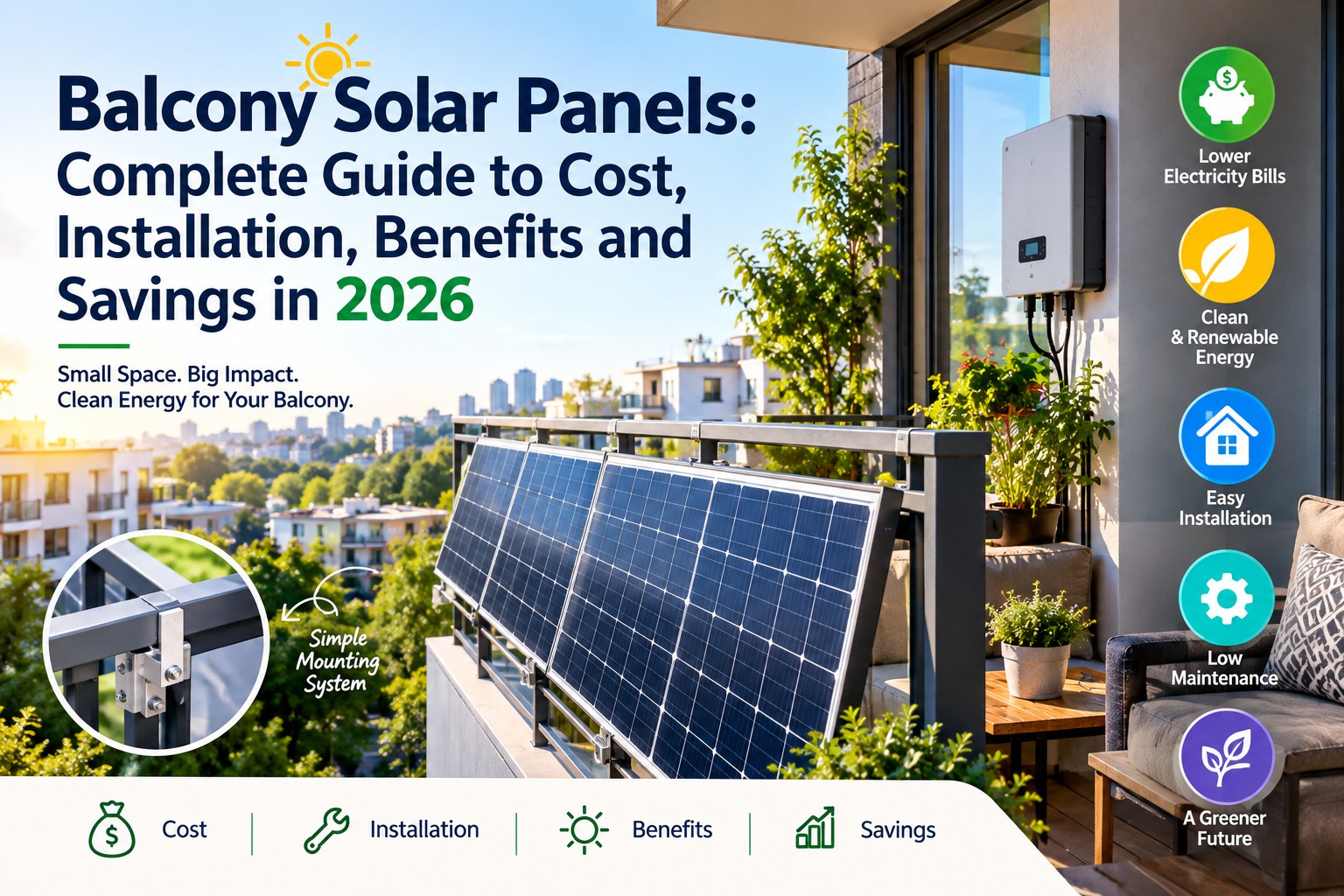
These compact solar systems can be mounted on suitable balconies, railings, terraces, or other approved locations. Depending on the system design, they can supply electricity directly to household appliances, reduce the amount of electricity drawn from the grid, or store energy in a compatible battery.
Often called balcony solar systems, plug-in solar panels, or mini solar systems, these installations are becoming an interesting option for people who want to explore renewable energy without committing to a large residential solar project. The European Commission recognizes balconies and terraces as potential locations for solar installations, although local requirements vary.
But are balcony solar panels actually worth buying? How much electricity can they generate? Can you install them in an apartment? And what should you know about safety, costs, and installation?
In this guide, you’ll learn how balcony solar panels work, how to estimate their electricity production, what affects their performance, how to choose the right system, and which mistakes to avoid.
What Are Balcony Solar Panels?
Balcony solar panels are compact photovoltaic panels designed to generate electricity in locations where a conventional rooftop solar installation may not be practical.
A typical system may include:
- One or more solar panels
- A compatible microinverter
- A mounting structure
- Electrical cables and connectors
- Monitoring equipment
- An optional battery
- Required electrical protection and connection equipment
The panels capture sunlight and convert it into direct-current (DC) electricity. If the system uses a microinverter, that device converts the electricity into alternating current (AC) for compatible household electrical systems.
Some systems are designed for direct grid-connected operation, while others use batteries or operate independently of the household grid.
Important: Not every balcony solar kit is designed to plug directly into a standard household outlet. Whether a plug-in system is permitted depends on the country, local electrical rules, product certification, and the specific installation.
How Do Balcony Solar Panels Work?
The basic process is straightforward.
Step 1: Solar Panels Capture Sunlight
Photovoltaic cells inside the panels convert sunlight into DC electricity.
The amount produced depends on the available sunlight, panel capacity, orientation, temperature, shading, and other environmental conditions.
Step 2: The Inverter Converts Electricity
In a typical grid-connected balcony system, a microinverter converts the panels’ DC electricity into AC electricity.
The inverter must be compatible with the panels and the intended electrical system.
Step 3: Your Home Uses the Electricity
When the system is properly connected, its electricity can help supply household loads.
For example, solar generation may offset some of the electricity used by a refrigerator, router, computer, lighting, or other appliances operating at the same time.
If your home needs more electricity than the balcony system produces, the remaining demand comes from another available source, such as the utility grid.
Step 4: Excess Electricity Is Managed
If the panels produce more electricity than the home uses at that moment, the surplus may be exported to the grid, stored in a compatible battery, or curtailed, depending on the system.
Do not assume that exported electricity will earn you money. Compensation, registration, and grid-connection rules depend on your location and utility arrangements.
How Much Electricity Can Balcony Solar Panels Produce?
Electricity production is one of the most important factors to consider before buying a balcony solar kit.
The answer depends on the panel capacity and the amount of usable sunlight your balcony receives.
A system’s rated wattage describes its power capacity under specified test conditions. It does not mean the system will produce that amount continuously throughout the day.
Example: Two 400W Balcony Solar Panels
Imagine installing two solar panels rated at 400 watts each.
The combined rated capacity is:
400W + 400W = 800W, or 0.8 kW
To estimate daily energy production, you can use this simplified formula:
Daily energy (kWh) = Solar capacity (kW) × Peak sun hours × Performance factor
Suppose the system has:
- Rated solar capacity: 0.8 kW
- Illustrative peak sun hours: 4 per day
- Illustrative performance factor: 0.80
The estimate becomes:
0.8 × 4 × 0.80 = 2.56 kWh per day
This is a planning example, not a prediction for every balcony.
Actual production could be lower or higher depending on the location, shading, orientation, panel temperature, inverter limits, weather, and other losses.
Estimated Production Under Different Conditions
Using the same 800W system and an illustrative performance factor of 0.80:
| Illustrative peak sun hours per day | Estimated daily production | Estimated 30-day production |
|---|---|---|
| 2 hours | 1.28 kWh | 38.4 kWh |
| 3 hours | 1.92 kWh | 57.6 kWh |
| 4 hours | 2.56 kWh | 76.8 kWh |
| 5 hours | 3.20 kWh | 96 kWh |
These figures are mathematical examples, not guaranteed output. A shaded balcony may perform substantially worse than an open, sunny location.
For a more realistic estimate, investigate local solar resources and use a calculator or simulation that accounts for your location, panel orientation, tilt, and shading.
What Can Balcony Solar Panels Power?
Balcony solar panels can help offset electricity used by appliances that operate while solar energy is available.
Potential examples include:
- Wi-Fi routers
- LED lighting
- Laptop computers
- Televisions
- Refrigerators
- Small electronics
- Fans
- Other compatible household appliances
However, the panels do not directly determine which appliances can run. The actual result depends on the system’s output, appliance consumption, operating schedule, and whether a battery is installed.
Example: Running a 100W Appliance
Suppose an appliance uses 100 watts and operates for 8 hours.
Its energy consumption is:
100W × 8 hours = 800Wh, or 0.8 kWh
If your balcony system produces 0.8 kWh of usable electricity during the same period, it could theoretically offset that amount of energy.
In practice, production and consumption rarely match perfectly throughout the day.
A system may generate more than the appliance needs at noon and less than it needs in the evening.
This is why understanding your daily electricity use is more useful than looking at panel wattage alone.
Are Balcony Solar Panels Worth It?
Balcony solar panels can be worth considering if your balcony receives adequate sunlight and you can use a meaningful share of the electricity when it is generated.
They may be particularly attractive for people who:
- Live in apartments
- Cannot install rooftop solar panels
- Have a sunny balcony or terrace
- Want to start with a small solar installation
- Can use electricity during daylight hours
- Want to monitor their solar generation
- Need a compact renewable-energy solution
However, they are not ideal for every property.
A north-facing balcony in the Northern Hemisphere, a balcony shaded by nearby buildings, or a location with strict installation restrictions may produce disappointing results.
Before buying a system, estimate its likely energy production and compare that figure with your daytime electricity consumption.
Advantages of Balcony Solar Panels
1. Suitable for Some Apartments
Balcony solar can provide a way to generate electricity without needing access to a private rooftop.
This can be useful for apartment residents who cannot install a conventional solar array.
2. Smaller Initial Installation
A compact balcony system generally requires fewer panels than a full residential rooftop installation.
The total cost still depends on equipment, mounting, electrical work, and any required permissions.
3. Potential Electricity-Bill Savings
When your household uses the electricity generated by the panels, it may purchase less electricity from the grid.
Your savings depend on the amount generated, how much you consume directly, your electricity tariff, system cost, and applicable fees.
4. Modular System Options
Some systems allow users to start with a small installation and expand later.
Expansion is not automatic: the inverter, electrical circuit, mounting structure, and local rules must support the additional equipment.
5. Renewable Electricity
Solar panels generate electricity without burning fuel during operation.
Using solar electricity can reduce reliance on grid electricity, although the overall environmental benefit depends on manufacturing, transport, equipment lifetime, and the electricity source being displaced.
Disadvantages of Balcony Solar Panels
Balcony solar systems also have limitations.
1. Limited Space
A balcony usually has less usable area than a roof.
This restricts the number and size of panels that can be installed.
2. Shading
Nearby buildings, trees, railings, and overhangs can block sunlight.
Even partial shading may reduce production.
3. Weather Exposure
Balcony panels and mounting structures must withstand the environmental conditions specified by the manufacturer, including wind and rain.
Poorly secured panels can fall and injure people or damage property.
4. Limited Energy Production
A compact system will not necessarily cover the electricity demand of an entire apartment.
High-consumption appliances may require substantially more power than the balcony system can provide.
5. Permission and Electrical Requirements
Apartment rules, building-owner approval, electrical standards, utility requirements, and local regulations may restrict installation.
Never assume that a balcony solar kit is legal to connect simply because it is sold online.
Where Should You Install Balcony Solar Panels?
The installation location can make a significant difference to energy production and safety.
Before choosing a position, consider the following factors.
Sunlight Exposure
Look for a location that receives substantial direct sunlight during the day.
Observe whether neighboring buildings, trees, balconies, or roof overhangs create shadows.
Remember that shading changes throughout the year.
Orientation
The ideal orientation depends on your location and when you want the system to generate the most electricity.
In the Northern Hemisphere, south-facing panels often receive strong sunlight over the course of the day. East-facing panels may favor morning production, while west-facing panels may produce more electricity later in the day.
These are general tendencies, not guarantees. Local geography, climate, obstructions, and panel tilt matter.
Tilt Angle
The best panel angle depends on latitude, orientation, seasonal sunlight, available mounting space, and safety requirements.
A panel mounted vertically on a railing may produce a different amount of energy from one installed at an optimized angle.
Do not compromise mounting security to achieve a preferred tilt.
Structural Safety
The balcony railing, wall, or mounting surface must be suitable for the equipment and its expected loads.
Consider wind pressure, vibration, corrosion, panel weight, and the possibility of falling objects.
If you are uncertain about the structure, ask a qualified professional to evaluate it.
How to Install Balcony Solar Panels
The installation process depends on the type of system, building, and local requirements.
The following overview is intended for planning rather than as a universal wiring procedure.
Step 1: Check Local Rules
Before purchasing equipment, confirm whether balcony panels are allowed in your building and location.
You may need permission from the property owner, landlord, homeowners’ association, building manager, or electricity provider.
Step 2: Estimate Your Energy Needs
Review your electricity bills and identify appliances that consume electricity during daylight hours.
This helps you determine whether a small solar system could offset a meaningful portion of your consumption.
Step 3: Evaluate Sunlight and Shading
Observe the balcony at different times of day.
Record significant shading and consider seasonal changes.
Step 4: Select Compatible Equipment
Check the panels, inverter, mounting hardware, connectors, monitoring system, and optional battery.
Confirm that the components are approved for the intended application and compatible with each other.
Step 5: Secure the Mounting Structure
Use mounting hardware intended for the panel and building type.
Follow the manufacturer’s instructions and applicable building requirements. Do not rely on improvised hooks, loose weights, or unsuitable railing attachments.
Step 6: Arrange the Electrical Connection
Use only an electrical connection method approved for the specific system and jurisdiction.
Some systems may be eligible for a regulated plug-in connection; others require a dedicated circuit or professional installation.
Never improvise a connection, modify a plug, or feed electricity into a household circuit through an ordinary outlet unless the complete system is specifically approved for that use under local rules.
Step 7: Verify and Monitor Performance
After installation, check that the system operates as intended.
Use the monitoring equipment to compare actual production with realistic expectations, taking weather and seasonal changes into account.
Are Plug-In Balcony Solar Panels Safe?
They can be safe when the complete product and installation meet applicable safety requirements, but plug-in solar is not automatically safe just because it is easy to connect.
In June 2026, the UK government published a study evaluating representative plug-in photovoltaic systems under tested electrical conditions. The study reported stable behavior and effective operation of protective devices in the conditions tested, while also identifying differences in product performance. These results should not be interpreted as approval of every product or every installation.
For safe installation:
- Buy a complete system from a reputable supplier.
- Check that the product is certified or approved for your market.
- Follow the manufacturer’s instructions.
- Verify that the mounting system can withstand expected wind loads.
- Keep cables protected from damage, water, and excessive heat.
- Use only an approved electrical connection method.
- Avoid extension leads and multiway adaptors unless the specific system and local rules explicitly permit them.
- Have an electrician inspect the installation if required or if you are unsure about the electrical circuit.
Electrical Safety First warns against connecting plug-in solar systems through extension leads, cable reels, and multiway adaptors in its UK guidance. Requirements differ by jurisdiction, so follow the rules applicable to your location.
Can You Install Balcony Solar Panels in a Rental Apartment?
Possibly, but you should check before buying the equipment.
A tenant may need written permission from the landlord or building management.
The installation could affect:
- Balcony railings
- Exterior walls
- Building appearance
- Shared spaces
- Electrical circuits
- Insurance coverage
- Building warranties
Even if the solar kit is removable, its mounting structure may still require approval.
Ask for permission in writing and confirm that the installation can be removed without damaging the property.
Can Balcony Solar Panels Work With a Battery?
Yes, some balcony solar systems can be paired with compatible battery storage.
A battery stores electricity generated during periods of solar production so that some of it can be used later.
For example, a balcony system might generate electricity in the afternoon while the household is away. A compatible battery could store part of the surplus for evening use.
However, not every balcony kit supports battery integration.
Before choosing a battery, check:
- Battery chemistry
- Usable capacity in kWh
- Continuous power output in watts
- Maximum charging power
- Inverter compatibility
- Charging and discharging limits
- Safety certifications
- Indoor or outdoor installation requirements
- Warranty
- Whether the system can provide backup power
Important: A battery does not automatically provide emergency power during a grid outage. Backup operation requires compatible equipment and a system specifically designed to operate safely during an outage.
How Much Do Balcony Solar Panels Cost?
The cost depends on the system size, panel quality, inverter, mounting hardware, battery options, installation requirements, and local market.
Instead of relying on a single advertised price, compare complete system costs.
Your budget may include:
- Solar panels
- Microinverter
- Mounting brackets
- Approved cables and connectors
- Monitoring equipment
- Electrical work
- Building approval
- Shipping
- Optional battery
- Maintenance or replacement costs
Prices vary between countries, so use current local quotes rather than assuming that a price advertised in another market will apply to your home.
How to Calculate Potential Savings
You can estimate annual savings using this formula:
Annual bill savings ≈ Annual solar energy used directly × Electricity price avoided
For example, suppose your system generates 500 kWh of electricity in a year and your household directly uses 80% of that generation.
Electricity used directly:
500 kWh × 0.80 = 400 kWh
If the applicable electricity price you avoid is €0.25 per kWh, the illustrative annual savings would be:
400 × €0.25 = €100 per year
This is a hypothetical example, not a price or savings forecast for your location.
The actual result depends on electricity tariffs, production, system losses, export rules, and how much solar electricity your household can use directly.
To estimate a simple payback period:
Simple payback period = Total system cost ÷ Annual bill savings
This calculation excludes financing, maintenance, component replacement, electricity-price changes, and other costs. It should be treated as a preliminary estimate rather than a guarantee.
Balcony Solar Panels vs. Rooftop Solar Panels
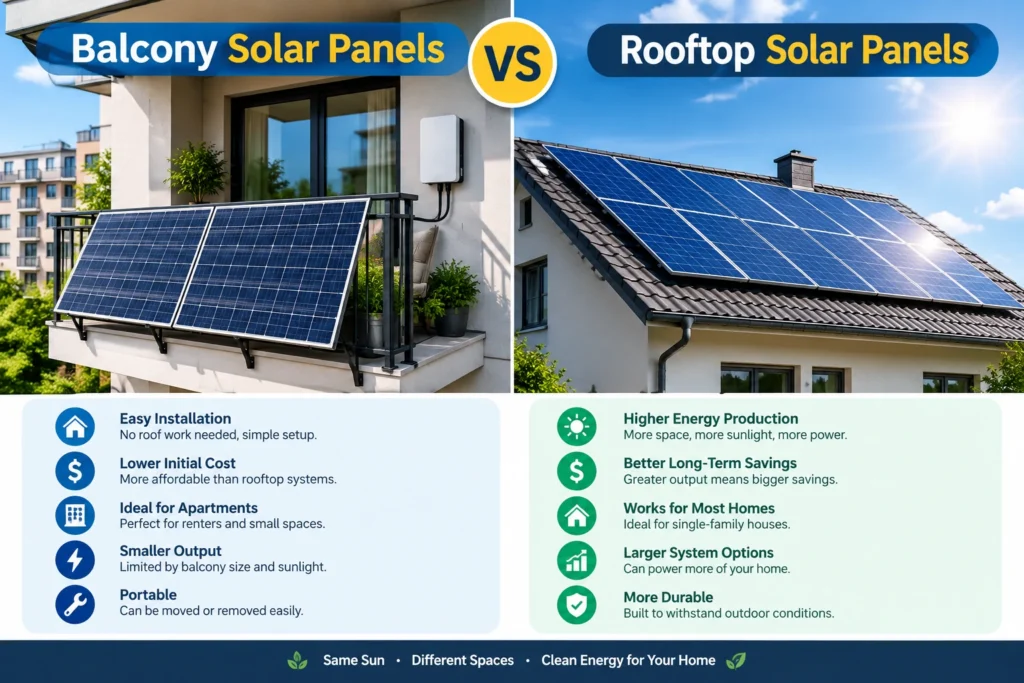
Both options generate electricity from sunlight, but they serve different needs.
| Feature | Balcony Solar Panels | Rooftop Solar Panels |
|---|---|---|
| Typical system size | Small | Often larger |
| Space available | Limited | Potentially much greater |
| Installation | Depends on system and local rules | Usually requires a planned installation |
| Electricity production | Generally lower overall | Often higher overall |
| Shading | Nearby buildings and railings can matter | Roof obstructions and trees can matter |
| Suitable for renters | Sometimes, with permission | Often more difficult |
| Battery options | Available with compatible systems | Available with compatible systems |
| Best suited for | Small-scale generation | Larger household energy needs |
A balcony system may be a practical starting point for an apartment resident. A rooftop system may be more suitable for someone who wants to generate a larger share of household electricity.
Neither option is automatically better for every property.
Balcony Solar Panels vs. Portable Solar Panels
These systems may look similar, but their intended uses can differ.
Balcony solar panels are commonly designed for a fixed or semi-permanent installation that supplies a building’s electrical system through an approved configuration.
Portable solar panels are often designed to charge a compatible portable power station or battery.
A portable panel can be convenient for camping, travel, or temporary use. A balcony system may be more suitable for regular household generation.
Always verify the intended use, connector compatibility, electrical limits, and safety instructions before connecting panels to an inverter or battery.
Common Balcony Solar Panel Mistakes to Avoid
Mistake 1: Choosing Panels Based Only on Wattage
A higher rated wattage does not guarantee higher real-world production.
Consider shading, orientation, panel size, inverter limits, and the amount of usable sunlight.
Mistake 2: Ignoring Wind Loads
Balcony panels can be exposed to strong gusts.
An unsuitable mounting system could allow a panel to fall from a height.
Mistake 3: Assuming Every Plug-In Kit Is Legal
Electrical and grid-connection rules differ by location.
Check local requirements before buying or connecting the system.
Mistake 4: Expecting the Panels to Power Everything
A small system cannot necessarily supply the entire apartment, particularly when several high-power appliances operate simultaneously.
Mistake 5: Forgetting Daytime Electricity Use
Solar production may be highest when nobody is home.
Look for opportunities to use compatible appliances during periods of generation, provided this is practical and safe.
Mistake 6: Buying an Incompatible Battery
Not every battery works with every inverter.
Check compatibility and operating limits before purchasing storage equipment.
Mistake 7: Ignoring Building Permission
A balcony installation may affect shared property, exterior appearance, or structural components.
Get the required approvals before installation.
How to Choose the Best Balcony Solar Panel Kit
Before buying a balcony solar kit, compare the following features.
1. Panel Power
Check the combined rated wattage and whether the panel dimensions fit the available space.
2. Inverter Compatibility
Verify the inverter’s input voltage, current limits, maximum PV power, AC output, and required grid protections.
3. Mounting System
Choose a mounting system designed for your balcony type and expected environmental loads.
4. Monitoring
Monitoring can help you understand production and identify unusual performance changes.
5. Expandability
If you plan to add panels or batteries later, verify that the inverter and electrical installation support the expansion.
6. Warranty and Support
Check product warranties, installation coverage, replacement procedures, and access to technical support.
7. Local Approval
Make sure the complete product and installation method comply with local requirements.
8. Total Cost
Compare the complete installed cost, not just the advertised panel price.
A well-matched small system may offer better value than a more powerful kit that cannot be installed safely or used efficiently.
Are Balcony Solar Panels Suitable for Morocco?
Balcony solar panels may be worth investigating in Morocco, where sunlight can be favorable in many locations. However, actual production depends on the city, balcony orientation, shading, panel tilt, and local weather.
Before installing a system, consider:
- How many hours of direct sunlight reach the balcony
- Whether neighboring buildings create shade
- Whether the railing or wall can safely support the panels
- Whether the property owner or building management permits the installation
- Whether the inverter and electrical connection meet applicable Moroccan requirements
- Whether the electricity provider or local authorities require notification or approval
Do not assume that plug-in solar rules in Europe or the United Kingdom apply in Morocco.
Confirm local requirements with the relevant electricity provider, building management, or a qualified solar installer before connecting the system to household wiring.
Frequently Asked Questions About Balcony Solar Panels
Do balcony solar panels really work?
Yes. Photovoltaic panels can generate electricity from sunlight when installed and connected correctly. Their output depends on sunlight, shading, orientation, temperature, equipment, and system losses.
How many balcony solar panels do I need?
The number depends on your available space, energy goals, panel wattage, and local sunlight. Calculate the expected energy production before deciding how many panels to install.
Can balcony solar panels reduce electricity bills?
They can reduce the amount of grid electricity purchased when the household uses the solar electricity generated. Savings depend on production, direct consumption, tariffs, and the system’s total cost.
Can I install balcony solar panels without drilling?
Some mounting systems are designed for particular railings or structures without drilling, but they are not suitable for every balcony. The mounting must be secure and approved for the panel and environmental conditions.
Do balcony solar panels work on cloudy days?
Yes, panels can generate electricity under diffuse daylight, but output is generally lower than under strong direct sunlight.
Can balcony solar panels work at night?
Solar panels do not generate meaningful electricity in darkness. A compatible battery may supply stored energy at night.
Can I use balcony solar panels during a power outage?
A typical grid-connected balcony system may shut down during a grid outage to prevent unsafe backfeeding. Backup power requires a system specifically designed and approved for that function.
Are balcony solar panels suitable for renters?
They may be, depending on the building, landlord permission, mounting requirements, electrical rules, and local regulations.
Do balcony solar panels need maintenance?
They generally require periodic inspection, cleaning when appropriate, cable checks, mounting checks, and monitoring. Follow the manufacturer’s maintenance instructions and avoid unsafe work at height.
Can I connect balcony solar panels to a normal outlet?
Only if the complete system is specifically designed and approved for that connection method under the applicable local rules. Never assume that an ordinary household outlet is suitable for every solar kit.
Final Verdict: Are Balcony Solar Panels Worth It?
Balcony solar panels can be a practical way to generate renewable electricity when rooftop solar is not an option.
They are particularly worth investigating if you have a sunny balcony, enough space for a secure mounting system, meaningful daytime electricity consumption, and permission to install the equipment.
Before purchasing a system, focus on five things:
- Realistic electricity production
- Total installed cost
- Local electrical and building requirements
- Safe mounting and connection
- How much of the generated electricity you can use
The most powerful system is not always the best investment. A properly designed, appropriately sized installation that fits your balcony and energy needs may offer more value than a larger system with poor sunlight or complicated installation requirements.
Start by evaluating your available sunlight, estimating your daily electricity use, and checking local requirements. Then compare complete system quotes and calculate potential savings using realistic production estimates.
The goal is not simply to install solar panels on your balcony. It is to generate useful electricity safely and economically.