
Electric vehicles are becoming an important part of the transition toward cleaner transportation, but charging an EV can increase household electricity consumption. One way to manage that additional electricity demand is solar EV charging.
A home solar system can generate electricity during the day, while an EV charger can use that electricity to charge an electric vehicle. Depending on the system design, homeowners can also combine solar panels with battery storage to use stored solar energy when the sun is not shining.
But how many solar panels do you need to charge an EV?
Can solar panels charge an electric car at night?
Is a home solar EV charger worth it?
And what happens when your EV needs more electricity than your solar panels are producing?
This guide explains how solar EV charging works, how much solar power an EV may need, charging options, batteries, costs, installation considerations, and common mistakes to avoid.
What Is Solar EV Charging?
Solar EV charging means using electricity generated by solar panels to charge an electric vehicle.
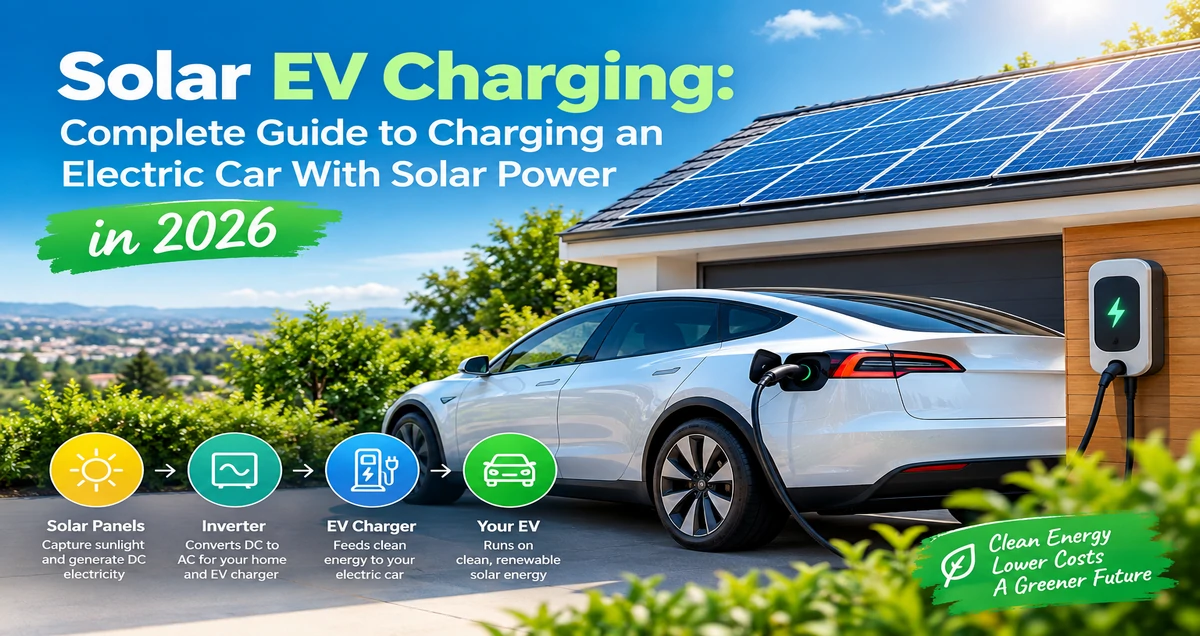
A basic system looks like this:
Sunlight → Solar panels → Inverter → EV charger → Electric vehicle
When the solar panels produce electricity, the home can use that electricity for appliances and EV charging.
If solar production is greater than the home’s immediate electricity demand, the excess electricity can potentially be used for EV charging, stored in a battery, or exported to the grid, depending on the system configuration and local rules.
Solar EV charging can therefore connect two major household energy systems:
- Solar electricity generation
- Electric vehicle charging
How Does Solar EV Charging Work?
Solar EV charging is easier to understand when you follow the electricity from the roof to the vehicle.
Step 1: Solar Panels Generate Electricity
Solar panels convert sunlight into DC electricity.
The amount produced changes throughout the day depending on:
- Sunlight
- Weather
- Season
- Panel orientation
- Roof angle
- Shading
- Temperature
- System losses
Step 2: The Inverter Converts Electricity
A solar inverter converts the panel’s DC electricity into AC electricity for compatible household loads.
Step 3: The EV Charger Supplies the Vehicle
The EV charger delivers electricity to the vehicle according to the charger’s specifications and the vehicle’s charging system.
Step 4: The Vehicle Stores the Energy
The EV’s battery stores the electricity for driving.
The charging rate depends on the vehicle, charger, electrical service, and charging configuration.
Can Solar Panels Charge an Electric Vehicle?
Yes.
A properly designed residential solar system can provide electricity for EV charging.
However, the solar panels do not have to produce enough electricity to charge the vehicle instantaneously.
For example, a home might produce solar electricity during the afternoon while the vehicle is parked at home. The charging system can use available solar power while the vehicle is connected.
Alternatively, electricity can come from a combination of:
Solar + Grid
or:
Solar + Battery + Grid
depending on the system.
This flexibility can be useful because EV charging can represent a significant additional household electrical load.
How Many Solar Panels Do You Need to Charge an EV?
There is no universal number.
The required solar capacity depends on:
- How many miles or kilometers you drive
- Your EV’s energy efficiency
- How often you charge
- Your local solar production
- Charging losses
- How much of the charging occurs directly from solar
- Your existing household electricity consumption
A simple way to estimate the additional annual electricity required is:
Annual EV electricity = annual driving distance × EV electricity consumption per mile
For example, suppose an EV uses approximately:
0.30 kWh per mile
and you drive:
10,000 miles per year
The estimated vehicle electricity requirement would be:
10,000 × 0.30 = 3,000 kWh/year
That is the energy needed by the vehicle under the stated assumption. Real-world consumption varies by vehicle, weather, driving style, speed, terrain, and charging losses.
You would then estimate how much additional solar production is needed to supply that electricity.
How Many Solar Panels Are Needed for EV Charging?
Suppose you use 400W solar panels.
A 5kW solar array would require approximately:
5,000 ÷ 400 = 12.5
So a real array might use around 13 panels, depending on the system design.
A 10kW array would require:
10,000 ÷ 400 = 25 panels
But panel count alone does not tell you whether the system can fully offset your EV charging.
For example, two 5kW systems in different locations may produce different amounts of electricity because their solar resources and installation conditions are different.
Solar EV Charging vs Grid EV Charging
A conventional EV charger can draw electricity from the utility grid.
Solar EV charging adds another electricity source.
| Feature | Grid EV Charging | Solar EV Charging |
|---|---|---|
| Uses grid electricity | Yes | Possible |
| Uses solar electricity | No | Yes |
| Requires solar panels | No | Usually |
| Can charge during daytime | Yes | Yes |
| Can charge at night | Yes | Yes, using grid or battery |
| Battery storage required | No | No |
| Can reduce grid electricity use | No | Potentially |
| Works with home solar | — | Yes |
Solar does not necessarily eliminate grid electricity.
Instead, it can reduce the amount of electricity purchased from the grid, depending on your energy production and consumption.
Can You Charge an EV Directly From Solar Panels?
Not in the simple sense of connecting ordinary rooftop solar panels directly to an EV.
A residential solar system normally uses an inverter and appropriate electrical equipment between the panels and household loads.
A simplified system is:
Solar panels → Inverter → Electrical panel → EV charger → EV
Some specialized solar EV charging systems can manage solar generation and EV charging dynamically.
The exact architecture depends on the equipment selected.
What Is a Solar EV Charger?
A solar EV charger generally refers to an EV charging setup designed to work with a solar energy system.
Some systems can monitor available solar production and adjust charging power.
For example:
High solar production → More EV charging
Low solar production → Less EV charging
No solar production → Grid or battery may provide electricity
This type of energy management can help increase direct use of solar electricity.
Smart EV Charging With Solar
Smart charging can make solar EV charging more flexible.
Instead of charging the vehicle at maximum power whenever it is plugged in, a smart system can potentially adjust charging according to:
- Solar production
- Household electricity consumption
- Battery state of charge
- Electricity prices
- Vehicle charging requirements
- User schedules
For example, if the solar system produces excess electricity at midday, the charger may increase charging power.
When clouds reduce solar production, the charging rate can be reduced or another electricity source can be used, depending on the system.
Solar EV Charging With Battery Storage
Adding a home battery creates another option.
A simplified system can operate like this:
Solar panels → Home
Solar panels → EV
Solar panels → Battery
During the day, excess solar electricity can charge the battery.
Later, the stored electricity may be used for household loads or EV charging, depending on the battery and energy-management system.
This can be particularly useful when the vehicle is normally at home at night rather than during peak solar production.
However, adding a battery increases system cost and introduces additional equipment, conversion losses, installation requirements, and maintenance considerations.
Can Solar Charge an EV at Night?
Solar panels do not produce normal photovoltaic electricity from sunlight at night.
Therefore, an EV cannot generally be charged from active rooftop solar production after sunset.
Nighttime EV charging can instead use:
- Grid electricity
- Stored battery energy
- A combination of sources
For example:
Day: Solar → Battery
Night: Battery → EV
This is one reason solar-plus-storage systems can be useful for EV owners.
How Big Should a Solar System Be for an EV?
There is no single ideal system size.
A useful approach is to calculate your existing household electricity consumption and then add your estimated EV electricity use.
Example
Suppose a home consumes:
9,000 kWh/year
and the EV requires approximately:
3,000 kWh/year
Total estimated electricity demand becomes:
12,000 kWh/year
The next step is to estimate how much electricity one installed kW of solar can produce at your location.
For illustration only, suppose a location produces:
1,400 kWh per installed kW per year
Then:
12,000 ÷ 1,400 ≈ 8.6 kW
This suggests a solar array around the 9kW range as an initial planning estimate.
The final system should be designed using location-specific production estimates, roof conditions, equipment specifications, utility requirements, and actual electricity consumption.
5kW vs 10kW Solar for EV Charging
EV owners often compare 5kW and 10kW solar systems.
5kW Solar System
A 5kW system can be suitable when:
- Household electricity consumption is moderate
- EV driving is relatively low
- Roof space is limited
- Budget is limited
- Grid electricity remains part of the charging strategy
10kW Solar System
A 10kW system provides approximately twice the installed solar capacity and may be more suitable when:
- Household electricity use is high
- EV driving is substantial
- Multiple vehicles need charging
- Air conditioning is heavily used
- Electric heating is used
- Future electricity consumption is expected to increase
The right choice should be based on annual electricity consumption rather than the EV alone.
How Long Does It Take to Charge an EV With Solar?
Charging time depends on the vehicle and charging equipment.
For example, if an EV receives:
7 kW of charging power
and needs:
35 kWh
of energy, a simplified calculation is:
35 ÷ 7 = 5 hours
Real charging time can differ because charging power may change during the session, and there are conversion and charging losses.
Also, a solar array’s rated capacity does not mean it will continuously supply that same power throughout the charging session.
Level 1 vs Level 2 EV Charging With Solar
Level 1 Charging
Level 1 charging generally uses a standard household electrical connection, depending on the country and electrical system.
It offers relatively low charging power.
It can work for drivers with modest daily mileage but may be slow for larger battery requirements.
Level 2 Charging
Level 2 charging provides substantially higher charging power and is commonly used for faster home EV charging.
A Level 2 charger can be a strong match for homes with solar when the electrical system and solar installation are designed appropriately.
The exact charging power depends on the charger, vehicle, electrical service, and local requirements.
Solar EV Charging and Time-of-Use Electricity Rates
Some electricity plans use different prices at different times of the day.
This can affect the best charging strategy.
For example, a homeowner may prefer to:
Charge from solar during the day
and potentially:
Charge from the grid during lower-cost periods at night
The best strategy depends on the local electricity tariff, solar production, export compensation, and EV schedule.
A smart energy management system can help automate charging decisions.
Solar EV Charging and Net Metering
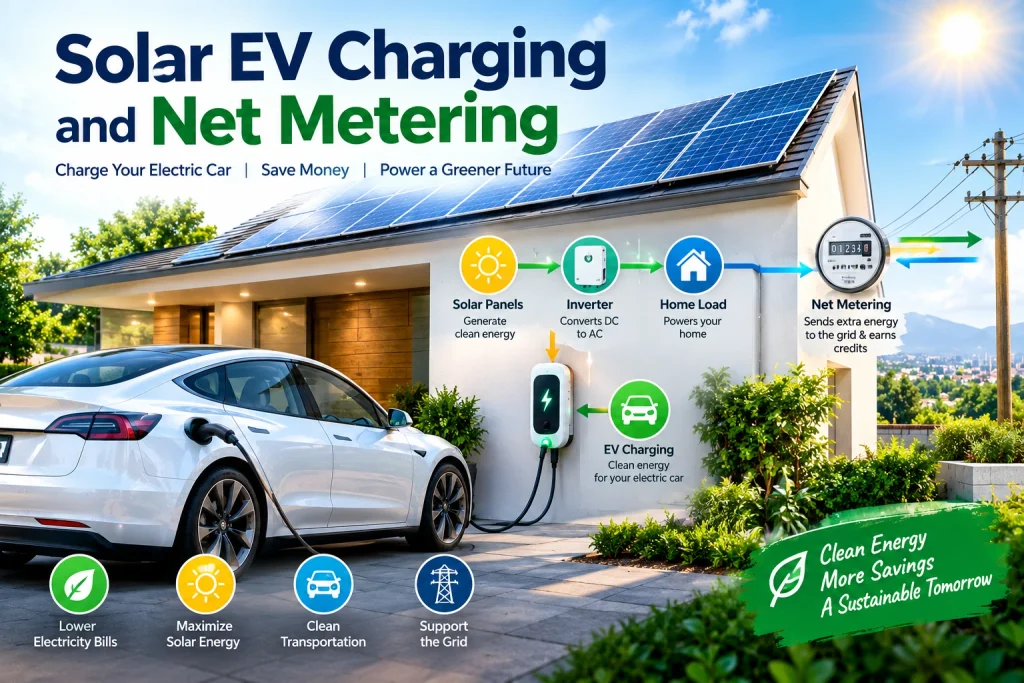
Where permitted, a grid-connected solar system may export excess electricity to the utility.
However, the financial value of exported electricity varies by location and utility program.
This matters for EV owners because you can compare:
Use solar electricity directly for EV charging
versus:
Export excess solar and charge the EV later
The financially preferable approach depends on the difference between electricity purchase prices and export compensation.
Local utility rules should always be checked before making financial assumptions.
Does an EV Need More Solar Panels?
Adding an EV can increase household electricity consumption.
If your existing solar system was already sized to closely match your home’s electricity use, adding an EV may mean that additional solar capacity is useful.
For example:
Existing home electricity: 9,000 kWh/year
EV electricity: 3,000 kWh/year
Combined demand: 12,000 kWh/year
That additional 3,000 kWh should be included when evaluating whether your existing solar system is large enough.
Solar EV Charging for Multiple Electric Vehicles
Two EVs can substantially increase electricity demand compared with one vehicle.
Before installing multiple chargers, consider:
- Daily driving distance
- Charging schedules
- Charger power
- Electrical panel capacity
- Solar production
- Battery storage
- Utility limits
- Load management
A home may not need two chargers operating at maximum power simultaneously.
Smart load management can potentially help prevent unnecessary peak electrical demand.
Solar EV Charging Installation
A typical installation may involve:
- Solar panels
- Solar inverter
- Electrical panel
- EV charger
- EV charging cable
- Monitoring or energy management
- Optional battery
- Appropriate protection and wiring
The exact equipment depends on the home and the selected products.
An EV charger can represent a significant electrical load, so the existing electrical service and panel should be evaluated before installation.
Can You Install an EV Charger With Existing Solar Panels?
Often, yes.
If you already have solar panels, an EV charger can potentially be added to the home’s electrical system.
However, the installer should evaluate:
- Electrical panel capacity
- Existing inverter
- Solar production
- Charger requirements
- Utility requirements
- Load management
- Future battery plans
If the existing electrical service does not have sufficient capacity, an electrical upgrade or load-management solution may be necessary.
Solar EV Charging Costs
The cost of a solar EV charging setup depends heavily on the equipment and installation.
Potential cost categories include:
- Solar panels
- Solar inverter
- EV charger
- Electrical wiring
- Mounting equipment
- Installation labor
- Electrical panel upgrades
- Battery storage
- Monitoring equipment
- Permits
- Other site-specific work
A simple EV charger added to an existing solar home can have very different costs from a new solar-plus-battery installation with a high-power charger.
For this reason, homeowners should compare complete installed quotes rather than relying on a single generic price.
Benefits of Solar EV Charging
Solar EV charging can provide several potential advantages.
1. Use Your Own Solar Electricity
An EV creates another way to consume solar energy generated by your home.
2. Reduce Grid Electricity Consumption
Using solar electricity for charging can reduce the amount of grid electricity required for the vehicle.
3. Increase Solar Self-Consumption
Instead of exporting excess electricity, you may be able to use some of it for EV charging.
4. Combine Transportation and Home Energy
Solar and EV charging can become part of a single household energy strategy.
5. Support Long-Term Electrification
As households adopt EVs and other electric technologies, solar can help offset some additional electricity demand.
Limitations of Solar EV Charging
Solar EV charging also has limitations.
Solar Production Changes
Solar generation varies with weather and time of day.
EVs Are Not Always Home During Solar Hours
Many people drive to work or school during the day when solar production is highest.
Batteries Add Cost
A battery can shift solar energy to nighttime but increases system complexity and cost.
Roof Space Is Limited
A home may not have enough usable roof area for all desired solar capacity.
Electrical Capacity Matters
The home must be able to safely support the EV charger and other electrical loads.
Common Solar EV Charging Mistakes
Mistake 1: Assuming Solar Will Always Charge the EV
Solar production varies.
Mistake 2: Sizing Solar Only for the Vehicle
Your existing home electricity consumption must also be included.
Mistake 3: Ignoring Charging Losses
The electricity drawn from the home and the energy stored in the EV battery are not exactly the same.
Mistake 4: Forgetting the Electrical Panel
The solar array and EV charger must work within the home’s electrical system.
Mistake 5: Installing a Large System Without Checking Export Rules
Local utility compensation can affect the economics of oversizing solar.
Mistake 6: Assuming a Battery Is Always Necessary
An EV can be charged using solar and grid electricity without a home battery.
Is Solar EV Charging Worth It?
Whether solar EV charging makes financial sense depends on your specific situation.
Important factors include:
- Solar installation cost
- EV electricity consumption
- Electricity rates
- Solar production
- Export compensation
- EV charging schedule
- Battery cost
- Available incentives
- Vehicle ownership period
For some households, direct solar EV charging can increase the use of self-generated electricity.
For others, grid charging during inexpensive electricity periods may be more economical.
The best decision comes from comparing your actual electricity consumption, charging habits, solar production, and local electricity prices.
Future of Solar EV Charging
Solar EV charging is becoming part of a broader home energy ecosystem.
Future systems may increasingly coordinate:
Solar + EV + Battery + Home Loads + Grid
Instead of treating each device separately, energy-management systems can coordinate electricity production and consumption.
Potential applications include:
- Smart EV charging
- Solar-aware charging
- Home battery integration
- Dynamic electricity pricing
- Load management
- Vehicle-to-home systems
- Vehicle-to-grid technologies
Availability and functionality depend on the vehicle, charger, utility, and local regulations.
Frequently Asked Questions
Can I charge my EV using solar panels?
Yes. A properly designed residential solar system can supply electricity for EV charging through compatible electrical equipment and an EV charger.
How many solar panels do I need to charge an EV?
There is no universal number. Calculate the EV’s annual electricity requirement and compare it with expected solar production at your location.
Can solar panels charge an EV at night?
Solar panels do not normally generate electricity at night. Nighttime charging can use the grid or stored energy from a compatible battery system.
Is a 5kW solar system enough for an EV?
It may be enough for some households, depending on home electricity consumption, driving distance, local solar production, and charging habits.
Is 10kW solar enough for an EV?
A 10kW system provides substantially more solar capacity than a 5kW system, but whether it is sufficient depends on total household and vehicle electricity consumption.
Do I need a battery for solar EV charging?
No. A battery is not required for solar EV charging. Solar electricity can be used while it is being generated, with the grid supplying additional electricity when necessary.
Can I charge an EV directly from rooftop solar?
The normal residential setup uses an inverter and EV charging equipment between the solar panels and vehicle. Simply connecting conventional rooftop panels directly to an EV is not the standard home installation method.
Does an EV increase my electricity bill?
It can increase household electricity consumption. The effect on your bill depends on electricity rates, charging behavior, solar production, and how much charging is supplied by solar.
Can I add an EV charger to an existing solar system?
Often yes, but the home’s electrical panel, service capacity, solar equipment, charger requirements, and local regulations should be evaluated first.
Final Thoughts
Solar EV charging can connect your home’s solar panels with your electric vehicle, allowing some of the electricity used for transportation to come from solar generation.
The key is proper system sizing.
Start by calculating:
Home electricity use + EV electricity use = total annual electricity demand
Then estimate how much solar electricity your location and roof can produce.
For some households, a 5kW solar system may provide useful EV charging support. Higher-consumption homes may need something closer to a 10kW system or larger. Battery storage can add another option for using solar energy when the sun is not shining.
Rather than choosing a solar system based on panel count alone, compare your actual electricity consumption, EV driving habits, solar production, roof space, electrical capacity, utility rules, and total installation cost.
A well-designed system can turn your EV from another major electricity load into an additional opportunity to use the energy generated by your own solar panels.