
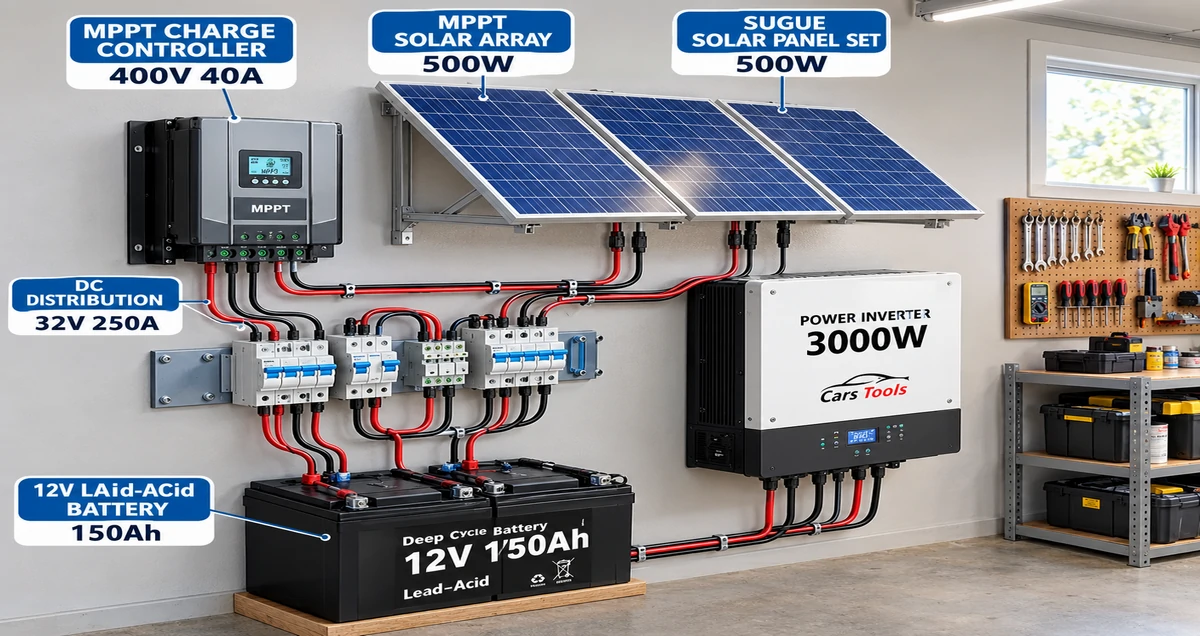
A solar power system with battery allows a home to generate electricity from sunlight and store some of that energy for later use.
Instead of using solar power only when the panels are producing electricity, a battery can store excess energy during the day and make it available when solar production falls. This can be especially useful in the evening, during periods of low sunlight, or during a power outage when the system is designed for backup operation.
A typical system combines:
Solar panels + inverter + battery storage + home electrical system

But choosing the right system involves more than simply buying panels and a battery. You need to consider household electricity consumption, solar production, battery capacity, inverter power, roof space, backup loads, installation requirements, and local regulations.
This complete guide explains how a solar power system with battery works, how to size it, how many batteries you may need, what it costs, and what to consider before installation.
What Is a Solar Power System With Battery?
A solar power system with battery is a photovoltaic system that combines solar panels with energy storage.
During the day, the solar panels generate electricity.
That electricity can be:
- Used by the home immediately
- Stored in the battery
- Exported to the electrical grid when permitted
- Limited or curtailed when production exceeds available demand and storage/export capacity
Later, the battery can supply stored energy to household loads.
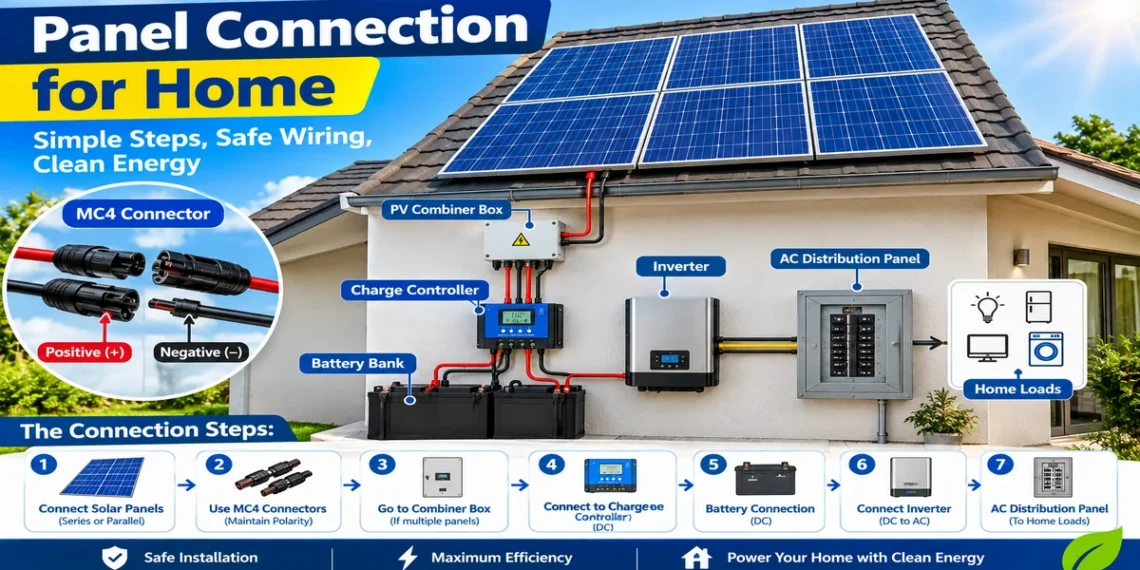
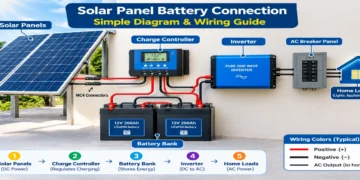
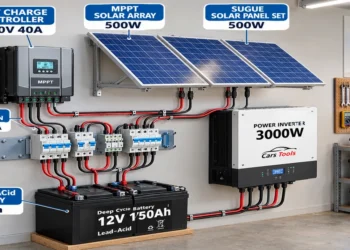
A simplified system looks like this:
             SUNLIGHT
                ↓
        ┌─────────────────┐
        │   SOLAR PANELS  │
        └────────┬────────┘
                 │
                 ↓
        ┌─────────────────┐
        │     INVERTER    │
        └───────┬─────────┘
                │
        ┌───────┴─────────┐
        ↓                 ↓
      HOME              BATTERY
     LOADS                 │
                           ↓
                      HOME LOADS
Modern solar-plus-battery systems can use advanced inverters to manage solar generation, battery charging, household loads, and—in systems designed for it—backup operation.
How Does a Solar Power System With Battery Work?
The basic operating cycle is simple.
Step 1: Solar panels produce electricity
Photovoltaic panels convert sunlight into DC electricity.
Production varies depending on factors such as:
- Time of day
- Season
- Weather
- Shading
- Panel orientation
- Temperature
- Dust and dirt
- System design
Solar production is therefore not constant throughout the day or year.
Step 2: The inverter manages the electricity
An inverter converts DC electricity into AC electricity suitable for household use.
Depending on the system, the inverter may also manage battery charging, battery discharge, monitoring, and grid interaction.
Step 3: Your home uses solar energy
When the solar system is producing electricity, household loads can use that electricity.
Examples include:
- Refrigerator
- Lighting
- Television
- Internet equipment
- Washing machine
- Air conditioning
- Water pump
- EV charger
Step 4: Excess energy charges the battery
If solar production exceeds the home’s immediate demand, available excess energy can be directed toward battery charging.
Step 5: The battery supplies energy later
When solar production decreases, the battery can discharge energy to the home’s loads.
This can shift the use of solar energy from one time of day to another.
Why Add a Battery to a Solar System?
Solar panels and batteries solve different problems.
Solar panels generate electricity.
Batteries store electricity.
Combining them can provide several benefits.
1. Use More Solar Energy at Home
Without storage, excess solar generation may be exported to the grid or otherwise limited depending on the system and utility arrangement.
A battery can store some of that energy for later use.
2. Evening Energy
Solar production normally falls after sunset.
A battery can provide stored energy during evening hours.
3. Backup Power
A properly designed solar-plus-battery system can provide backup electricity during a grid outage.
However, solar panels alone generally do not provide automatic backup during an outage. Backup requires appropriately configured inverter and storage equipment.
4. Energy Management
A battery can allow a homeowner to shift when stored solar energy is used.
The usefulness of this depends on the local electricity tariff, utility rules, system controls, and household consumption.
5. Off-Grid Applications
For homes without a utility connection, battery storage is often an important part of the system because electricity needs to be supplied when solar production is unavailable.
What Are the Main Components?
A residential solar power system with battery can contain several components.
Solar Panels
Panels generate DC electricity from sunlight.
The total number required depends on electricity consumption, panel wattage, location, solar resource, roof space, and system design.
Solar Inverter
The inverter converts DC electricity into AC electricity and may manage other functions depending on its design.
Battery
The battery stores electrical energy for later use.
Battery specifications commonly include:
- Usable energy capacity
- Maximum continuous power
- Peak or surge power
- Round-trip efficiency
- Operating temperature
- Warranty
- Cycle specifications
- Installation requirements
Mounting System
Roof-mounted or ground-mounted structures secure the solar panels.
Electrical Protection
Depending on the installation, protection equipment may include:
- Disconnects
- Circuit breakers
- Fuses
- Surge protection
- Grounding and bonding equipment
- Appropriate enclosures
Monitoring System
Many modern systems provide monitoring through a display, website, or mobile application.
Solar Battery Capacity: kWh vs. kW
This is one of the most important concepts when choosing a battery.
kWh = Energy
Battery capacity is generally expressed in kilowatt-hours (kWh).
It describes how much energy the battery can store.
kW = Power
Power describes how quickly electricity can be delivered.
For example, imagine a battery with:
10 kWh usable capacity
and:
5 kW continuous output
The battery may have enough stored energy for a certain period of household consumption, but it cannot necessarily power unlimited appliances simultaneously.
The U.S. Department of Energy distinguishes storage energy capacity from power capacity, which are measured in kWh and kW respectively.
How Big Should a Solar Battery Be?
Battery sizing depends on what you want the battery to accomplish.
You might size it for:
- Evening electricity use
- Essential appliances
- Several hours of backup
- Overnight energy
- Whole-home backup
- Off-grid operation
- Electricity-rate management
A simple starting formula is:
Battery capacity ≈ Desired backup energy ÷ allowable usable fraction
For example, if your essential loads require approximately 8 kWh and your design allows 90% of the nominal battery capacity to be used:
8 ÷ 0.90 ≈ 8.9 kWh
A battery around 9–10 kWh could therefore be a starting point for that simplified example.
Actual battery sizing should use the manufacturer’s usable-energy specifications and the home’s expected load profile.
How Long Will a Solar Battery Last?
Battery runtime depends on the load.
A simple estimate is:
Runtime = Usable battery capacity ÷ Average electrical load
For example:
10 kWh ÷ 1 kW = approximately 10 hours
But this is an idealized calculation.
Actual runtime can change because of:
- Inverter losses
- Battery operating limits
- Temperature
- Battery state of charge
- Changing household loads
- Battery reserve settings
- Appliance startup loads
If the average load increases to 2 kW:
10 kWh ÷ 2 kW = approximately 5 hours
This demonstrates why battery size alone doesn’t determine backup duration.
How Many Solar Panels Do You Need With a Battery?
The number of solar panels depends on both household consumption and the amount of energy you want to produce for battery charging.
Consider a simplified example.
Suppose a home uses:
900 kWh per month
Annual consumption:
900 × 12 = 10,800 kWh
Assume, purely for illustration, that the location produces approximately:
1,400 kWh per installed kW per year
Estimated solar capacity:
10,800 ÷ 1,400 ≈ 7.7 kW
With 400-watt panels:
7,700 ÷ 400 ≈ 19.25
That suggests approximately:
20 panels
as an initial illustrative estimate.
Actual solar sizing requires location-specific production modeling and consideration of losses, roof orientation, shading, panel specifications, and the desired solar offset.
Can Solar Panels Charge a Battery Directly?
The answer depends on the system architecture.
Modern solar-plus-storage systems may use:
- Hybrid inverters
- DC-coupled architecture
- AC-coupled architecture
- Dedicated battery inverters
- Integrated power-management systems
A typical hybrid configuration might look like:
SOLAR PANELS
      ↓
HYBRID INVERTER
   ↙       ↘
HOME      BATTERY
LOADS
The exact connections depend on the equipment.
Do not connect a battery directly to a solar panel simply because the voltage appears similar. Batteries require appropriate charging controls and protection.
AC-Coupled vs. DC-Coupled Solar Battery Systems
There are two common system architectures.
DC-Coupled System
Solar panels and the battery are connected through DC-side power electronics.
Simplified:
SOLAR PANELS
      ↓
      DC
      ↓
HYBRID INVERTER
   ↙       ↘
HOME      BATTERY
This architecture can be particularly relevant for new solar-plus-storage installations.
AC-Coupled System
Solar panels use one inverter while the battery uses another power-conversion system.
SOLAR PANELS
      ↓
SOLAR INVERTER
      ↓
      AC
      ↓
HOME ELECTRICAL SYSTEM
      ↑
BATTERY INVERTER
      ↑
    BATTERY
AC coupling can be useful for certain battery additions to existing solar systems.
Neither architecture is automatically right for every property.
The correct choice depends on the equipment, existing solar installation, battery compatibility, backup requirements, and electrical design.
Can a Solar Battery Power Your House During a Blackout?
Yes, if the system is specifically designed for backup operation.
A conventional grid-connected solar system may shut down when the utility grid fails.
A backup-capable solar-plus-storage system can isolate the home from the grid and use the battery and appropriately configured inverter to supply selected loads.
For example:
UTILITY GRID
     X
  ISOLATED
     │
     ↓
BACKUP INVERTER
     ↑
     │
   BATTERY
     ↑
     │
SOLAR PANELS
     ↓
BACKUP LOADS
The U.S. Department of Energy explains that residential solar panels alone generally aren’t enough for outage resilience; appropriately configured inverters and storage are needed for independent operation.
Whole-Home Backup vs. Essential-Load Backup
Not every battery system needs to power the entire house.
Essential-Load Backup
A backup panel can supply selected circuits such as:
- Refrigerator
- Lights
- Wi-Fi router
- Security equipment
- Small appliances
- Selected outlets
This can reduce battery and inverter requirements.
Whole-Home Backup
Whole-home backup attempts to supply most or all household circuits.
Large loads can dramatically increase power requirements.
Examples include:
- Central air conditioning
- Electric water heaters
- Heat pumps
- Electric ovens
- Well pumps
- EV chargers
The inverter must be capable of supplying the required continuous and startup power.
Can Solar Panels Recharge the Battery During an Outage?
Some backup-capable systems can continue using solar generation to recharge the battery during a grid outage.
However, this depends on:
- Inverter architecture
- Battery system
- Backup configuration
- Solar inverter compatibility
- System controls
- Load demand
- Solar production
Not every solar-plus-battery installation behaves the same way during an outage.
Solar Battery for an Off-Grid Home
An off-grid solar system needs to supply electricity without depending on the utility grid.
A typical configuration is:
SOLAR PANELS
      ↓
CHARGE / INVERTER SYSTEM
      ↓
BATTERY BANK
      ↓
OFF-GRID INVERTER
      ↓
HOME
The battery becomes particularly important because solar panels don’t generate electricity at night and their production can fall during cloudy weather.
Off-grid design therefore needs to consider:
- Daily energy consumption
- Peak loads
- Battery capacity
- Solar production
- Seasonal changes
- Backup generation
- Generator integration
- Inverter capacity
- Battery reserve
What Size Inverter Do You Need?
Battery capacity and inverter size are different.
A large battery does not automatically mean you have a large amount of available power.
For example:
Battery: 20 kWh
Inverter: 5 kW
The battery may store 20 kWh, but the inverter may limit the home’s simultaneous load to approximately 5 kW under its specified operating conditions.
When sizing an inverter, consider:
Continuous loads
How much power your appliances normally consume simultaneously.
Startup loads
Motors and compressors can require additional power when starting.
Future loads
Consider whether you plan to add:
- EV charging
- Air conditioning
- Heat pumps
- Electric heating
- Workshop equipment
- Pool equipment
How Much Battery Storage Does a Home Need?
There is no universal battery size for every house.
A practical approach is to start with your actual electricity consumption.
Suppose a home uses:
30 kWh per day
and you want the battery to cover approximately one-third of daily consumption.
Target stored energy:
30 × 0.33 ≈ 10 kWh
That could lead to a battery around 10 kWh of usable capacity.
However, if the goal is overnight backup or extended outage protection, a larger battery may be required.
For off-grid systems, the calculation can be considerably more complex because the battery may need to cover periods of low solar production.
What Battery Chemistry Is Best for Solar?
Residential energy-storage systems can use different battery chemistries.
One common modern option is lithium-ion, including lithium iron phosphate (LFP) designs.
Other battery technologies also exist.
When comparing batteries, don’t look only at chemistry.
Consider:
- Usable capacity
- Power output
- Efficiency
- Warranty
- Operating temperature
- Installation requirements
- Safety features
- Monitoring
- Compatibility
- Expected service life
- Manufacturer support
A battery with a larger nominal capacity is not automatically the best match for every system.
Solar Power System With Battery Cost
The cost of a solar-plus-battery system varies substantially.
Important cost factors include:
- Solar array size
- Battery capacity
- Battery power rating
- Inverter
- Mounting equipment
- Electrical work
- Roof condition
- Installation complexity
- Electrical-service upgrades
- Backup-panel installation
- Permits
- Location
- Monitoring equipment
- Existing solar equipment
Adding a battery to an existing solar system can also have different costs from installing solar and storage together.
Because prices vary significantly by location and system design, a single universal price should not be treated as a reliable estimate for every homeowner.
Solar Only vs. Solar Plus Battery
| Feature | Solar Only | Solar + Battery |
|---|---|---|
| Solar electricity | Yes | Yes |
| Stores solar energy | No | Yes |
| Evening stored solar | No | Yes |
| Backup capability | Usually limited | Possible with proper equipment |
| System complexity | Lower | Higher |
| Upfront equipment | Lower | Higher |
| Energy shifting | Limited | Yes |
| Off-grid operation | Not by itself | Designed for it when properly configured |
The right configuration depends on the homeowner’s goals.
Solar Battery vs. Generator
A solar battery and generator serve different purposes.
Solar battery
Advantages can include:
- Quiet operation
- No fuel storage
- Automatic operation in compatible systems
- Can charge from solar
- Can provide short-duration backup
Generator
Advantages can include:
- Long-duration operation when fuel is available
- High power output depending on model
- Useful during extended low-solar periods
Some properties may use solar, batteries, and a generator together.
Can a Battery Work Without Solar Panels?
Yes, depending on the battery system.
Some battery systems can charge from the electrical grid and discharge later.
However, a solar-plus-battery system specifically combines solar generation with storage.
For off-grid applications, solar generation is typically an important energy source, while a generator may serve as additional backup.
What Happens on Cloudy Days?
Solar panels can still generate electricity under cloudy conditions, but output can be lower than during strong sunlight.
Solar production is affected by weather, season, time of day, shading, dirt, and other factors.
A battery can help smooth the timing mismatch between solar production and electricity demand, but it does not create additional energy.
If several low-production days occur in an off-grid system, the battery may eventually become depleted unless there is sufficient solar production or another backup energy source.
Solar Battery Efficiency
No energy-storage system is perfectly efficient.
Energy is lost during:
- Charging
- Battery storage
- Inversion
- Discharging
- Electrical conversion
The Department of Energy notes that energy storage is not 100% efficient because some energy is lost during conversion and retrieval.
When comparing systems, look at round-trip efficiency rather than only the battery’s nominal capacity.
How Long Do Solar Batteries Last?
Battery service life depends on the technology and operating conditions.
Important factors include:
- Number of cycles
- Depth of discharge
- Temperature
- Charging behavior
- Discharging behavior
- Battery management system
- Manufacturer specifications
Instead of assuming that every battery lasts the same number of years, compare the manufacturer’s warranty and expected operating conditions.
Solar Power System With Battery for EV Charging
An EV can significantly increase household electricity consumption.
If you plan to charge an electric vehicle using solar energy, the solar system may need additional capacity.
For example, suppose an EV uses approximately:
0.30 kWh per mile
and you drive:
10,000 miles per year
Annual EV electricity requirement:
0.30 × 10,000 = 3,000 kWh
That’s an additional 3,000 kWh of annual electricity demand before considering charging losses.
A solar-plus-battery system can potentially supply some of that energy, but EV charging can also represent a substantial instantaneous power load.
Solar Power System With Battery for a Well Pump
Water pumps can create an important design challenge because motors may have significant starting power requirements.
If you want solar and battery power to operate a well pump, consider:
- Pump horsepower
- Pump voltage
- Starting current
- Continuous running power
- Daily operating time
- Water-storage requirements
- Inverter surge rating
- Battery power capability
For some applications, storing water in a tank can be more practical than using a very large battery solely to store electricity for later pumping.
Common Solar Battery Mistakes
Mistake 1: Buying the biggest battery possible
A huge battery isn’t necessarily useful if the solar array cannot adequately recharge it or the household doesn’t need the stored energy.
Mistake 2: Confusing kW and kWh
A battery’s energy capacity does not tell you how much power it can deliver simultaneously.
Mistake 3: Ignoring inverter capacity
A large battery connected to an undersized inverter can still limit the available household power.
Mistake 4: Assuming solar automatically provides backup
Grid-connected solar generally shuts down during outages unless the system is specifically configured for backup operation.
Mistake 5: Ignoring large appliances
Air conditioning, pumps, electric heating, and EV chargers can dramatically change system requirements.
Mistake 6: Ignoring future electricity use
Plan for expected changes before selecting the final system.
Mistake 7: Mixing incompatible batteries
Only use batteries and power electronics that are approved and compatible with each other.
How to Choose a Solar Power System With Battery
Before buying, answer these questions.
1. How much electricity does your home use?
Review at least several months of utility bills if available.
2. What is your main goal?
Is it:
- Lower grid consumption?
- Evening solar use?
- Backup power?
- Off-grid living?
- EV charging?
- Energy-rate management?
3. How much battery energy do you need?
Calculate your target kWh based on the loads and backup duration.
4. How much inverter power do you need?
Calculate both continuous and startup loads.
5. How much solar generation is required?
Use location-specific solar production estimates.
6. Is the equipment compatible?
Check panel, inverter, battery, and electrical-system specifications.
7. What happens during an outage?
Ask exactly which circuits will remain powered and how the system isolates from the utility.
8. What are the installation requirements?
Check permits, utility requirements, electrical upgrades, and inspection requirements.
Solar Power System With Battery Installation Checklist
Before installation, review:
- Household electricity consumption
- Solar panel capacity
- Battery usable capacity
- Battery power rating
- Inverter continuous output
- Inverter surge rating
- Panel voltage and current
- Battery/inverter compatibility
- Roof condition
- Shading
- Electrical service capacity
- Backup loads
- Required disconnects
- Overcurrent protection
- Grounding and bonding
- Surge protection
- Monitoring
- Permits
- Utility requirements
- Professional inspection
Frequently Asked Questions
Is a solar power system with battery worth it?
Its value depends on electricity prices, solar production, battery costs, backup needs, utility rules, and how much of the stored energy you can actually use.
How many batteries do I need for my house?
It depends on daily electricity consumption, desired backup duration, battery usable capacity, inverter power, and which appliances you want to operate.
Can solar batteries power a house all night?
They can, if the battery has sufficient usable capacity and power output for the home’s overnight loads.
Can a solar battery power an entire house?
Some systems can provide whole-home backup, while others are designed for selected essential circuits. The inverter and battery must be appropriately sized.
Can solar panels charge batteries during a blackout?
Some properly designed solar-plus-storage systems can continue solar charging during an outage. The exact behavior depends on the inverter, battery, system architecture, and backup configuration.
Do I need batteries if I have solar panels?
Not necessarily. A grid-connected solar system can operate without batteries. Batteries become useful when you want energy storage, backup power, or greater control over when solar energy is used.
What size solar system do I need with a battery?
Solar array size should be based on electricity consumption, local solar production, system losses, battery charging requirements, roof space, and future loads.
What is better: a 10 kWh or 20 kWh battery?
Neither size is universally better. The appropriate capacity depends on the home’s energy consumption and the intended use of the battery.
Can I add a battery to an existing solar system?
Often, yes, but compatibility and system architecture must be checked. An AC-coupled retrofit may be appropriate for some existing installations, while other systems may require different equipment.
Final Thoughts
A solar power system with battery combines solar generation with energy storage to give homeowners more control over when electricity is produced and used.
The basic concept is:
Solar panels → inverter → home + battery → stored energy for later use
The most important thing is not simply buying the largest solar array or battery. A good system matches:
Energy production + battery capacity + inverter power + household demand + backup requirements
Before installation, analyze your electricity consumption, determine which appliances you want to operate during an outage, check the available solar resource, and verify compatibility between the panels, inverter, battery, and electrical system.
For grid-connected homes, remember that solar panels alone generally aren’t sufficient for blackout operation. A properly configured inverter and storage system are needed when backup power is a goal.
A well-designed solar-plus-battery system can therefore serve several different purposes: increasing the use of solar energy, shifting energy to later in the day, supporting backup loads, and—when properly engineered—helping a property operate independently from the grid.
Technical Safety Note
Solar PV and battery systems involve potentially hazardous DC and AC electricity.
Do not use this article as a substitute for an electrical design.
Exact requirements for:
- Cable sizing
- Fuses
- Circuit breakers
- Disconnects
- Grounding
- Battery protection
- Inverter settings
- Utility interconnection
- Backup wiring
depend on the equipment and local electrical requirements.
Use manufacturer documentation and qualified electrical professionals for system design and installation.