
Terracotta Cooling Wall System: A Guide to Natural Building Cooling
Discover how terracotta tubes, water evaporation, and natural airflow can work together to create a more comfortable indoor environment while reducing dependence on conventional air conditioning.
As temperatures rise and cooling costs increase, homeowners and architects are exploring new ways to keep buildings comfortable without relying entirely on traditional air conditioning. One interesting solution is the Terracotta Cooling Wall System, an innovative approach that combines natural materials, water evaporation, and ventilation.
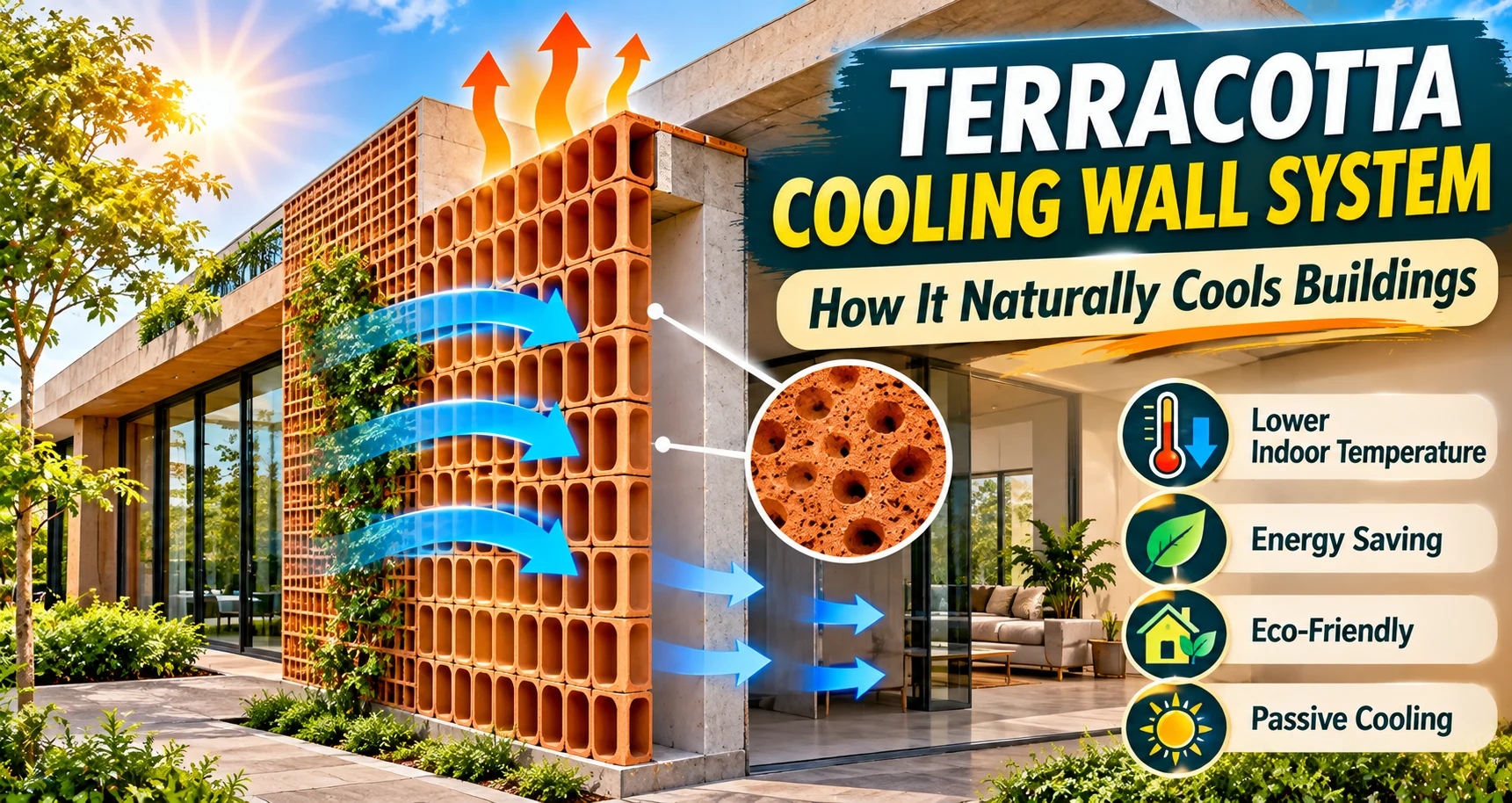
This system uses rows of clay or ceramic tubes arranged inside a wall-mounted structure. When water reaches the surface of suitable porous ceramic materials, evaporation can absorb heat from the surrounding air. As air moves through or around the tubes, it may become cooler before entering the building.
Unlike conventional air conditioning, which uses a refrigeration cycle, evaporative cooling relies on the physical process of water changing into vapor. This makes it particularly interesting for sustainable architecture and buildings located in suitable dry climates.


In this guide, we explain how a terracotta cooling wall works, its main components, installation considerations, advantages, limitations, and whether it can be a practical option for modern homes.
1. What Is a Terracotta Cooling Wall System?
A terracotta cooling wall is a building feature designed to use evaporative cooling to reduce the temperature of incoming air or nearby surfaces.
It typically consists of hollow clay or ceramic tubes installed vertically or horizontally within a supporting frame. A water distribution system keeps the appropriate surfaces moist, while openings allow outdoor air to pass through the assembly.
When water evaporates from the ceramic surfaces, it absorbs heat from the surrounding environment. This process can reduce the temperature of air passing through the wall under suitable conditions.
Some systems use porous ceramic tubes that naturally absorb and distribute water through capillary action. Other designs use a controlled water supply, a pump, or a fan to improve water distribution and airflow.
The exact arrangement varies between designs. The illustration in this article represents a conceptual building-integrated cooling wall, not a universal installation blueprint.
2. How Does a Terracotta Cooling Wall Work?
The operating principle is based on evaporative cooling. When water changes from liquid into vapor, it requires energy. Some of this energy is taken from the heat of the surrounding air and the wet ceramic surface.
How the Cooling Process Works
Outdoor air enters
Water evaporates
Heat is absorbed
Air enters the room
Simplified illustration of direct evaporative cooling.
Step 1: Warm Outdoor Air Enters
Outdoor air approaches the terracotta wall through openings in the frame. Depending on the design, natural wind pressure or a low-energy fan moves air through the system.
Step 2: Water Reaches the Ceramic Tubes
Water is supplied to the clay tubes through a reservoir, distribution pipe, or another suitable arrangement. Porous ceramic materials may absorb water and spread it across their surfaces.
Step 3: Evaporation Removes Heat
Water evaporates from the moist ceramic surfaces. This process absorbs heat, lowering the temperature of the wet surface and potentially cooling the air that passes through the wall.
Step 4: Cooler Air Enters the Building
Air leaving the cooling assembly may be cooler than the incoming air. It can then enter the room through a suitable ventilation opening.
Step 5: Humid Air Is Ventilated
Because evaporative cooling adds moisture to the air, the building needs an appropriate ventilation strategy. Excess humidity should not be allowed to accumulate indoors.
3. Main Components of a Terracotta Cooling Wall
A well-designed system combines several components that manage water, airflow, structural support, and drainage.
1. Terracotta or Ceramic Tubes
The tubes form the main cooling surface. Their material properties matter because water absorption, porosity, dimensions, and surface area influence performance.
Not every clay pipe is suitable. Some products are glazed or have low water absorption, while others may crack or deteriorate when exposed to repeated wetting and drying.
2. Supporting Frame
A supporting structure holds the tubes in position and transfers their weight safely to the building. It must be designed for the combined weight of the tubes, water, frame, and environmental loads.
3. Water Distribution System
A water supply system keeps the intended ceramic surfaces moist. Depending on the design, it may include a small reservoir, pipes, distribution channels, or a low-power pump.
4. Water Collection Tray
A collection tray at the bottom catches excess water and directs it toward a drain or suitable reservoir. It should prevent leaks from reaching the building envelope.
5. Air Inlet and Outlet
Air openings allow outdoor air to pass through the cooling assembly. Their size and placement affect airflow resistance and overall performance.
6. Fan or Natural Ventilation
Some systems rely on wind and natural pressure differences. Others use a fan to provide more predictable airflow. A fan-assisted system consumes electricity, but its power requirement may be relatively modest compared with conventional compressor-based cooling, depending on the installation.
7. Sensors and Controls
Temperature and humidity sensors can help control water flow and ventilation. These devices are useful for preventing unnecessary water use and limiting excessive indoor humidity.
4. Why Are Terracotta Tubes Used?
Terracotta is a traditional ceramic material made from fired clay. Its properties make certain types of terracotta useful in evaporative cooling applications.
- Porosity: Some unglazed ceramic materials can absorb and hold water.
- Capillary action: Suitable porous materials can move water through small connected pores.
- Surface area: Arranging many small tubes creates a large area for air and water interaction.
- Thermal behavior: Ceramic materials can absorb and release heat as their temperature changes.
- Durability: Properly selected ceramic products can be durable, although they still need protection from impact and unsuitable weather conditions.
The most important characteristic is not simply that the tubes are made from clay. Their ability to absorb and distribute water must be appropriate for the intended cooling design.
5. How to Design a Terracotta Cooling Wall
Designing a cooling wall requires more than placing clay tubes against a building. The system must be engineered to provide safe structural support, controlled water distribution, suitable airflow, and protection against moisture damage.
Step 1: Evaluate the Climate
Start by examining outdoor temperature, relative humidity, wind conditions, and seasonal water availability.
Evaporative cooling generally works better in hot, dry air. In humid weather, the air has less capacity to accept additional moisture, so the cooling effect becomes smaller.
Step 2: Select Suitable Ceramic Tubes
Choose tubes with documented water absorption and suitable resistance to weather exposure. Test a sample before planning a large installation.
Check the dimensions, wall thickness, porosity, strength, and compatibility with the intended water supply.
Step 3: Plan the Airflow Path
Determine where outdoor air enters, how it moves through the tubes, and where it exits into the building.
Avoid creating a system with excessive resistance. If the air cannot move through the assembly, the cooling potential may not translate into useful indoor ventilation.
Step 4: Design the Water Supply
Plan how water will reach the ceramic surfaces. A uniform water distribution system can help avoid dry sections and unnecessary water waste.
Include a means of shutting off the water supply for cleaning, maintenance, or periods when cooling is not needed.
Step 5: Add Drainage and Waterproofing
Water must be collected and removed safely. Provide a suitable drainage tray, waterproof backing, and details that prevent water from entering the building structure.
Step 6: Provide Access for Maintenance
The tubes, reservoir, filters, and drainage channels should be accessible. This makes it easier to remove mineral deposits, clean surfaces, and inspect the installation.
Step 7: Test the System
Before relying on the system for indoor comfort, measure the inlet and outlet air temperature and humidity under different weather conditions.
Also monitor water consumption, airflow, drainage, and the condition of the building envelope.
6. How Much Cooling Can a Terracotta Wall Provide?
The cooling performance depends on outdoor conditions and system design. There is no single temperature reduction that applies to every terracotta cooling wall.
Researchers have investigated passive evaporative walls made from porous ceramic pipes. One published experimental study reported that air passing through a prototype system could be cooled by several degrees under summer conditions.
Another practical application study reported an air-temperature reduction of around 2°C during the measured summer daytime conditions. These results describe specific experimental systems and should not be treated as guaranteed performance for a different building or DIY design.
Actual performance depends on:
- Outdoor air temperature.
- Relative humidity and wet-bulb temperature.
- Water temperature and availability.
- Porosity and water absorption of the ceramic tubes.
- Air velocity and contact time.
- Tube arrangement and total surface area.
- Sun exposure and surrounding building conditions.
- Maintenance and water distribution quality.
For a real project, performance should be estimated by a qualified building-services engineer and verified through measurements after installation.
7. Advantages of a Terracotta Cooling Wall System
Can reduce the need for compressor-based cooling in suitable conditions.
Uses ceramic materials that can be durable and locally available.
Some designs can use natural airflow and capillary water movement.
Can become a distinctive feature of sustainable building design.
Suitable designs may collect and reuse some unevaporated water.
May support other passive cooling strategies in an efficient building.
8. Disadvantages and Limitations
Although terracotta cooling walls are promising, they are not suitable for every building or climate.
High Humidity Reduces Cooling Performance
Evaporative cooling is less effective when outdoor air is already humid. In coastal or humid climates, the temperature reduction may be limited.
Water Consumption
The system needs water to replace the moisture that evaporates. Water demand varies with temperature, humidity, airflow, surface area, and operating time.
Maintenance Requirements
Mineral deposits, dust, algae, and biological growth may affect water distribution and system hygiene. Regular inspection and cleaning are essential.
Moisture Risks
Poorly designed installations can allow water to enter walls, insulation, or other building materials. Waterproofing and drainage must be carefully planned.
Limited Performance in Some Weather
On humid days or during periods with little airflow, the cooling effect may be too small to provide useful indoor comfort.
Structural Requirements
A large wall containing ceramic tubes, supporting frames, and water can be heavy. The building structure must be assessed before installation.
9. Terracotta Cooling Wall vs. Traditional Air Conditioning
These technologies operate differently and serve different purposes. A terracotta cooling wall is a form of evaporative cooling, while conventional air conditioning generally uses a refrigeration cycle to remove heat and often control indoor humidity.
| Feature | Terracotta Cooling Wall | Traditional AC |
|---|---|---|
| Cooling Method | Water evaporation | Refrigeration cycle |
| Electricity | May be low or none for passive designs | Required |
| Water Use | Requires evaporation water | Usually no direct evaporative water supply |
| Humidity Effect | Adds moisture to air | Often removes indoor moisture |
| Climate Suitability | Best in hot, dry conditions | Works across a wider range of climates |
| Temperature Control | Depends on weather and design | Usually more precise |
A terracotta cooling wall may complement conventional air conditioning, but it should not automatically be considered a complete replacement. A hybrid approach may be more practical where reliable indoor temperature and humidity control are required.
10. Is a Terracotta Cooling Wall Suitable for Hot, Dry Climates?
Hot, dry climates are generally more favorable for evaporative cooling because the air has more capacity to absorb additional water vapor.
In regions with hot summers and low humidity, a terracotta cooling wall may provide useful cooling when designed with suitable airflow and water distribution.
However, local conditions still matter. Water availability, dust, mineral content, wind direction, and building orientation can all influence performance.
In areas where water is scarce, the design should prioritize efficient water distribution, careful control, and recovery of unevaporated water where appropriate.
11. Can You Combine a Terracotta Cooling Wall With Solar Power?
Yes. A terracotta cooling wall can be combined with a solar energy system, particularly when a fan or small water pump is needed.
A photovoltaic system can supply electricity to low-power equipment such as:
- A ventilation fan.
- A small circulation pump.
- Temperature and humidity sensors.
- A simple automatic water-control system.
For example, a solar panel can generate electricity during the day when cooling demand is high. A battery may be added if operation outside solar production hours is required.
However, the solar equipment should be sized according to the actual electrical loads. The cooling wall itself does not produce electricity, and solar power does not remove the need for a suitable water supply.
12. Maintenance Tips for Long-Term Performance
Regular maintenance is important for keeping the cooling wall effective and preventing water-related problems.
- Inspect ceramic tubes for cracks and damage.
- Clean dust and deposits from tube surfaces.
- Check water distribution for blocked outlets.
- Clean filters and collection trays regularly.
- Inspect drainage channels and waterproofing.
- Check the reservoir for sediment and contamination.
- Monitor water consumption and unexpected leaks.
- Inspect fans, pumps, and electrical connections if fitted.
- Keep the system dry and protected when not in use for long periods.
Water that remains stagnant for extended periods should be avoided. A suitable cleaning and water-management plan is important, especially in systems that operate frequently.
13. Is a Terracotta Cooling Wall Worth It?
A terracotta cooling wall can be an interesting investment for a building that has suitable climate conditions, reliable water access, and an appropriate architectural design.
It may be particularly attractive for:
- Eco-friendly homes.
- Energy-conscious office buildings.
- Courtyards and semi-outdoor spaces.
- Educational buildings exploring sustainable architecture.
- Buildings in hot, dry regions.
- Projects that combine passive cooling with solar energy.
Before installing one, compare its expected cooling performance with its construction cost, water demand, maintenance needs, and the cost of alternative cooling technologies.
A small prototype with temperature, humidity, airflow, and water-consumption measurements can be a useful first step before planning a full building installation.
Final Thoughts
A terracotta cooling wall demonstrates how traditional materials and natural physical processes can contribute to modern sustainable architecture. By combining porous ceramic tubes, controlled water supply, and ventilation, the system can cool passing air through evaporation.
It is not a universal replacement for air conditioning, and its performance depends strongly on humidity, water availability, and careful engineering. However, in suitable climates, it can be an interesting part of a wider strategy for reducing building cooling demand.
As interest in energy-efficient buildings continues to grow, technologies like terracotta cooling walls show how natural materials can inspire practical approaches to more sustainable living.
Frequently Asked Questions
1. What is a terracotta cooling wall?
It is a building cooling system that uses ceramic or terracotta tubes, water evaporation, and airflow to reduce the temperature of incoming air under suitable conditions.
2. How does a terracotta cooling wall reduce temperature?
Water evaporates from suitable wet ceramic surfaces and absorbs heat from the surrounding air. Air passing through the system can therefore become cooler.
3. Does a terracotta cooling wall need electricity?
Some passive designs can operate using natural airflow and water movement. Other designs use an electric fan or pump to improve airflow and water distribution.
4. Does evaporative cooling work in humid climates?
It is generally less effective in humid climates because the air has less capacity to absorb additional moisture.
5. Do terracotta cooling walls consume water?
Yes. Water is needed to replace the moisture that evaporates. Consumption depends on climate, airflow, ceramic properties, and operating time.
6. Can I build a terracotta cooling wall at home?
A small experimental prototype may be possible, but a building-mounted installation needs careful structural, waterproofing, drainage, and ventilation design. Consult qualified professionals before modifying a building.
7. Can solar panels power a terracotta cooling wall?
Yes. Solar panels can supply electricity to a small fan, water pump, or control system if the design uses those components.
8. Can a terracotta cooling wall replace air conditioning?
Not in every situation. It may reduce cooling demand in suitable dry climates, but conventional air conditioning provides more controlled temperature and humidity management.
Disclaimer: This article is for educational purposes. The image represents a conceptual cooling-wall design, not a certified construction plan. Building-mounted systems require professional assessment of structural loads, waterproofing, drainage, ventilation, and electrical safety.