
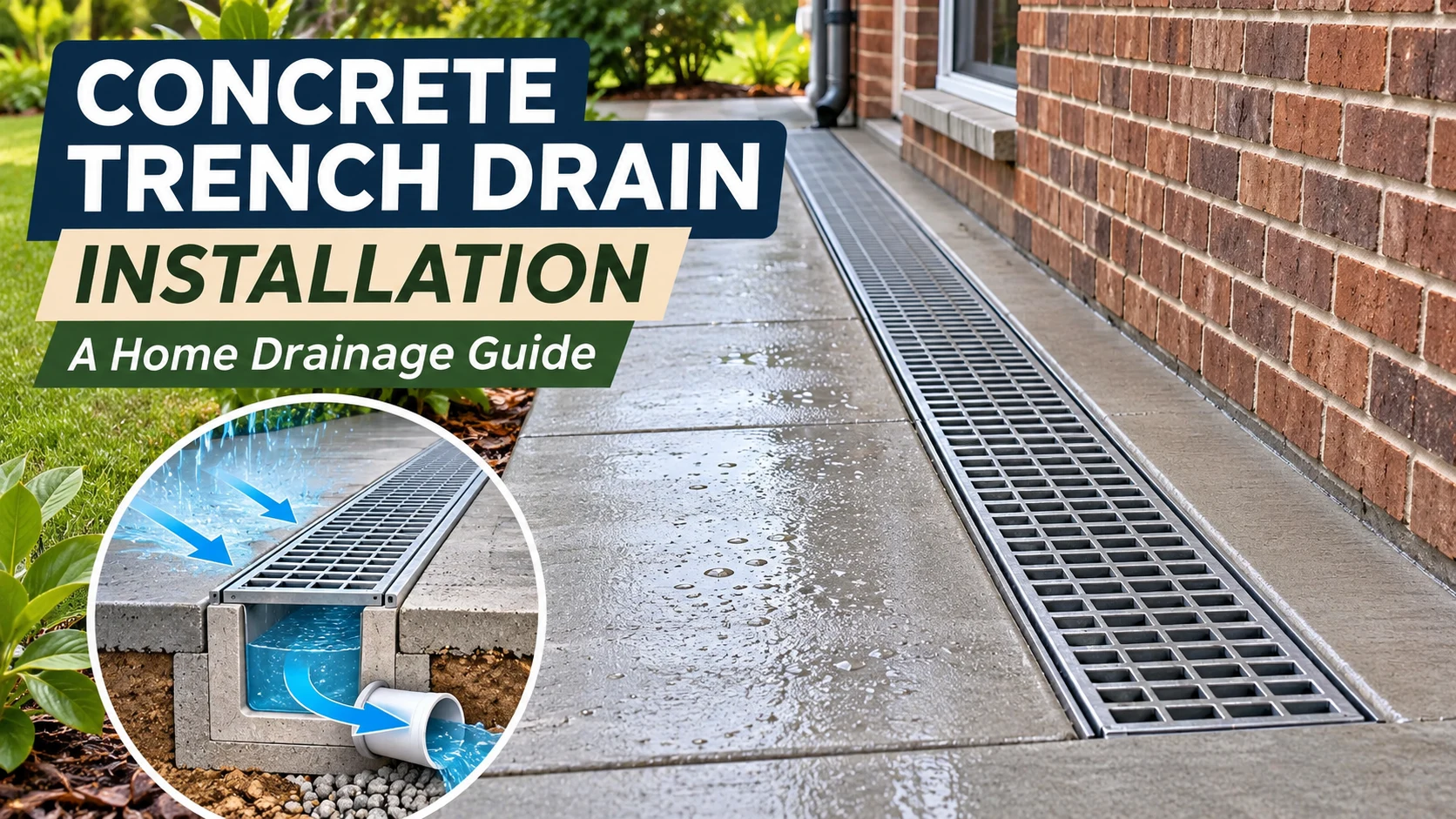
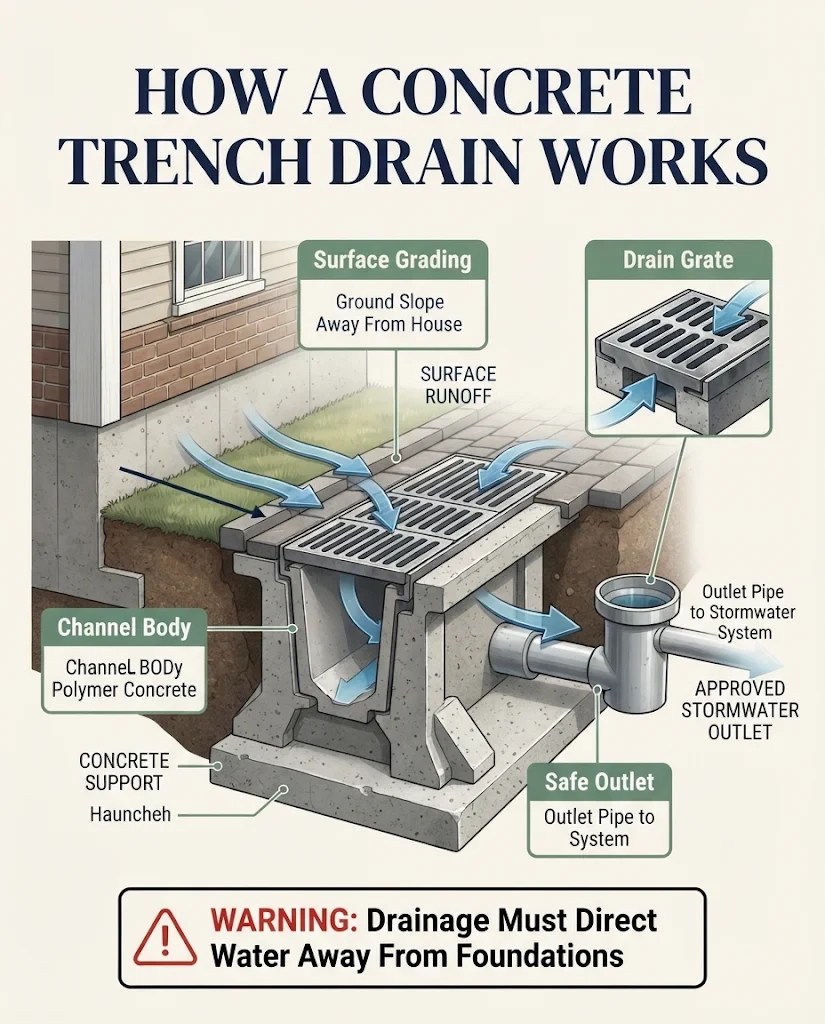
concrete trench drain installation , also called a channel drain or linear drain, collects rainwater from a paved surface and carries it toward a suitable drainage outlet. These long, narrow drainage channels are commonly installed near driveways, patios, garages, and walkways where surface water tends to collect.
For an off-grid home or rural property, managing rainwater is an important part of protecting the building and keeping outdoor areas usable. But a trench drain only works properly when its location, capacity, outlet, concrete support, and surrounding surface grading are planned together.
Concrete Trench Drain: Quick Answer
- Purpose: Collect and redirect surface rainwater.
- Main components: Drainage channel, removable grate, outlet, and appropriate supporting concrete.
- Common locations: Driveways, patios, walkways, and garage entrances.
- Water movement: Depends on surface grading, channel design, outlet elevation, and drainage capacity.
- Foundation protection: Requires a complete site drainage strategy, not just a channel next to the wall.
- Maintenance: Regular grate, sediment, and outlet inspection.
Bottom line: A trench drain needs a safe place to discharge water. A channel without a properly designed outlet can simply collect water and overflow.
What Is a Concrete Trench Drain?
A trench drain is a linear drainage system installed at or just below the surrounding finished surface. Water enters through a grate and flows through the channel toward a designated outlet.


Many residential products use a polymer concrete or plastic channel supported by a concrete surround. Some systems are manufactured entirely from concrete or other materials.
The visible grate may be made from metal or another material selected for pedestrian, vehicle, and environmental exposure.
Unlike a buried French drain, which generally manages water within the ground, a surface trench drain is primarily designed to capture runoff flowing across paved surfaces.
What the Pinterest Drainage Image Shows
The reference image shows a long metal drainage grate installed through a narrow strip of freshly finished concrete beside a brick wall. Wooden formwork supports the edges of the new concrete, and a round white outlet pipe is visible at one end.
This appears to be a surface drainage installation under construction. However, the photograph does not establish the channel model, required concrete thickness, drainage capacity, outlet destination, or waterproofing details.
Those missing details are important because a visually neat trench drain can still perform poorly when runoff cannot reach or leave the channel correctly.
How Does a Channel Drain Work?
Rainwater moves across a sloped surface toward the grate. The channel receives that water and conveys it to an approved discharge point through an outlet or connected drainage pipe.
RAIN FALLS ON PAVEMENT
↓ Surface runoff
GRATED CHANNEL DRAIN
↓ Collected water
SUITABLE OUTLET AND PIPEWORK
↓
APPROVED STORMWATER DISCHARGE LOCATION
Conceptual water flow only. Drainage arrangements and permitted discharge locations vary by site and jurisdiction.
Where Should a Trench Drain Be Installed?
The best location is where surface runoff can naturally reach the drain and where the collected water can be safely discharged.
- Garage entrance: Intercept runoff moving down a sloped driveway.
- Patio: Collect water from properly graded paving.
- Side walkway: Manage runoff where space is limited.
- Courtyard: Intercept water that would otherwise collect in low areas.
- Utility building: Help manage surface water around suitable off-grid equipment buildings.
A drainage channel installed close to a building must be planned carefully. Water should not be directed into the foundation, basement, or a space beneath the building.
Can a Trench Drain Protect Your Foundation?
A trench drain may help intercept surface water before it reaches a foundation wall. But it does not replace proper site grading, waterproofing, footing drainage, or other components of a complete foundation water-management system.
The U.S. Department of Energy’s Building America guidance recommends grading the ground and hard surfaces to move runoff away from buildings. It also discusses gutters, downspouts, drainage systems, and suitable discharge locations.
Where a driveway or paved area slopes toward a garage, a channel drain may help collect incoming surface water. The outlet must still convey runoff away without causing erosion or flooding elsewhere.
Foundation safety: Do not excavate beside an existing foundation or alter its support without assessing buried utilities, structural stability, waterproofing, and drainage. If water is already entering a basement or undermining a wall, seek professional evaluation.
Understanding Trench Drain Slope
Drainage depends on more than making the channel look level. Two different slopes matter: the surrounding surface slope and the hydraulic slope available inside the drainage system.
The surrounding pavement should guide runoff toward the grate without creating puddles against the wall. The drainage channel and connected outlet must also allow water to move toward the discharge point.
Some manufactured channels have built-in slopes, while others use level channel bodies with outlet arrangements designed for the required hydraulic performance. Follow the exact manufacturer’s instructions rather than applying one universal slope to every product.
For example, a 1% surface slope means a vertical change of 10 mm over one meter of horizontal distance. This is a mathematical illustration, not a required slope for every drainage installation.
What Parts Does a Concrete Trench Drain Need?
| Component | Purpose |
|---|---|
| Drain channel | Collects and transports surface runoff |
| Removable grate | Allows water entry and limits larger debris |
| Outlet connection | Connects collected water to its discharge system |
| End caps | Close channel ends as required by the design |
| Concrete support | Provides the manufacturer’s required structural support |
| Sediment collection | May help with maintenance where specified |
| Discharge piping | Moves water toward an approved destination |
Not every drainage product uses exactly the same components. Some designs integrate the outlet into a channel section, while others use a separate catch basin or sump.
How to Plan a Trench Drain Installation
Before construction begins, define how the water reaches the drain, how much flow the system must manage, and where the collected water will go.
- Identify the drainage problem. Observe where runoff collects and which surfaces direct water toward the building.
- Check local rainfall conditions. Estimate runoff using the contributing area and appropriate design rainfall intensity.
- Select the discharge location. Confirm the proposed outlet is permitted and will not harm foundations or neighboring property.
- Review existing utilities. Locate underground electrical lines, water pipes, drains, and other services before excavation.
- Choose a drainage product. Match channel capacity, grate load rating, and material to the installation.
- Review grading and elevations. Confirm runoff will enter the channel and can leave through the outlet.
- Follow the installation manual. Use the required bedding, concrete surround, joint treatment, and grate support.
- Verify the completed drainage path. Check alignment, outlet continuity, and potential obstruction before the area is put into service.
- Plan maintenance. Provide safe access for grate cleaning and debris removal.
This is a planning guide, not a structural construction specification. The exact trench dimensions and concrete details depend on the selected drain, expected loading, soil conditions, and manufacturer requirements.
Why the Concrete Surround Matters
Many channel drains require a concrete bed and side support to prevent movement or damage when exposed to pedestrian or vehicle loads.
ACO’s installation guidance specifies that the required encasement depends on the product and loading conditions. The surrounding concrete, grate, and channel must work together as a complete system.
Some ACO installation instructions describe finishing adjacent paving approximately 2–3 mm above the grate to help surface runoff enter the drain. This is a product-specific detail, not a universal rule for every drainage channel.
Concrete cutting or grinding may expose workers to respirable crystalline silica. Use appropriate dust controls, protective equipment, and qualified contractors where necessary.
How to Size a Drain for Rainfall
Drain capacity depends on the surface area contributing runoff, design rainfall intensity, surface characteristics, inlet capacity, and downstream drainage restrictions.
For a simplified planning illustration, 10 mm of rainfall over 20 m² represents 200 liters of precipitation before losses.
20 m² × 10 mm = 200 liters of rainfall
That is approximately 53 US gallons.
This is a water-volume example, not a drain capacity calculation. The rate at which rainfall occurs is critical when sizing a channel and outlet.
A short, intense storm may produce a much higher peak runoff rate than the same rainfall spread over several hours. Drain selection should therefore use appropriate local stormwater design criteria and product hydraulic data.
Where Should the Collected Water Go?
A trench drain needs an appropriate downstream outlet. Depending on the property and local rules, this might connect to an approved stormwater system or another engineered runoff-management arrangement.
Do not discharge water directly beside the home’s foundation, onto neighboring property, or into a sanitary sewer unless an applicable authority explicitly permits the connection.
If water will be directed into a rain garden, infiltration area, or other landscape feature, that system must be located and sized so that infiltrating water does not create a foundation or drainage problem.
A closed or clogged outlet can cause a trench drain to overflow, even when the channel is correctly installed.
Trench Drain vs. French Drain
| Feature | Trench Drain | French Drain |
|---|---|---|
| Primary purpose | Collect surface runoff | Collect or redirect subsurface water |
| Typical appearance | Visible grated channel | Buried gravel and perforated pipe |
| Common location | Patio, driveway, garage entrance | Landscaped areas or designed drainage zones |
| Maintenance access | Removable grates | Depends on cleanouts and system design |
| Foundation protection | May intercept surface runoff | May assist with groundwater management |
These systems solve different problems. A property may require one, both, or neither depending on its grading, soils, groundwater, and existing drainage conditions.
Trench Drain Maintenance
Routine maintenance helps prevent leaves, soil, gravel, and other debris from restricting the channel or outlet.
- Inspect grates for visible blockages after storms.
- Remove debris using safe methods and suitable protective equipment.
- Follow the product instructions when removing and replacing grates.
- Check for standing water and unusual sediment buildup.
- Look for cracked concrete, shifted grates, or damaged channel edges.
- Have persistent backups or outlet blockages professionally evaluated.
- Do not direct high-pressure cleaning into unknown or damaged piping.
Common Installation Mistakes
- No working outlet: Collected water has nowhere to go.
- Incorrect surface grading: Runoff bypasses the channel.
- Using the wrong loading class: Grates or channels may fail under vehicles.
- Insufficient structural support: The channel can shift or crack.
- Discharging near the foundation: Water may cause moisture damage or erosion.
- Ignoring underground utilities: Excavation may damage buried services.
- Using an undersized outlet: Water may back up during heavy rain.
- Skipping maintenance: Debris can block an otherwise functional drain.
- Assuming a surface drain fixes groundwater problems: Different drainage measures may be required.
Frequently Asked Questions
Can you install a trench drain next to a house?
Yes, where the design is suitable for the building and site. The outlet and grading must move water away safely, and excavation must not undermine the foundation or damage waterproofing.
Does a channel drain need a slope?
The drainage system needs sufficient hydraulic capacity and an effective path to its outlet. Some channels have built-in fall, while others use different configurations. The surrounding paving must also direct surface water into the grate.
Can a trench drain stop basement flooding?
It may reduce some surface runoff reaching the building, but it cannot guarantee protection from groundwater, foundation leaks, or inadequate site drainage.
Can you drive over a trench drain?
Only if the complete channel, grate, supporting concrete, and installation are rated and designed for the expected vehicle loads.
Is a trench drain the same as a French drain?
No. A trench drain usually captures surface runoff through a visible grate. A French drain generally manages water moving through soil or a buried aggregate drainage zone.
Does a trench drain need concrete around it?
Many systems require concrete bedding or encasement, but the exact construction depends on the product and loading conditions. Always follow the applicable manufacturer’s instructions.
Final Drainage Planning Checklist
- Identify the source of unwanted runoff.
- Confirm the contributing drainage area.
- Check local rainfall design requirements.
- Plan a legal and effective discharge destination.
- Evaluate surface grading and outlet elevations.
- Select the correct channel and grate load ratings.
- Read the manufacturer’s installation manual.
- Locate underground utilities before digging.
- Protect existing foundations and waterproofing.
- Verify channel alignment and drainage continuity.
- Plan regular grate and outlet maintenance.
- Obtain professional help for complex foundation or stormwater problems.
Is a Concrete Trench Drain Worth Installing?
A concrete-supported trench drain can be a practical solution when rainwater collects on patios, driveways, and walkways. It may also form part of a larger drainage strategy for an off-grid property.
The important part is not simply installing a long metal grate. Water must enter the channel, travel through the system, and discharge safely without creating new problems around foundations, neighboring properties, or landscaping.
Before construction, verify the site grading, outlet, drainage capacity, manufacturer installation details, and applicable local requirements. A correctly planned system can be easier to maintain and more reliable during heavy rainfall.
Technical sources: ACO Drain Installation Guidance; DOE Building America: Final Grade Slopes Away From Foundation; DOE Building America: Paved Surface Drainage; DOE Building America: Stormwater Control. Consult local authorities and the selected drainage-system manufacturer before installation.