
solar powered bike charging station A solar-powered bike charging station uses photovoltaic panels to generate electricity for charging electric bicycles, scooters, and other compatible small electric vehicles. Some stations use panels mounted above the parking area, while experimental systems use walkable solar pavement beneath the vehicles.
These stations can reduce electricity purchased from the grid and provide charging in places with limited power access. But their performance depends on sunlight, panel size, battery storage, charger compatibility, and how many vehicles need charging. A solar pavement tile does not automatically charge a vehicle parked above it.
Solar Charging Stations: Quick Facts
- Purpose: Charge compatible e-bikes, electric scooters, and other small electric vehicles.
- Power source: Solar photovoltaic panels, with optional grid support.
- Panel locations: Rooftops, parking canopies, or specialized walkable pavement.
- Energy storage: Batteries can provide power after sunset or during cloudy periods.
- Charging connection: Usually an approved charger, electrical outlet, or compatible charging interface.
- Biggest limits: Shade, energy demand, equipment ratings, installation cost, and maintenance.
Bottom line: Solar charging is technically possible, but a station needs a complete electrical system. Solar tiles alone are not a charger.
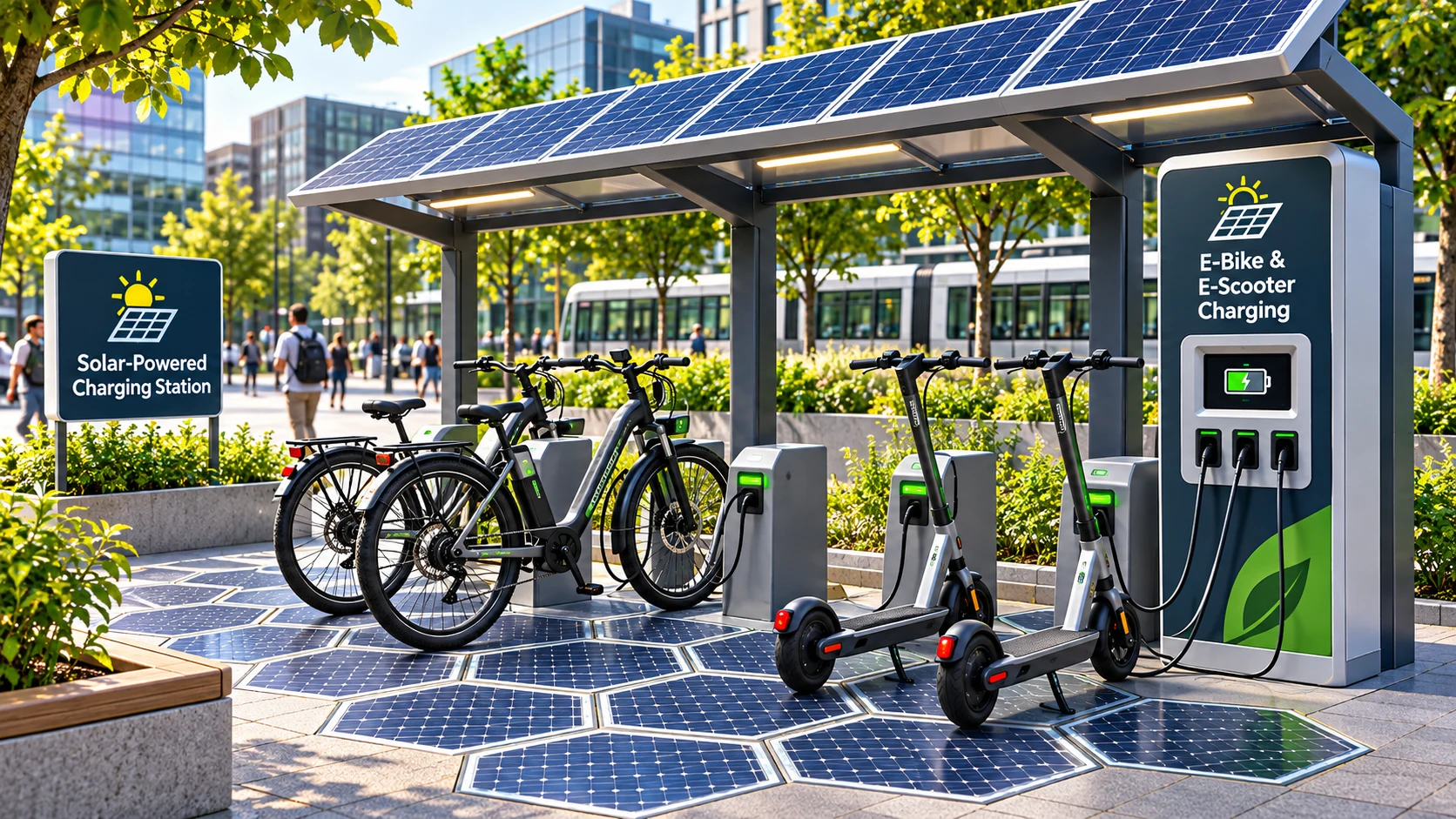
FEATURED IMAGE: Insert the 1920 × 1080 image showing an urban solar-powered e-bike and scooter charging station with photovoltaic pavement, compatible charging docks, and a clear modern city setting. The image must not imply that vehicles charge wirelessly simply by standing on solar tiles.


What Is a Solar-Powered Bike Charging Station?
A solar-powered bike charging station is a designated place where electricity generated by solar panels helps recharge electric bicycle batteries. Many systems can also support electric scooters, cargo bikes, and other compatible light electric vehicles.
The solar panels convert sunlight into DC electrical energy. Power electronics then regulate, store, or convert the electricity into a form suitable for the vehicle’s approved charging equipment. solar powered bike charging station
A small station may serve one or two vehicles. Larger installations can support shared fleets at universities, public transportation stops, workplaces, and urban mobility hubs.
Some stations are connected to the electrical grid, while others have batteries and operate partly or fully off-grid. The best arrangement depends on the site’s energy needs and expected charging schedule.
How Does a Solar E-Bike Charging Station Work?
A typical battery-supported station has several connected components. The exact power-conversion arrangement depends on whether it uses AC chargers, compatible DC charging equipment, or a grid-connected system.
SOLAR PV PANELS
↓
POWER CONVERSION & CHARGE CONTROL
↓
OPTIONAL ENERGY STORAGE
↓
APPROVED CHARGING EQUIPMENT
↓
E-BIKE OR SCOOTER BATTERY
This is a simplified functional illustration, not an installation wiring diagram. Grid-connected stations may use a different electrical architecture.
1. Solar Panels Generate Electricity
Photovoltaic modules produce DC electricity when exposed to sunlight. Their available output varies with the time of day, weather, temperature, orientation, and shading.
2. Power Electronics Manage the Energy
A solar charge controller, inverter, or other power-conversion equipment manages the electricity according to the system design. A battery-based station may use an MPPT controller to charge its storage battery.
A grid-connected station may use different inverter and protection equipment. Charging hardware must match the chosen architecture.
3. Battery Storage Supports Flexible Charging
Stationary battery storage can collect solar energy for use when the sun is unavailable or when several vehicles need electricity at the same time.
Battery size should reflect daily charging demand, usable storage capacity, expected backup duration, charging limits, and the actual station load. solar powered bike charging station
4. Approved Chargers Recharge the Vehicles
Most e-bikes and scooters need charging equipment designed for their battery voltage, chemistry, connector, and battery management system.
A public station may provide protected AC outlets for approved chargers or a manufacturer-compatible charging interface. Never connect a solar panel directly to an e-bike battery or substitute a charger based only on matching connector shape.
Can Solar Pavement Really Charge Electric Scooters?
Yes, solar pavement can generate electricity for a charging station when it is engineered for that purpose and connected to appropriate charging equipment.
Unlike ordinary rooftop panels, walkable photovoltaic modules are designed to become part of a pedestrian surface. They need a protective surface that can handle the expected loads while allowing sunlight to reach the solar cells. solar powered bike charging station
In 2021, a pilot solar-pavement scooter charging station was reported in Seville, Spain. The published project description identified approximately 7.6 square meters of walkable photovoltaic area, a 1kW solar installation, and battery storage. The project was presented as a way to power shared scooters using solar pavement.
That real-world example shows the basic idea is feasible. It does not mean that every decorative solar-looking floor tile is an electricity-producing device or that an e-scooter can charge automatically through its tires.
See the reported Seville solar pavement pilot for a documented example.
Important distinction: Solar pavement generates electrical energy. It does not inherently transmit that energy into a parked vehicle. Wireless charging requires separate compatible transmitting and receiving hardware, with appropriate electrical and safety controls.
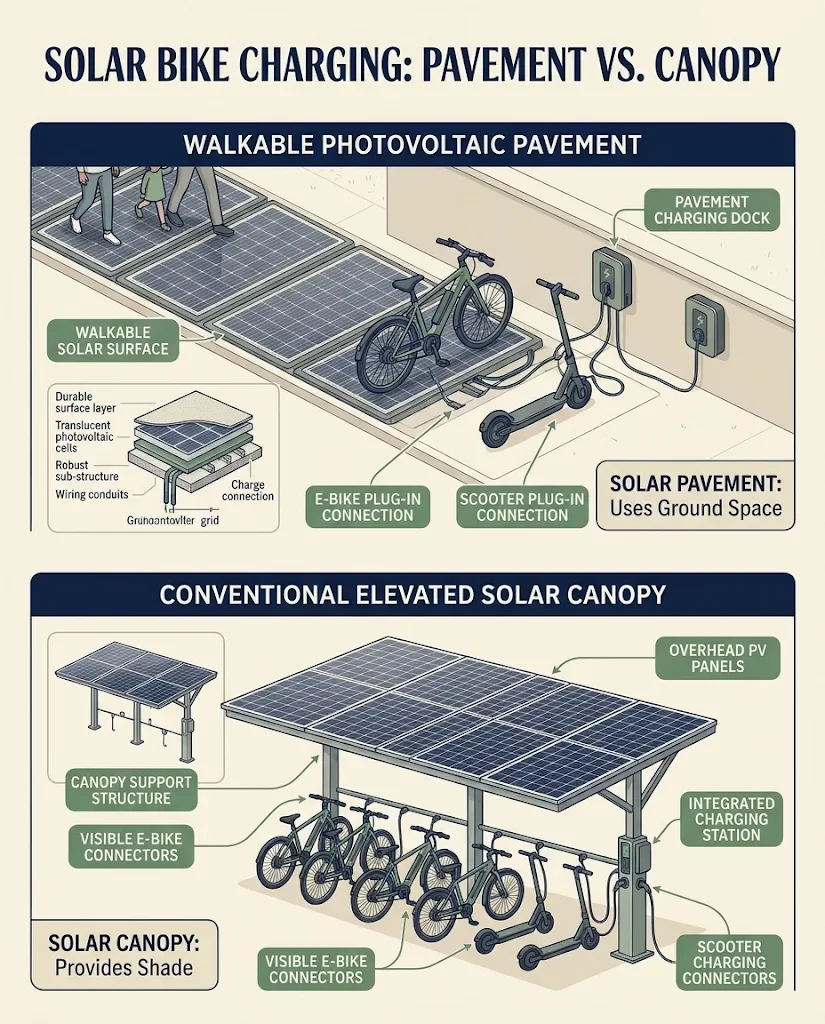
Solar Pavement vs. Solar Canopy Charging Stations
Both approaches use sunlight to support electric mobility, but they have different practical advantages.
| Factor | Solar Pavement | Solar Canopy |
|---|---|---|
| Panel location | Ground surface | Above parking area |
| Shading | Can be affected by parked vehicles and people | Depends on surrounding structures and trees |
| Surface durability | Requires traffic-rated modules | Panels are not normally walked on |
| Extra benefit | Uses existing pavement area | Can provide shade and rain shelter |
| Maintenance | Specialized surface access and cleaning | Conventional PV inspection and access |
| Best use | Specialty urban projects and pilots | Practical parking and charging hubs |
For many new installations, a solar canopy may be simpler to evaluate because conventional solar modules can be mounted away from foot traffic and parked vehicles. However, final costs and feasibility depend on structural requirements, available space, and the actual site.
Research on photovoltaic pavement highlights shading, durability, and long-term cost-effectiveness as important limitations. Solar pavement should not be assumed to perform as well as a conventional elevated solar panel of similar nameplate capacity.
How Much Solar Power Does an E-Bike Charging Station Need?
Solar station sizing begins with energy demand, not simply the number of bikes or scooters parked at the station. solar powered bike charging station
The energy needed for charging depends on each vehicle’s battery capacity, remaining charge, charging efficiency, and how often it needs to recharge.
Step 1: Calculate Battery Energy
For a battery with a specified nominal voltage and amp-hour capacity:
Nominal battery energy (Wh) = Nominal voltage (V) × Capacity (Ah)
Example: 36V × 10Ah = 360Wh.
This is a nominal energy calculation. The electricity drawn from the charging station can be higher because charging equipment and the battery lose some energy as heat.
Step 2: Estimate the Daily Charging Demand
Imagine a small charging hub that supplies ten complete charging equivalents per day. If each vehicle receives 400Wh of stored energy, the daily energy delivered to vehicle batteries would be:
10 × 400Wh = 4,000Wh, or 4kWh.
If we assume an 85% average charging efficiency for illustration, the station must supply approximately: solar powered bike charging station
4,000Wh ÷ 0.85 ≈ 4,706Wh (4.7kWh).
The 85% assumption is for this example, not a measured efficiency value for any particular charger. Additional stationary battery and conversion losses may increase the required solar energy.
Step 3: Estimate PV Capacity
For a simplified initial estimate:
Solar capacity (W) ≈ Daily solar-side energy (Wh) ÷ (Peak sun hours × Performance factor).
If the station needs 4,706Wh per day before additional storage losses, and we assume four peak sun hours and a 75% PV performance factor:
4,706 ÷ (4 × 0.75) ≈ 1,569W.
That suggests approximately 1.6kW of solar capacity as a preliminary mathematical estimate for these assumptions. It is not a final design recommendation. Seasonal weather, location, shading, stationary battery losses, and charging schedules may require a different array size. solar powered bike charging station
| Illustrative Daily Charging | Energy Delivered to Vehicles | Charger Input at 85% Efficiency |
|---|---|---|
| 2 × 400Wh | 0.8kWh | 0.94kWh |
| 5 × 400Wh | 2.0kWh | 2.35kWh |
| 10 × 400Wh | 4.0kWh | 4.71kWh |
| 20 × 400Wh | 8.0kWh | 9.41kWh |
Does a Solar Charging Station Need a Battery?
Not every solar charging station needs stationary battery storage. A grid-connected system may use solar electricity when available and draw power from the grid when solar output is insufficient.
For a remote or off-grid station, stationary battery storage is usually important if vehicles need reliable charging during changing weather or after sunset. solar powered bike charging station
The required storage capacity depends on how much energy must be delivered, the acceptable depth of discharge, the battery chemistry, charging efficiency, and the number of days of expected backup.
For example, a battery labeled 24V 100Ah contains approximately 2.4kWh of nominal energy. Its usable energy may be lower, and it may not support all desired vehicle charging sessions without additional power.
Storage batteries also require appropriate battery management, temperature protection, overcurrent protection, ventilation where specified, and safe enclosures.
Why Solar Pavement Is More Difficult Than It Looks
Solar pavement is visually appealing because it uses ground space that already exists. However, turning a pedestrian surface into a reliable solar generator introduces several practical challenges.
Shadows From Parked Vehicles
When bikes and scooters park directly above solar tiles, they may block some sunlight from reaching the cells. Nearby buildings, trees, street furniture, and pedestrians can add more shading.
Shading reduces energy collection and can affect electrical performance depending on the module and circuit design. This is one reason output from pavement cannot be predicted from panel area alone.
Foot Traffic and Mechanical Loads
Walkable solar modules need surfaces designed for pedestrian loads, slip resistance, water exposure, impact, and routine cleaning. A conventional solar panel is not automatically suitable for installation as pavement.
Dirt, Water, and Drainage
Ground-level modules can collect dirt and face standing water or other urban contaminants. Their electrical connections and surrounding structures require appropriate environmental protection and maintenance access.
Repair and Replacement Costs
Specialized pavement modules may have different installation and replacement requirements from conventional rooftop PV. Repairs can also interfere with pedestrian access or the operation of the charging station.
Scientific reviews of PV pavement identify long-term durability, performance, and cost-effectiveness as important challenges that must be evaluated before large-scale adoption.
For further technical background, see the research review Photovoltaic Pavement and Solar Road: A Review and Perspectives.
IMAGE 2: Insert a 1200 × 1500 educational illustration comparing a solar canopy charging station with a walkable solar pavement station. Label the power-generation area, energy storage, and compatible charging connection. Keep electrical wiring conceptual rather than terminal-specific.
Are There Real Solar E-Bike and Scooter Charging Projects?
Yes. The technology is not limited to futuristic illustrations. Research groups and businesses have investigated and developed charging stations that use solar panels, energy storage, and compatible charging equipment.
Seville Solar Pavement Project
A reported 2021 pilot in Seville used walkable solar pavement to help power a shared electric scooter charging station. This demonstrates one possible use of PV pavement in an urban mobility setting.
University Research on Solar Charging
The University of California, Davis has described a research project exploring solar-powered micromobility, including a charging station for e-bikes and scooters. The research focuses on practical charging demand and use patterns.
Learn more from the UC Davis National Center for Sustainable Transportation project description.
Research on Self-Sufficiency
Research published in Applied Energy examined photovoltaic and battery-supported bike-sharing stations and found that solar power did not necessarily make stations fully self-sufficient.
This finding matters because even a station with visible solar panels may need grid power or more storage during periods of high demand and low sunlight.
See the research paper Photovoltaic-Battery Powered Bike Share Stations Are Not Necessarily Energy Self-Sufficient.
How Much Does a Solar Charging Station Cost?
There is no single reliable price for every solar-powered bike or scooter charging station. A small private installation and a public charging hub with specialized pavement have different requirements.
Budget items can include:
- Solar panels or specialized walkable photovoltaic modules.
- Mounting structures or pavement preparation.
- Solar inverters and charge-control equipment.
- Optional battery storage and battery management.
- Compatible vehicle chargers, outlets, or charging docks.
- Electrical protection, cabling, grounding, and weatherproof enclosures.
- Site preparation, accessibility, drainage, and civil construction.
- Permits, engineering, inspections, and installation labor.
- Maintenance, monitoring, and component replacement.
For a real project, obtain a site-specific design and current quotations. Comparing only the purchase price of solar panels will overlook much of the installation cost.
Safety and Design Requirements
Public solar charging stations combine electrical equipment, battery charging, outdoor exposure, and pedestrian access. A design must address each of these risks.
Electrical and battery safety: Use only approved chargers compatible with the vehicle batteries. Outdoor outlets, electrical protection, battery enclosures, disconnects, and cabling must be designed for the installation environment. A qualified professional should design and commission the electrical system. Do not build a public charging surface from ordinary unprotected solar modules.
Important planning considerations include:
- Electrical protection: Suitable overcurrent protection, grounding, bonding, and disconnecting equipment.
- Weather protection: Outdoor-rated chargers, connectors, enclosures, and cable routing.
- Battery safety: Compatible charging equipment, temperature monitoring, and appropriate energy-storage protection.
- Pedestrian safety: Slip-resistant surfaces, accessibility, protected cables, and safe docking layouts.
- Structural design: Approved load-bearing surfaces or canopy structures.
- Fire precautions: Follow battery, charger, and local fire-safety requirements.
- Monitoring: Detect equipment faults and track power production and charging demand.
How to Plan a Solar Bike Charging Hub
If you are considering a solar charging station for a workplace, campus, apartment complex, or small business, start with a demand and site assessment.
- Count expected users. Estimate how many e-bikes and scooters will need charging each day.
- Estimate energy per session. Use battery specifications and typical charging depth.
- Study the solar resource. Evaluate local sunlight, seasonal conditions, and shading.
- Compare PV mounting options. Assess canopies, rooftops, and specialized pavement for the site.
- Determine backup needs. Decide whether the station will be grid-connected or use battery storage.
- Choose compatible charging equipment. Consider vehicle battery types and supported connectors.
- Review site safety. Include weather resistance, walking surfaces, accessibility, and secure parking.
- Obtain professional engineering. Confirm all electrical, structural, and local compliance requirements before installation.
For larger projects, monitoring daily energy production and charging demand helps determine whether additional panels or battery capacity would improve performance.
Frequently Asked Questions
Can you charge an electric bike with solar power?
Yes. A properly designed solar station can provide electricity to compatible e-bike charging equipment. The station may use a battery, a grid connection, or other approved power-conversion equipment.
Do solar pavement tiles charge scooters wirelessly?
Not by themselves. Solar tiles generate electricity. Wireless charging requires additional specialized hardware and a compatible receiver on the vehicle.
How many e-bikes can a solar panel charge?
That depends on the panel’s actual daily energy production, the amount of energy each battery needs, charger efficiency, and station storage losses. Panel wattage alone does not establish how many full charges are possible.
Do solar charging stations work at night?
They can if they have available stationary battery storage or a grid connection. Solar panels do not generate meaningful electricity at night.
Are solar pavement panels better than rooftop panels?
Not necessarily. Pavement can use otherwise available ground area, but its performance may be limited by shade, traffic, surface conditions, and specialized construction costs. Conventional rooftop or canopy panels are often easier to evaluate and maintain.
Can a solar charging station be completely off-grid?
Yes, if the solar array, energy storage, charging hardware, and expected demand are properly matched. However, research shows that some solar-supported micromobility stations still need grid power or additional capacity to achieve reliable service.
Are Solar Bike Charging Stations Worth Considering?
Solar-powered bike and scooter charging stations offer a practical way to connect renewable electricity with small electric vehicles. Real pilot projects and research show that solar charging is technically possible, including systems using specialized photovoltaic pavement.
However, the best design is not always the most futuristic one. A shaded parking hub with conventional solar panels above it may be more practical than putting solar cells directly beneath parked vehicles.
Start with daily charging demand, local solar conditions, electrical safety, and long-term maintenance. Then compare the options with realistic energy estimates instead of relying on visual concepts or optimistic performance claims.
Research sources: PV Magazine: Solar Pavement Scooter Charging Pilot, UC Davis: Solar-Powered Micromobility Research, Photovoltaic Pavement Research Review, and Applied Energy: Solar Bike Share Station Self-Sufficiency.