
Complete Off-Grid Solar System with Batteries for Energy Independence (2026 Guide)
Imagine powering your home with sunlight, storing excess electricity for nighttime use, and reducing your dependence on the traditional power grid. A complete off-grid solar system with batteries can make this possible when the system is correctly designed for your electricity consumption, local weather, and backup requirements.
Off-grid solar is particularly useful for remote homes, rural properties, cabins, farms, workshops, and locations where connecting to the utility grid is expensive or impractical.
However, achieving reliable energy independence involves more than buying solar panels and a battery. You need the right combination of solar capacity, battery storage, inverter power, charge control, electrical protection, and energy management.
In this complete guide, you’ll learn how off-grid solar systems work, how to estimate the size you need, which batteries to consider, what affects installation costs, and how to avoid common system-design mistakes.
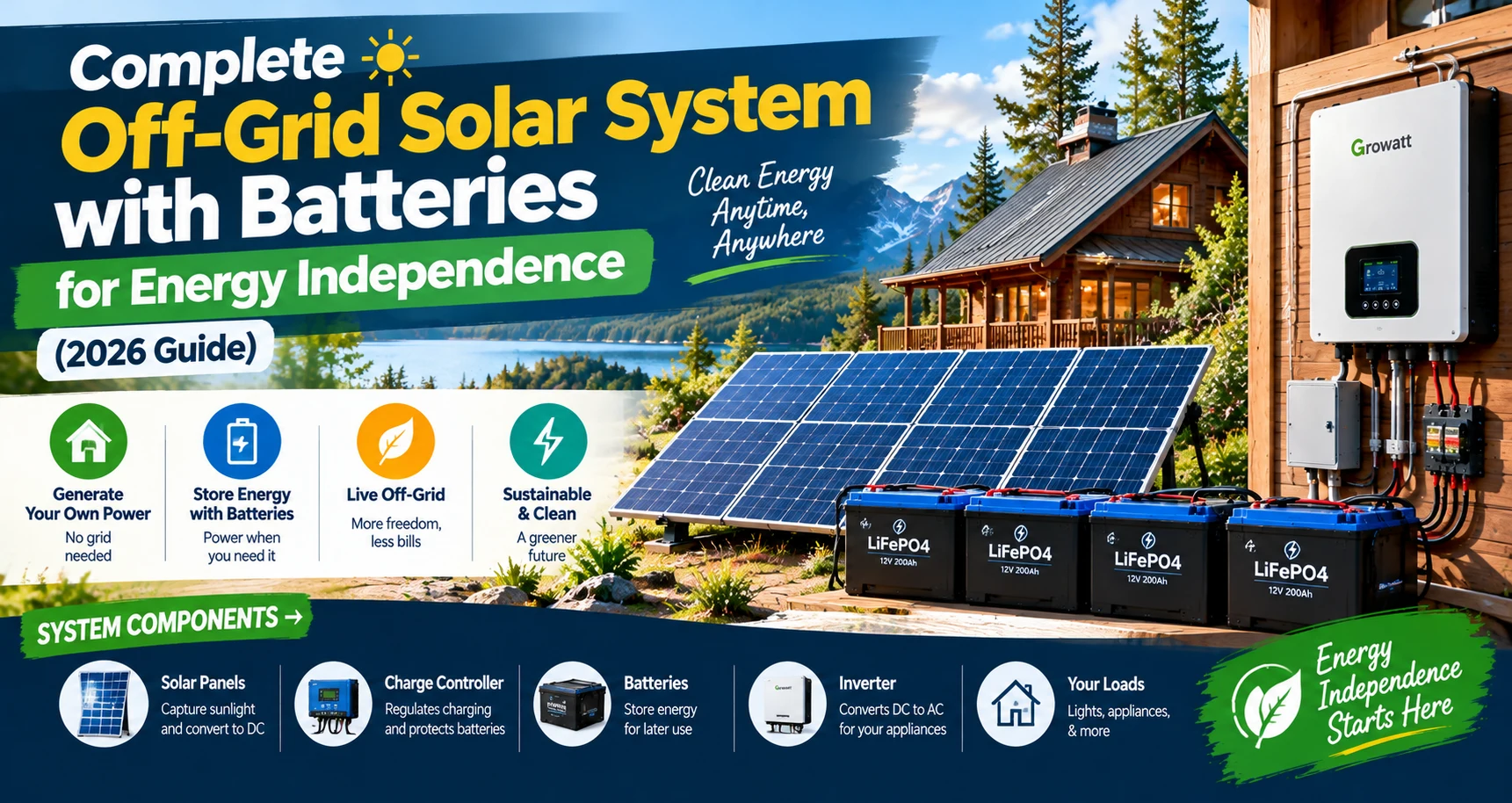
Quick answer: A complete off-grid solar system typically includes solar panels, battery storage, an off-grid or compatible hybrid inverter, charge-control equipment where required, electrical protection, mounting hardware, and monitoring. The correct size depends on your daily electricity use, peak power demand, available sunlight, and how many days of backup you want.
What Is a Complete Off-Grid Solar System with Batteries?
A complete off-grid solar system generates and stores electricity without relying on a utility-grid connection for normal operation.
Solar panels capture sunlight and produce direct-current (DC) electricity. The system then uses compatible power electronics to supply household appliances and charge the batteries.
When solar production falls after sunset or during cloudy weather, the batteries provide stored electricity to the inverter, which supplies alternating-current (AC) power to compatible household equipment.
Unlike a typical grid-connected solar installation, a true off-grid system must be designed to meet electricity demand even when the utility grid is unavailable.
A well-designed system may also include a backup generator for extended periods of poor solar production.
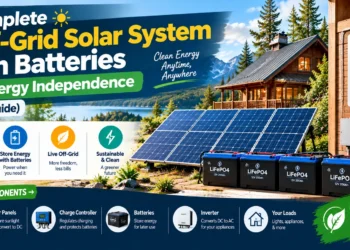
Main Components of an Off-Grid Solar System
| Component | Main function |
|---|---|
| Solar panels | Generate electricity from sunlight |
| Solar charge controller | Regulates PV charging when required by the system architecture |
| Off-grid inverter | Converts DC electricity into usable AC power |
| Battery bank | Stores energy for nighttime and low-sun periods |
| Battery management system | Monitors and protects compatible batteries |
| Mounting structure | Secures solar panels to a suitable surface |
| Electrical protection | Helps protect against specified electrical faults |
| Monitoring system | Tracks production, battery status, and energy consumption |
| Backup generator (optional) | Provides additional energy during extended low-solar periods |
The exact configuration depends on whether you choose a dedicated off-grid inverter, a compatible hybrid inverter, an integrated power system, or another manufacturer-approved design.
Important: Not every inverter requires a separate charge controller, and not every battery is compatible with every inverter. Verify the equipment specifications before purchasing components.
How Does an Off-Grid Solar System with Battery Storage Work?
An off-grid solar system manages energy through several operating stages.
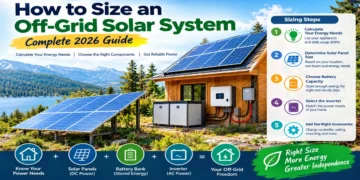
1. Solar Panels Generate Electricity
During daylight hours, the panels produce electricity based on sunlight, temperature, orientation, shading, and system losses.
Production is usually highest during favorable midday conditions, but the actual output changes throughout the day and across seasons.
2. Solar Power Supplies Household Loads
The inverter and system controls direct available energy to connected appliances, such as lighting, refrigerators, computers, water pumps, and other compatible equipment.
Using electricity while the panels are generating can reduce the amount of stored energy needed later.
3. Excess Energy Charges the Batteries
When solar production exceeds the immediate demand and the batteries can accept more energy, the system can store the surplus for later use.
The amount stored depends on battery capacity, charging limits, battery temperature, state of charge, and conversion losses.
4. Batteries Supply Electricity at Night
When solar production decreases, the batteries provide energy to the inverter.
The inverter converts the stored DC electricity into AC power for household appliances.
5. The System Manages Low-Sun Conditions
During cloudy weather or several days of poor solar production, the system may have to reduce discretionary loads or use a backup generator.
This is why an off-grid system needs sufficient generation and storage for the expected conditions—not just for an average sunny day.
For additional technical background, see the U.S. Department of Energy’s guide to solar energy and storage.
What Size Off-Grid Solar System Do You Need?
Choosing the correct system size is one of the most important steps in planning an off-grid installation.
A system that is too small may leave you without enough stored energy during cloudy weather. An unnecessarily large system can increase the purchase price without providing equivalent practical benefits.
Start by calculating how much electricity your household uses each day.
Step 1: Calculate Your Daily Electricity Consumption
List your main appliances and estimate their daily energy use.
Use this formula:
Daily energy consumption (kWh) = Appliance power (W) × Hours of use ÷ 1,000
For example, a 100-watt appliance operating for five hours uses:
100 W × 5 hours ÷ 1,000 = 0.5 kWh.
The following table is an illustrative example for a small household. Actual consumption varies by appliance and usage habits.
| Appliance | Estimated daily energy |
|---|---|
| LED lighting | 0.5 kWh |
| Refrigerator | 1.2 kWh |
| Laptop and electronics | 0.6 kWh |
| Television | 0.3 kWh |
| Water pump | 0.8 kWh |
| Washing machine | 0.5 kWh |
| Other small appliances | 0.6 kWh |
| Illustrative daily total | 4.5 kWh |
This household uses approximately 4.5 kWh per day in the example.
Your actual total could be significantly higher if you use electric heating, air conditioning, electric cooking, an electric water heater, large pumps, or other energy-intensive appliances.
Whenever possible, use actual meter readings or measured appliance consumption instead of relying entirely on estimates.
Step 2: Estimate the Solar Panel Capacity
Solar panel sizing depends on daily energy consumption, local peak-sun-hours, and overall system efficiency.
A preliminary estimate can use this formula:
Solar array size (kW) = Daily energy demand (kWh) ÷ (Peak-sun-hours × Estimated system efficiency)
For illustration, suppose a household uses 4.5 kWh per day, receives an average of five peak-sun-hours per day during the period being considered, and assumes 75% overall system efficiency.
The preliminary estimate is:
4.5 ÷ (5 × 0.75) = 1.2 kW.
This is a mathematical starting point, not a final recommendation for an off-grid installation.
A real system may require more solar capacity to recharge the batteries after poor weather, accommodate seasonal sunlight changes, support daytime loads, and compensate for system losses.
The design should use local solar-production data for the least favorable periods in which the system is expected to operate reliably.
Step 3: Estimate the Battery Capacity
Battery capacity determines how much energy can be stored for use when the panels are not producing enough electricity.
A simple starting formula is:
Nominal battery capacity (kWh) = Daily energy demand × Days of autonomy ÷ (Usable depth of discharge × Battery-system efficiency)
For an illustrative household using 4.5 kWh per day, assume:
- Daily energy demand: 4.5 kWh
- Desired autonomy: 2 days
- Usable depth of discharge: 80%
- Assumed battery-system efficiency factor: 95%
The calculation is:
4.5 × 2 ÷ (0.80 × 0.95) = approximately 11.84 kWh.
This example suggests approximately 11.8 kWh of nominal battery capacity under the stated assumptions.
Actual battery sizing must follow the battery manufacturer’s limits, including usable capacity, temperature restrictions, continuous discharge power, surge capability, and warranty conditions.
Also remember that autonomy is not a guarantee of uninterrupted operation. Actual runtime changes with consumption, conversion losses, battery condition, temperature, and other factors.
Step 4: Choose the Correct Inverter Power
Battery capacity and inverter power measure different things.
- Battery capacity (kWh): How much energy can be stored.
- Inverter power (kW): How much power the system can supply at a given moment.
An inverter with sufficient energy storage behind it can still shut down if the connected appliances demand more power than its output rating allows.
Add up the running power of the appliances that may operate simultaneously. Then account for startup surges from equipment such as refrigerators, pumps, and motors.
The inverter must also be compatible with the battery voltage, electrical system, and required AC output.
Have a qualified installer verify the continuous output, surge rating, and circuit requirements before choosing the final inverter.
Off-Grid Solar System Size Guide
The following table is a general planning illustration, not a universal equipment-sizing chart.
| Daily electricity use | Typical planning focus |
|---|---|
| 1–3 kWh | Essential loads, lighting, communications, and limited appliances |
| 3–5 kWh | A small, energy-efficient household |
| 5–10 kWh | A larger household or a home with additional appliances |
| 10–20 kWh | High household demand, larger properties, or multiple significant loads |
| More than 20 kWh | Detailed energy audit and a customized system design |
The appropriate solar array and battery bank can vary widely within each category.
A household using 5 kWh daily in a sunny location with efficient appliances may need a different configuration from a household using the same amount in a location with frequent winter cloud cover.
For a reliable design, evaluate daily energy consumption, peak power, seasonal solar production, and the required backup duration together.
Best Batteries for a Complete Off-Grid Solar System
Battery selection affects the cost, maintenance requirements, available energy, and reliability of an off-grid installation.
The right option depends on your budget, expected cycling, operating temperature, available space, and the equipment’s compatibility.
1. LiFePO4 Lithium Batteries
Lithium iron phosphate (LiFePO4) batteries are widely used in modern residential and off-grid storage systems.
Advantages:
- High usable capacity when operated within manufacturer limits.
- Generally long cycle life under appropriate conditions.
- Relatively low routine maintenance.
- Often compact compared with traditional lead-acid storage.
- Integrated battery-management features in many products.
Considerations:
- Higher initial purchase price than some basic lead-acid options.
- Compatibility with the inverter and battery-management system must be confirmed.
- Charging at low temperatures may be restricted or prohibited unless the battery has suitable protection or heating.
- Product life and warranty depend on the specific model and operating conditions.
For many new residential installations, LiFePO4 is worth comparing first, but it is not automatically the best option for every budget or application.
2. Lead-Acid Batteries
Lead-acid batteries have a long history in backup and off-grid applications.
Some types are flooded batteries, while others are sealed designs such as AGM or gel batteries.
Advantages:
- Familiar technology.
- Some products have a lower upfront price.
- Certain designs are suitable for particular backup applications.
Considerations:
- Usable capacity may be more limited for long service life.
- Flooded types may require maintenance and ventilation.
- Batteries can be heavy and require suitable installation space.
- Deep cycling and high temperatures can shorten service life.
Compare the total cost over the expected service life rather than judging only by the initial purchase price.
3. Other Battery Technologies
Sodium-ion and other emerging storage technologies may be suitable for some applications, depending on product availability and specifications.
Before purchasing, compare independently documented performance, usable capacity, warranty, operating-temperature limits, safety certifications, and manufacturer support.
Do not assume a battery is suitable for an off-grid home simply because its nominal voltage matches the inverter.
Battery Comparison Table
| Feature | LiFePO4 lithium | Lead-acid |
|---|---|---|
| Usable capacity | Often relatively high within manufacturer limits | Often more restricted for long life |
| Routine maintenance | Usually low | Depends on battery type |
| Initial cost | Often higher | Can be lower |
| Weight | Generally lighter for comparable usable energy | Generally heavier |
| Low-temperature charging | May require restrictions or heating | Depends on battery design |
| Best selection method | Compare specifications, warranty, and compatibility | Compare specifications, maintenance, and lifetime cost |
Battery life varies by product and operating conditions. Check the manufacturer’s actual cycle-life conditions and warranty instead of relying on a generic lifespan estimate.
For more information about storage capacity and battery selection, consult the U.S. Department of Energy’s solar-plus-storage guide.
How Many Solar Panels Do You Need for an Off-Grid Home?
The number of panels depends on the total array capacity and the wattage of each panel.
Use this basic formula:
Number of panels = Required solar array capacity (W) ÷ Panel rating (W)
For example, a preliminary 4,000-watt array using 400-watt panels would require:
4,000 ÷ 400 = 10 panels.
That gives a nominal array rating of 4 kW.
However, ten panels do not guarantee a particular daily energy output. Actual production depends on sunlight, panel orientation, shading, temperature, and system losses.
The installer must also check the maximum PV input voltage and current, string configuration, and inverter limits. Solar strings must remain within the equipment’s permitted operating range under relevant temperature conditions.
What Affects Solar Panel Performance?
Several factors influence how much energy an off-grid array produces:
- Local sunlight and seasonal weather.
- Panel orientation and tilt.
- Shading from trees, buildings, or terrain.
- High panel temperatures.
- Dirt and dust accumulation.
- Cable and inverter losses.
- Snow, if relevant to the location.
- The available space for the array.
A system intended for year-round off-grid living should be evaluated using seasonal production estimates rather than the best summer month alone.
What Does a Complete Off-Grid Solar System Cost?
The total price depends on the solar array, battery capacity, inverter rating, installation complexity, electrical protection, mounting requirements, and location.
A smaller system serving essential appliances is usually less expensive than a whole-home installation designed to run air conditioning, electric cooking, water heating, and large pumps.
Because prices and installation costs vary by country, supplier, and project, there is no single reliable price for every complete off-grid solar system.
What Is Included in the Total Cost?
| Cost category | What to consider |
|---|---|
| Solar panels | Total array capacity, panel quality, and warranty |
| Battery storage | Usable kWh, discharge power, warranty, and expected life |
| Inverter | Continuous output, surge rating, compatibility, and monitoring |
| Mounting system | Roof type, ground mounting, wind exposure, and structural needs |
| Electrical protection | Appropriate disconnects, overcurrent protection, grounding, and surge protection |
| Installation | Labor, design, testing, and commissioning |
| Optional generator | Equipment, fuel, installation, and maintenance |
| Monitoring | Compatible hardware, communications, and any ongoing service costs |
How to Avoid Paying for an Oversized System
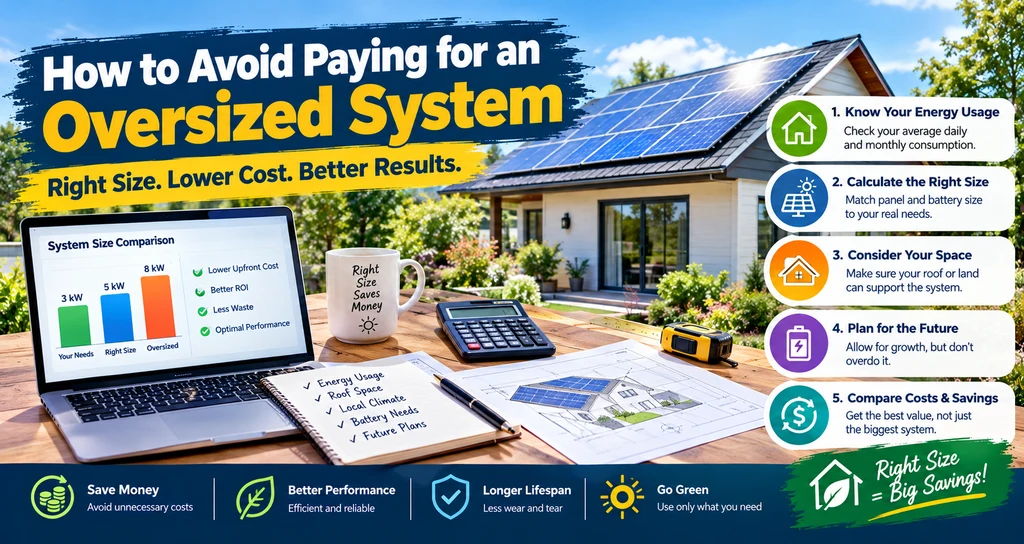
Start with an energy audit.
Identify which loads are essential, which can be used during sunny hours, and which can be reduced during poor weather.
For example, running a washing machine during strong solar production may reduce the amount of battery energy needed later. Efficient lighting and appliances can also reduce the size of the required solar array and storage bank.
However, do not undersize the system simply to lower the initial quote. A battery that repeatedly runs out of usable energy may fail to meet the purpose of the installation.
Ask installers to explain the assumptions behind their production estimates, battery-autonomy calculations, and equipment selections.
Can an Off-Grid Solar System Power an Entire House?
Yes, an appropriately designed off-grid system can power an entire house. Whether it can do so reliably depends on the home’s energy consumption and the system’s ability to meet that demand throughout the year.
A home using efficient lighting, refrigeration, electronics, and a modest water pump may require a much smaller system than a house with electric heating, air conditioning, electric cooking, and an electric water heater.
Appliances That Need Special Attention
Air conditioning: Can consume substantial energy, especially during hot weather and prolonged operation.
Electric water heating: May require a large amount of energy and can be better managed through dedicated scheduling or alternative heating methods.
Water pumps: Can have high startup power requirements, so inverter surge capability matters.
Electric cooking: Multiple heating elements can create high simultaneous demand.
Electric vehicles: Charging can add a substantial load and may require a separate system-design assessment.
An energy-efficient home is generally easier and less expensive to supply with off-grid solar than a home with high electrical demand.
Off-Grid Solar vs. Grid-Tied Solar with Batteries
These systems serve different needs.
| Feature | Fully off-grid solar | Grid-tied solar with batteries |
|---|---|---|
| Utility connection | Not required for normal operation | Connected to the utility grid |
| Battery requirement | Normally essential for reliable nighttime supply | Depends on the chosen system and goals |
| Extended cloudy weather | Requires sufficient storage, load management, or backup generation | May be able to import grid electricity |
| Upfront cost | Can be high because the system must cover more operating conditions | Often lower when a grid connection is available |
| Energy independence | Can provide independence from the utility supply | Reduces grid dependence but usually retains the connection |
| Backup power | Depends on correct design and available energy | Depends on whether the system supports backup operation |
For most properties with a reliable and affordable grid connection, a grid-connected solar system may be more economical.
Off-grid solar is especially worth evaluating where grid access is unavailable, unreliable, or expensive.
Remember that a grid-connected solar system does not automatically provide electricity during an outage. Backup operation requires equipment specifically designed and configured for that purpose.
The U.S. Department of Energy explains this distinction in its guide to solar and resilience.
Is a Backup Generator Necessary for Off-Grid Solar?
Not every off-grid system needs a generator, but a backup generator can be useful when extended cloudy weather or unusually high electricity demand reduces battery reserves.
A generator can provide an additional source of electricity when solar production is insufficient.
Whether it is necessary depends on:
- Local seasonal weather.
- Daily electricity consumption.
- Battery autonomy.
- The importance of uninterrupted power.
- Fuel availability and cost.
- The system’s ability to reduce nonessential loads.
For a remote home where refrigeration, water pumping, communications, or medical equipment must remain powered, a carefully planned backup strategy may be particularly important.
The generator must be compatible with the system’s approved charging and power-management arrangements and installed according to local requirements.
Installation and Safety: What You Must Know
An off-grid solar installation involves DC and AC electrical systems, battery storage, high-current circuits, and equipment that must be properly protected.
Poorly designed wiring or incorrect equipment selection can create risks of electric shock, fire, equipment damage, or loss of power.
Important Safety Requirements
- Use an appropriately qualified solar installer and electrician.
- Follow local electrical and building regulations.
- Verify that the inverter and battery are compatible.
- Use correctly rated cables, connectors, overcurrent protection, and disconnects.
- Provide the required battery ventilation, clearances, and environmental protection.
- Install batteries only in locations permitted by the manufacturer and local rules.
- Confirm that the battery-management system and inverter settings are correctly configured.
- Have the completed system tested and commissioned.
- Keep the manufacturer’s manuals and emergency procedures accessible.
Never assume that a system is safe to touch because its inverter is switched off. Solar panels can generate DC electricity whenever illuminated, and batteries can deliver substantial fault current.
Do not improvise electrical connections, bypass protection devices, or open energized equipment.
Common Mistakes When Building an Off-Grid Solar System
Avoid these mistakes when planning your installation.
Mistake 1: Sizing the System Only by Solar Panel Wattage
A large panel array does not guarantee enough stored energy overnight or during cloudy weather.
Better approach: Calculate daily energy use, battery autonomy, seasonal production, and inverter power together.
Mistake 2: Buying a Battery Based Only on Nominal Capacity
Two batteries with the same nominal kWh rating may have different usable capacities, power limits, warranties, and operating-temperature requirements.
Better approach: Compare usable energy, continuous discharge power, surge capability, cycle-life conditions, and compatibility.
Mistake 3: Ignoring Startup Surges
Motors, compressors, and pumps can demand substantially more power when starting than while running.
Better approach: Check appliance starting requirements and the inverter’s specified surge capability.
Mistake 4: Forgetting Winter or Cloudy-Weather Production
A system designed around ideal sunny conditions may not recharge its batteries sufficiently during less favorable weather.
Better approach: Evaluate the local seasonal solar resource and define how much backup autonomy is required.
Mistake 5: Expecting Unlimited Electricity
Even a large off-grid installation has finite generation and storage capacity.
Better approach: Prioritize essential loads, use efficient appliances, and plan how to manage energy during prolonged low-solar conditions.
Mistake 6: Mixing Incompatible Equipment
Battery voltage alone does not guarantee that a battery and inverter can operate together correctly.
Better approach: Confirm compatibility using the manufacturers’ specifications and approved configuration guidance.
Frequently Asked Questions About Complete Off-Grid Solar Systems
How much does a complete off-grid solar system with batteries cost?
The price depends on the solar capacity, battery storage, inverter, installation, location, and backup requirements. Obtain itemized quotes based on your actual energy consumption rather than comparing packages by panel wattage alone.
How many batteries do I need for an off-grid house?
The number depends on each battery’s usable capacity, daily electricity use, desired autonomy, and power requirements. Calculate the total usable storage first, then select a compatible battery configuration.
Can an off-grid solar system run a refrigerator all night?
Yes, if the battery has sufficient usable energy and the inverter can support the refrigerator’s operating and startup requirements. Actual runtime depends on the refrigerator’s consumption, battery condition, and other connected loads.
Can I run air conditioning on off-grid solar?
Yes, with a system designed for the air conditioner’s energy consumption and startup characteristics. Air conditioning can significantly increase the required solar array, battery capacity, and inverter power.
Are LiFePO4 batteries good for off-grid solar?
LiFePO4 batteries are a popular option because of their usable capacity, low routine maintenance, and potential for long cycle life. Check the specific product’s warranty, temperature limits, compatibility, and power ratings before buying.
How many days of battery backup should I plan for?
The right autonomy depends on local weather, the importance of your loads, and whether a generator or another backup source is available. More autonomy generally requires more battery storage and can increase upfront costs.
Will off-grid solar work during cloudy weather?
Solar panels can generate electricity in cloudy conditions, but production is generally lower than in strong direct sunlight. The battery can help bridge the difference, provided the stored energy and system capacity are sufficient.
Is an off-grid solar system completely maintenance-free?
No. Solar panels, batteries, mounting structures, electrical protection, and monitoring equipment should be inspected according to manufacturer recommendations and local requirements.
Can I expand my off-grid system later?
Sometimes, but expansion depends on the inverter, battery architecture, solar-input limits, compatibility, and available installation capacity. Planning for future demand before buying can help avoid expensive redesigns.
Final Verdict: Is a Complete Off-Grid Solar System Worth It?
A complete off-grid solar system with batteries can provide reliable electricity for remote homes, rural properties, cabins, and locations where a utility connection is unavailable or impractical.
The most successful systems are designed around real electricity consumption, realistic seasonal solar production, adequate battery storage, and an inverter that can handle the required loads.
For many households, the best approach is to begin with an energy audit, calculate the necessary solar and battery capacity, compare compatible equipment, and obtain a professionally designed installation.
Energy independence is not simply about installing more panels. It is about balancing energy generation, storage, power demand, and backup planning so that the system performs when you need it.
Before purchasing equipment, ask a qualified installer to provide a system design that includes expected energy production, usable battery capacity, days of autonomy, inverter power, seasonal assumptions, safety requirements, and a complete itemized quote.
Disclaimer: This article is for educational purposes and does not replace a site-specific electrical design or professional installation advice. Equipment sizing and installation must follow manufacturer specifications and applicable local regulations.