
Growatt vs EG4 hybrid inverters
Choosing a 48V hybrid or off-grid inverter is one of the most important decisions when building a solar battery system.
Two names frequently considered by DIY solar builders and off-grid homeowners are Growatt and EG4.
Both brands offer all-in-one inverter systems that can combine solar panels, batteries, AC power, and household loads. However, the specifications can be very different depending on the exact model.
Related Post
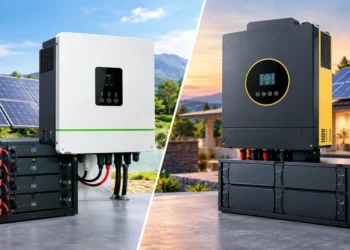
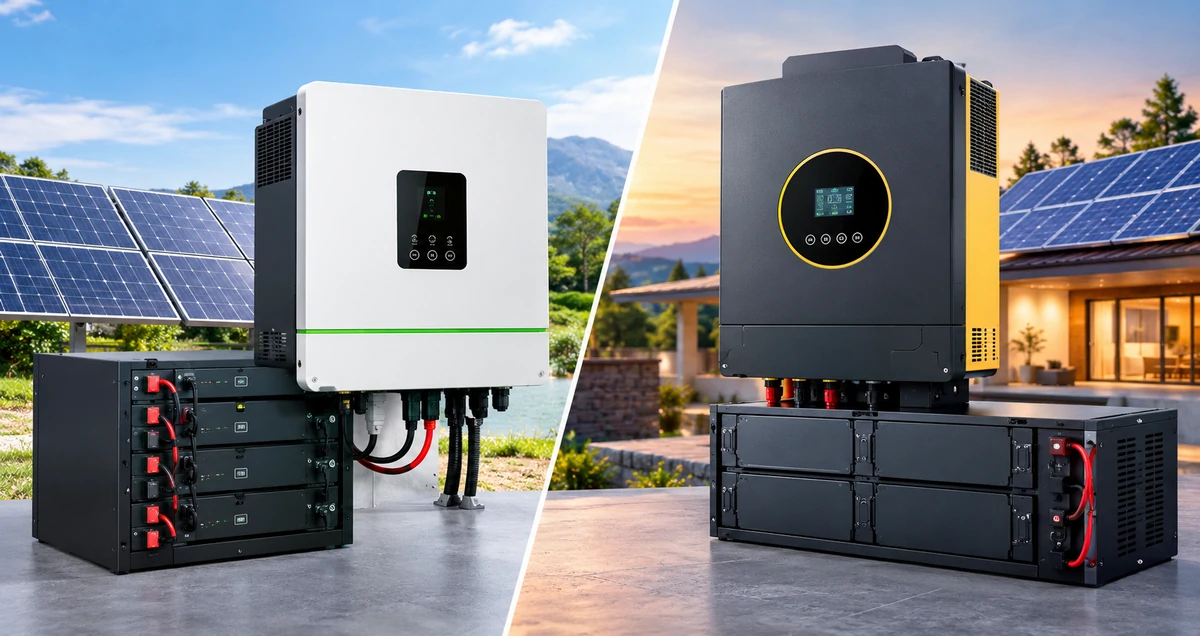
For this comparison, we will focus primarily on the Growatt SPF 5000 ES and EG4 6000XP, two 48V-class off-grid inverter options, rather than treating every Growatt or EG4 product as identical.
The Growatt SPF 3000–5000 ES family is a transformerless, single-phase 230V system with 450V maximum PV input and support for up to six units in parallel.
The EG4 6000XP is a 48V off-grid inverter/charger with split-phase 120/240V output, 6kW continuous output, up to 8kW of PV input, two MPPTs, and support for up to 16 units in parallel.
So how do they compare for a 48V solar system?
Let’s break down the important differences.
Growatt vs EG4 at a Glance
| Feature | Growatt SPF 5000 ES | EG4 6000XP |
|---|---|---|
| System battery voltage | 48V class | 48V |
| Continuous AC output | Up to 5,000W/VA class | 6,000W |
| PV input | Up to 4,500W according to Growatt’s current product page family specification | Up to 8,000W |
| Maximum PV voltage | 450V | 480V |
| AC output | 230V single phase | 120/240V split phase |
| MPPT architecture | Model-dependent; verify exact datasheet | 2 MPPTs |
| Parallel capability | Up to 6 units | Up to 16 units |
| Battery compatibility | Lithium, lead-acid and GEL | 48V batteries, including EG4 batteries and supported third-party batteries |
| Generator input | Supported configurations | Dedicated GEN port |
| Monitoring | Wi-Fi/GPRS options | EG4 monitoring software/app |
| Main application | 48V off-grid systems | Larger 48V off-grid systems |
Important: Specifications can vary by region, firmware, revision, and exact model. Always verify the datasheet for the unit you are buying.
What Is a 48V Hybrid Inverter?
A 48V hybrid inverter is essentially the control center of a solar-plus-battery system.
It can manage electricity from sources such as:
- Solar panels
- Battery storage
- Utility power
- Generator power
while supplying AC electricity to household loads.
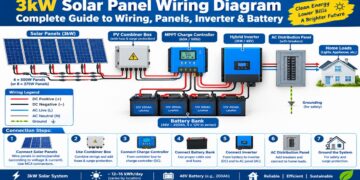
A simplified system looks like this:
Solar Panels → MPPT → 48V Battery → Inverter → AC Loads
Depending on the inverter, AC input from the grid or generator can also be available for battery charging or supplemental power.
This type of all-in-one design can reduce the number of separate components required compared with a system built from an inverter, external MPPT controller, charger, and transfer equipment.
Growatt SPF 5000 ES: Overview
The Growatt SPF 3000–5000 ES family is designed for single-phase off-grid applications.
Growatt lists features including:
- Transformerless design
- 230VAC output
- Up to 450VDC PV input
- Up to six units in parallel
- Lithium, lead-acid, and GEL battery compatibility
- Wi-Fi/GPRS monitoring options
- Programmable operating modes
- Solar, battery, utility, and generator-related system configurations depending on setup.
Growatt also describes applications involving remote homes, farms, and off-grid solar-storage systems.
The SPF 5000 ES therefore fits the traditional all-in-one off-grid inverter concept.
EG4 6000XP: Overview
The EG4 6000XP takes a somewhat different approach.
It is a 48VDC off-grid inverter/charger designed around a 120/240V split-phase AC output.
According to EG4’s published specifications, it provides:
- 6,000W continuous output
- Up to 8,000W PV input
- Maximum PV voltage of 480V
- Two MPPTs
- 120/240V split-phase output
- Generator input
- Parallel operation up to 16 units
- Remote monitoring
- Closed-loop battery communication with supported batteries.
That makes the 6000XP particularly relevant to larger residential off-grid systems where split-phase power is required.
1. Output Power
One of the biggest differences is inverter output.
The Growatt SPF 5000 ES is in the 5kW class, while the EG4 6000XP is rated for 6kW continuous output.
That extra 1kW can matter when several appliances operate simultaneously.
For example, an off-grid home might have:
- Refrigerator
- Freezer
- Lights
- Internet equipment
- Washing machine
- Well pump
- Microwave
- Computers
- Fans
If the combined load approaches the inverter’s continuous limit, having additional output capacity provides more operating headroom.
However, more inverter power does not automatically mean the system will have more energy.
That depends on the battery and solar array.
2. Battery Capacity Is Separate From Inverter Power
This distinction is extremely important.
A 6kW inverter does not mean you have a 6kWh battery.
The inverter determines how much power can be delivered at a moment in time.
The battery determines how much energy can be stored.
For example:
6,000W × 1 hour = 6,000Wh
A 48V battery bank with approximately 10kWh of usable energy could theoretically support a 6kW load for around:
10kWh ÷ 6kW = 1.67 hours
before considering inverter losses, battery limits, and other factors.
Therefore, when comparing Growatt vs EG4, you should evaluate:
Inverter power + battery capacity + solar production
rather than looking only at the inverter’s wattage.
3. Solar Input
Solar input is another major difference.
Growatt’s current SPF 3000–5000 ES product page lists a 450VDC PV input and describes a DC/AC ratio up to 1.2 for the family.
The EG4 6000XP supports up to 8kW of PV input and a maximum PV voltage of 480VDC.
This gives the EG4 considerable room for a larger solar array.
For example, an 8kW PV array can potentially produce substantially more daytime energy than a smaller 4–5kW array, assuming adequate sunlight and appropriate system design.
But PV wattage is not the only specification.
You also need to check:
- Voc
- Vmp
- Isc
- Imp
- Maximum PV voltage
- Maximum PV current
- MPPT operating range
- Panel temperature effects
4. Why MPPT Configuration Matters
MPPT stands for Maximum Power Point Tracking.
An MPPT controller attempts to operate the solar array at a voltage/current combination that extracts useful power under changing conditions.
Multiple MPPTs can be particularly useful when you have solar arrays with different orientations.
For example:
Roof A: South-facing panels
Roof B: East-facing panels
Using separate MPPT inputs can allow the inverter to track those arrays independently.
The EG4 6000XP has two MPPTs.
When evaluating a Growatt model, verify the exact MPPT configuration rather than assuming every Growatt inverter has the same design.
This is one reason comparing model numbers is more useful than simply comparing brands.
5. 120/240V Split Phase vs 230V Single Phase
This may be one of the most important differences for your installation.
The Growatt SPF 3000–5000 ES is specified as a 230VAC single-phase system.
The EG4 6000XP is designed for 120/240V split-phase output.
Why does this matter?
Many North American homes use a split-phase electrical system.
Some loads require:
120V
while others require:
240V
Examples of potentially higher-voltage residential loads include certain:
- Well pumps
- Air conditioners
- Water heaters
- Workshop equipment
- Electric ranges
- EV chargers
A 230V single-phase inverter is not automatically interchangeable with a 120/240V split-phase residential system.
If you are building a system in the United States or another market with split-phase residential wiring, verify the inverter’s output architecture before purchasing.
6. Parallel Expansion
Both product families provide expansion possibilities, but their published limits differ.
Growatt states that the SPF 3000–5000 ES supports up to six units in parallel.
EG4 states that the 6000XP can support up to 16 units in parallel, potentially reaching 96kW of continuous output when configured appropriately.
This is a major scalability difference on paper.
However, installing multiple inverters is not as simple as connecting them together.
Parallel systems require:
- Correct communication wiring
- Matching configuration
- Proper AC distribution
- Appropriate battery capacity
- Correct protection
- Correct grounding
- Manufacturer-approved configuration
- Compliance with local electrical requirements
7. Battery Compatibility
A 48V inverter needs a battery bank with an appropriate voltage range.
Growatt lists compatibility with:
- Lithium batteries
- Lead-acid batteries
- GEL batteries.
EG4 focuses heavily on 48V lithium battery integration and states that the 6000XP can communicate with EG4 48V batteries and supported batteries from other manufacturers. EG4 also notes that firmware updates may be required for certain closed-loop configurations.
What Is Closed-Loop Communication?
In a closed-loop battery system, the battery BMS can communicate information to the inverter.
This can include:
- State of charge
- Voltage
- Current
- Temperature
- Charge limits
- Discharge limits
- Protection status
This can be useful for lithium battery systems because the inverter can respond to information supplied by the battery management system.
However, compatibility should always be confirmed for the exact battery and inverter firmware.
8. Growatt + EG4 Batteries: Can They Work Together?
This question comes up frequently because EG4 sells popular 48V battery systems.
The answer is model- and communication-dependent.
A battery being labeled “48V” does not automatically mean that every 48V inverter will have full closed-loop communication with it.
For example, third-party compatibility documentation shows that specific Growatt SPF 5000 ES and EG4 LifePower4 combinations can have compatible voltage and current ranges, while communication and surge behavior still need to be verified for the exact configuration.
Before combining equipment, check:
- Battery voltage range
- Maximum charge current
- Maximum discharge current
- BMS limits
- CAN/RS485 protocol
- Communication cable
- Inverter firmware
- Battery firmware
- Manufacturer compatibility documentation
Never assume that two products are fully compatible simply because both are advertised as 48V.
9. Generator Integration
Off-grid homes often need a generator for extended periods of cloudy weather or unusually high energy demand.
The EG4 6000XP includes a dedicated generator port and EG4 says it can support generator input up to 7kW under the specified configuration.
Growatt’s off-grid solutions also support multiple power sources and generator-related configurations.
A generator can be useful when:
- Several cloudy days occur
- Battery state of charge becomes low
- Winter solar production is insufficient
- Emergency loads exceed available solar generation
The generator should be appropriately sized and installed according to local electrical requirements.
10. Monitoring and Connectivity
Modern hybrid/off-grid systems increasingly provide remote monitoring.
Growatt’s SPF ES family supports Wi-Fi/GPRS monitoring options and Growatt’s monitoring ecosystem.
EG4 provides monitoring software and wireless connectivity options for the 6000XP.
Remote monitoring can allow you to check:
- Battery state of charge
- Solar production
- Load power
- Grid/generator status
- Faults
- System settings
This is particularly useful for remote cabins and off-grid properties where you cannot physically inspect the inverter every day.
11. Efficiency
Inverter efficiency should be considered, but don’t look at one headline percentage in isolation.
Actual system efficiency depends on:
- Battery voltage
- Load level
- PV voltage
- Temperature
- Conversion stage
- Standby consumption
- Battery charging losses
- Battery discharge losses
- Wiring losses
Growatt’s off-grid solution page lists maximum efficiency of up to 95% for the referenced system family.
The EG4 6000XP specification sheet lists an MPPT efficiency of 99% and provides additional efficiency specifications in its technical documentation.
These figures describe different parts or operating conditions of the system, so they should not be treated as directly interchangeable.
12. Which Inverter Is Better for a 48V Off-Grid Cabin?
For a smaller off-grid cabin, the correct choice depends on the electrical architecture.
A typical cabin might need:
- Refrigerator
- Lights
- Small pump
- Laptop
- Internet router
- TV
- Small kitchen appliances
If the system uses a 230V single-phase architecture, the Growatt SPF 5000 ES can be considered within its published specifications.
If the cabin requires 120/240V split-phase power and more solar input, the EG4 6000XP’s architecture may be more relevant.
The important point is to start with the electrical requirements rather than selecting a brand first.
13. Which Is Better for a Full Off-Grid Home?
A full off-grid home typically requires more than just an inverter.
You need to size:
Solar array + battery bank + inverter + backup generator + electrical protection
For example, consider a home using:
20kWh per day
A 5kW inverter does not necessarily mean the home can comfortably operate all day.
You might need:
- Larger battery storage
- More PV capacity
- Multiple inverters
- Generator backup
The EG4 6000XP’s 8kW PV input and parallel capability provide a path toward larger systems.
Growatt’s SPF family also supports parallel expansion, with up to six units for the SPF 3000–5000 ES family.
14. How Large Should the 48V Battery Be?
Battery sizing should begin with your energy consumption.
Use:
Battery capacity = Daily energy requirement × Backup days ÷ Maximum usable depth of discharge
For example, suppose your essential loads consume:
8kWh per day
and you want approximately one day of backup.
If your battery system is designed around an assumed 80% usable fraction:
8kWh ÷ 0.80 = 10kWh nominal battery capacity
This is a simplified example.
Real systems should account for:
- Inverter efficiency
- Battery temperature
- BMS limits
- Battery manufacturer’s recommended operating window
- Aging
- Surge loads
- Future energy consumption
15. Why 48V Is Popular for Larger Solar Systems
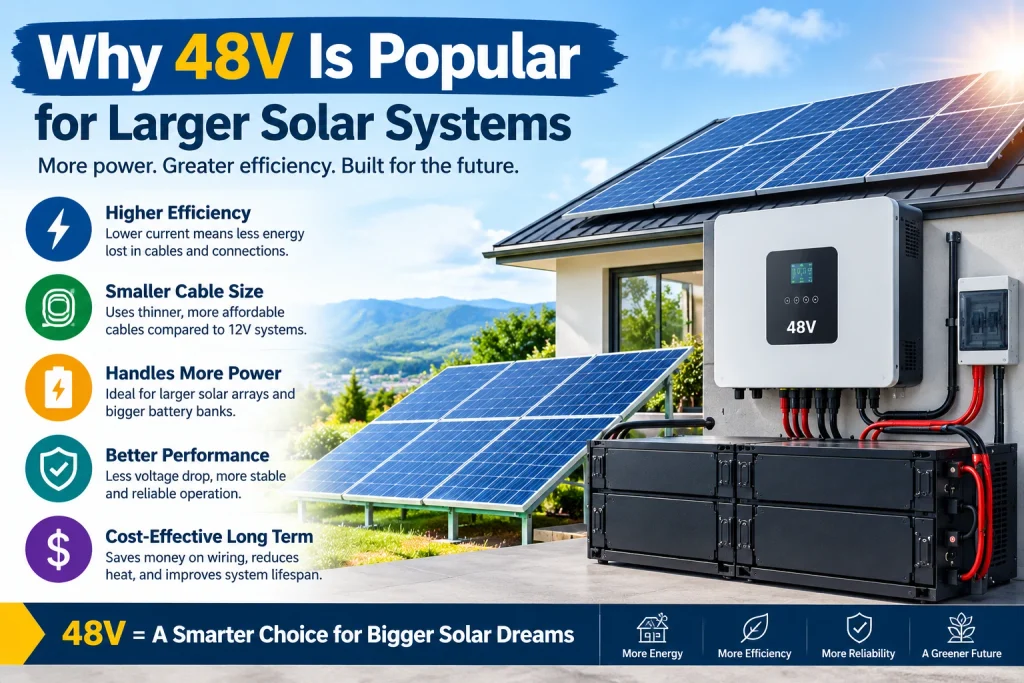
Higher battery voltage can reduce current for the same power.
The basic relationship is:
Power = Voltage × Current
Therefore:
Current = Power ÷ Voltage
Suppose an inverter supplies approximately 5,000W from a 48V battery:
5,000W ÷ 48V ≈ 104A
At 24V:
5,000W ÷ 24V ≈ 208A
At 12V:
5,000W ÷ 12V ≈ 417A
These are simplified calculations and do not include conversion losses.
This is one reason 48V battery systems are common for larger off-grid installations.
16. Solar Panel Sizing Example
Suppose you want an 8kW solar array.
You could potentially use:
20 × 400W panels = 8,000W
or:
16 × 500W panels = 8,000W
But panel count alone does not determine whether the array is compatible.
You must calculate:
String Voc
String Vmp
String Isc
String Imp
Then compare those values against the inverter’s MPPT specifications.
For the EG4 6000XP, the manufacturer specifies up to 480VDC maximum PV input.
For the Growatt SPF 3000–5000 ES family, Growatt specifies 450VDC PV input.
Cold-weather Voc must also be considered because PV voltage can rise as panel temperature falls.
17. Common Mistakes When Building a 48V System
Mistake 1: Choosing the inverter based only on wattage
A 6kW inverter isn’t automatically suitable for every 6kW load.
Check:
- Voltage
- Surge
- Phase configuration
- Battery current
- PV input
- AC input
- Generator support
Mistake 2: Ignoring battery current
At 48V, a high-power inverter can require significant battery current.
For example:
6,000W ÷ 48V = 125A
Actual current can be higher because of conversion losses and changing battery voltage.
Your battery BMS, cables, busbars, disconnects, and fuses must all be appropriately sized.
Mistake 3: Using too many solar panels in series
More panels in series increase voltage.
Exceeding the inverter’s maximum PV voltage can damage equipment or trigger protective shutdowns.
Always calculate the cold-weather maximum Voc.
Mistake 4: Assuming 48V means universal compatibility
Two devices can both be called “48V” while having different:
- Operating voltage ranges
- Charge limits
- Discharge limits
- Communication protocols
- BMS requirements
Mistake 5: Ignoring 120/240V requirements
A 230V single-phase inverter is not automatically equivalent to a 120/240V split-phase inverter.
Check the electrical system before purchasing.
18. Growatt vs EG4: Advantages and Limitations
Growatt SPF 5000 ES
Potential advantages
- 5kW-class output
- 450V PV input
- 48V battery architecture
- Parallel capability
- Multiple battery chemistry options
- Remote monitoring options
- Established off-grid product family
Growatt specifically lists lithium, lead-acid and GEL battery compatibility for the SPF 3000–5000 ES family.
Considerations
- 230V single-phase architecture
- Exact MPPT configuration must be checked
- Regional model differences matter
- Larger residential split-phase installations may require a different Growatt model
19. EG4 6000XP
Potential advantages
- 6kW continuous output
- 8kW PV input
- 480V maximum PV input
- Two MPPTs
- 120/240V split-phase
- Generator port
- Parallel capability up to 16 units
- Closed-loop battery communication with supported batteries
- Remote monitoring
These specifications come directly from EG4’s published product documentation.
Considerations
- More powerful system may require larger battery capacity
- Installation is not plug-and-play
- Battery communication should be verified
- Firmware can matter for certain battery integrations
- Electrical installation must follow applicable codes
20. Which One Should You Buy?
Instead of choosing based on the brand name, match the inverter to your system.
A Growatt SPF 5000 ES may fit a system where:
- 230V single-phase output is appropriate
- Around 5kW inverter capacity is sufficient
- You want a 48V battery system
- You need parallel expansion
- You want compatibility with several battery chemistries
- Your PV array fits the inverter’s voltage and power limits
An EG4 6000XP may fit a system where:
- 120/240V split-phase is required
- Around 6kW continuous output is useful
- A larger PV array is planned
- Two MPPTs are useful
- Generator integration is important
- Larger parallel expansion is desired
Neither specification set automatically makes one product suitable for every installation.
The electrical requirements of the property should determine the model.
21. Frequently Asked Questions
Is Growatt compatible with 48V batteries?
Yes. The SPF 3000–5000 ES family is designed around a battery system and Growatt lists lithium, lead-acid, and GEL battery compatibility. Always verify the exact battery voltage range and communication requirements.
Is the EG4 6000XP a 48V inverter?
Yes. EG4 specifies the 6000XP as a 48VDC off-grid inverter/charger.
How much solar can the EG4 6000XP handle?
EG4 specifies up to 8kW of PV input and a maximum PV voltage of 480VDC.
How much solar can the Growatt SPF 5000 ES handle?
The exact specification depends on the model/version. Growatt’s current SPF 3000–5000 ES page identifies the family with a 450VDC PV input and a DC/AC ratio up to 1.2. Check the exact datasheet for your unit before designing the array.
Can EG4 6000XP run a 48V LiFePO4 battery?
The 6000XP is designed for 48V battery systems and supports closed-loop communication with EG4 batteries and supported third-party batteries. Verify the exact battery compatibility and firmware requirements before installation.
Can you connect Growatt and EG4 batteries?
Potentially, but compatibility is model-specific. Voltage compatibility alone does not guarantee communication compatibility. Check BMS, CAN/RS485 protocol, current limits, firmware, and manufacturer documentation.
Can the EG4 6000XP run 240V appliances?
Yes. EG4 specifies 120/240V split-phase output for the 6000XP.
Can the Growatt SPF 5000 ES provide 120/240V split-phase?
The SPF 3000–5000 ES discussed in this article is specified as 230VAC single phase. Growatt offers other inverter families with different output architectures, so check the exact model rather than assuming all Growatt inverters have the same output.
Can these inverters work completely off-grid?
Yes. Both product families are designed for off-grid applications, although exact operating modes and required equipment vary by model. Growatt explicitly describes the SPF ES series as an off-grid inverter family, while EG4 describes the 6000XP as an off-grid inverter.
Final Thoughts
The Growatt SPF 5000 ES and EG4 6000XP are both 48V-class off-grid inverter options, but they are designed around different electrical architectures and capabilities.
The Growatt SPF 5000 ES is a 230V single-phase 5kW-class platform with 450V PV input and parallel capability.
The EG4 6000XP provides 6kW output, up to 8kW of PV input, two MPPTs, 480V maximum PV input, 120/240V split-phase output, and extensive parallel capability.
For a successful off-grid installation, don’t select an inverter based only on its advertised wattage.
Calculate your:
Daily energy use → Peak load → Surge load → Battery capacity → Battery current → Solar array → PV voltage → Electrical phase requirements
That process will give you a much more reliable system than choosing an inverter based simply on brand popularity.
Safety: A 48V battery bank and high-voltage PV array can deliver dangerous energy. Proper fusing, disconnects, grounding, conductor sizing, overcurrent protection, and installation practices are essential. Follow the manufacturer’s manual and applicable local electrical codes. Have fixed residential wiring installed or inspected by a qualified professional where required.