
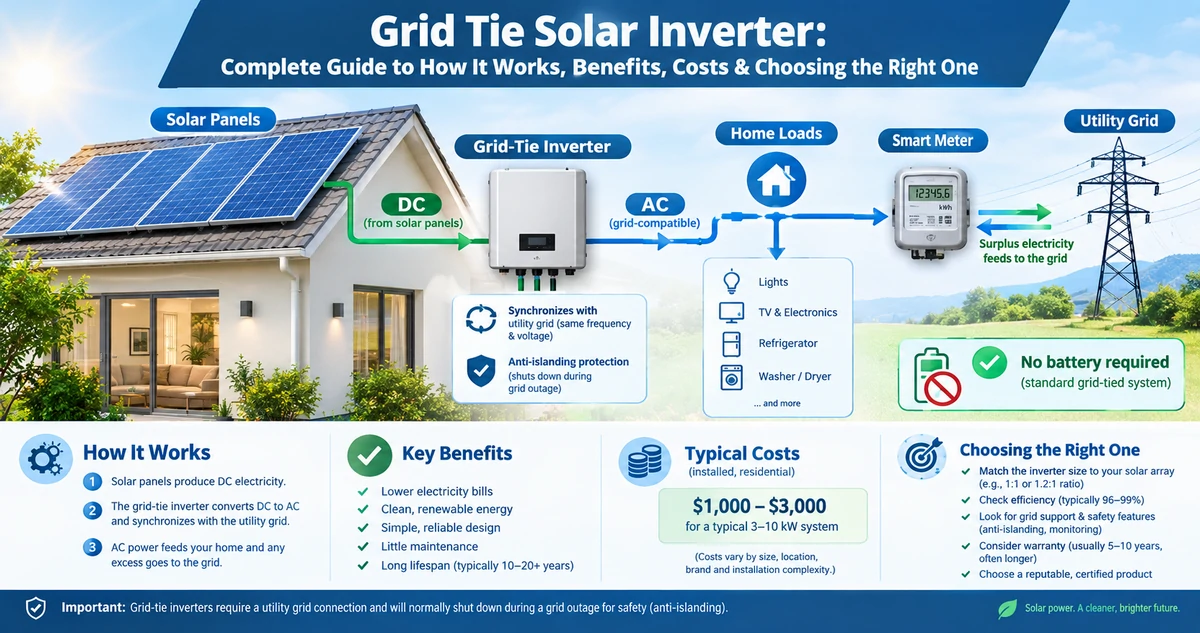
If you’re planning a home solar system connected to the electrical grid, one of the most important components you’ll need is a grid tie solar inverter.
Solar panels generate electricity as direct current (DC), but most homes and the utility grid use alternating current (AC). The inverter converts the electricity into a form that can be used by household appliances and, where permitted, exported to the utility grid.
But choosing a grid tie inverter isn’t simply about buying the highest-wattage model.
The right inverter depends on your solar panel capacity, electrical service, local grid requirements, system design, shading conditions, monitoring needs, and whether you want battery backup in the future.
This guide explains what a grid tie solar inverter is, how it works, the different types, advantages and limitations, sizing basics, safety considerations, and what to look for before buying one.
What Is a Grid Tie Solar Inverter?
A grid tie solar inverter, also called a grid-connected solar inverter or on-grid inverter, is an inverter designed to connect a solar photovoltaic (PV) system to the utility electricity grid.
Its primary job is to convert DC electricity produced by solar panels into AC electricity that can be used by compatible household electrical equipment and, under approved interconnection arrangements, supplied to the grid.
A simplified solar system looks like this:
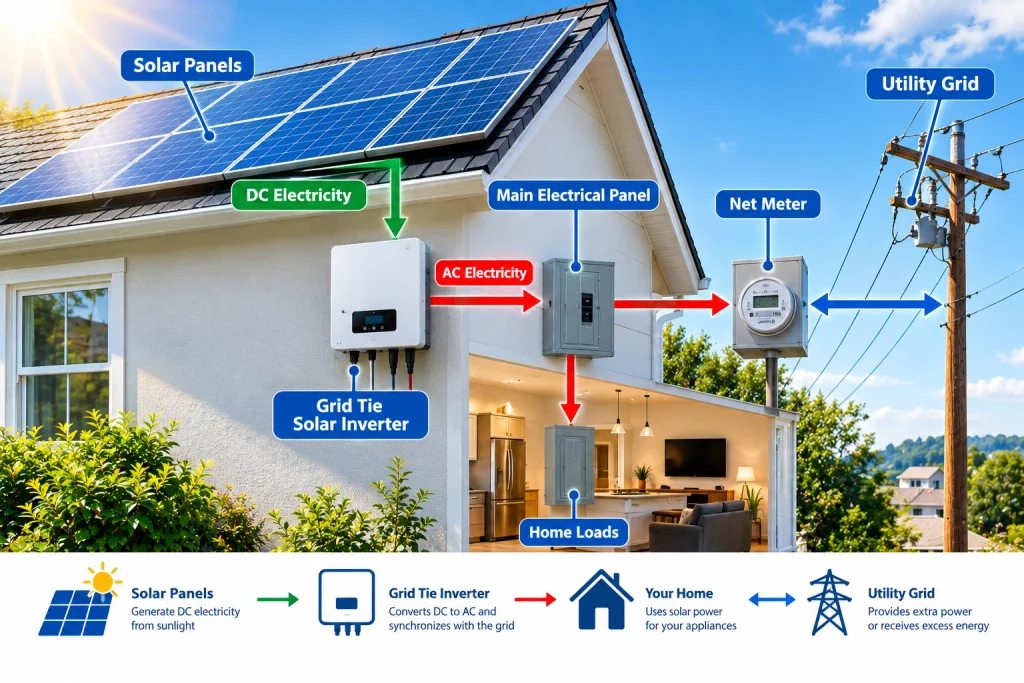
Solar panels → DC electricity → Grid tie inverter → AC electricity → Home / Utility grid
Unlike an off-grid system, a conventional grid-tied solar system normally does not need a large battery bank simply to operate during normal grid-connected conditions.
However, there’s an important limitation:
A standard grid-tied solar system usually does not provide backup power when the grid goes down.
That’s because grid-connected inverters are designed with safety functions that prevent unintended islanding. This helps protect utility workers and the electrical system.
NREL research describes anti-islanding testing associated with standards such as IEEE 1547.1 and UL 1741 in North America.
How Does a Grid Tie Solar Inverter Work?
The process is easier to understand in four steps.
Step 1: Solar panels generate DC electricity
Sunlight reaches the photovoltaic cells in your solar panels.
The panels generate direct-current electricity.
The amount produced changes throughout the day depending on sunlight, temperature, shading, panel orientation, weather, and other conditions.
Step 2: The inverter converts DC to AC
The grid tie solar inverter converts the electricity from DC into AC.
This makes the electricity compatible with the home’s AC electrical system.
Step 3: Your home uses solar electricity
When solar production is sufficient, your home can use electricity generated by the solar array.
The actual energy flow depends on the system design and the home’s electrical demand at that moment.
Step 4: Excess electricity may go to the grid
If the solar system produces more electricity than the home is consuming, the excess may be exported to the utility grid if the system is approved for that arrangement.
The financial treatment of exported electricity varies by utility and location.
That’s why you should never assume that excess solar electricity automatically results in a specific payment or credit.
Grid Tie vs Off-Grid Solar Inverter
These two types of systems are often confused.
| Feature | Grid-Tie Inverter | Off-Grid Inverter |
|---|---|---|
| Utility grid connection | Yes | Usually no |
| Solar panels | Yes | Yes |
| Battery required | Not necessarily | Usually |
| Export electricity | Often possible with approved interconnection | Usually not |
| Backup during grid outage | Usually no | Yes, when properly designed |
| Main purpose | Reduce grid electricity use / export excess | Operate independently from the grid |
A grid-tied system is generally designed around the utility grid.
An off-grid system must independently manage generation, energy storage, loads, and system stability.
What Happens to a Grid-Tied Solar System During a Power Outage?
This is one of the most important questions to understand before buying a grid tie solar inverter.
In most conventional systems, the solar inverter shuts down when the utility grid goes down.
That can seem surprising.
After all, the solar panels may still be receiving sunlight.
But a standard grid-connected inverter cannot simply continue sending electricity onto a utility circuit that has lost grid power.
The shutdown is part of the system’s protection against unintended islanding.
Want solar power during an outage?
You’ll generally need equipment specifically designed for backup operation, such as:
- Battery storage
- Backup-capable inverter
- Automatic transfer equipment where applicable
- Critical-load panel or appropriate load-management equipment
- Properly configured protection and controls
The exact architecture depends on the equipment and local electrical requirements.
Main Types of Grid Tie Solar Inverters
There isn’t just one type of grid-tied inverter.
The main configurations include string inverters, microinverters, and hybrid or battery-capable inverters.
1. String Inverter
A string inverter connects multiple solar panels together in one or more strings.
The DC electricity from the strings is sent to a central inverter, which converts it into AC.
Advantages
- Relatively simple system architecture
- Fewer inverter units
- Often convenient for straightforward roofs
- Can be cost-effective depending on system size and design
- Easier centralized maintenance in some installations
Potential limitations
If panels in the same string experience different conditions, such as shading or different orientations, system design becomes more important.
A qualified installer should evaluate string configuration rather than simply connecting panels together.
Best for
String inverters can be particularly suitable for roofs with:
- Similar panel orientations
- Limited shading
- Simple layouts
- Larger groups of panels with similar conditions
2. Microinverters
With microinverters, individual solar panels—or small groups of panels depending on the design—have their own inverter electronics.
Instead of one central inverter handling the entire array, power conversion is distributed across the system.
Advantages
- Panel-level monitoring may be available
- Useful for roofs with multiple orientations
- Can help manage certain shading situations
- System architecture can be flexible
Potential limitations
- More electronic equipment is installed on the roof
- Replacement can require rooftop access
- Total equipment cost can be higher depending on the system
Best for
Microinverters can be attractive for homes with:
- Multiple roof orientations
- Partial shading
- Complex roof designs
- Panel-level monitoring requirements
3. Hybrid or Battery-Capable Inverter
A hybrid inverter can combine grid-connected solar operation with battery storage capabilities, depending on the model and system design.
This can be useful if you’re considering adding batteries now or later.
A hybrid system may support functions such as:
- Solar energy conversion
- Battery charging
- Battery discharge
- Grid interaction
- Backup operation
However, not every hybrid inverter automatically provides whole-home backup.
The battery capacity, inverter power, transfer equipment, wiring, and configuration all matter.
Grid Tie Solar Inverter vs Hybrid Inverter
If you’re deciding between a conventional grid-tied inverter and a hybrid model, consider your long-term plans.
Choose a conventional grid-tie inverter if:
- You mainly want to use solar with the grid
- Backup power isn’t currently a priority
- You don’t expect to add batteries
- Your system design is relatively straightforward
Consider a hybrid inverter if:
- You want battery storage
- Backup power is important
- You want more flexibility for future expansion
- Your system is being designed around energy storage
A hybrid inverter may cost more or require more complex system design, so don’t pay for features you won’t use.
How Do You Size a Grid Tie Solar Inverter?
Inverter sizing is one of the most important parts of solar system design.
You shouldn’t simply choose an inverter based on the number printed on your solar panels.
For example, imagine a solar array rated at:
8 kW DC
The inverter might have a lower AC rating depending on the system design.
This relationship is commonly described using a DC-to-AC ratio.
Simple example
Suppose:
- Solar array = 8 kW DC
- Inverter = 6.5 kW AC
The DC-to-AC ratio would be:
8 ÷ 6.5 = 1.23
That’s an example for understanding the concept—not a universal recommendation.
Actual sizing should consider the inverter’s specifications, local conditions, solar production profile, voltage limits, clipping, utility requirements, and the complete system design.
What Is Solar Inverter Clipping?
Clipping happens when the solar array can temporarily produce more DC power than the inverter can convert into AC power.
For example, if an inverter has a 6 kW AC output limit, it cannot continuously deliver 7 kW AC simply because the panels could theoretically produce that much DC power.
The inverter limits the output.
This isn’t automatically a design mistake.
A properly designed system can intentionally have more DC panel capacity than inverter AC capacity because solar panels rarely operate at their laboratory-rated maximum for long periods.
However, the appropriate ratio depends on the specific system.
What Should You Look for in a Grid Tie Solar Inverter?
Don’t choose an inverter based solely on price.
Compare the following specifications.
1. Continuous AC Power
Look at the inverter’s rated AC output.
It should be appropriate for the intended solar system and electrical installation.
2. Maximum DC Input
Check how much PV power the inverter is designed to accept.
3. MPPT Voltage Range
The maximum power point tracking range affects how the inverter operates with the solar array.
4. Maximum Input Current
This is especially important when using modern high-current solar modules.
5. Number of MPPT Inputs
Multiple MPPT inputs can be useful when panels are installed across different roof orientations or have different operating conditions.
6. Efficiency
Higher conversion efficiency can reduce energy losses during the conversion process.
But don’t compare efficiency numbers without considering how the manufacturer defines and reports them.
7. Monitoring
Modern inverters may provide:
- Solar production monitoring
- System alerts
- Historical production
- Mobile applications
- Remote diagnostics
Monitoring can make it much easier to identify unusual system behavior.
8. Warranty
Compare:
- Standard warranty period
- Optional extensions
- Warranty conditions
- Service availability
- Replacement process
Does a Grid Tie Inverter Need Batteries?
No—not necessarily.
A conventional grid-tied solar system can operate without batteries.
During daylight hours, solar energy can serve household loads, while electricity can also be drawn from the grid when solar production is insufficient.
If the system is approved to export electricity, excess production may be sent to the grid.
Why add batteries?
A battery can provide additional flexibility.
It may allow you to:
- Store solar energy for later use
- Increase solar self-consumption
- Shift some energy use away from solar-production hours
- Provide backup power when designed for that purpose
Battery economics depend heavily on electricity prices, utility rules, battery costs, system design, and how the battery is operated.
How Much Does a Grid Tie Solar Inverter Cost?
There is no single price that applies to every system.
The cost can vary based on:
- Inverter capacity
- Brand
- String vs microinverter architecture
- Monitoring
- Warranty
- Installation
- Electrical upgrades
- Permitting
- Local labor
- System complexity
A small residential inverter and a large commercial inverter can have very different prices.
More importantly, don’t compare the inverter alone when planning a solar installation.
The relevant number is the total installed system cost.
Can You Install a Grid Tie Solar Inverter Yourself?
This is where you need to be careful.
Solar electrical systems can involve DC voltage, AC electricity, utility interconnection requirements, grounding, disconnects, overcurrent protection, and other electrical hazards.
A grid-connected system also has to comply with applicable electrical and utility requirements.
DIY research is fine.
You can learn about:
- Solar system architecture
- Inverter specifications
- Panel sizing
- Monitoring
- Energy production
- Battery concepts
But connecting a solar inverter to a home’s electrical system or utility grid should not be treated as a simple DIY plug-in project.
Requirements vary by jurisdiction, and grid interconnection normally involves approval and technical requirements.
For permanent electrical installation, use appropriately qualified professionals and follow local codes and utility requirements.
Grid Tie Solar Inverter Safety
Safety is more important than saving a few dollars on installation.
Important considerations include:
Anti-islanding protection
The inverter needs appropriate protection so that it does not unintentionally energize a grid circuit during an outage.
Overcurrent protection
The system must be designed with appropriate protection for the equipment and wiring.
Grounding and bonding
These are important parts of safe electrical system design.
Disconnects
Appropriate disconnecting means may be required depending on the equipment and jurisdiction.
Utility interconnection
A grid-connected solar system normally needs to meet applicable utility and electrical requirements.
The exact standards depend on the country and installation.
Can a Grid Tie Inverter Work Without the Grid?
A conventional grid-tied inverter generally isn’t designed to operate as an independent off-grid inverter.
This distinction is extremely important.
If you want solar power during grid outages, look for a system specifically designed for backup or islanded operation.
That can include:
Solar panels + battery + backup-capable inverter + appropriate controls
rather than a basic grid-tied inverter alone.
What Is Net Metering?
Net metering is a billing arrangement used in some jurisdictions where electricity exported from an approved solar system can affect a customer’s electricity bill.
However, policies vary significantly.
Some utilities may use:
- Net metering
- Net billing
- Time-of-use rates
- Export credits
- Different compensation rates
Therefore, never assume that installing a grid-tied inverter automatically means you will receive a one-for-one credit for every kilowatt-hour exported.
Check your utility’s current rules before purchasing the system.
Grid Tie Solar Inverter Efficiency: Does It Matter?
Yes, but don’t focus on one number alone.
Suppose an inverter receives 5,000 watts of DC power.
If its conversion efficiency were 98%, approximately 4,900 watts would be available on the AC side under the simplified conditions of that example.
Actual system performance is more complicated because efficiency varies with operating conditions.
Look at the manufacturer’s published efficiency specifications and consider how the inverter performs across the expected load range.
Common Grid Tie Solar Inverter Problems
Solar inverters can experience issues for many reasons.
Common examples include:
- Grid voltage problems
- Grid frequency problems
- Over-temperature conditions
- Communication failures
- DC input issues
- Arc-fault detection events where applicable
- Ground faults
- Installation errors
- Component failures
An error message does not automatically mean the inverter itself has failed.
A qualified technician should diagnose the system based on the inverter’s error code, electrical measurements, installation conditions, and manufacturer procedures.
7 Mistakes to Avoid When Buying a Grid Tie Solar Inverter
1. Choosing the cheapest inverter
Price should not be the only factor.
2. Ignoring the solar panel specifications
The inverter must be compatible with the array.
3. Forgetting future expansion
If you may add panels or batteries later, discuss that during system design.
4. Ignoring shading
Your roof conditions can influence whether a string inverter or microinverter architecture makes more sense.
5. Assuming every inverter provides backup
A conventional grid-tied inverter usually does not provide backup power during a grid outage.
6. Ignoring utility requirements
A solar inverter must be suitable for the electrical and interconnection requirements applicable to your location.
7. Installing without professional evaluation
Grid-connected electrical systems should be designed and installed according to applicable safety and code requirements.
Grid Tie Solar Inverter: Pros and Cons
Advantages
- Works with utility-connected solar systems
- Can reduce electricity purchased from the grid
- Doesn’t necessarily require batteries
- Can be highly efficient
- Can support solar self-consumption
- Excess generation may be exported where approved
- Monitoring can make system performance easier to track
Disadvantages
- Conventional systems generally shut down during grid outages
- Requires utility-compatible equipment
- Interconnection approval may be required
- Doesn’t provide backup by itself
- System performance depends on solar conditions
- Installation must meet electrical and safety requirements
Is a Grid Tie Solar Inverter Worth It?
For homeowners who have suitable solar access and remain connected to the utility grid, a grid-tied inverter can be a practical part of a residential solar system.
The financial value depends on factors such as:
- Solar installation cost
- Electricity rates
- Local solar resource
- System size
- Export compensation
- Incentives
- Financing
- Maintenance
- Expected system lifetime
There is no universal savings figure that applies to every homeowner.
Instead of asking only:
“How much will a grid tie solar inverter save me?”
ask:
“How much electricity will my complete solar system produce, how much will I use directly, how much can I export, and what will the system cost?”
That produces a much more realistic financial picture.
Final Buying Checklist
Before purchasing a grid tie solar inverter, check:
☑ Inverter AC capacity
☑ Maximum DC input
☑ MPPT voltage range
☑ Maximum input current
☑ Number of MPPT channels
☑ Efficiency specifications
☑ Monitoring features
☑ Warranty
☑ Local service availability
☑ Utility compatibility
☑ Electrical requirements
☑ Future battery compatibility if needed
☑ Installer experience
☑ Total installed cost
Frequently Asked Questions
What is a grid tie solar inverter?
A grid tie solar inverter converts electricity from solar panels into AC electricity for use by a home and, when an approved interconnection allows it, export to the utility grid.
Does a grid tie inverter work during a power outage?
A conventional grid-tied inverter normally shuts down when the utility grid is unavailable. Backup operation requires equipment specifically designed for that purpose.
Can a grid tie inverter work without batteries?
Yes. A conventional grid-connected solar system can operate without battery storage.
What is the difference between a grid tie inverter and an off-grid inverter?
A grid-tie inverter is designed to operate with the utility grid, while an off-grid inverter is designed to provide stable electricity without relying on the utility grid.
Is a hybrid inverter better than a grid-tie inverter?
Not necessarily. A hybrid inverter can be useful if you want battery storage or backup capability, but a conventional grid-tie inverter may be the simpler choice for a straightforward grid-connected solar system.
How do I choose the right grid tie inverter?
Compare the inverter’s AC rating, DC input limits, MPPT range, input current, efficiency, monitoring, warranty, compatibility, and local installation requirements.
Can I install a grid tie inverter myself?
Grid-connected solar involves electrical and utility safety requirements. Researching and planning your system yourself is possible, but permanent electrical and grid interconnection work should follow applicable codes and be handled by appropriately qualified professionals.
Does a grid tie inverter reduce my electricity bill?
It can reduce electricity purchased from the grid when your solar system generates usable electricity, but the actual savings depend on system production, electricity rates, export rules, usage patterns, and total system costs.
Final Verdict
A grid tie solar inverter is one of the most important components of a grid-connected solar system.
The best choice isn’t necessarily the inverter with the highest wattage or the lowest price.
Instead, choose equipment that matches your solar array, electrical system, roof conditions, utility requirements, monitoring needs, and long-term plans.
If you only want to reduce grid electricity purchases, a conventional grid-tied system may be appropriate.
If you also want electricity during blackouts, consider a properly designed solar-plus-battery system with backup capability instead.
The smartest approach is to compare the entire solar system, not just the inverter.
That means evaluating the panels, inverter, electrical equipment, installation, warranties, expected production, utility rules, and total cost together.