
What Size Solar System Do I Need for a 2000 Sq Ft Home?
Let’s be honest, trying to figure out the right size for a solar system can feel like trying to solve a complicated math problem. You see numbers and acronyms thrown around everywhere—kilowatts, kilowatt-hours, inverters, panels… it’s enough to make your head spin.
But what you really want to know is simple: “For my 2000 square foot house, what do I actually need to get the job done?”
I’ve been setting up these systems for years, and I can tell you this: the size of your house is a good starting point, but it’s not the most important factor. The real answer depends on how you live in that house.
Let’s break it down in simple terms, so you can figure out exactly what you need.
It’s Not About Square Feet, It’s About Your Power Bill
This is the secret. The most important number you need is not your home’s square footage; it’s the “kWh usage” on your monthly power bill.
Kilowatt-hours (kWh) is just a measure of how much electricity you use. A 2000 sq ft home with a young family that runs the AC, TV, and video games all day will use way more power than the same size home owned by a retired couple.
So, grab your last few power bills. Look for your average monthly kWh usage. For a typical 2000 sq ft American home, this is usually somewhere between 800 kWh and 1,200 kWh per month. This number is our starting point.
The Simple Math to Find Your System Size
Ready? This is all you need to do.
- Find your daily kWh usage: Take your monthly kWh (let’s use 900 kWh as an example) and divide it by 30.
900 kWh / 30 days = 30 kWh per day.
- Figure out your “peak sun hours”: This is just the average number of hours per day that you get good, strong sunlight. It’s not the same as “hours of daylight.” A place like Arizona might get 6 sun hours, while a place in the Northeast might only get 4. You can find this number easily by searching online for “peak sun hours in [your city]”. Let’s say you get 5 hours.
- Calculate your system size: Divide your daily usage by your sun hours.
30 kWh / 5 hours = 6 kW.
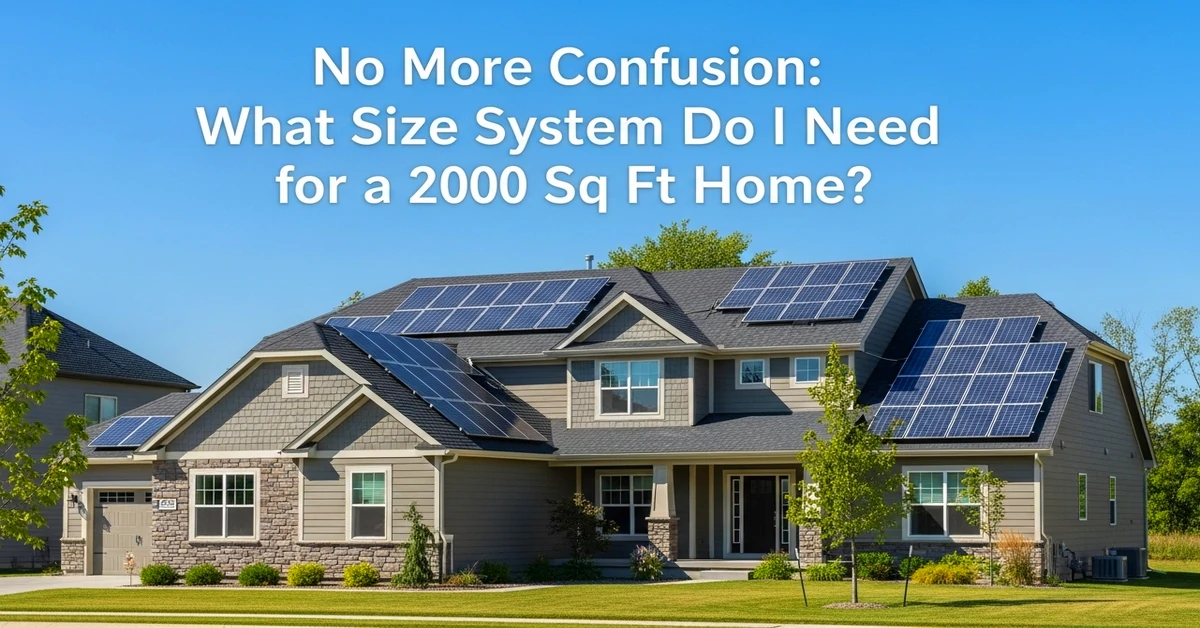
Boom. There’s your number. For a 2000 sq ft home that uses 900 kWh per month in a location with 5 peak sun hours, you’ll need a 6 kW solar system.
This is the size of your solar array—the total power of all your panels combined.
So, How Many Panels is a 6 kW System?
This is the easy part. Most solar panels today are around 400 watts (or 0.4 kW).
6 kW / 0.4 kW per panel = 15 panels.
So, you’d need about 15 solar panels on your roof. See? Not so scary when you break it down.
System Sizes and Panels by Region
The size of your solar system and the number of panels depend on where you live because peak sun hours vary by region. The chart below shows typical system sizes and panel counts for a home using around 900 kWh per month in different U.S. regions:
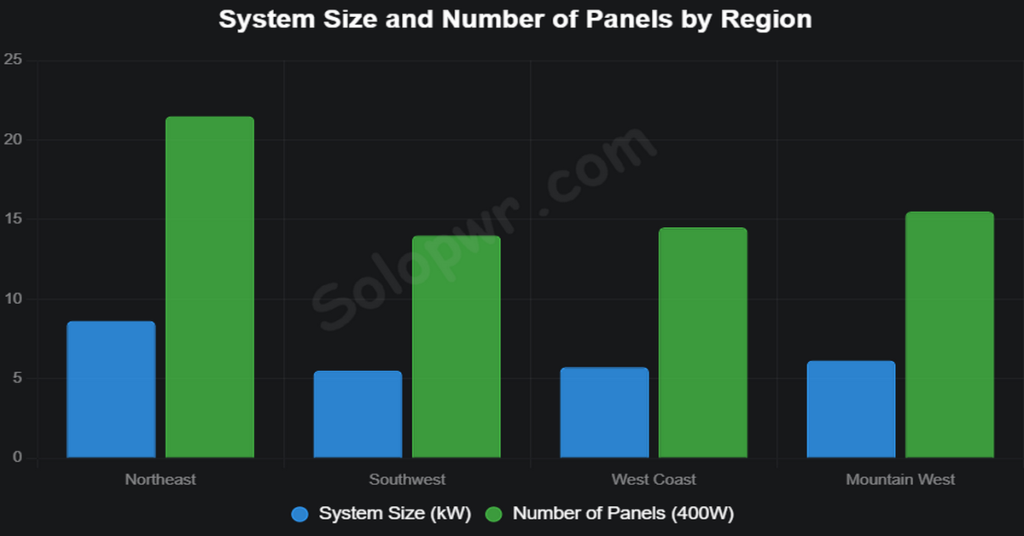
This chart shows the average system size (kW) and number of 400W panels needed for a 2000 sq ft home using 900 kWh per month, based on regional peak sun hours.
Solar System Sizes by Region (For 2,000 Sq Ft Home Using 900 kWh/Month)
| U.S. Region | Peak Sun Hours | System Size Needed | Number of 400W Panels |
|---|---|---|---|
| Northeast | 4 hours/day | 7.5-9.75 kW | 19-24 panels |
| Pacific Northwest | 4 hours/day | 7.5-9.75 kW | 19-24 panels |
| Southwest | 6 hours/day | 5-6 kW | 13-15 panels |
| Mid-Atlantic | 4.5 hours/day | 6.67-8.18 kW | 17-20 panels |
| Southeast | 5 hours/day | 6-7.5 kW | 15-19 panels |
| Mountain West | 5.5 hours/day | 5.45-6.82 kW | 14-17 panels |
| West Coast | 6 hours/day | 5-6.43 kW | 13-16 panels |
| Midwest | 4.5 hours/day | 6.92-8.18 kW | 17-20 panels |
Note: Calculations assume 900 kWh monthly usage (30 kWh/day). Actual needs may vary based on roof angle, shading, and panel efficiency.
A Word of Warning: Don’t Forget the Batteries!
The calculation above is perfect if you just want to lower your power bill while staying connected to the grid.
But if you want to have power during a blackout or go completely off-grid, you’ll need to add a battery bank. Sizing a battery is a whole different conversation that depends on what you want to power when the grid is down. The 6 kW system is still your starting point for generating the power, but storing it is the next step in your planning.
Quick FAQ
Q: What if I have a pool or an electric car? A: Great question! Those things use a lot of power. You’ll need to look at your power bill—it will be much higher than average. Just use the same simple math with your bigger kWh number, and it will tell you the larger system size you need.
Q: Can I just cover my whole roof with panels to be safe? A: You could, but it’s a huge waste of money! A system that’s too big is just sending free power to the utility company for pennies. The goal is to build a system that’s just right for your needs.
Q: Does the direction of my roof matter? A: Absolutely. A south-facing roof is perfect. East or west-facing roofs are good too, but you might need an extra panel or two to make up for the slightly lower production.
I hope this cleared things up. Finding the right size for your solar system is all about your personal energy use, not just the size of your house.
If you’ve got questions about your specific situation, feel free to drop a comment. I’ll do my best to point you in the right direction.