
Lithium vs. Lead-Acid Solar Batteries: Which Is Better?
solar battery storage Choosing between lithium and lead-acid solar batteries can make a major difference in how much stored energy your system delivers, how often you need to replace the batteries, and how much maintenance your off-grid setup requires.
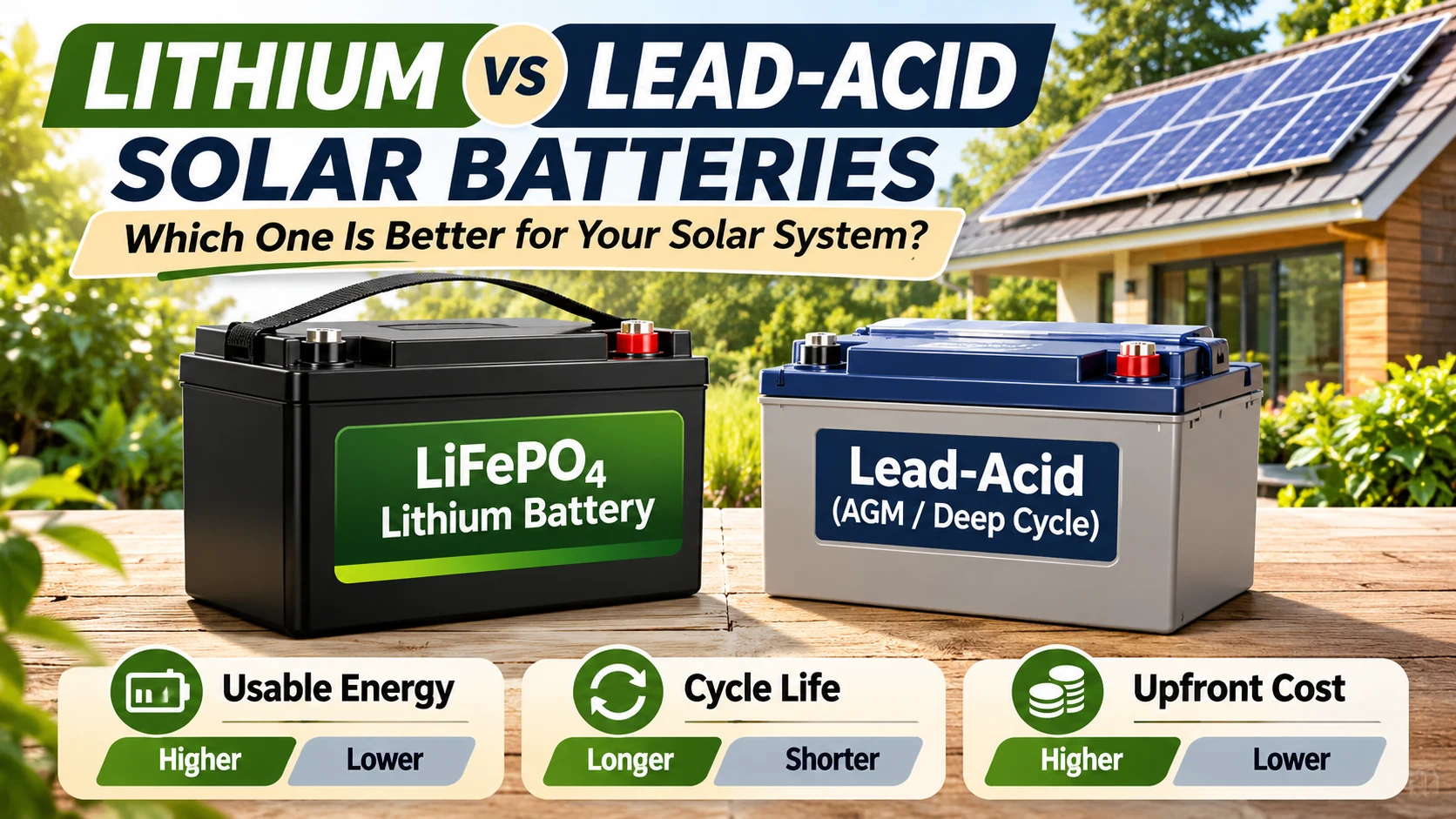
For many frequently cycled solar systems, lithium iron phosphate (LiFePO4) is an attractive option because it generally provides more usable energy, lower weight, and longer cycle life. Lead-acid batteries can still make sense for certain backup systems and projects with a limited initial budget.
Quick Verdict
- Best for frequent off-grid use: LiFePO4 is often worth considering first.
- Best for lower upfront costs: Lead-acid may be suitable, depending on the application.
- Best for compact installations: LiFePO4 generally delivers more usable energy for its weight.
- Best for cold climates: Compare actual charging temperature limits, insulation, and heating requirements.
- Best for occasional backup: Either type may work when properly selected and maintained.
Key takeaway: Compare usable kilowatt-hours, documented cycle life, charging limits, warranty, and full system cost—not just battery voltage and amp-hours.
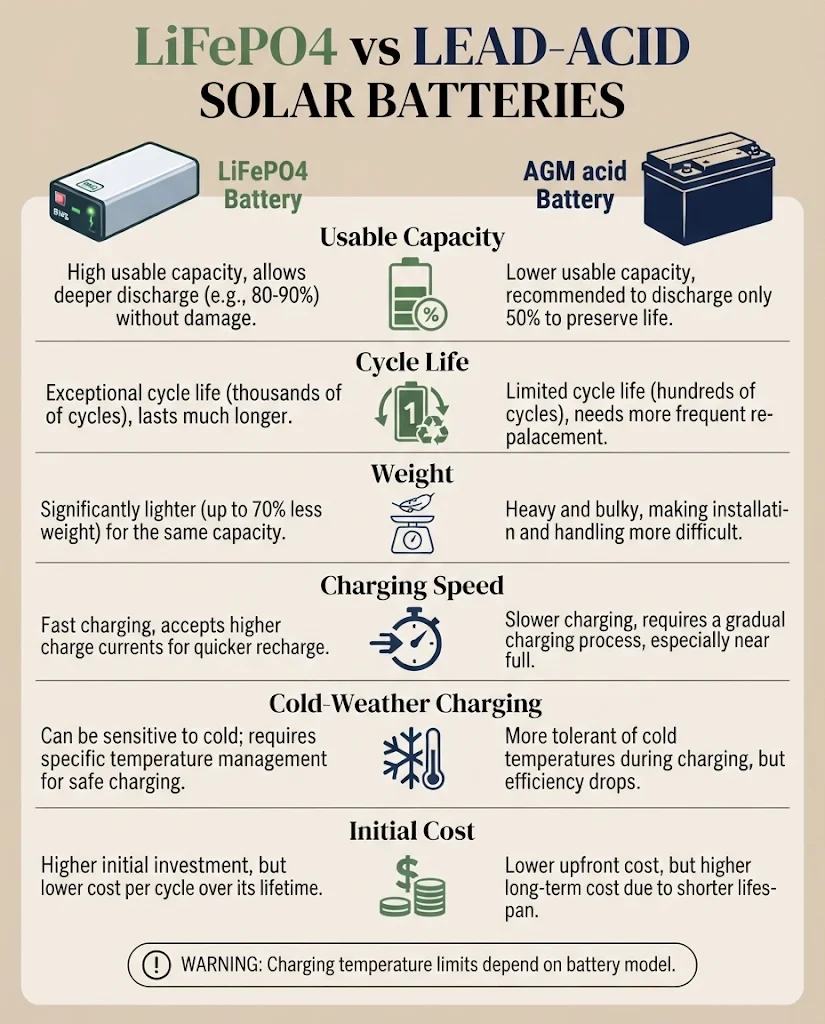
LiFePO4 vs. Lead-Acid Comparison Chart
| Feature | LiFePO4 | Lead-Acid |
|---|---|---|
| Usable energy | Often higher | Often more limited for long life |
| Cycle life | Often thousands of cycles | Usually fewer cycles |
| Weight | Generally lighter | Generally heavier |
| Charging | Can accept faster charging | Often slower near full charge |
| Efficiency | Generally higher | Generally lower |
| Routine maintenance | Low, with BMS monitoring | Varies: flooded vs. AGM or gel |
| Cold charging | May require low-temperature cutoff or heating | Requires model-appropriate charging settings |
| Initial cost | Often higher | Often lower |
| Long-term value | Often attractive for frequent cycling | Depends on duty cycle and replacement cost |
1. How Much Usable Energy Do You Get?
A battery’s nameplate capacity does not always equal the amount of energy you should use every day. Depth of discharge (DoD) describes the portion of a battery’s capacity removed during operation.


For a simple example, compare a nominal 12.8V 100Ah LiFePO4 battery with a nominal 12V 100Ah lead-acid battery. Assume an illustrative 80% usable DoD for lithium and 50% for lead-acid.
LiFePO4 Example
12.8V × 100Ah = 1,280Wh nominal
1,280Wh × 0.80 = 1,024Wh illustrative usable energy
Lead-Acid Example
12V × 100Ah = 1,200Wh nominal
1,200Wh × 0.50 = 600Wh illustrative usable energy
In these examples, lithium delivers about 1.7 times as much usable nominal energy. Real output depends on battery voltage, temperature, discharge rate, age, and manufacturer limits. Inverter losses would reduce usable AC energy further.
Some lithium models allow deeper discharge, while some lead-acid batteries are designed for different cycling conditions. Always use the product’s specified operating range.
2. Which Battery Lasts Longer?
LiFePO4 batteries often provide more charge-discharge cycles than traditional lead-acid batteries under comparable operating conditions.
However, there is no universal cycle-life number. The claimed cycle count usually depends on the depth of discharge, temperature, charging conditions, and the capacity remaining at the end of the test.
For example, a battery advertised at 4,000 cycles may be rated to retain a specified percentage of its original capacity after those cycles. It does not mean that every battery will operate for exactly 4,000 days or fail immediately after that point.
Compare documented test conditions, not just the largest number on the product label.
3. Which Battery Charges Faster?
Many LiFePO4 batteries can accept relatively high charging currents when temperatures and battery management limits are suitable. Lead-acid batteries often need a longer absorption phase as they approach full charge.
This can be valuable for solar installations that need to recover stored energy during a limited sunlight window.
But a lithium battery will not charge faster simply because of its chemistry. Actual speed also depends on solar array production, MPPT controller capacity, BMS current limits, state of charge, and battery temperature.
4. Temperature: The Important Safety Difference
Operating temperature is one of the most important differences between battery types. A battery’s permitted discharge temperature range may be different from its permitted charging range.
For example, Victron’s Lithium Smart battery manual lists charging from +5°C to +50°C and discharging from -20°C to +50°C for the referenced product.
Other LiFePO4 models may have different limits, low-temperature charging protection, or an integrated heating system. Do not assume those features are present unless the manufacturer specifies them.
Lead-acid batteries have different temperature-related limitations. Cold conditions reduce available capacity, while high heat can accelerate degradation. Proper temperature compensation may be required for charging.
Battery safety: Never bypass lithium low-temperature charging protection. Never assume a general operating temperature range permits charging throughout that range. Follow the battery manufacturer’s exact requirements.
5. Maintenance: AGM Is Not the Same as Flooded Lead-Acid
Lead-acid batteries are available in several designs, including flooded, AGM, and gel. Their maintenance requirements are not identical.
- Flooded lead-acid: May require electrolyte-level checks and manufacturer-specified maintenance.
- AGM and gel: Typically do not require routine water topping, but they still need correct charging and inspection.
- LiFePO4: Usually needs little routine battery maintenance, but BMS status, cable connections, temperature, and system condition still matter.
Battery maintenance also includes keeping the installation clean, dry, and within permitted environmental conditions. Low-maintenance does not mean inspection-free.
6. Is Lithium Cheaper Over Time?
A lead-acid battery may have a lower initial purchase price. A LiFePO4 battery may provide greater lifetime value when a solar system is cycled frequently, but the outcome depends on actual prices, useful energy, cycle life, installation requirements, and replacement costs.
One way to compare batteries is to estimate the cost per lifetime kilowatt-hour delivered.
Simplified cost per delivered kWh = Battery purchase cost ÷ (Usable energy per cycle × Expected equivalent full cycles)
For example, suppose a battery costs $600, provides 1kWh of usable energy per equivalent full cycle, and achieves 3,000 equivalent full cycles. The simplified battery purchase cost per delivered kWh would be $0.20.
This is a hypothetical calculation, not a current market price or guarantee of battery life. It excludes financing, installation, electrical losses, maintenance, and other system costs.
7. Which Battery Is Best for an Off-Grid Solar Home?
For an off-grid home that uses stored electricity every night, LiFePO4 is often an attractive choice because of its usable capacity, potential cycle life, weight, and charging behavior.
Lead-acid may still be useful for systems with modest budgets, infrequent cycling, or specialized operating requirements where a suitable product has been selected.
Before buying, compare the complete battery system, including its BMS, inverter compatibility, warranty, operating temperature, current ratings, protection, and installation requirements.
Frequently Asked Questions
Is LiFePO4 better than lead-acid for solar? For many frequently cycled solar systems, LiFePO4 offers practical advantages. Lead-acid may still be appropriate for certain applications and budgets.
Does a 100Ah lithium battery provide more power than a 100Ah lead-acid battery? It may provide more usable energy under the selected operating limits. Maximum output power is a separate specification and depends on the battery’s current rating and other conditions.
Can a lead-acid solar battery last 10 years? Some specialized lead-acid products may last many years under favorable conditions, but service life depends on the specific model, temperature, cycling, maintenance, and usage.
Can you replace lead-acid batteries with LiFePO4? Sometimes, but the charge controller, inverter, charging profile, protection, wiring, and BMS compatibility must be verified first. A matching nominal voltage does not guarantee a safe replacement.
Can you mix LiFePO4 and lead-acid batteries in one battery bank? Do not directly parallel batteries with different chemistries unless the entire arrangement is specifically engineered and approved. Separate banks may require appropriate chargers and controls.
Which battery is safer? Safety depends on battery chemistry, product design, protection, installation, and maintenance. LiFePO4 generally has good thermal stability among lithium-ion chemistries, but all battery systems require suitable electrical and fire protection.
Final recommendation: Choose your solar battery based on the usable energy you need, documented cycle-life performance, charging conditions, safety requirements, and the total cost of ownership. For frequent off-grid use, LiFePO4 deserves strong consideration. For low-cost or occasional backup, a properly selected lead-acid system may still be practical.
Technical sources: Victron Energy: Lithium vs. Lead-Acid Batteries; Victron: Lithium Battery Charging and Temperature Requirements; Australian Government: Battery Storage Guide. Verify all ratings against the battery manufacturer’s current datasheet.