
How to Prevent LiFePO4 Batteries from Freezing & Winterize Your Off-Grid Solar System
Winter can create serious challenges for an off-grid solar power system. Shorter days, snow-covered solar panels, lower temperatures, and reduced battery performance can make it harder to maintain a reliable electricity supply.
One of the most important components to protect is the LiFePO4 battery. Lithium iron phosphate batteries are popular in off-grid solar installations because of their long service life, high efficiency, and excellent energy storage capabilities. However, they have an important limitation: many standard LiFePO4 batteries must not be charged when their internal temperature is below freezing.
Charging a cold lithium battery outside its permitted temperature range can cause permanent cell damage. Fortunately, proper insulation, temperature monitoring, low-temperature charging protection, and suitable battery heating systems can help keep an off-grid installation operating safely throughout winter.
- Many standard LiFePO4 batteries should not be charged below 0°C (32°F).
- Cold temperatures can reduce available battery capacity and charging performance.
- A low-temperature protection BMS can prevent unsafe charging when correctly configured.
- Insulation slows heat loss but does not generate heat.
- Self-heating batteries can warm their cells before accepting a charge.
- Winterizing also requires checking solar panels, wiring, charge controllers, and backup power.
1. Can LiFePO4 Batteries Freeze in Winter?
LiFePO4 batteries can operate in cold environments, but their performance and charging limitations become increasingly important as temperatures fall.
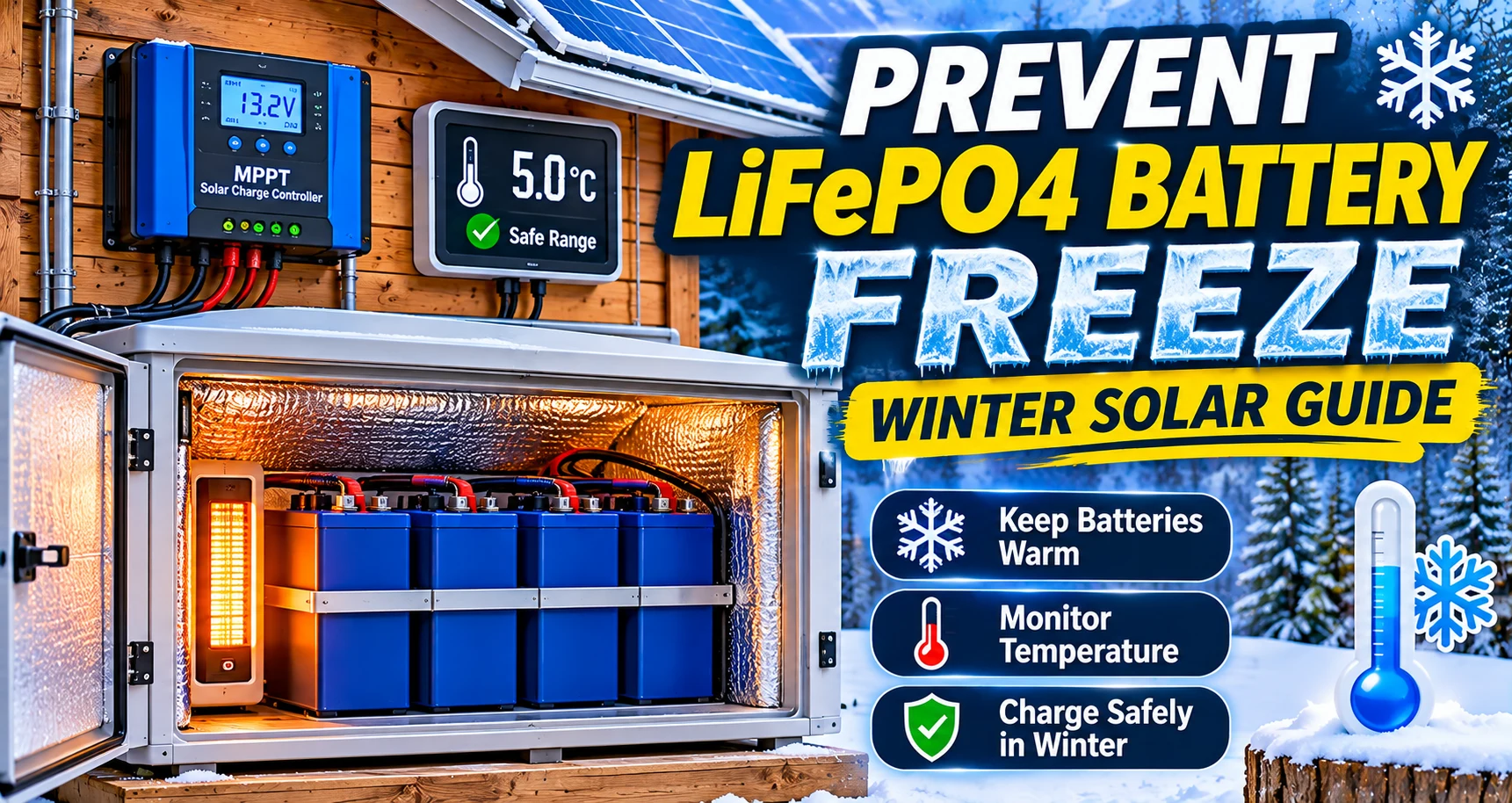
The most important distinction is between charging and discharging. Many standard lithium iron phosphate batteries can discharge at temperatures below 0°C, provided the battery manufacturer permits it. However, charging is generally restricted to temperatures at or above 0°C.
When a lithium battery is charged below its permitted temperature, lithium plating can occur inside the cells. This can permanently reduce battery capacity and damage the battery.
The exact operating limits depend on the battery model, cell chemistry, BMS, and manufacturer’s specifications.
Never bypass the battery management system to force a cold LiFePO4 battery to accept a charge. If the battery is too cold, allow it to warm within the manufacturer’s permitted temperature range before charging.
2. What Temperature Is Too Cold for a LiFePO4 Battery?
Temperature limits vary between manufacturers and battery models. A common charging limit for standard LiFePO4 batteries is 0°C (32°F), while some manufacturers specify a higher minimum charging temperature.
Discharging may be permitted at lower temperatures, but available capacity and maximum output can decrease.
| Battery Condition | Temperature | What to Know |
|---|---|---|
| Normal charging range | Above 0°C | Follow the battery’s specified charging range. |
| Freezing point | 0°C | This is the lower charging limit for many standard models. |
| Below freezing | Below 0°C | Standard charging should be stopped unless the manufacturer specifically permits it. |
| Very cold conditions | Below -10°C | Discharge limits and available capacity may be significantly affected. |
These are general reference points, not universal operating specifications. Always check the technical documentation for your exact battery.
3. Why Cold Weather Is Dangerous for Lithium Battery Charging
During normal charging, lithium ions move through the electrolyte and enter the graphite anode. When the cells are too cold, this process becomes more difficult.
If charging continues outside the permitted temperature range, metallic lithium can deposit on the anode surface. This process is called lithium plating.
Potential consequences include:
- Permanent loss of usable battery capacity.
- Increased internal resistance.
- Reduced battery performance.
- Long-term degradation of the cells.
- Potential internal safety problems.
The damage may not be immediately visible. A battery can appear to operate normally even after experiencing harmful charging conditions.
This is why low-temperature charging protection is essential in an off-grid solar installation exposed to winter temperatures.
4. The Best Ways to Prevent LiFePO4 Batteries from Freezing
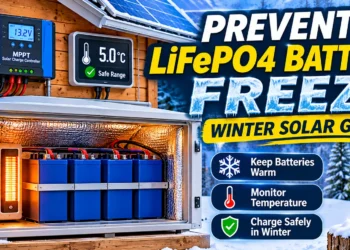
Method 1: Install Batteries Inside an Insulated Space
One of the simplest ways to protect lithium batteries is to install them inside a suitable indoor battery room, utility space, or insulated equipment cabinet.
An indoor installation can reduce exposure to freezing outdoor temperatures and help maintain a more stable battery temperature.
Consider the following:
- Choose a dry location protected from rain and snow.
- Use suitable insulation around the battery enclosure.
- Keep batteries away from direct sunlight and excessive heat.
- Maintain the manufacturer’s ventilation and installation requirements.
- Provide enough space for inspection and maintenance.
Remember that insulation slows heat loss but does not create heat. If the battery remains in freezing conditions for a long period, its internal temperature can eventually fall below the charging limit.
Method 2: Use a LiFePO4 Battery with Built-In Self-Heating
Self-heating lithium batteries are designed for installations where temperatures can fall below freezing.
These batteries contain heating elements controlled by their battery management system. When the battery becomes too cold, the heating system raises the cell temperature before allowing normal charging.
A typical self-heating process works as follows:
- The battery temperature falls below the configured heating threshold.
- The BMS prevents ordinary charging while the cells are too cold.
- The heating elements warm the battery cells.
- Once the required temperature is reached, charging is permitted.
The exact operating sequence differs between products. Some heaters use energy from the incoming charging source, while others may draw energy from the battery itself.
Before buying a self-heating battery, check:
- Minimum charging temperature.
- Heating activation temperature.
- Heating power consumption.
- Whether the heater works without an external charging source.
- Compatibility with your inverter and solar charge controller.
Method 3: Install a Suitable Battery Heating System
If your existing LiFePO4 battery does not include built-in heating, a compatible external heating solution may be considered.
A purpose-designed battery heating pad or heating system can help maintain an appropriate temperature inside an insulated enclosure.
However, the heating system must be compatible with the battery manufacturer’s installation instructions. It should use appropriate temperature sensors, electrical protection, and independent temperature controls.
Do not place an uncontrolled heating element directly against a battery or use an improvised heater inside a battery cabinet.
Method 4: Monitor Battery Temperature
A temperature monitoring system helps you understand what is happening inside the battery enclosure.
Depending on the battery design, monitoring may be available through:
- Built-in BMS temperature sensors.
- Bluetooth battery monitoring applications.
- Compatible battery monitoring equipment.
- External temperature sensors installed according to the manufacturer’s instructions.
Monitoring the internal cell temperature is more useful than relying only on the outdoor air temperature.
5. How to Winterize an Off-Grid Solar System
Protecting the battery is only one part of preparing an off-grid solar installation for winter. The entire system needs to be checked before temperatures drop.
Step 1: Inspect Your Solar Panels
Solar panels can continue generating electricity in cold weather, but snow, ice, dirt, and debris may reduce their output.
Before winter, inspect the panels for:
- Cracked glass or damaged frames.
- Loose mounting hardware.
- Damaged electrical connections.
- Debris and accumulated dirt.
- Potential snow accumulation.
Make sure the mounting structure is suitable for the expected wind and snow loads in your location.
Step 2: Check the Solar Charge Controller
The charge controller regulates the electricity coming from the solar panels and manages battery charging.
Check that it has the correct LiFePO4 charging profile and that its low-temperature protection features are configured appropriately.
If your battery communicates with the controller through a compatible BMS connection, confirm that temperature information and charging permissions are working correctly.
Step 3: Verify Low-Temperature Charging Protection
A battery’s BMS may include low-temperature charging protection, but this does not automatically mean that every charging source in the solar system is controlled.
Check all charging sources, including:
- Solar charge controllers.
- AC battery chargers.
- Inverter-chargers.
- Vehicle alternator charging systems.
- Other DC charging equipment.
Every charging source must respect the battery’s temperature limits. A qualified installer should verify the protection and control connections.
Step 4: Inspect Battery Cables and Connections
Cold weather can expose problems in an already weak electrical installation.
Inspect battery cables, terminals, fuses, circuit breakers, and connectors for signs of corrosion, overheating, loose connections, or mechanical damage.
Use appropriately rated cables and protection devices for the system voltage and current. Electrical work should be completed by a qualified person.
Step 5: Calculate Your Winter Energy Needs
Solar production usually changes throughout the year. Shorter daylight hours, cloudy weather, and snow can reduce the electricity available for charging.
Review your daily energy consumption and identify essential loads such as:
- Refrigerators and freezers.
- Lighting.
- Communication equipment.
- Water pumps.
- Heating controls.
- Essential household electronics.
Reducing unnecessary consumption can help preserve battery energy during periods of limited solar production.
6. How Much Battery Heating Power Do You Need?
The heating power required depends on the battery size, enclosure insulation, outdoor temperature, air leakage, and the desired internal temperature.
A small insulated battery cabinet may require less heating than a large enclosure exposed to strong winds and very low temperatures.
The following example illustrates how heating energy consumption can affect an off-grid battery system.
Assume a compatible battery heating system uses 30 watts while actively heating.
Heating power: 30 W
Operating time: 5 hours
Daily energy consumption:
30 W × 5 hours = 150 Wh
The heater would consume 150 watt-hours during those five operating hours. Actual daily consumption depends on the heating system’s duty cycle and environmental conditions.
This energy should be included when calculating the required battery capacity and winter solar production.
7. Insulated Battery Enclosure: What Should You Consider?
An insulated battery cabinet can help protect an off-grid energy storage system from rapid temperature changes.
A suitable enclosure should include:
- Weather-resistant construction.
- Appropriate thermal insulation.
- Protection against water entry and condensation.
- Suitable ventilation where required by the battery manufacturer.
- Temperature monitoring.
- Access for maintenance and inspection.
- Safe cable routing and electrical protection.
Avoid sealing a battery cabinet without considering the manufacturer’s ventilation and fire-safety requirements. The enclosure must also prevent heating equipment from creating localized hot spots.
8. What Happens to LiFePO4 Battery Capacity in Cold Weather?
Low temperatures can temporarily reduce the amount of energy available from a lithium battery.
For example, a battery that normally provides a certain amount of usable energy at room temperature may deliver less when its cells become very cold.
The exact reduction depends on:
- Battery cell design.
- Battery temperature.
- Discharge current.
- Battery age and condition.
- Manufacturer operating specifications.
In many cases, available capacity improves again as the battery warms up, provided it has not been damaged by operating outside its permitted limits.
For this reason, an off-grid system should not be sized using room-temperature battery performance alone if it will operate in a very cold environment.
9. Common Winter Battery Mistakes to Avoid
Mistake 1: Charging Below the Permitted Temperature
This can cause lithium plating and permanent cell damage. Respect the manufacturer’s minimum charging temperature.
Mistake 2: Assuming Insulation Is Enough
Insulation slows heat loss but cannot maintain a temperature indefinitely without a suitable heat source.
Mistake 3: Ignoring the Battery BMS
Never bypass low-temperature protection or force a battery to charge when the BMS has stopped charging for safety reasons.
Mistake 4: Forgetting Other Charging Sources
An external charger or inverter-charger may continue sending current unless its low-temperature control is correctly configured.
Mistake 5: Ignoring Winter Energy Consumption
Battery heating, shorter daylight hours, and increased electricity demand can place additional pressure on an off-grid solar system.
10. Winter Preparation Checklist for Off-Grid Solar Owners
Before Winter Arrives
- Check the battery’s charging and discharging temperature limits.
- Verify that low-temperature charging protection works.
- Inspect battery insulation and enclosure condition.
- Test compatible battery heating equipment.
- Inspect solar panels and mounting structures.
- Check charge controller settings.
- Inspect wiring, fuses, and electrical connections.
- Calculate expected winter electricity consumption.
- Prepare a backup power option if necessary.
- Review battery monitoring and warning systems.
11. Should You Disconnect Your Solar Battery During Winter?
Not necessarily. Many off-grid solar systems can continue operating during winter if the battery, inverter, solar charge controller, and charging sources are designed for the expected temperatures.
However, if the system will remain unused for an extended period, follow the battery manufacturer’s storage instructions.
These may specify:
- A recommended storage state of charge.
- A permitted storage temperature range.
- Periodic battery inspection.
- How to isolate external loads and charging equipment.
- How frequently the battery should be checked or recharged.
Do not leave a lithium battery completely discharged for an extended period. Also avoid disconnecting the battery without considering the operating requirements of the inverter and other equipment.
12. Final Thoughts: Protect Your Solar Batteries Before Winter
LiFePO4 batteries are an excellent option for many off-grid solar installations, but cold weather requires careful planning. The biggest risk is charging standard lithium iron phosphate batteries when their internal temperature is below the permitted limit.
A combination of suitable battery placement, insulation, temperature monitoring, low-temperature BMS protection, and compatible heating equipment can help prevent winter-related problems.
It is equally important to prepare the rest of the solar installation. Inspect the panels, charge controller, wiring, and inverter, and make sure your energy storage capacity is sufficient for shorter winter days.
The Bottom Line
The best winter protection strategy is to keep LiFePO4 battery cells within their specified operating temperature range and prevent unauthorized cold charging. With proper preparation, an off-grid solar system can remain safer and more dependable throughout the cold season.
Frequently Asked Questions
Can LiFePO4 batteries freeze?
LiFePO4 batteries can be exposed to freezing temperatures, but their performance and operating limits are affected. The most important restriction for many standard models is that they must not be charged below 0°C unless the manufacturer specifically permits it.
Can I charge a LiFePO4 battery below 0°C?
Only if the battery is specifically designed and approved for charging at that temperature, such as a model with an appropriate low-temperature heating system. Follow the exact battery specifications.
Does an insulated battery box prevent freezing?
Insulation slows the rate at which a battery loses heat, but it does not generate heat. For prolonged freezing conditions, an appropriate heating solution or temperature-controlled indoor location may be necessary.
Are self-heating LiFePO4 batteries worth it?
They can be useful in cold climates because they are designed to warm their cells before allowing charging. Their value depends on the climate, heating energy consumption, installation requirements, and purchase cost.
Can LiFePO4 batteries discharge in winter?
Many models permit discharge below freezing, although available capacity and output may decrease. Always check the manufacturer’s minimum discharge temperature and current limits.
What happens if my BMS stops charging in cold weather?
The BMS may have activated its low-temperature protection. Stop attempting to charge the battery, allow it to warm gradually within the permitted range, and follow the manufacturer’s instructions before restarting charging.
Should I keep my solar batteries indoors during winter?
An appropriate indoor location can help maintain a more stable temperature. However, the installation must still meet the manufacturer’s requirements for ventilation, mounting, electrical safety, and environmental conditions.
How often should I check my off-grid solar system during winter?
Check battery temperature, state of charge, solar production, and system warnings regularly. Inspection frequency should increase when the system is exposed to severe weather or operates without supervision.
Safety and editorial note: This article provides general educational information. Battery charging limits, heating requirements, storage procedures, and electrical protection vary by product. Always follow the manufacturer’s documentation. Have battery wiring, heating systems, and solar charging controls inspected by a qualified professional.