
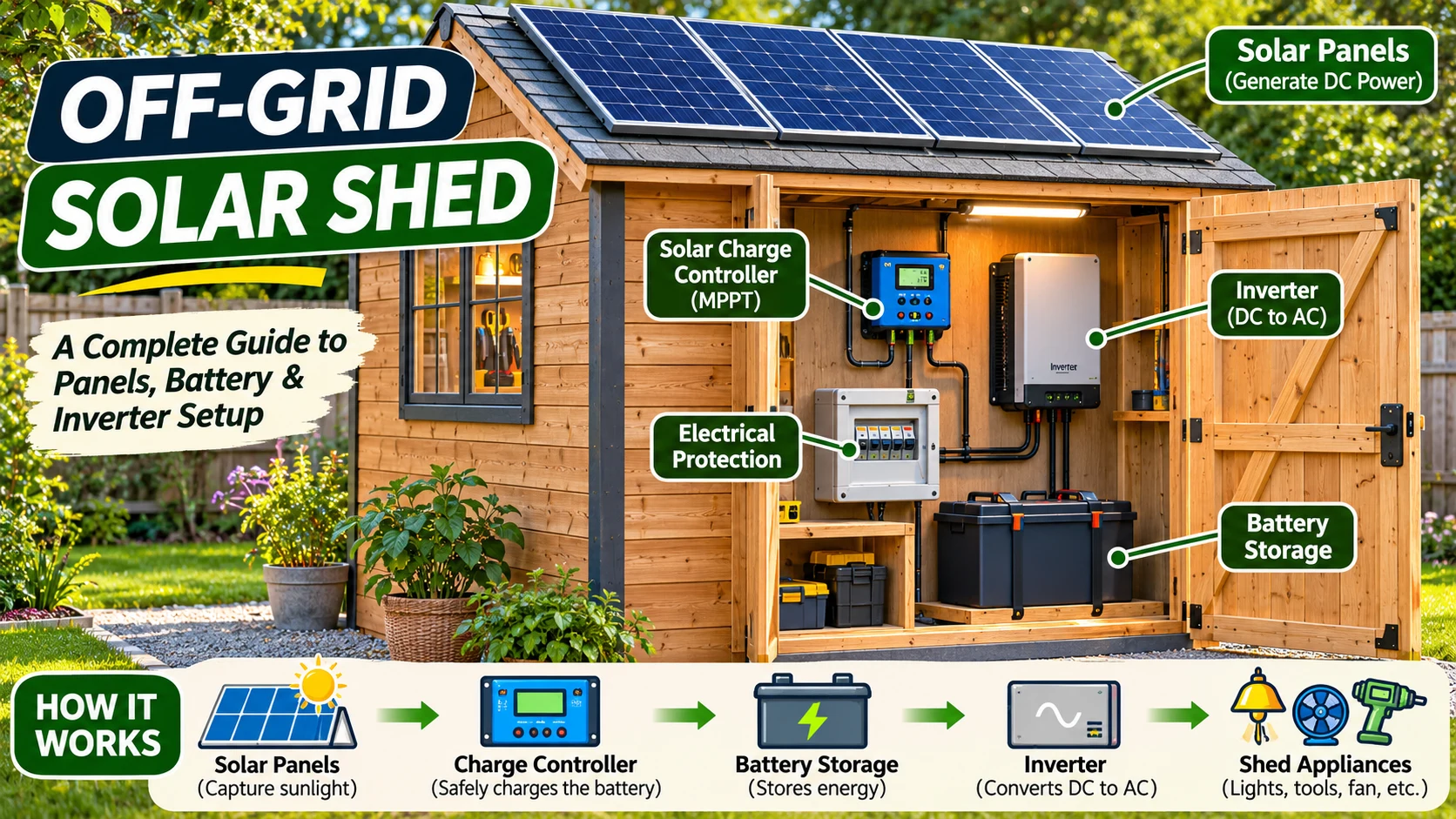
off grid solar shed uses solar panels, a charge controller, battery storage, and sometimes an inverter to power a backyard shed without relying on a conventional utility connection. A small system may run LED lights and charge cordless-tool batteries, while a larger system can support selected workshop equipment.
The right setup depends on how much electricity you use each day, the maximum power your equipment needs, sunlight at your location, and the battery capacity required after sunset. This guide explains how to plan a practical solar-powered shed, choose compatible components, and avoid common electrical and installation mistakes.
Off-Grid Solar Shed: Quick Answer
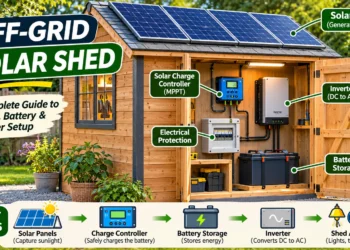
- Solar panels: Generate electricity during daylight.
- Charge controller: Manages solar charging for compatible batteries.
- Battery: Stores energy for nighttime or cloudy conditions.
- Inverter: Converts DC battery power into AC power when required.
- Electrical protection: Includes appropriately rated disconnects, overcurrent protection, and other required safety devices.
- Shed structure: Must safely support the panels and protect equipment from weather, excessive heat, and moisture.
- System sizing: Starts with daily energy consumption and the highest simultaneous load.
Bottom line: A small solar shed can be practical, but panel wattage, battery capacity, and inverter output must be selected together.
FEATURED IMAGE: Insert a verified 1920 × 1080 image of a small backyard shed with rooftop solar panels and an organized off-grid equipment area. Show the system as a conceptual layout, not an installation-ready wiring schematic.
What Is a Solar-Powered Shed?
A solar-powered shed is a garden shed, storage building, or small workshop that uses photovoltaic panels to produce electricity. Depending on the design, it may run entirely off-grid or use solar power alongside a conventional electricity supply.
An off-grid setup operates independently of the utility grid. Solar panels collect energy when sunlight is available, and batteries can store electricity for use later.
Solar sheds are commonly considered for outdoor lighting, security cameras, phone charging, battery-powered tools, ventilation, and occasional light-duty workshop use.
However, an electric heater, air conditioner, table saw, or other high-power appliance can require a much larger system than a few LED lights. The required design follows the loads, not the size of the shed alone.
How an Off-Grid Solar Shed System Works
Most conventional battery-based off-grid solar systems follow a similar energy path. The panels supply DC electricity to compatible charge-control equipment, which manages the battery charging process. The battery then provides power to suitable DC loads or an inverter.
ROOFTOP SOLAR PANELS
↓
APPROPRIATE PV-SIDE PROTECTION
↓
MPPT SOLAR CHARGE CONTROLLER
↓
BATTERY STORAGE & DC PROTECTION
↓
COMPATIBLE INVERTER, IF NEEDED
↓
PROTECTED AC LOADS
Conceptual energy flow only. The actual installation needs model-specific electrical drawings, protection, conductor sizing, disconnects, and grounding or bonding arrangements.
Some systems use an all-in-one solar inverter or portable power station instead. These products may integrate charging, storage, and power conversion into a single manufacturer-designed system.
What Can a Solar Shed Power?
The first step is to list the electrical devices you plan to use. Multiply each device’s power in watts by its expected hours of operation to estimate daily energy consumption.
| Device | Example Watts | Daily Use | Energy |
|---|---|---|---|
| Two LED lights | 20W total | 4 hours | 80Wh |
| Small ventilation fan | 25W | 4 hours | 100Wh |
| Security camera | 8W | 24 hours | 192Wh |
| Tool battery charger | 100W | 2 hours | 200Wh |
| Total | — | — | 572Wh |
This example shed uses approximately 572Wh per day at the listed loads. The solar and storage systems may need to provide additional energy to account for conversion losses, standby consumption, and charging inefficiency.
If you want to run saws, compressors, pumps, or refrigeration equipment, also consider starting surge and the number of appliances operating simultaneously.
How Many Solar Panels Does a Shed Need?
Solar sizing depends on daily energy needs, local sunlight, shading, roof orientation, seasonal weather, and system losses.
A useful first-pass planning formula is:
Solar watts ≈ Daily energy demand (Wh) ÷ (Peak sun hours × Performance factor)
Example: 572Wh ÷ (4 × 0.75) ≈ 191W
Under these illustrative conditions, approximately 191W of solar nameplate power would mathematically offset the estimated daily load.
A 200W panel might appear sufficient on paper, but actual system sizing needs seasonal production data, battery charging behavior, component compatibility, and a suitable margin for less favorable conditions.
For a more demanding shed, consider the following simplified examples:
| Daily Energy Need | Calculated PV at 4 Sun Hours and 75% Performance |
|---|---|
| 300Wh | 100W |
| 600Wh | 200W |
| 1,200Wh | 400W |
| 2,400Wh | 800W |
Actual installations may require substantially more PV capacity in cloudy climates or when important loads must operate throughout the year.
You can estimate site-specific solar production using the PVWatts Calculator from the National Renewable Energy Laboratory.
Choosing Battery Storage for a Solar Shed
Without storage, a solar-powered shed may only have useful energy while the sun is shining, depending on the equipment. A battery allows electricity collected during daylight to be used after sunset.
Battery sizing depends on daily consumption, desired backup duration, permitted depth of discharge, battery chemistry, temperature, and conversion losses.
Example: A 12V 100Ah Battery
For an illustrative battery rated at 12V and 100Ah:
12V × 100Ah = 1,200Wh, or 1.2kWh of nominal energy.
This does not mean every battery provides 1,200Wh of usable AC energy. Battery chemistry, discharge limits, temperature, age, and inverter losses reduce the amount available in practice.
LiFePO4 vs. Lead-Acid Batteries
LiFePO4 batteries are popular for many small off-grid systems because they can offer long cycle life and useful energy capacity when operated within their specifications. However, charging temperature, battery management, and current limits must be respected.
Lead-acid batteries may have a lower upfront purchase price but commonly have stricter practical depth-of-discharge limitations and different ventilation and maintenance needs.
The right battery depends on the system, not just the advertised amp-hour capacity.
Battery safety: Do not place batteries in an improvised sealed wooden cabinet. Lead-acid batteries may release flammable gases, and lithium systems have their own temperature, enclosure, and fire-safety requirements. Follow the battery manufacturer’s instructions for placement, ventilation, separation, and protection.
Does a Solar Shed Need an Inverter?
Not always. If every device uses a compatible low-voltage DC supply, a separate AC inverter may not be necessary.
However, many tool chargers, household fans, and other electrical appliances require AC electricity. A compatible inverter converts battery DC into AC power for those loads.
The inverter should be selected for the highest simultaneous running load, the required starting surge, battery voltage, efficiency, and manufacturer requirements.
Why Bigger Is Not Always Better
A large inverter can have greater standby consumption, higher potential battery-current demand, and more expensive electrical protection requirements.
For example, a 1,000W AC load with an assumed 90% inverter efficiency and 12V battery voltage would require approximately:
1,000W ÷ (12V × 0.90) ≈ 93A of DC input current.
This simplified result demonstrates why inverter selection must consider the battery’s permitted discharge current, not only the AC output rating. Actual DC current varies with voltage, efficiency, and load.
Where Should the Solar Equipment Go?
A garden shed may experience temperature extremes, dust, humidity, condensation, and occasional water intrusion. These conditions affect where batteries and electronics can be installed.
The equipment layout must follow manufacturer clearance, temperature, ventilation, mounting, and access requirements.
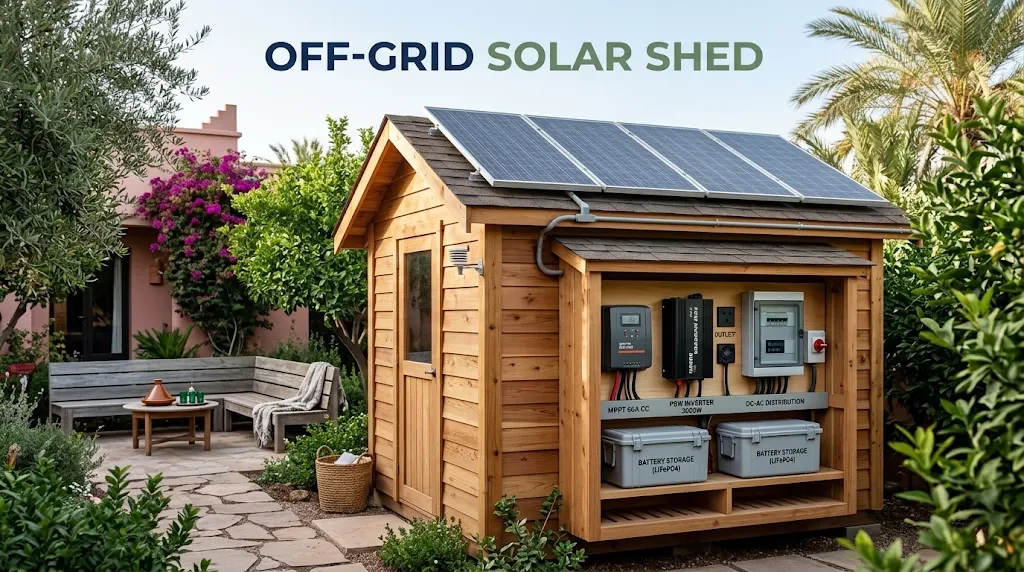
- MPPT controller: Needs an approved location with sufficient cooling and suitable protection from moisture.
- Inverter: Needs the manufacturer-specified mounting position, airflow, and safe working clearances.
- Battery: Requires chemistry-specific temperature control, enclosure protection, and ventilation or separation.
- Electrical protection: Needs suitable enclosures and accessible disconnecting arrangements.
- Wiring: Must be protected from sharp edges, rodents, abrasion, moisture, and accidental damage.
Do not assume that mounting all components to the same wooden wall is approved. Heat-generating equipment, batteries, and protective devices may require different installation arrangements.
The Rolls Battery enclosure guidance provides examples of why battery placement and ventilation must be designed for the selected battery type.
IMAGE 2: Insert a 1200 × 1500 educational illustration showing the functional equipment zones of a solar shed: rooftop PV, protected control equipment, separate battery storage, and approved AC loads. Do not show unverified electrical terminal wiring.
Can You Put Solar Panels on a Shed Roof?
Solar panels can be installed on a suitable shed roof, but the roof must be assessed for the added weight, wind loads, mounting attachments, weatherproofing, and applicable building requirements.
A lightweight wooden shed may not have the same structural capacity as a residential building. The roof material and framing condition also matter.
Before selecting panels, check:
- Available roof space and panel dimensions.
- Roof orientation and potential shading.
- Structural load capacity and wind exposure.
- Approved mounting hardware for the roofing material.
- Roof waterproofing and drainage.
- Required panel ventilation and service access.
- Local permit and inspection requirements.
Do not drill into solar module frames or improvise attachment points. The module and mounting manufacturers specify how the panels may be secured.
Portable Power Station vs. Permanent Solar Shed System
A portable solar power station may be more convenient for a shed that only needs occasional electricity. It typically combines battery storage, charging electronics, and AC or DC outputs in one manufactured unit.
| Feature | Portable Power Station | Permanent Solar System |
|---|---|---|
| Best for | Occasional and mobile use | Regular shed electricity demand |
| Battery | Usually integrated | Selected separately or integrated |
| Installation | Follow product setup instructions | Requires site-specific electrical design |
| Expansion | Model-dependent | Potentially more flexible |
| Weather protection | Model-specific | Designed for the installed environment |
| Maintenance | Follow product instructions | System-level inspection and maintenance |
For a few lights and occasional tool charging, an appropriately rated portable system may avoid the complexity of permanent shed wiring. For daily loads, a designed fixed installation may provide greater flexibility.
How to Plan Your Solar Shed
Use the following planning workflow before purchasing components or commissioning an installation.
- List your loads. Record each device’s wattage, hours of use, and starting surge.
- Calculate daily energy. Add the expected watt-hours required by all devices.
- Evaluate sunlight. Check local peak sun hours and seasonal shading.
- Choose solar capacity. Allow for real operating conditions and conversion losses.
- Determine storage needs. Decide how many hours or days the shed should operate without sufficient sunlight.
- Select compatible equipment. Check solar panel, battery, controller, and inverter limits together.
- Inspect the shed structure. Confirm that the roof and walls can support approved equipment mounting.
- Plan equipment locations. Consider temperatures, moisture, ventilation, fire safety, and battery separation.
- Design electrical protection. Have the required wiring, fuses, breakers, disconnects, and grounding specified.
- Arrange qualified installation. Verify permits, inspections, and commissioning requirements.
Common Off-Grid Solar Shed Mistakes
- Buying a panel without calculating loads: Panel wattage alone does not determine usable electricity.
- Choosing too little battery storage: A system may fail to meet nighttime or cloudy-day demand.
- Using an oversized inverter unnecessarily: High-power inverters can increase cost and standby energy use.
- Ignoring battery current limits: A battery must support the required charging and discharge conditions.
- Placing equipment in damp or hot locations: Heat and moisture can damage components.
- Overloading a lightweight roof: Solar mounts must suit the structure.
- Copying generic wiring pictures: They rarely show all protection and installation details.
- Installing AC outlets without proper protection: AC distribution requires appropriate design and inspection.
- Ignoring winter production: Annual average sunlight may not meet year-round needs.
- Using indoor-rated equipment outdoors: Enclosures and cables must match environmental exposure.
Electrical safety: Do not connect an off-grid inverter directly to existing household wiring, a wall outlet, or another power source without an approved transfer or interconnection design. Backfeeding and incorrect grounding or bonding can create lethal shock and fire hazards. Use qualified electrical installation and inspection.
Frequently Asked Questions
How many solar panels do I need for a shed?
It depends on your daily electricity use and available sunlight. Calculate the required watt-hours, account for system losses, and use location-specific solar production data before selecting the panels.
Can a 200W solar panel power a shed?
Potentially, for modest energy needs such as efficient lighting or small charging loads. Whether it is sufficient depends on local sunlight, connected equipment, and battery storage.
Can I run power tools from a solar shed?
Yes, with a system sized for the tool’s running wattage, starting surge, operating time, battery discharge capability, and inverter output. Large workshop tools can require substantial power.
Does a solar shed need a battery?
A battery is usually useful when electricity is needed after sunset or during changing sunlight. Some specialized solar-powered devices can operate without storage, but their operation depends on available solar energy.
Can I install an inverter inside a wooden shed?
Only where the inverter manufacturer’s installation instructions and applicable electrical requirements permit the mounting arrangement. Heat dissipation, moisture, working clearances, and nearby materials must be considered.
Can a solar shed work during winter?
Yes, but seasonal solar production can fall considerably due to shorter days, cloud cover, snow, and shading. Reliable winter operation may require more PV capacity, battery storage, or another approved backup source.
Is a portable power station better for a garden shed?
For occasional low-energy use, a properly selected portable power station can be simpler. For frequent use or a larger number of devices, a designed fixed solar installation may be more appropriate.
Final Solar Shed Planning Checklist
- Calculate daily shed electricity use.
- Identify maximum running and surge loads.
- Check available roof space and structural capacity.
- Estimate seasonal solar production.
- Select appropriate solar panel capacity.
- Size battery storage for required backup duration.
- Check MPPT and battery charging compatibility.
- Select an inverter that matches the battery and loads.
- Plan battery temperature management and ventilation.
- Protect equipment from moisture and physical damage.
- Specify approved electrical protection and disconnects.
- Arrange necessary professional review and inspection.
Is an Off-Grid Solar Shed Worth It?
An off-grid solar shed can be useful for backyard lighting, device charging, small workshop activities, and places where extending utility electricity would be difficult.
The best system is sized around real electrical demand rather than the largest panel or inverter you can fit. A carefully planned small setup may be more practical than an expensive system that rarely uses its full capacity.
Start by measuring your energy needs, evaluating sunlight and the shed structure, and choosing equipment designed to work together. For permanent electrical installations, have a qualified professional verify the complete design before connecting power.
For more information about general system design, read our Off-Grid Solar System Sizing Guide and Solar System for a Cabin Guide.
Technical references: NREL PVWatts Calculator, VeraSol Off-Grid Solar Installation Guidelines, Rolls Battery: Battery Box Design, and ASHRAE Solar Energy Guidance. Follow the applicable equipment manuals, installation standards, and local regulations.