
How to Make a DIY Water Filter Using Sand, Gravel and Activated Charcoal
Discover how a homemade water filter works, which materials are used, how sand and gravel trap visible particles, and what additional treatment is necessary before water can be considered safe to drink.
Access to clean water is one of the most important requirements for everyday life. Whether you are living in a remote cabin, preparing for emergencies, camping outdoors, or developing an off-grid property, understanding basic water filtration can be extremely useful.
One interesting DIY project is a homemade water filter made from simple materials such as sand, gravel, small stones, and activated charcoal. These materials can help reduce visible dirt, suspended particles, and some substances that affect water appearance or taste.
However, there is an important difference between filtered water and safe drinking water. A homemade sand-and-gravel filter does not reliably remove disease-causing microorganisms, dissolved chemicals, heavy metals, or other dangerous contaminants.

In this guide, we will explain how a DIY water filter works, what materials are needed, how to understand its filtration layers, and how to approach drinking-water safety responsibly.
1. What Is a DIY Water Filter?
A DIY water filter is a homemade device designed to remove some unwanted particles from water using materials that act as physical filtration media.
Traditional homemade designs often use a container filled with different layers of materials. Water passes through these layers, and some suspended particles become trapped along the way.
Common filtration materials include:
- Small stones: Help support the filtration layers and improve drainage.
- Gravel: Helps retain larger particles and supports the sand layers.
- Coarse sand: Provides an additional physical filtration stage.
- Fine sand: Helps capture smaller suspended particles.
- Activated charcoal: Can adsorb certain substances that affect taste and odor, depending on its quality and the water conditions.
These materials work together to improve the physical appearance of water. However, visible clarity does not prove that harmful microorganisms or chemicals have been removed.
2. How Does a Homemade Water Filter Work?
The basic principle is physical filtration. When water moves through a properly designed filter bed, some particles are trapped between the filtration materials or attach to their surfaces.
Basic Water Filtration Process
Contains visible particles
Sand, gravel and carbon
Reduced visible sediment
Physical filtration improves clarity but does not establish drinking-water safety.
How Each Material Helps
Small Stones and Pebbles
Stones provide structural support and help distribute water through parts of the filter. They can also prevent finer materials from moving into the outlet.
Gravel
Gravel provides a supporting layer and helps retain larger suspended particles. It is commonly used in multi-layer filtration systems.
Coarse and Fine Sand
Sand provides a larger filtration surface and can trap suspended particles as water passes through the filter bed. Fine sand is especially important in properly engineered slow-sand filtration systems, where biological processes may also contribute to treatment.
Activated Charcoal
Activated carbon has a porous structure that can adsorb certain organic compounds and substances responsible for unpleasant tastes and odors.
However, ordinary charcoal from a fire or barbecue is not equivalent to properly manufactured activated carbon. Even activated carbon does not remove every contaminant and should not be treated as a complete disinfection system.
3. Materials Needed for a DIY Water Filter
A basic educational water filtration model can be made using the following materials:
DIY Filter Materials Checklist
- A clean, sturdy container or transparent demonstration column.
- Washed small stones or pebbles.
- Clean coarse gravel.
- Washed coarse sand.
- Washed fine sand.
- Commercial activated carbon suitable for water filtration.
- A suitable outlet or collection container.
- Clean water for rinsing the filtration materials.
All materials should be clean and appropriate for their intended use. Avoid painted, chemically treated, contaminated, or unknown materials.
4. Understanding the Different Filter Layers
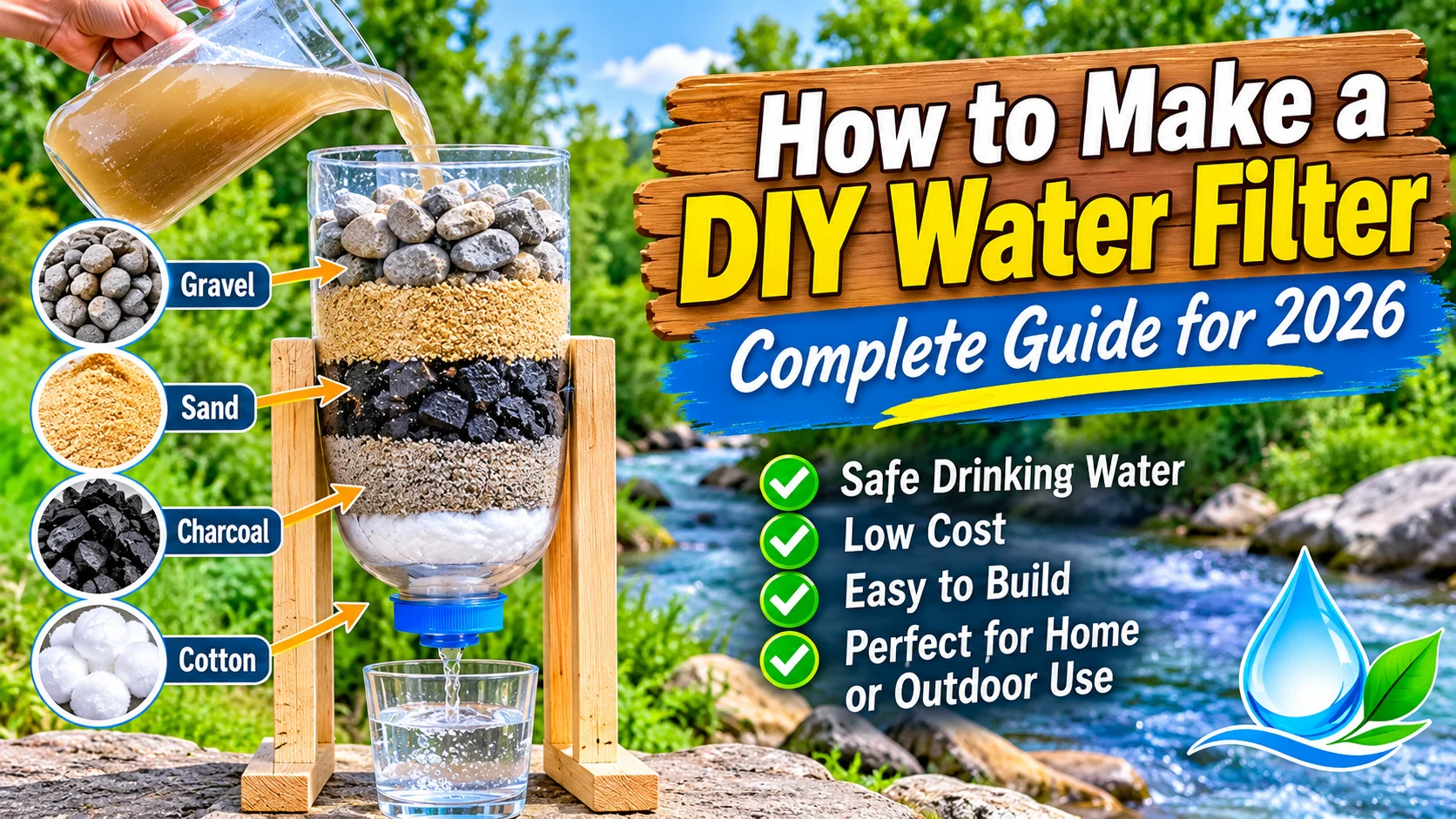
The reference illustration shows a vertical container with several filtration layers. It is useful for understanding the different materials, but its specific thickness measurements should not be considered a scientifically validated filter design.
| Material | Main Function |
|---|---|
| Small Pebbles | Structural support and drainage. |
| Coarse Gravel | Support for finer filter media and retention of larger particles. |
| Coarse Sand | Additional physical filtration. |
| Fine Sand | Captures smaller suspended particles. |
| Activated Carbon | Adsorbs certain substances affecting taste and odor. |
The actual arrangement of a filter depends on its design. Commercial filters and engineered slow-sand systems use specific media grades, flow rates, support structures, and maintenance procedures. Simply copying the layers in a picture does not reproduce a validated drinking-water treatment system.
5. How to Build a Simple DIY Filter Demonstration
You can construct a small demonstration model to observe how different materials affect water containing visible sediment. This is useful for educational projects and understanding the basic principles of filtration.
Step 1: Prepare the Container
Choose a clean, stable container that can safely hold the demonstration materials. A transparent container makes it easier to observe the different layers.
Step 2: Prepare the Filter Media
Wash the stones, gravel, and sand thoroughly using clean water to remove loose dust and unwanted particles. Use commercially manufactured activated carbon intended for water filtration rather than ordinary fireplace charcoal.
Step 3: Create Separate Material Layers
Arrange the materials in a stable demonstration setup so that water can pass through the different media without large gaps or uncontrolled movement.
Step 4: Observe the Filtration Process
Pour a small amount of water containing visible soil or sediment through the demonstration filter. Collect the output in a separate container and compare its appearance with the original water.
Step 5: Evaluate the Result
Observe whether the filter reduces visible particles, cloudiness, or certain odors. Do not taste the output or use its appearance as proof that it is safe to drink.
6. Does a DIY Sand and Charcoal Filter Remove Bacteria?
This is one of the most important questions about homemade water filters.
A simple sand, gravel, and charcoal filter cannot be assumed to remove bacteria, viruses, or parasites. Some engineered filtration systems can reduce certain microorganisms, but their performance depends on carefully controlled media, construction, flow rate, and validation.
Ordinary homemade filters do not have the testing or certification needed to establish reliable pathogen removal.
The Centers for Disease Control and Prevention explains that portable filters have specific pore-size requirements for removing certain organisms and that many filters do not remove viruses. It recommends additional disinfection when necessary.
Therefore, a homemade filter should be treated as a preliminary sediment-removal device rather than a complete drinking-water treatment system.
7. How to Make Filtered Water Safer for Drinking
If water may contain disease-causing microorganisms, additional treatment is necessary. The appropriate method depends on the source of the water and the type of contamination.
Boiling Water
According to the CDC, bringing clear water to a rolling boil for one minute is an effective way to kill disease-causing bacteria, viruses, and parasites. At elevations above 6,500 feet, the recommended boiling time is three minutes.
If water is cloudy, allow it to settle first and remove visible sediment using a clean cloth or suitable prefilter. Then follow the recommended boiling procedure.
Approved Water Disinfection Products
Some approved chemical treatment products can disinfect water when used according to their labels. The correct product, concentration, contact time, and water conditions matter.
Not all disinfectants work equally well against every parasite. Always follow local public-health guidance and product instructions.
Certified Water Filters
For regular drinking-water use, consider a commercially manufactured filter that has been independently tested and certified for the specific contaminants you need to remove.
Check the product’s performance claims rather than relying on general terms such as “pure water” or “advanced filtration.”
Critical Safety Warning
- Boiling does not remove heavy metals, fuel, pesticides, salts, or most harmful chemicals.
- Ordinary sand and charcoal filters do not reliably remove all pathogens.
- Water suspected of chemical or fuel contamination should not be made drinkable by boiling or homemade filtration.
- Use a different verified water source when chemical contamination is suspected.
8. What Contaminants Can Different Water Filters Remove?
Different water treatment technologies are designed for different contaminants. No single filter should be assumed to remove everything.
| Treatment Method | Typical Function | Important Limitation |
|---|---|---|
| Sand and Gravel | Reduces suspended particles. | Not reliable disinfection. |
| Activated Carbon | Reduces certain chemicals, odors, and taste compounds. | Performance depends on carbon type and contaminant. |
| Boiling | Kills disease-causing microorganisms. | Does not remove most chemicals or dissolved metals. |
| Certified Microbial Filter | Can reduce specified microorganisms. | Must meet the relevant performance specification. |
| Reverse Osmosis | Can reduce many dissolved substances. | Performance and removal vary by system and contaminant. |
9. Common Mistakes When Making a Homemade Water Filter
Using Ordinary Charcoal
Charcoal from a fireplace or barbecue is not necessarily activated carbon. It may contain ash, binders, or other unwanted substances.
Using Dirty Filter Materials
Unwashed sand and gravel can introduce more dirt into the water instead of improving its appearance.
Assuming Clear Water Is Safe
Many dangerous contaminants cannot be seen, smelled, or tasted. Clear water may still contain harmful bacteria, viruses, chemicals, or dissolved metals.
Ignoring Filter Maintenance
Filter materials can become clogged or contaminated. A homemade filter should not be treated as a permanent maintenance-free solution.
Using an Unknown Water Source
Water from industrial areas, agricultural runoff, flooded locations, or chemically contaminated sites may contain substances that ordinary filtration cannot remove.
10. Can a DIY Water Filter Be Useful for Off-Grid Living?
Yes. Understanding basic filtration is useful for people interested in off-grid living, emergency preparedness, camping, and sustainable projects.
A homemade filter demonstration can help explain how sediment removal works and why different filtration materials have different functions.
For a real off-grid home, however, water treatment should be planned as a complete system. This includes:
- Identifying and testing the water source.
- Selecting treatment equipment for the actual contaminants present.
- Installing suitable sediment filtration when needed.
- Using appropriate disinfection when microbial risks exist.
- Providing safe water storage.
- Maintaining and replacing filters according to manufacturer instructions.
- Testing treated water when required.
A dependable water system is just as important as solar panels and battery storage when planning an independent home.
11. How to Store Treated Water Safely
Water can become contaminated again after treatment if it is stored incorrectly.
Use clean, food-grade containers with tight-fitting lids. Keep containers away from chemicals, fuel, animals, dust, and direct sources of contamination.
- Clean and sanitize storage containers before use.
- Keep containers covered.
- Avoid touching the inside of containers or lids.
- Use clean dispensing equipment.
- Follow public-health guidance for storage duration.
12. Final Thoughts: Is a Homemade Water Filter Worth Building?
A DIY water filter made with sand, gravel, small stones, and activated charcoal is an interesting project for understanding the basic principles of filtration.
It can demonstrate how different materials help remove visible particles and how activated carbon can improve certain taste and odor characteristics.
However, a homemade filter should never be confused with a certified drinking-water treatment system. Safe drinking water requires treatment appropriate to the source and the contaminants present.
For off-grid homes and emergency situations, the best approach is to combine reliable filtration, appropriate disinfection, safe storage, and water-quality testing where necessary.
Conclusion
A homemade water filter can be a valuable educational DIY project, but clean-looking water is not necessarily safe water. Understand what each filtration material can do, use certified treatment equipment for drinking water, and follow trusted public-health recommendations.
When it comes to drinking water, safety should always come before convenience.
Frequently Asked Questions
1. Can I make a water filter using sand and gravel?
Yes. Sand and gravel can be used in a simple physical filtration demonstration to reduce visible suspended particles. This does not establish that the filtered water is safe to drink.
2. Does activated charcoal make water safe to drink?
No. Activated carbon can reduce certain substances that affect taste and odor, but it does not reliably disinfect water or remove every chemical contaminant.
3. Can a homemade filter remove bacteria?
An ordinary homemade sand-and-gravel filter cannot be relied upon to remove disease-causing bacteria. Use an appropriate, validated treatment method.
4. Should filtered water be boiled?
If microbial contamination is possible, appropriate disinfection is necessary. CDC guidance recommends bringing clear water to a rolling boil for one minute, or three minutes above 6,500 feet. Follow local advisories and remember that boiling does not remove harmful chemicals.
5. Can a homemade filter remove salt from seawater?
No. Ordinary sand, gravel, and charcoal filters do not remove dissolved salt. Desalination requires specialized treatment, such as an appropriate reverse-osmosis system or distillation process.
6. How often should filter materials be replaced?
There is no universal replacement schedule for homemade filters. Materials may clog or become contaminated, and the appropriate maintenance depends on the design and water quality.
7. Is a DIY water filter suitable for emergency preparedness?
It can be useful for reducing visible sediment, but it should not be the only drinking-water safety measure. Keep an appropriate emergency water supply and validated treatment products available.
Health and Safety Disclaimer: This article is for educational purposes only. A homemade filter made from natural materials is not a certified drinking-water treatment device. Never drink water solely because it looks clear after passing through a DIY filter. Use a treatment method validated for the contaminants present and follow local public-health recommendations.