
How to Wire a 2-Way Switch: Complete Staircase Lighting Guide
Learn how a two-way lighting circuit works, how two switches control one bulb, which components are required, and what you should understand before working with residential electrical systems.
Have you ever wondered how you can turn a staircase light on at the bottom of the stairs and switch it off at the top? This convenient arrangement is possible thanks to a 2-way switch wiring circuit.
Two-way lighting is commonly used in staircases, hallways, bedrooms, and rooms with two entrances. Instead of relying on one traditional light switch, this arrangement allows two separate switches to control the same light fixture.
Understanding a 2-way switch wiring diagram makes it easier to recognize the different parts of the circuit and understand how electricity travels between the power supply, switches, and light bulb.
1. What Is a 2-Way Switch?
A two-way switch is an electrical switch that allows one light to be controlled from two different locations.
Unlike a basic one-way switch, which simply opens or closes one electrical path, a two-way switch changes the connection between a common terminal and one of two other terminals.
This type of switch is particularly useful when you want convenient lighting control in different areas of a building.
Common Applications
- Staircases: Control lighting from the top and bottom of the stairs.
- Hallways: Operate a light from either end of a corridor.
- Bedrooms: Control the same light from the entrance and bedside location.
- Large rooms: Switch lighting from two separate entrances.
- Garages: Control lighting from different access points.
2. Understanding the Staircase Wiring Diagram
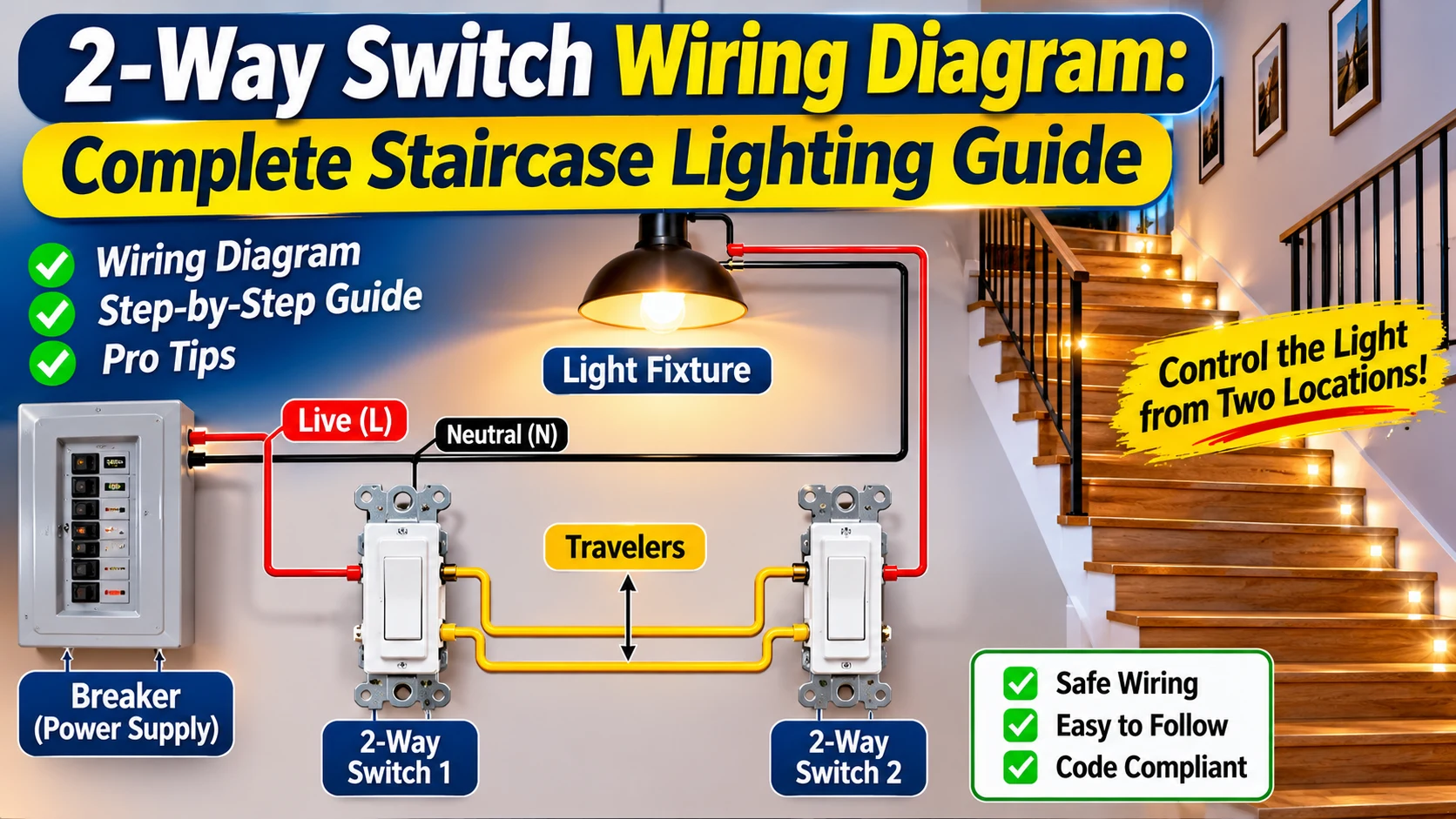
The diagram illustrates a typical staircase lighting concept. Two switches are positioned at different points, allowing the same bulb to be controlled from either location.
Staircase Two-Way Lighting Circuit Diagram
[INSERT FEATURED WIRING DIAGRAM IMAGE HERE]
Illustration showing two switches controlling one staircase light.
The main parts illustrated in this type of circuit include:
- AC electrical power supply.
- Two two-way changeover switches.
- One light bulb or lighting fixture.
- Two traveler conductors connecting the switches.
- Neutral and protective earth conductors.
- Appropriate circuit protection.
Important: The supplied Pinterest illustration is a simplified drawing, not a verified installation diagram. Its switch terminals are not clearly identified, so do not use its red and black lines as a practical wiring instruction. Actual terminal connections must be verified from the switch markings and a correct circuit schematic.
3. Main Components of a Two-Way Lighting Circuit
Two Two-Way Switches
The circuit requires two changeover switches. Each switch normally has three functional terminals:
| Terminal | Function |
|---|---|
| COM | Common terminal that changes connection between L1 and L2. |
| L1 | One of the two changeover terminals. |
| L2 | The second changeover terminal. |
Terminal markings and physical layouts vary between manufacturers. Always consult the manufacturer’s documentation.
Light Bulb
The light bulb is the electrical load controlled by the two switches. It may be an LED lamp, a conventional bulb, or another compatible lighting fixture.
Electrical Supply
The circuit receives electricity from the building’s distribution board through an appropriately protected lighting circuit.
Many residential installations use a nominal supply around 220–240V AC, depending on the country and local electrical supply.
Connecting Conductors
The circuit requires conductors selected according to the installation design, current rating, protective device, installation method, and applicable electrical regulations.
Protective earth conductors must also be provided and connected where required. They must never be treated as ordinary current-carrying wires.
4. How Does a Two-Way Switch Circuit Work?
The operating principle is based on two changeover switches and two traveler connections.
Each switch changes which traveler path is connected to its common terminal. When either switch is operated, the electrical path changes, which changes the state of the light.
Understanding the Four Switch Combinations
The following table shows a common arrangement where matching switch selections complete the lighting path. The physical ON/OFF lever positions can vary depending on how the switches are installed.
| Switch 1 | Switch 2 | Light |
|---|---|---|
| Path 1 | Path 1 | ON |
| Path 1 | Path 2 | OFF |
| Path 2 | Path 1 | OFF |
| Path 2 | Path 2 | ON |
The important principle is that changing either switch changes the circuit state. This is what makes staircase lighting convenient.
5. Difference Between One-Way and Two-Way Switches
| Feature | One-Way Switch | Two-Way Switch |
|---|---|---|
| Control locations | One | Two |
| Typical terminals | Two functional terminals | COM, L1, L2 |
| Typical use | Small rooms | Stairs and hallways |
| Circuit complexity | Simple | More connections |
6. Can You Control One Light from Three or More Locations?
Yes. If you want to control one light from three or more locations, an intermediate switching arrangement can be used.
This configuration generally uses:
- One two-way switch at the first location.
- One intermediate switch between the two end switches.
- Another two-way switch at the final location.
Additional intermediate switches can be included for more control locations, provided the circuit is designed correctly.
This arrangement is useful in long hallways, large staircases, hotels, and buildings with several entrances.
7. Common Two-Way Switch Wiring Problems
Light Works from Only One Switch
This can indicate incorrect switch type, an incorrect terminal connection, a loose conductor, or a damaged switch.
Light Does Not Turn On
Possible causes include a failed bulb, an interrupted circuit, a tripped protective device, a faulty connection, or a defective switch.
Switch Positions Seem Confusing
In a two-way arrangement, the physical UP and DOWN positions do not necessarily correspond to ON and OFF. This depends on the switch positions and circuit configuration.
Loose or Damaged Connections
Loose terminals, damaged insulation, and unsuitable connections can create overheating and electrical hazards. These problems should be inspected by a qualified electrician.
8. Electrical Safety: Important Things to Know
⚠ Warning: Mains Electricity Can Be Dangerous
Residential AC electricity can cause serious injury, burns, electric shock, or death. The diagram in this article is for educational understanding only, not a step-by-step installation guide.
- Never work on an energized circuit.
- Isolate the circuit at the distribution board before electrical work.
- Have a competent person verify that the circuit is de-energized using suitable test equipment.
- Never assume wire color alone identifies a conductor’s function.
- Use suitable circuit protection, grounding, and correctly rated components.
- Never switch the neutral conductor instead of the live conductor.
- Follow local electrical regulations and manufacturer instructions.
For actual installation or repair, use a qualified electrician.
9. Advantages of Two-Way Staircase Lighting
- Convenience: Control the same light from two locations.
- Improved usability: Switch on a staircase light before climbing the stairs.
- Flexible placement: Install switches at opposite ends of a hallway.
- Practical operation: Either switch can change the light’s current state.
- Suitable for many buildings: Useful in houses, offices, and commercial properties.
10. Final Thoughts
A two-way switch wiring circuit is a practical electrical solution for controlling one light from two separate locations. It is especially useful for staircases, corridors, bedrooms, and other areas where convenient lighting control matters.
By understanding the roles of the common terminal, L1, L2, and traveler connections, you can better understand the operating principle behind staircase lighting.
However, understanding a diagram is different from performing an electrical installation. Always use a verified circuit design, appropriate protection, and qualified electrical assistance when working with mains voltage.
Frequently Asked Questions
1. What is a two-way switch used for?
A two-way switch allows one light to be controlled from two different locations, such as the top and bottom of a staircase.
2. How many terminals does a two-way switch have?
A typical two-way changeover switch has three functional terminals: COM, L1, and L2. Some products include additional terminals for other functions or connections.
3. Can two switches control one bulb?
Yes. A correctly designed two-way switching circuit allows two separate switches to control the same light fixture.
4. What are traveler wires?
Traveler wires, sometimes called strapper wires, connect the two changeover switches and provide alternative electrical paths between them.
5. Can I use a two-way switch for a normal light?
Yes. A two-way switch can be used in some one-location lighting applications when connected according to the manufacturer’s instructions and the circuit design.
6. What is an intermediate switch?
An intermediate switch is used between two two-way switches to control the same lighting circuit from a third location.
7. Is two-way switch wiring the same in every country?
The basic switching principle is similar, but wiring practices, conductor colors, regulations, and terminology differ between countries. Always follow the standards applicable to your location.
Disclaimer: This article is for general educational purposes. It does not replace electrical training, professional installation, or local wiring regulations. Never use an unverified illustration as a live mains wiring diagram.