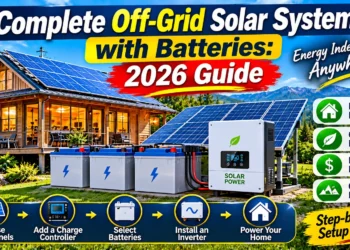

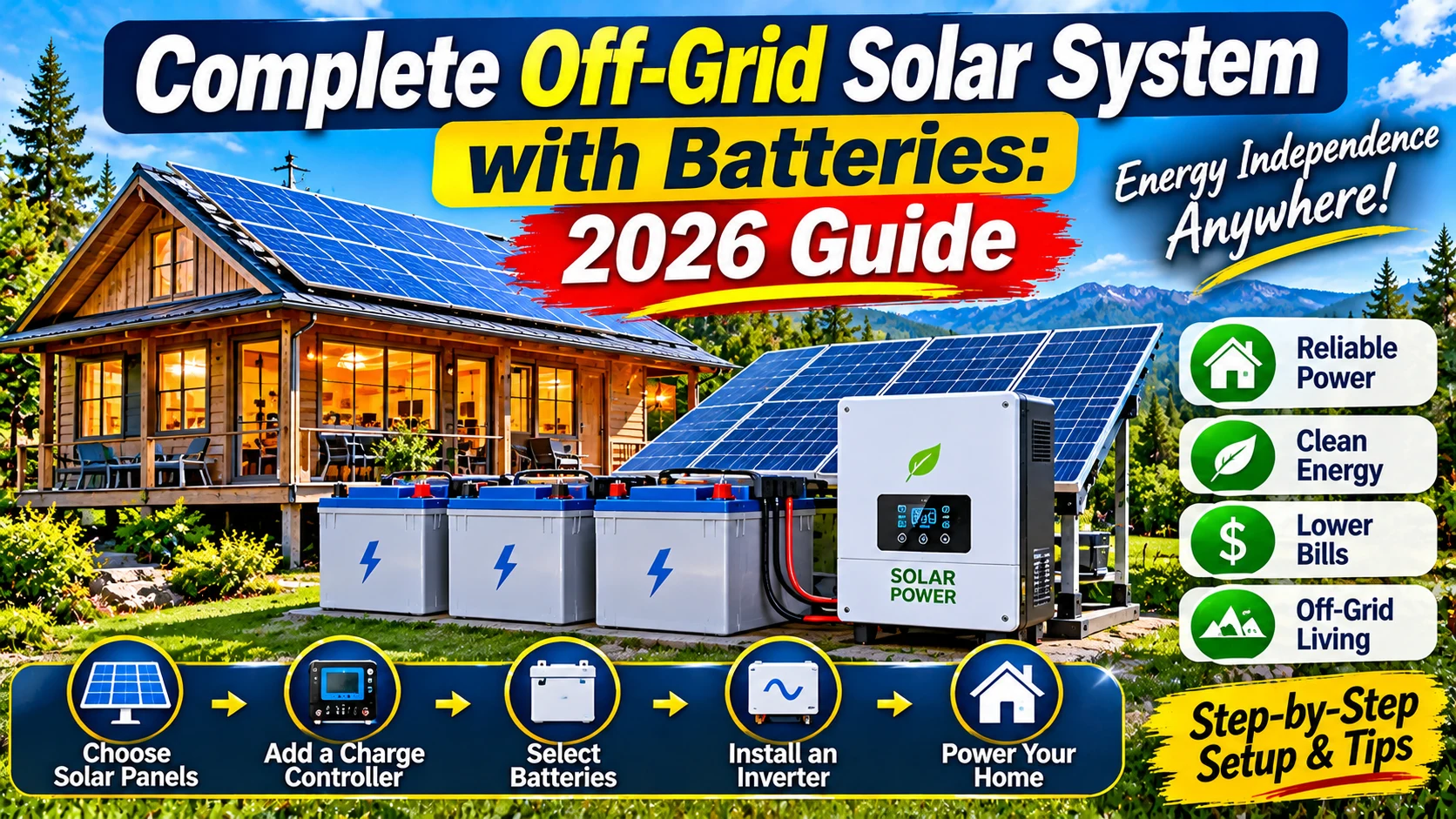
Complete Off-Grid Solar System with Batteries for Energy Independence
Discover how to generate, store, and manage your own electricity with a complete off-grid solar power system. Learn how to choose solar panels, batteries, inverters, and essential components for a reliable independent energy setup.
Imagine having reliable electricity without depending on a traditional utility connection. Whether you live in a remote cabin, own a rural property, operate a small farm, or simply want greater control over your energy supply, a complete off-grid solar system with batteries can help make energy independence possible.
Unlike a standard grid-connected solar installation, an off-grid system generates electricity from sunlight and stores unused energy in batteries. This stored electricity can power your appliances at night, during cloudy weather, or whenever solar panels are not producing enough energy.
However, building a dependable system requires more than purchasing solar panels and connecting a battery. Every component must be correctly sized to match your electricity consumption, local sunlight conditions, and backup requirements.

1. What Is a Complete Off-Grid Solar System?
An off-grid solar system is an independent electricity setup that operates without relying on the utility grid. Solar panels convert sunlight into DC electricity, which is regulated and used to charge batteries or supply power through an inverter.
The battery bank stores energy for periods when sunlight is unavailable. The inverter converts DC electricity into AC electricity for household appliances such as refrigerators, televisions, computers, lights, and other equipment.
How an Off-Grid Solar System Works
Generate DC power
Regulates charging
Stores electricity
Converts DC to AC
Final destination: Household appliances and electrical equipment.
2. Main Components of an Off-Grid Solar System
Solar Panels
Solar panels are responsible for generating electricity from sunlight. Their combined power rating, measured in watts (W), determines how much electricity the system can potentially produce under suitable conditions.
When choosing solar panels, consider:
- Total daily electricity consumption.
- Available roof or ground installation space.
- Local sunlight conditions throughout the year.
- Panel efficiency and product warranty.
- Temperature, shading, orientation, and installation angle.
For a larger off-grid installation, several panels are connected in series or parallel to achieve the voltage and current required by the solar charge controller. The electrical limits of the controller must always be respected.
Solar Battery Bank
The battery bank is one of the most important parts of an off-grid solar system. It stores electricity generated during the day so that appliances can continue operating after sunset or during periods of limited solar production.
Battery capacity is usually measured in kilowatt-hours (kWh) or amp-hours (Ah). However, nominal capacity is not the same as usable capacity. The recommended depth of discharge depends on battery chemistry and manufacturer specifications.
| Battery Type | Typical Planning DoD | Main Advantage | Consideration |
|---|---|---|---|
| Flooded Lead-Acid | Around 50% | Lower initial cost | Maintenance and ventilation may be required |
| AGM / Gel | Often around 50% | Sealed battery options | Usable capacity and lifespan vary |
| LiFePO4 | Often 80–90% | High usable capacity and long cycle life | Higher upfront cost; requires compatible BMS and charging settings |
Why consider LiFePO4 batteries? Lithium iron phosphate batteries are popular for modern off-grid installations because they can offer high usable capacity, efficient operation, and long cycle life. Choose a battery with a suitable battery management system (BMS), compatible inverter settings, and appropriate temperature protection.
Solar Inverter
The inverter converts the battery bank’s DC electricity into AC electricity used by most household appliances.
For a residential off-grid installation, a pure sine wave inverter is generally the preferred option because it provides AC output suitable for many sensitive electronics and motor-driven appliances.
Before choosing an inverter, check:
- Continuous power rating in watts or kilowatts.
- Surge capacity for starting motors and compressors.
- Compatibility with the battery bank voltage.
- Battery charging and generator input options.
- Efficiency and manufacturer support.
MPPT Solar Charge Controller
An MPPT charge controller manages the electricity coming from the solar panels and adjusts the charging process to suit the battery bank.
It helps extract available solar energy efficiently while protecting the battery from inappropriate charging conditions. The controller must be compatible with the panel array voltage, maximum input current, battery voltage, and battery chemistry.
Mounting Equipment, Cables, and Protection
A reliable installation also requires strong mounting structures, correctly rated solar cables, connectors, fuses, circuit breakers, disconnect switches, grounding, and suitable surge protection.
These components are essential for safe operation. They should be selected according to system voltage, current, installation environment, and applicable electrical standards.
3. How to Calculate Your Off-Grid Solar System Size
The most important step is calculating how much electricity your property uses every day. Do not choose a solar system based only on the size of your house. A small property with energy-intensive appliances may need a larger installation than a bigger, energy-efficient home.
Step 1: Calculate Daily Energy Consumption
Make a list of the appliances you want to power. Multiply each appliance’s wattage by the number of hours it operates per day.
Daily Wh = Appliance Watts × Hours Used
Add the daily energy consumption of all appliances to calculate your total electricity requirement.
Here is an example of a small household energy audit:
| Appliance | Power | Daily Use | Energy |
|---|---|---|---|
| Refrigerator | 150 W average | 8 hours equivalent | 1,200 Wh |
| LED Lighting | 60 W | 5 hours | 300 Wh |
| Television | 100 W | 4 hours | 400 Wh |
| Laptop | 65 W | 5 hours | 325 Wh |
| Small Water Pump | 500 W | 1 hour | 500 Wh |
| Estimated Daily Total | 2,725 Wh | ||
This example uses simplified energy estimates. Actual refrigerator consumption depends on its efficiency, ambient temperature, and operating cycle. Always check real appliance consumption when possible.
Step 2: Calculate Solar Panel Capacity
Once you know your daily electricity consumption, estimate the solar panel capacity required to produce enough energy.
A preliminary formula is:
Solar Array Watts = Daily Wh ÷ (Peak Sun Hours × System Performance Factor)
For example, assume your household uses 2,725 Wh per day, receives 5 peak sun hours in the design season, and the system performance factor is estimated at 0.75.
2,725 ÷ (5 × 0.75) = approximately 727 W.
This is a simplified starting estimate, not a final system specification. Additional capacity may be needed to recharge batteries, cover cloudy periods, and support seasonal changes. Use the worst-month solar resource for your location rather than relying only on annual averages.
Step 3: Calculate Battery Capacity
The battery bank should store enough usable energy to cover nighttime consumption and the number of backup days you require.
Nominal Battery Capacity = Daily Energy × Backup Days ÷ (Usable DoD × Efficiency)
For example, consider a household using 2.725 kWh daily, with two days of autonomy, an 80% usable battery depth of discharge, and an estimated 90% discharge-path efficiency.
2.725 × 2 ÷ (0.80 × 0.90) = approximately 7.57 kWh of nominal battery capacity.
A battery bank around this size is a preliminary example. The final design should account for inverter standby consumption, battery manufacturer limits, temperature, aging, and actual load patterns.
Step 4: Choose the Right Inverter
Battery capacity and inverter power are two different measurements. A battery’s kWh rating tells you how much energy it stores, while an inverter’s kW rating tells you how much power it can deliver at a given moment.
Calculate the appliances that may operate simultaneously and include their starting surge requirements. Refrigerators, pumps, compressors, and other motors can briefly require considerably more power than their normal running rating.
4. Example of a Complete Off-Grid Solar Setup
For a small home using approximately 2.7 kWh of electricity per day, a preliminary system concept could look like this:
This is an educational example rather than a ready-to-install shopping list. The solar array, inverter, controller, cables, and protection devices must be engineered as one compatible system.
5. How Many Batteries Do You Need?
The number of batteries depends on their individual capacity, voltage, and the total storage required.
For example, if you need approximately 8 kWh of nominal storage and select batteries rated at 5 kWh each, two batteries would provide around 10 kWh of nominal capacity, provided their specifications and system configuration are compatible.
Before connecting multiple batteries, check:
- Whether the manufacturer permits series or parallel connections.
- Maximum supported battery count.
- Battery voltage and capacity compatibility.
- BMS communication requirements.
- Equal cable lengths and appropriate busbar arrangements where required.
- Recommended fusing and isolation for each battery branch.
6. Benefits of an Off-Grid Solar System with Batteries
Greater Energy Independence
You can generate and store your own electricity instead of relying entirely on a utility provider. This is particularly useful for remote homes and properties without convenient grid access.
Electricity During Grid Outages
A correctly designed off-grid system can continue supplying its connected loads when the public electricity grid is unavailable because it does not depend on that grid for normal operation.
Renewable Energy
Solar panels generate electricity without directly burning fuel during operation. A solar-and-battery setup can reduce dependence on fossil-fuel-based electricity, depending on the energy sources it replaces.
Flexible Installation
Off-grid systems can be designed for cabins, farms, workshops, rural homes, tiny houses, and other locations where a conventional grid connection is difficult or expensive.
Better Control of Energy Consumption
Battery monitoring and inverter displays help users understand energy production, storage levels, and electricity consumption. This information can encourage more efficient energy habits.
7. How Much Does a Complete Off-Grid Solar System Cost?
The cost of an off-grid solar installation depends on system capacity, battery technology, equipment quality, installation complexity, and local labor costs.
In general, the battery bank and inverter can represent a significant portion of the total investment. Installation costs may also increase when a property needs extensive wiring, ground mounting, structural work, or additional electrical protection.
| Cost Factor | What Influences the Price? |
|---|---|
| Solar Panels | Number, wattage, efficiency, and brand. |
| Battery Storage | Chemistry, usable capacity, BMS, and battery count. |
| Inverter | Power rating, surge capacity, features, and brand. |
| Charge Controller | PV input limits, charging current, and compatibility. |
| Installation | Labor, mounting, wiring, protection, and site conditions. |
For an accurate budget, request a quotation based on your actual energy audit and equipment specifications. Avoid comparing systems using panel wattage alone: two installations with the same solar array can have very different battery capacity and inverter performance.
8. Common Mistakes to Avoid
- Buying too few batteries: Insufficient storage can leave appliances without power overnight or during cloudy weather.
- Undersizing the solar array: Panels may produce enough energy on sunny days but fail to recharge the batteries adequately in the worst season.
- Choosing an undersized inverter: Large appliances and motor-starting surges can overload an inverter.
- Ignoring battery compatibility: Incorrect charging settings can reduce battery life or create safety risks.
- Using unsuitable cables: Incorrect cable sizes and poor connections can cause voltage drop, overheating, or equipment damage.
- Forgetting electrical protection: Fuses, breakers, disconnects, grounding, and surge protection are essential parts of a safe installation.
- Ignoring energy efficiency: Reducing unnecessary electricity consumption can lower the required system size and cost.
9. Maintenance Tips for Long-Term Performance
Even though solar systems generally require less routine maintenance than fuel-powered generators, regular inspections help protect performance and equipment life.
- Inspect solar panels and clean them when dust or dirt reduces production.
- Check mounting structures for corrosion, loose fasteners, or physical damage.
- Monitor battery voltage, temperature, and state of charge.
- Review inverter and charge controller error messages.
- Inspect cables, connectors, breakers, and electrical enclosures for damage.
- Keep equipment within the temperature and ventilation conditions specified by the manufacturer.
- Schedule professional electrical inspections when required.
LiFePO4 batteries need particular attention to low-temperature charging limits. Some batteries include internal heating or charging protection, but you should never assume that every model supports charging below freezing.
10. Is an Off-Grid Solar System Worth It?
An off-grid solar system can be a valuable investment for people who need independent electricity, especially in remote areas where grid connection is unavailable or costly.
However, complete energy independence requires careful planning. The system must produce enough electricity during the least favorable solar season, store enough energy for periods without sunlight, and support the appliances that users expect to operate.
For some properties, a hybrid solar system connected to the utility grid may be more economical. For others, a fully off-grid installation offers the flexibility and independence they need.
Final Thoughts
A complete off-grid solar system with batteries can provide a practical path toward energy independence. By combining solar panels, reliable battery storage, an appropriately sized inverter, and proper electrical protection, homeowners can build a system that meets their daily energy needs.
The key is to start with an accurate energy audit, calculate battery autonomy, size the solar array for local conditions, and choose compatible equipment. A carefully designed system is more valuable than simply buying the largest panels or batteries you can afford.
Frequently Asked Questions
1. What do I need for a complete off-grid solar system?
You generally need solar panels, an MPPT charge controller, a compatible battery bank, an off-grid inverter, mounting equipment, suitable cables, electrical protection, and grounding.
2. How many solar panels are needed for an off-grid house?
The number depends on daily electricity consumption, panel wattage, local peak sun hours, seasonal weather, and system losses. Calculate the required total array wattage before deciding how many panels to buy.
3. What is the best battery for an off-grid solar system?
LiFePO4 batteries are a popular choice because they offer high usable capacity and long cycle life. However, the best option depends on budget, temperature, charging requirements, and manufacturer specifications.
4. Can an off-grid solar system power an entire house?
Yes, if the solar array, battery bank, inverter, and protection equipment are correctly sized for the home’s energy consumption and peak loads. Large heating and cooling appliances may require substantial additional capacity.
5. How many days can solar batteries provide backup power?
Backup time depends on usable battery capacity and daily energy consumption. A larger battery bank can provide more autonomy, but the system must also have enough solar generation to recharge it.
6. Is a 48V battery system better for a large off-grid installation?
A 48V battery architecture is commonly used in larger residential off-grid systems because it can reduce DC current for a given power level compared with lower-voltage systems. The inverter and battery must be designed for the same voltage.
7. Can I expand my off-grid solar system later?
Many systems can be expanded, but future upgrades should be planned from the beginning. Check inverter capacity, controller limits, battery compatibility, cable ratings, and available installation space.
Disclaimer: This article provides general educational information, not a site-specific electrical design. Solar and battery installations involve potentially dangerous DC and AC voltages and currents. Consult a qualified solar installer or electrical professional, follow local regulations, and use manufacturer-approved equipment and wiring instructions.