
SOLAR ENERGY • DIY & HOME IMPROVEMENT
Solar Panel Fence: Benefits, Costs and Installation Guide (2026)
Can your garden fence generate electricity? Discover how solar panel fences work, their advantages and disadvantages, installation options, and the key factors to consider before investing.
Quick Answer: Can You Install Solar Panels on a Fence?
Yes. Solar panels can be installed vertically along a suitable fence or mounted on a specially designed fence structure. This approach can turn an otherwise unused boundary into a small solar electricity generator.
However, a vertical solar panel fence generally receives sunlight at a different angle from a well-oriented tilted array. Its electricity production depends on location, orientation, shading, panel specifications, and seasonal sunlight. It is most useful when the fence receives good sunlight and the installation is properly engineered.

1. What Is a Solar Panel Fence?
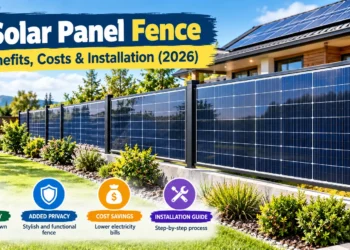
A solar panel fence is a fencing system that incorporates photovoltaic (PV) panels into or alongside its structure. Instead of using every section of a property boundary only for privacy or security, a solar fence can also generate electricity from sunlight.
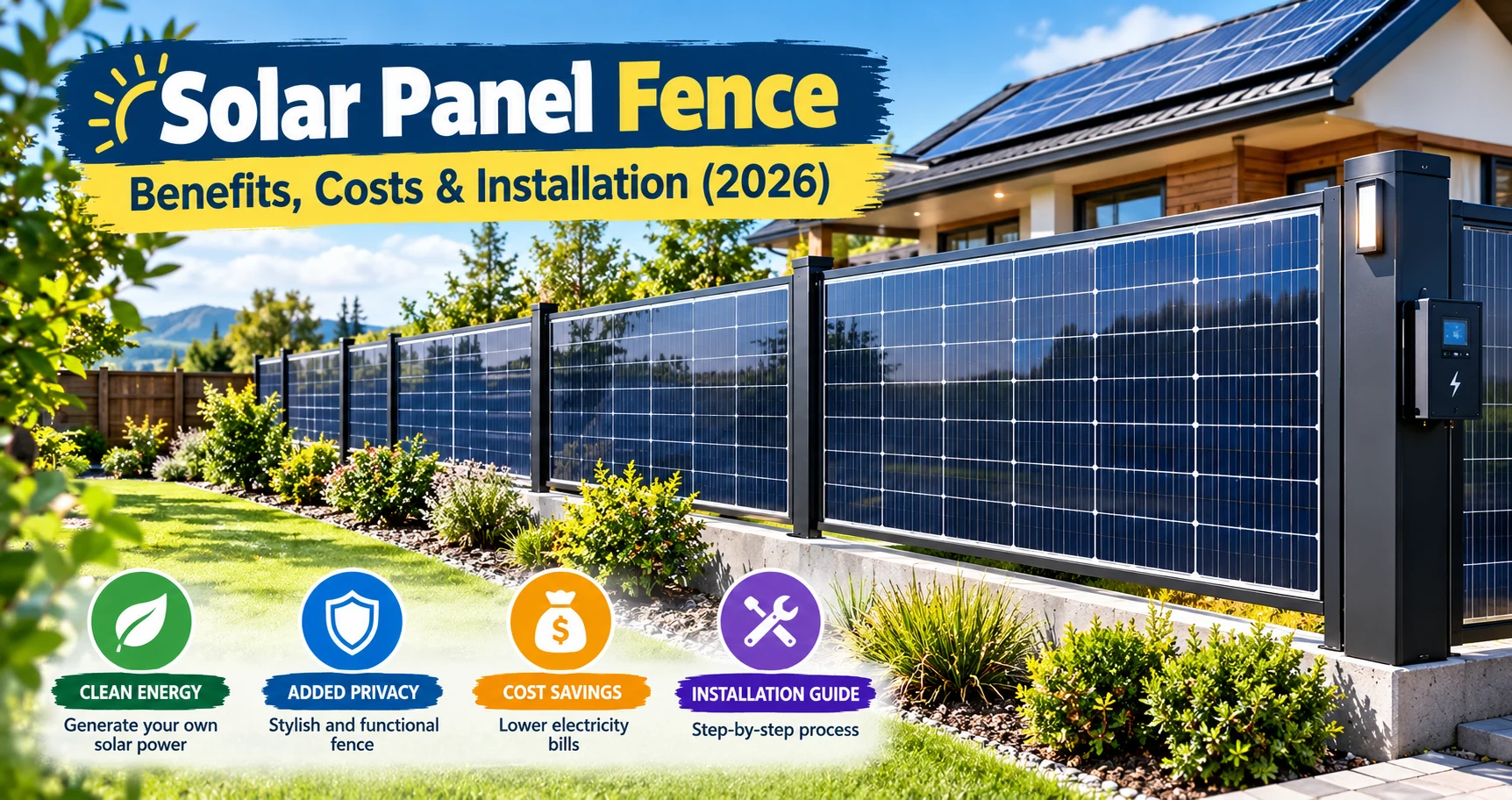
As illustrated by the idea behind this project, framed solar panels can be mounted vertically against a suitable metal fence or incorporated into a purpose-built solar fencing system. The finished installation can provide a practical alternative when rooftop space is limited or a conventional ground-mounted array is not suitable.
Solar fencing can take several forms:
Fence-Mounted Panels
Conventional framed panels attached to a purpose-designed, structurally suitable fence or support system.
Integrated Solar Fencing
Specialized systems designed to combine photovoltaic modules with fencing components.
Bifacial Solar Fence
A system using panels capable of collecting light from both sides when the design and surroundings provide useful reflected or rear-side light.
A solar fence can potentially support household electricity use, compatible batteries, lighting, or other electrical loads through an appropriately designed system. Its actual output must be evaluated for the specific site rather than assumed from the panel’s advertised wattage alone.
2. How Does a Solar Panel Fence Work?
The basic electricity-generation process is similar to that of a conventional solar installation. The difference is that the panels are mounted vertically or near-vertically along a boundary.
The amount of electricity generated changes throughout the day and across the seasons. A panel that receives direct sunlight for several hours may produce substantially more electricity than an identical panel shaded by a building, tree, or neighboring fence.
3. Seven Benefits of Installing Solar Panels on a Fence
1. Make Better Use of Existing Space
One of the biggest attractions of a solar fence is its use of an existing property boundary. Homes with limited roof space or small gardens may have few convenient locations for additional solar panels. A suitable sunny fence can create another installation option without occupying the center of the garden.
2. Generate Renewable Electricity
Solar panels can produce electricity during daylight hours without burning fuel at the point of generation. The electricity can offset some purchased power when it is used by compatible household loads.
The environmental benefit depends on the electricity source being displaced, the manufacturing and installation impacts, and the system’s lifetime performance.
3. Combine Energy Production With a Property Boundary
A well-designed solar fence can serve two purposes: defining a property boundary and generating electricity. Some purpose-built systems can also provide a modern architectural appearance, although the final result depends on the panel arrangement and fence design.
4. Offer an Alternative to Rooftop Installation
Not every roof is suitable for solar panels. Roof shading, orientation, structural limitations, complicated roof geometry, or limited available space can make other locations worth considering. A fence may be an option if it has adequate sunlight and can safely support the equipment.
5. Provide Opportunities for Small Solar Projects
A small fence-mounted array can be used as part of a carefully planned project for compatible loads. Depending on its size and electrical configuration, a system may support selected lights, small appliances, or battery charging.
However, do not assume a small array can power a whole house. Household consumption, seasonal production, and peak electrical demand must all be considered.
6. Potentially Improve Low-Sun-Angle Production
Vertical panels can receive sunlight at useful angles during certain parts of the day or year. In some locations, a well-oriented vertical installation may produce a different seasonal pattern from a tilted rooftop array.
This is not a universal advantage: the result depends on latitude, orientation, shading, weather, and nearby reflective surfaces.
7. Create a Potential Option for Bifacial Panels
Bifacial solar modules can collect light from their front and rear surfaces. A fence arrangement may be worth investigating if the rear side receives useful reflected or direct light.
Additional production is not guaranteed. A fence, wall, dense vegetation, or other obstruction immediately behind the panel may limit rear-side illumination.
4. Disadvantages and Limitations of Solar Panel Fences
Although solar fencing can be useful, it is not automatically more efficient or cheaper than conventional solar mounting. Consider the following limitations before purchasing equipment.
| Potential Challenge | Why It Matters |
|---|---|
| Vertical orientation | Panels may receive less direct sunlight than a suitably tilted array during some periods. |
| Shading | Trees, buildings, fence posts, and neighboring structures can reduce output. |
| Structural requirements | The fence and its foundations must safely support the panels and resist local wind loads. |
| Installation cost | Reinforcing or replacing a fence can add cost beyond the solar equipment. |
| Limited capacity | The available fence length may restrict the number of panels that can be installed. |
| Access and maintenance | Panels may be more exposed to accidental impact, vegetation, dirt, and damage. |
There is also a practical trade-off between privacy and electricity production. A dense screen or solid backing may affect how much sunlight reaches a panel’s rear surface. The design should be evaluated as a complete system rather than treating the fence and solar panels as unrelated components.
5. Does Fence Direction Affect Solar Production?
Yes. The direction a fence faces can influence how much sunlight its panels receive and when electricity is produced. The best orientation depends on the location, nearby obstructions, local weather, and the household’s energy-use pattern.
| Site Condition | What to Consider |
|---|---|
| Fence receives strong sunlight | May provide a useful location for a vertical array. |
| Fence is shaded for much of the day | Production may be too low to justify the installation cost. |
| Fence faces east or west | Production timing may differ, with more exposure during morning or afternoon hours depending on the site. |
| Fence faces toward the equator | May receive useful sunlight, but the optimal arrangement depends on local latitude and conditions. |
| Bifacial panels have open space behind them | Rear-side light may contribute to production if the surroundings provide sufficient illumination. |
In the Northern Hemisphere, south-facing surfaces often receive favorable annual sunlight, but a vertical south-facing panel is not equivalent to a south-facing tilted panel. East-west orientations can also be useful for certain daily production patterns.
Best approach: Ask an installer to model the actual fence location, orientation, shade, and proposed panel layout. An annual energy estimate is more useful than relying on a general rule about direction.
6. How Much Does a Solar Panel Fence Cost in 2026?
The price of a solar fence depends on the number and type of panels, fence materials, mounting hardware, foundations, electrical equipment, labor, and local regulations. Retrofitting an existing fence may cost less than building a new structure, but only if the existing fence is suitable.
| Project Type | Illustrative Budget | Main Consideration |
|---|---|---|
| Small experimental installation | Hundreds of dollars to several thousand | Equipment and mounting requirements vary widely. |
| Fence retrofit with several panels | Several thousand dollars or more | Fence reinforcement and electrical work may be significant. |
| Purpose-built residential solar fence | Several thousand to tens of thousands | Fence length, foundations, panel capacity, and finish affect the total. |
| Long or specialized solar fence | Project-specific quotation required | Engineering, access, site conditions, and system scale determine the price. |
These broad categories are not suitable for calculating a final project budget. Obtain itemized quotations that identify the structure, panels, inverter, wiring, labor, permits, and any battery equipment separately.
What Affects the Final Price?
- Solar panels: Module type, power rating, dimensions, and warranty.
- Fence construction: Posts, rails, foundations, materials, and reinforcement.
- Mounting hardware: Clamps, rails, brackets, and weather-resistant fasteners.
- Electrical equipment: Inverter, wiring, disconnects, protection devices, and monitoring.
- Battery storage: Optional battery capacity, power rating, and compatible controls.
- Installation: Labor, site access, electrical work, engineering, and local permits.
Is a Solar Fence Financially Worth It?
To estimate the financial benefit, calculate the electricity generated each year and determine how much of it will replace electricity you would otherwise purchase.
For example, if a system produces 1,000 kWh annually and 80% is used to offset electricity priced at $0.20 per kWh, the approximate annual value of that directly used electricity would be:
Annual production: 1,000 kWh
Directly used electricity: 1,000 × 80% = 800 kWh
Illustrative electricity value: 800 × $0.20 = $160 per year
This simplified example excludes installation costs, maintenance, financing, degradation, incentives, and the value of any exported electricity. It is not a prediction of a real system’s performance.
Compare the estimated annual value with the total installed cost. A solar fence may be less financially attractive than a conventional solar array if the vertical orientation produces less energy while the specialized mounting structure adds significant expense.
7. How to Install a Solar Panel Fence Safely
Planning is essential because solar panels add weight and wind resistance to a fence. A structure that was designed only as a boundary may not be strong enough to support the additional loads.
Step 1: Inspect the Fence and Site
Check the fence’s condition, post spacing, foundations, available space, and exposure to sunlight. Identify nearby trees, buildings, and objects that could cast shadows.
Step 2: Choose Compatible Panels and Mounts
Select panels that fit the intended layout and use mounting equipment designed for the installation. Avoid assuming that ordinary fence mesh, thin rails, or decorative panels can safely support a solar array.
Step 3: Assess Wind and Structural Loads
Have the structure evaluated for local wind conditions and any other relevant loads. A vertical panel can act like a sail, placing substantial force on its mounting points and foundations.
Step 4: Plan the Electrical System
Determine the array’s voltage and current, inverter or charge-controller compatibility, cable routing, overcurrent protection, grounding or earthing, and disconnect requirements. Electrical design must comply with applicable local codes.
Step 5: Obtain Required Approvals
Check whether building permission, electrical inspections, property-boundary restrictions, or utility approval are required. Requirements vary by jurisdiction and by whether the system is grid-connected.
Step 6: Install and Test the System
Use suitable mounting methods and have electrical connections completed or checked by qualified professionals. Test the installation, inspect the cable routing, and confirm that the system operates within the equipment manufacturers’ specifications.
8. Solar Panel Fence vs. Rooftop Solar
Both options can generate renewable electricity, but they suit different properties and budgets.
| Feature | Solar Fence | Rooftop Solar |
|---|---|---|
| Installation location | Property boundary or purpose-built fence | Suitable roof surface |
| Use of space | Can make use of an existing boundary | Uses available roof area |
| Orientation | Often vertical or near-vertical | Can often be installed at a suitable tilt |
| Structural concerns | Fence strength, posts, foundations, and wind | Roof condition, loading, and waterproofing |
| Potential cost advantage | May be useful when fence space is already available | May cost less when the roof is suitable |
| Best starting point | Properties with a sunny, suitable boundary | Properties with a suitable roof and sufficient area |
Which is better? If your main goal is maximizing solar generation at the lowest reasonable cost, compare a fence installation against a properly designed rooftop or ground-mounted array. The best choice depends on the property rather than the mounting method alone.
9. Solar Fence Maintenance Tips
Solar panels generally require limited routine maintenance, but fence-mounted equipment should be inspected regularly because it may be exposed to accidental contact, vegetation, and weather.
- Inspect the mounting points and fence posts for movement, corrosion, or damage.
- Keep vegetation from shading the panels or interfering with the structure.
- Check for dirt and clean the panels according to the manufacturer’s instructions.
- Inspect accessible cables and protective conduits for visible damage.
- Monitor system output and investigate unexpected drops in production.
- Check drainage and the surrounding ground for erosion near the foundations.
- Arrange professional inspections if severe weather or physical damage occurs.
Do not climb on the fence or attempt electrical repairs while the system is energized. Follow the manufacturer’s cleaning guidance and use a qualified technician for electrical or structural problems.
10. Frequently Asked Questions
Can I attach solar panels to an existing garden fence?
Possibly, if the fence, posts, foundations, and mounting equipment are suitable for the additional weight and wind loads. Many ordinary fences need reinforcement or replacement before they can safely support panels.
Do vertical solar panels generate electricity?
Yes. Vertical panels generate electricity when sunlight reaches their cells. Their output depends on orientation, location, shading, weather, and seasonal sunlight, and may differ from that of tilted panels.
Are solar panel fences worth the money?
They can be worthwhile where fence space receives strong sunlight and the installation cost is reasonable. Compare expected annual production and electricity savings with the total installed price before making a decision.
Can a solar fence power an entire house?
It depends on the array’s capacity, solar production, household energy consumption, and electrical configuration. A short fence may not provide enough panel area to cover a home’s annual energy use. A detailed system design is necessary.
Are bifacial solar panels better for a fence?
They may be useful when the rear of the panels receives additional sunlight or reflected light. Their benefit depends on the space behind the panels, surface reflectivity, shading, and mounting design.
Can I build a DIY solar panel fence?
A DIY project may be possible for someone with appropriate skills, but structural design and electrical safety are essential. Use suitable mounting hardware, verify wind resistance, and have grid-connected electrical work completed or inspected by qualified professionals as required locally.
Do solar panels work when it is cloudy?
Yes. They can generate electricity under cloudy skies, although production is generally lower than under strong direct sunlight. The reduction depends on cloud cover and local conditions.
Final Verdict: Is a Solar Panel Fence a Good Idea?
THE BOTTOM LINE
A solar panel fence can be an innovative way to generate renewable electricity from a property boundary that would otherwise serve only as a fence. It may be particularly attractive when rooftop space is limited and the fence receives plenty of sunlight.
However, vertical panels do not automatically produce more electricity or cost less than conventional solar installations. Fence strength, orientation, shading, installation costs, and electrical safety all matter.
Before investing, compare the expected energy production and total installed cost with a conventional solar array. A well-planned system should fit your property, electrical needs, and long-term budget.