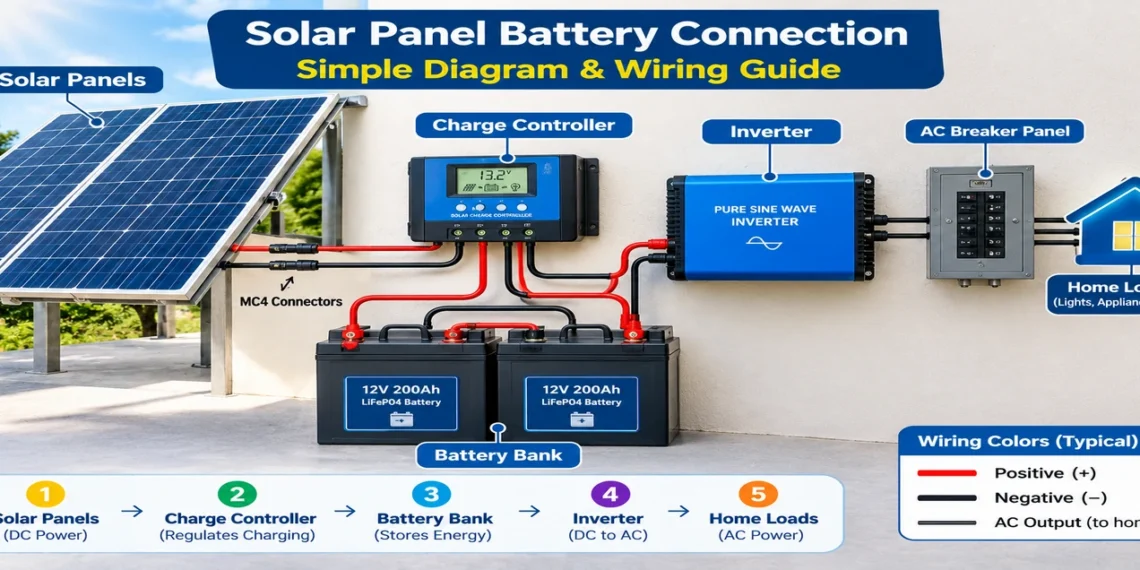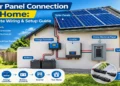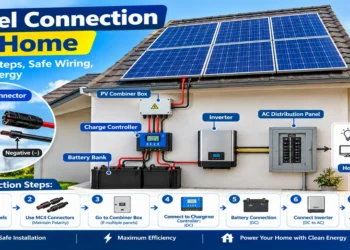

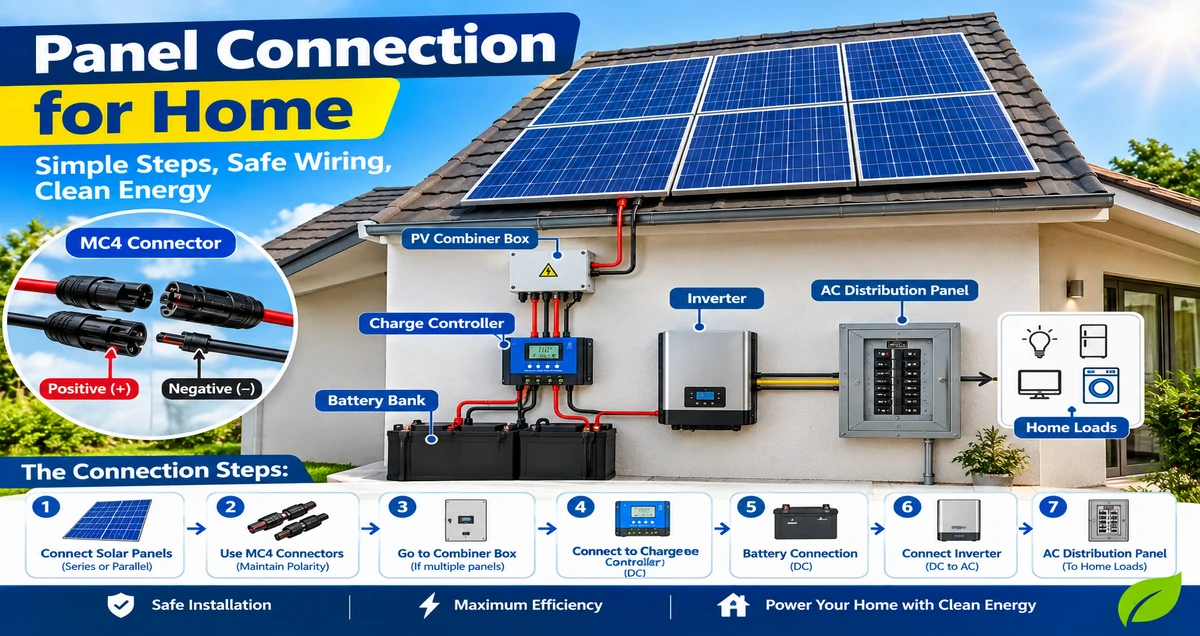
Connecting solar panels to a home is more than simply attaching panels to a roof and plugging in a cable. A properly designed residential solar system combines solar panels, wiring, an inverter, protection equipment, the home’s electrical panel, and sometimes battery storage.
This guide explains how a solar panel connection for home works, the main components involved, series versus parallel connections, battery integration, grid connection, system sizing, and important safety considerations.
Safety note: Solar PV systems can produce dangerous DC voltage even when the utility power is disconnected. Exact wire sizes, overcurrent protection, disconnects, grounding, inverter settings, and grid-interconnection requirements depend on the equipment and local electrical rules. Installation and final connection should be performed or inspected by a qualified professional.
What Is a Solar Panel Connection for Home?
A solar panel connection for home is the electrical pathway that transfers electricity produced by photovoltaic (PV) panels into a home’s usable electrical system.
A typical residential system works approximately like this:
Sunlight → Solar Panels → DC Wiring → Inverter → AC Electrical Panel → Home Appliances
If battery storage is included:
Sunlight → Solar Panels → Inverter/Charge System → Battery → Home Loads
A PV panel generates direct current (DC) electricity. Because most household appliances use alternating current (AC), an inverter is normally required to convert the electricity into a usable AC supply.
How Does a Solar Panel Connection Work?
The basic process is straightforward:
1. Solar panels generate electricity
When sunlight reaches the photovoltaic cells, the cells generate electrical energy.
The output from individual panels can be combined into one or more electrical strings or handled by panel-level electronics.
2. DC electricity travels through PV wiring
The electricity produced by the panels travels through appropriately rated PV cables and electrical protection equipment.
Depending on the system design, panels may be connected in series, parallel, or a combination of both.
3. The inverter converts DC to AC
The inverter converts the panels’ DC electricity into AC electricity suitable for the home’s electrical system.
Inverters are a central component of residential PV systems because they perform the DC-to-AC conversion.
4. Electricity enters the home’s electrical system
The AC output can then supply household electrical loads through the properly designed electrical distribution system.
5. Excess electricity may be stored or exported
Depending on the system configuration, excess solar energy can:
- Charge a battery
- Supply additional household loads
- Be exported to the utility grid where permitted
- Be curtailed when production exceeds available demand or system limits
The exact operation depends on the inverter, battery system, utility arrangement, and local rules.
Solar Panel Connection Diagram for a Home
A simplified grid-connected system looks like this:
             SUNLIGHT
                ↓
        ┌─────────────────┐
        │   SOLAR PANELS  │
        └────────┬────────┘
                 │
                 │ DC
                 ↓
        ┌─────────────────┐
        │  PV PROTECTION  │
        │ / DISCONNECTS   │
        └────────┬────────┘
                 │
                 ↓
        ┌─────────────────┐
        │     INVERTER    │
        └────────┬────────┘
                 │
                 │ AC
                 ↓
        ┌─────────────────┐
        │ ELECTRICAL PANEL│
        └───────┬─────────┘
                │
        ┌───────┴─────────┐
        ↓                 ↓
   HOME APPLIANCES     UTILITY GRID
A solar-plus-battery system adds storage:
SOLAR PANELS
      ↓
    INVERTER
      ↓
 ┌────┴─────┐
 ↓          ↓
HOME      BATTERY
LOADS        ↓
             └── BACKUP LOADS
This is a conceptual diagram, not a wiring plan. Actual systems require equipment-specific engineering.
What Equipment Is Needed for a Solar Panel Connection?
A residential solar installation can include several important components.
1. Solar Panels
Solar panels convert sunlight into DC electricity.
The number of panels depends on the home’s electricity consumption, panel wattage, local solar conditions, available roof area, shading, and desired solar production.
2. Solar Inverter
The inverter converts DC electricity from the PV system into AC electricity used by the home’s electrical system.
Common inverter configurations include:
- String inverter
- Microinverters
- Hybrid inverter
- Off-grid inverter
- Grid-interactive inverter
A string inverter handles electricity from a group of panels, while a microinverter is installed at the panel level.
3. Solar PV Wiring
PV cables connect the solar modules to the inverter or other power electronics.
The cable must be suitable for the electrical environment, voltage, current, temperature, sunlight exposure, and installation method.
Do not choose cable size based only on the panel wattage.
4. Electrical Protection Equipment
Depending on the design, a system may require equipment such as:
- DC disconnects
- AC disconnects
- Circuit breakers
- Fuses
- Surge protection
- Grounding and bonding equipment
- Appropriate enclosures
- Rapid-shutdown equipment where required
The exact equipment depends on the system design and applicable electrical requirements.
5. Electrical Distribution Panel
The home’s electrical panel distributes AC electricity to household circuits.
A solar installation must be connected to the home’s electrical system according to the inverter manufacturer’s requirements and applicable electrical rules.
6. Battery Storage
Battery storage is optional for many grid-connected systems but can provide additional functionality.
A battery can store solar energy for later use, including periods when solar production is low.
Solar Panels in Series vs. Parallel
One of the most important decisions in PV wiring is how panels are electrically combined.
Solar Panels in Series
When panels are connected in series:
Voltage increases while current remains approximately the same.
For example, consider three hypothetical panels:
- Panel voltage: 40 V
- Panel current: 10 A
Connected in series:
40 V + 40 V + 40 V = 120 V
The current remains approximately:
10 A
This can be useful for creating a PV string with a voltage appropriate for the inverter’s operating range.
However, the string must remain within the inverter’s maximum voltage limits, including conditions such as low temperatures that can increase PV voltage.
Solar Panels in Parallel
When panels or strings are connected in parallel:
Current increases while voltage remains approximately the same.
For example:
- String voltage: 40 V
- String current: 10 A
Two similar strings in parallel could produce approximately:
40 V × 20 A
The actual design must account for equipment ratings, conductor ampacity, protection requirements, and module electrical characteristics.
Series vs. Parallel: Which Is Better?
There is no universal answer.
The correct configuration depends on:
- Panel electrical specifications
- Inverter voltage range
- Maximum inverter input voltage
- Maximum input current
- Number of MPPT inputs
- Roof layout
- Shading
- Temperature
- Cable distances
- Local electrical requirements
A properly designed system balances voltage and current rather than simply trying to maximize either one.
How Many Solar Panels Can You Connect to a Home?
The number of solar panels is determined primarily by the home’s energy requirements and the characteristics of the solar site.
For example, suppose you use 10,000 kWh of electricity annually and choose 400-watt panels.
A simple first estimate might be:
10,000 kWh ÷ estimated annual production per kW = required solar capacity
If a hypothetical location produces approximately 1,400 kWh annually for each installed kW:
10,000 ÷ 1,400 ≈ 7.1 kW
A 7.1 kW system using 400 W panels would require approximately:
7,100 W ÷ 400 W ≈ 18 panels
This is only an illustration. Actual system sizing should use location-specific solar production estimates, losses, roof conditions, and electrical requirements.
Solar Panel Connection to an Inverter
The PV array connects to the inverter through the system’s DC-side equipment.
The inverter must be compatible with the PV array’s:
- Operating voltage
- Maximum voltage
- Operating current
- Maximum input current
- Number of strings
- MPPT configuration
- Temperature range
This is one reason you should not connect an arbitrary number of panels to an inverter simply because the total wattage appears suitable.
The inverter’s electrical specifications are just as important as the panel wattage.
Solar Panel Connection to the Home Electrical Panel
After converting DC electricity into AC electricity, the inverter connects to the home’s electrical distribution system through appropriate protection and disconnect equipment.
Conceptually:
Solar Panels
     ↓
DC Wiring
     ↓
Inverter
     ↓
AC Protection
     ↓
Home Electrical Panel
     ↓
Household Circuits
The exact connection point and protection arrangement depend on the inverter, electrical panel, service configuration, system capacity, and local electrical requirements.
A professional installer should verify the existing electrical service before installation.
Can Solar Panels Be Connected Directly to a Wall Outlet?
Generally, a standard rooftop solar system should not be connected to a household wall outlet as a substitute for a properly designed electrical installation.
A residential PV system requires equipment designed to manage:
- Voltage
- Current
- Grid synchronization
- Protection
- Grounding
- Disconnecting
- Fault conditions
- Utility interaction
Grid-connected inverters are specifically designed to convert solar DC electricity into AC and interact safely with the electrical system.
Solar Panel Connection With Battery Storage
Adding a battery changes the system design.
There are two common approaches.
DC-Coupled Solar and Battery
In a DC-coupled architecture, solar electricity can charge the battery on the DC side before being converted to AC.
Simplified:
SOLAR PANELS
      ↓
     DC
      ↓
HYBRID / BATTERY INVERTER
      ↓
   ┌──┴───┐
   ↓      ↓
BATTERY  HOME
AC-Coupled Solar and Battery
An AC-coupled battery system uses power electronics connected on the AC side.
Simplified:
SOLAR PANELS
      ↓
SOLAR INVERTER
      ↓
      AC
      ↓
HOME ELECTRICAL SYSTEM
      ↓
BATTERY INVERTER
      ↓
    BATTERY
The best architecture depends on whether the system is new or being retrofitted, the inverter equipment, battery compatibility, backup requirements, and system design.
Does Solar Work During a Power Outage?
This is one of the most important questions homeowners ask.
Solar panels alone generally do not keep a standard grid-connected home powered during a utility outage.
Many grid-connected solar systems are designed to shut down when the grid goes down.
This protects utility workers and prevents an uncontrolled source of electricity from energizing portions of the grid.
For backup operation, a system generally needs appropriately configured inverter and storage equipment capable of operating in an islanded or backup mode.
Therefore:
Solar panels ≠ automatic blackout backup.
A properly designed solar-plus-storage system can provide backup power when the equipment is specifically designed and configured for that function.
How Does a Solar Battery Power the House During an Outage?
A backup-capable solar-plus-storage system can disconnect the home’s selected loads from the utility grid and create an independent electrical supply.
For example:
UTILITY GRID
     X
  DISCONNECTED
     │
     ↓
BACKUP INVERTER
     ↑
     │
   BATTERY
     ↑
     │
SOLAR PANELS
     ↓
BACKUP LOADS
Depending on the system, the backup panel may power selected circuits such as:
- Refrigerator
- Lights
- Internet equipment
- Security systems
- Small appliances
- Essential medical equipment where appropriately designed
Whole-home backup requires considerably more planning because large loads can require substantial inverter power.
How Many Batteries Do You Need?
Battery sizing depends on energy capacity and power demand.
Battery capacity is commonly expressed in:
kWh
Power is expressed in:
kW
These are not interchangeable.
For example, a battery might have:
- 10 kWh usable energy
- 5 kW continuous output
That means it may store approximately 10 kWh of usable energy while supplying loads up to its specified power limit.
A simple runtime estimate is:
Runtime ≈ Usable battery energy ÷ Average load
Example:
10 kWh ÷ 1 kW = approximately 10 hours
Actual runtime will be lower or different depending on inverter losses, battery operating limits, temperature, load changes, and other factors.
What Happens to Excess Solar Electricity?
If the solar panels produce more electricity than the home is using, the excess may be:
- Stored in a battery
- Exported to the grid if permitted
- Used by additional loads
- Limited by the system when export or charging capacity is unavailable
Grid export arrangements vary by location and utility.
Do not assume that every utility offers the same compensation structure for exported electricity.
How to Connect Solar Panels for an Off-Grid Home
An off-grid solar system is different from a standard grid-connected system.
A typical off-grid configuration includes:
SOLAR PANELS
      ↓
CHARGE CONTROLLER / INVERTER
      ↓
BATTERY BANK
      ↓
OFF-GRID INVERTER
      ↓
HOME ELECTRICAL LOADS
Some modern systems combine several functions into a single inverter.
Off-grid systems need enough solar generation and battery capacity to handle periods of low solar production.
This makes proper system sizing particularly important.
What Size Inverter Do You Need?
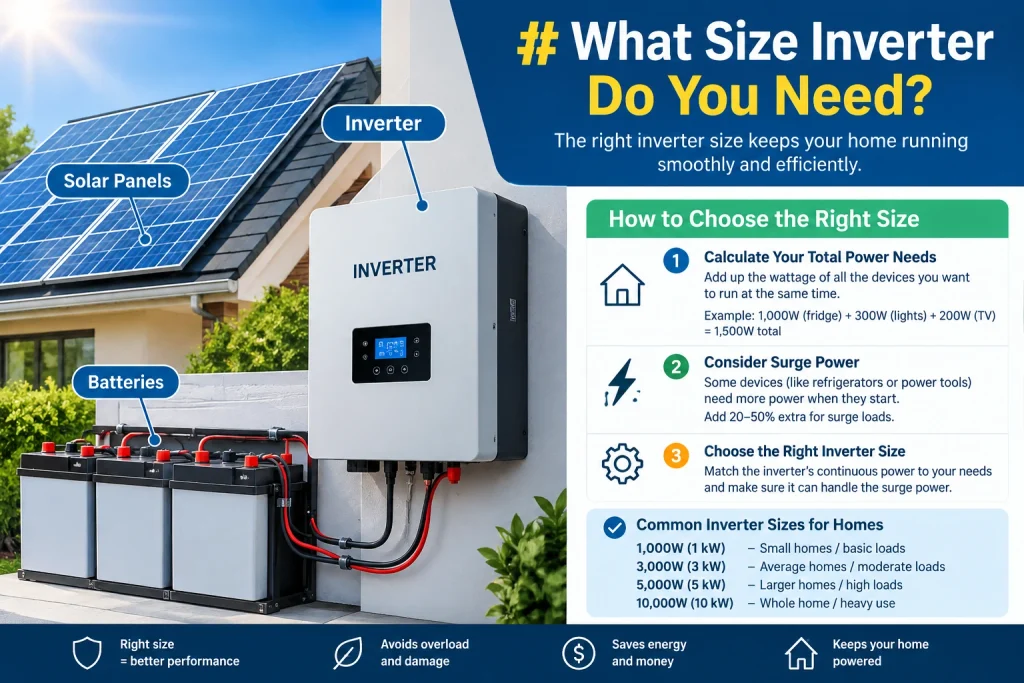
Inverter sizing should consider both:
Continuous power
This is the amount of power the inverter can supply continuously.
Surge power
Some appliances require additional power when starting.
Examples can include:
- Pumps
- Refrigerators
- Compressors
- Air conditioners
- Power tools
A system that looks adequate based only on average consumption may still fail if the inverter cannot handle startup requirements.
Always compare appliance requirements with the inverter’s continuous and surge ratings.
How Much Roof Space Does a Solar System Need?
Roof space depends on:
- Number of panels
- Panel dimensions
- Panel wattage
- Roof shape
- Roof orientation
- Setbacks
- Ventilation equipment
- Chimneys
- Skylights
- Fire-access requirements
- Shading
Higher-wattage panels can sometimes produce the same system capacity with fewer modules, but physical dimensions and efficiency still matter.
For example, a hypothetical 8 kW system could use:
20 × 400 W panels = 8,000 W
or:
16 × 500 W panels = 8,000 W
The physical roof area will depend on the actual dimensions of those panels.
What About Solar Panel Wiring Size?
There is no single wire size that is correct for every residential solar system.
Wire selection depends on factors including:
- Maximum current
- System voltage
- Cable length
- Temperature
- Installation method
- Voltage drop
- Conductor material
- Insulation rating
- Local electrical requirements
The same principle applies to breakers, fuses, disconnects, and other protection equipment.
Do not copy a cable or breaker size from another solar installation.
The equipment specifications and electrical design must determine the appropriate values.
Common Solar Panel Connection Mistakes
Avoid these common mistakes when planning a home solar system.
1. Connecting too many panels in series
Too many panels can push the string voltage beyond the inverter’s permitted input range.
2. Ignoring cold-weather voltage
PV voltage can rise under cold conditions, so system design needs to account for the expected temperature range.
3. Mixing incompatible equipment
Panels, inverters, batteries, and protection equipment must be electrically compatible.
4. Using undersized wiring
Incorrect conductor sizing can cause excessive voltage drop, overheating, or other safety problems.
5. Ignoring shading
A small amount of shading can affect production, particularly in certain string configurations.
6. Assuming solar automatically works during blackouts
A standard grid-connected system may shut down when utility power fails. Backup requires appropriate equipment and configuration.
7. Installing a battery without checking inverter compatibility
Not every inverter supports every battery.
8. Designing only for today’s electricity use
Future loads such as an EV, heat pump, workshop, or additional appliances may increase electricity consumption.
String Inverter vs. Microinverters
Both approaches can be used in residential solar installations.
| Feature | String Inverter | Microinverters |
|---|---|---|
| Inverter location | Centralized | At/near each panel |
| Panel-level conversion | No | Yes |
| Typical system architecture | Strings | Individual modules |
| Shading response | Depends on design | Panel-level operation |
| Maintenance access | Central location | Distributed |
| Equipment complexity | Centralized | More distributed |
| Best choice | Depends on site | Depends on site |
The Department of Energy notes that microinverters can allow independent panel operation, while string inverters connect groups of panels to one inverter.
There is no universally best inverter architecture for every home.
Solar Panel Connection With an Existing Electrical System
Before adding solar to an existing home, several things should be checked.
Electrical service
The existing service and distribution equipment must be appropriate for the planned installation.
Roof condition
If the roof needs major repairs, those issues may be better addressed before installing a long-lived PV system.
Existing loads
Review current electricity consumption and large electrical loads.
Future upgrades
Consider planned additions such as:
- EV charging
- Electric heating
- Heat pumps
- Pool equipment
- Workshop equipment
- Additional battery storage
Existing solar equipment
If you’re adding a battery to an existing solar system, check inverter compatibility and whether the architecture needs to be AC-coupled, DC-coupled, or replaced.
How to Calculate Solar System Size for a Home
A useful starting point is annual electricity consumption.
Step 1: Find annual electricity usage
Check your utility bills.
Example:
900 kWh/month × 12 = 10,800 kWh/year
Step 2: Estimate local solar production
Suppose an illustrative location produces:
1,400 kWh per installed kW per year
Then:
10,800 ÷ 1,400 = 7.7 kW
The initial estimate would therefore be approximately:
7.7 kW of solar capacity
Step 3: Convert capacity into panel count
With 400 W panels:
7,700 W ÷ 400 W = 19.25
You might therefore need approximately 20 panels as a starting illustration.
Actual system design requires more detailed production modeling and equipment checks.
Solar Panel Connection for Home: Grid-Tied vs. Off-Grid
| Feature | Grid-Tied | Off-Grid |
|---|---|---|
| Utility connection | Yes | No |
| Battery | Optional | Usually essential |
| Backup during outage | Usually no without special equipment | Yes, if properly designed |
| Solar-only operation | Limited by grid connection | Designed for independent operation |
| System complexity | Generally lower | Generally higher |
| Battery sizing importance | Moderate if battery is included | Very high |
| Generator may be useful | Sometimes | Often considered |
Grid-connected and off-grid systems solve different problems.
A homeowner should first determine whether the goal is:
- Lower electricity purchases
- Backup power
- Energy independence
- Remote power
- Battery storage
- EV charging
- A combination of these
How to Make a Solar Panel Connection More Efficient
Good system performance starts with good design.
Reduce shading
Avoid unnecessary shade on the PV array.
Use appropriate panel orientation
The best orientation depends on location and system goals.
Choose compatible equipment
Panel and inverter specifications should work together.
Monitor system performance
Modern inverters often provide monitoring tools that can help identify production problems.
Maintain the system
Keep the system visually inspected and follow the manufacturer’s maintenance recommendations.
Plan for future loads
If electricity demand is likely to increase, account for it before finalizing system capacity.
Is Solar Panel Connection Safe?
A professionally designed and installed solar system can be a safe electrical installation, but PV systems involve potentially hazardous DC and AC electricity.
Important safety considerations include:
- Proper grounding and bonding
- Correct overcurrent protection
- Proper disconnects
- Appropriate PV-rated wiring
- Correct equipment compatibility
- Weather-resistant connections
- Proper labeling
- Compliance with local electrical requirements
- Qualified installation and inspection
The U.S. Department of Energy notes that qualified installers should install solar systems according to applicable building, fire, and electrical codes.
Can You Install a Solar Panel Connection Yourself?
Some homeowners may be able to perform limited preparation or non-electrical tasks, depending on local rules.
However, residential PV electrical work can involve hazardous DC voltage, AC electrical systems, utility interconnection, grounding, protection equipment, and code requirements.
Before attempting DIY work, check:
- Local electrical regulations
- Utility requirements
- Equipment manufacturer instructions
- Permit requirements
- Inspection requirements
- Insurance requirements
For grid-connected systems, professional installation is often the safest approach.
Frequently Asked Questions
Can I connect solar panels directly to my house?
Solar panels should be integrated through a properly designed PV system with compatible power electronics, protection equipment, and an appropriate connection to the home’s electrical system.
Do I need an inverter for home solar?
For a conventional home using AC electricity, an inverter is normally required to convert the panels’ DC output into AC electricity.
Can solar panels power my house at night?
Solar panels do not produce electricity from sunlight at night. A home can use grid electricity or stored energy from a battery system.
Can solar panels work during a blackout?
A conventional grid-connected solar system may shut down during an outage. Backup operation requires appropriately configured equipment, typically including an inverter and storage system capable of operating independently from the grid.
Should solar panels be connected in series or parallel?
It depends on the panel specifications, inverter input limits, system voltage, current, shading, temperature, and overall design.
How many solar panels does a house need?
There is no universal number. Electricity consumption, location, sunlight, panel wattage, roof space, shading, and desired solar offset all affect the answer.
Can I add batteries later?
In many systems, batteries can be added later, but compatibility and system architecture must be checked first.
What is the difference between kW and kWh?
kW measures power.
kWh measures energy.
For example, a 5 kW load operating for 2 hours consumes approximately:
5 kW × 2 hours = 10 kWh
Does a bigger solar system always mean better?
Not necessarily. The system should be appropriately sized for electricity consumption, site conditions, available roof or land area, equipment limits, budget, and applicable utility rules.
Final Thoughts: Solar Panel Connection for Home
A solar panel connection for home is a complete electrical system rather than a simple connection between panels and appliances.
A properly designed system may include:
Solar panels → PV wiring → protection equipment → inverter → electrical panel → home loads
Battery storage can be added when the homeowner wants to store excess solar energy or provide backup power.
The most important factors are correct system sizing, compatible equipment, proper wiring, electrical protection, inverter selection, and compliance with applicable local requirements.
Solar technology is modular, but that does not mean every combination of panels, cables, batteries, and inverters will work safely together. A well-designed system should be based on the actual home’s electricity use and the technical specifications of every major component.
For homeowners considering installation, the best starting point is to understand their electricity consumption, inspect the available installation area, determine whether battery backup is needed, and then have the system professionally designed around those requirements.
Quick Solar Panel Connection Checklist
Before installation, check:
- Annual household electricity consumption
- Available roof or ground area
- Shading conditions
- Solar panel specifications
- Inverter specifications
- Maximum PV voltage
- Maximum PV current
- Series/parallel configuration
- Cable requirements
- Disconnect requirements
- Overcurrent protection
- Grounding and bonding
- Battery compatibility, if applicable
- Backup-load requirements
- Utility requirements
- Local permits and inspections
- Manufacturer installation instructions
- Qualified electrical inspection
Important: The checklist is for planning purposes and does not replace an electrical design or local code requirements.