
A rain barrel filter helps keep leaves, roof debris, and some sediment out of collected rainwater. For an off-grid garden, a properly designed rain barrel can provide a useful source of water for suitable outdoor tasks while reducing dependence on a household water supply.
One popular DIY idea is to fill a rain barrel with layers of stones, gravel, biochar, and sand. Although those materials can be used in certain filtration systems, stacking them inside a storage barrel does not automatically produce clean or safe water. It can also create maintenance and drainage problems.
This guide explains how rain barrel filtration works, what the layered-filter diagram gets wrong, and how to plan a more practical rainwater collection system for non-drinking garden use.
Rain Barrel Filter: Quick Answer
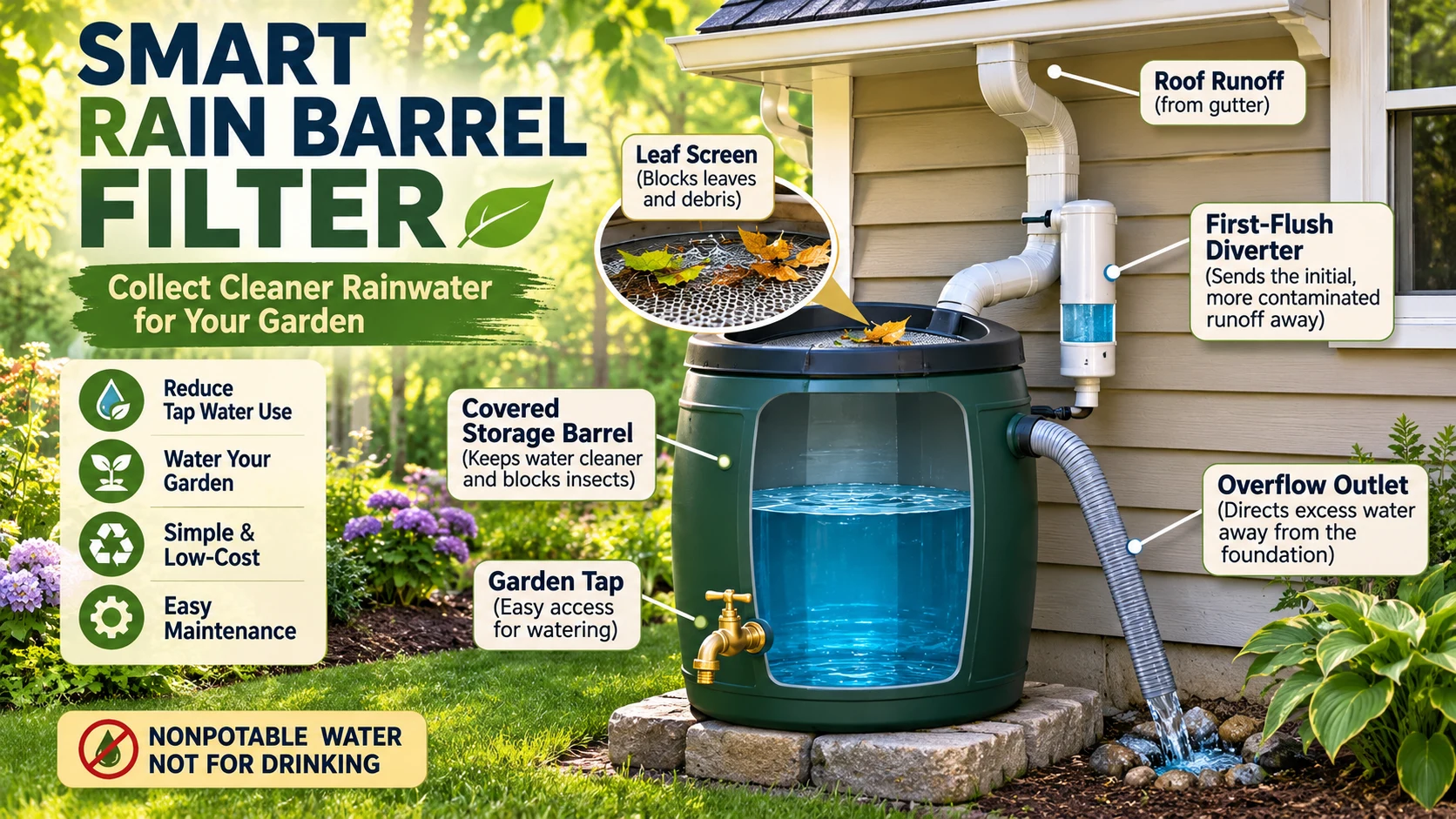
The most practical starting point is a covered, suitable water-storage barrel with a removable debris screen, an optional correctly designed first-flush diverter, a screened overflow, and a garden outlet.
- Leaf screen: Keeps larger debris and insects from entering.
- First-flush diverter: Redirects some initial roof runoff away from storage.
- Covered barrel: Reduces contamination and mosquito access.
- Overflow: Directs excess water away from the building.
- Garden tap: Provides controlled access to stored water.
- Optional filtration: Must match the intended use and be designed for appropriate flow and maintenance.
Important: A basic rain barrel filter does not make collected rainwater safe for drinking, cooking, bathing, or washing food.
What Is a Rain Barrel Filter?
A rain barrel filter is a device or collection of components designed to remove selected materials from water as it enters or leaves a rainwater storage system.
Simple rain barrels usually rely on a mesh inlet screen to stop leaves and large debris. More complex systems may include sediment filters, separate treatment units, or equipment that reduces specific contaminants.
Filtration performance depends on the filter material, particle size, contact time, flow rate, water quality, and maintenance schedule. No single filter removes every possible contaminant.
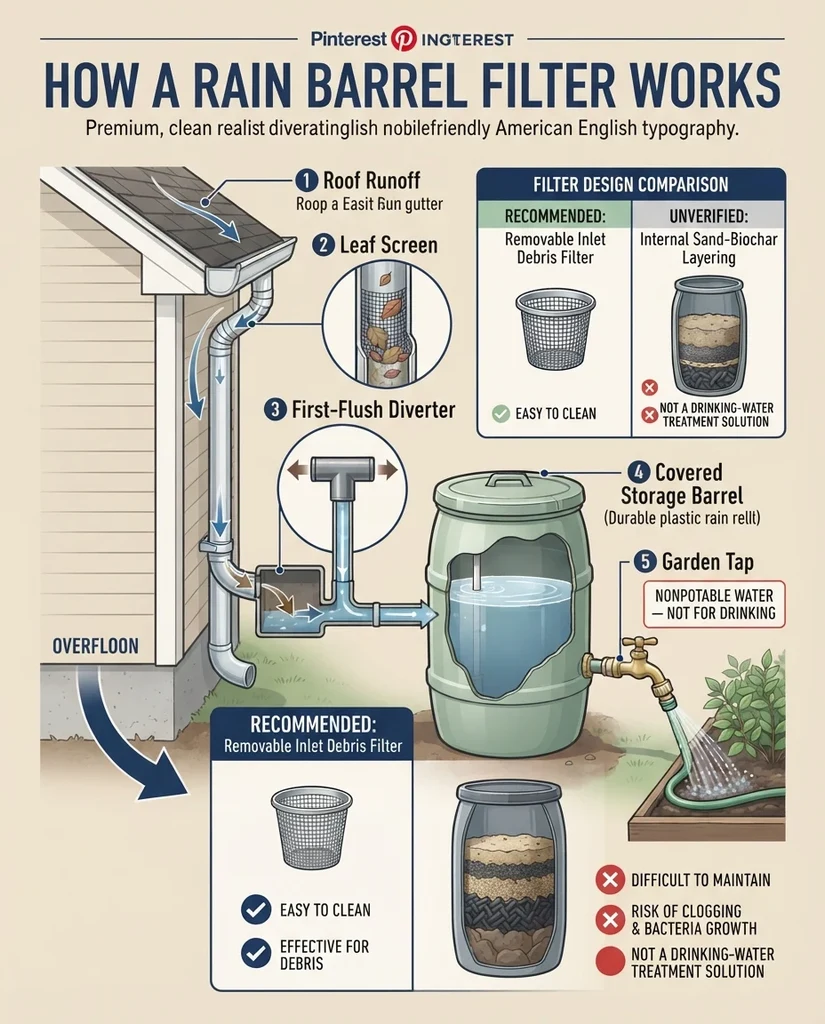
How the Pinterest Layered Rain Barrel Filter Is Supposed to Work
The reference image shows roof runoff entering a barrel containing several layers of filtering material above a small water storage area.
The illustrated layers include a leaf screen, coarse stones, biochar, fine gravel, and washed sand. The drawing also labels a first-flush bypass, an overflow outlet, and a garden tap.
| Component | Possible Function | Important Limitation |
|---|---|---|
| Mesh screen | Stops leaves and larger debris | Needs regular cleaning |
| Coarse stones | Provide coarse separation or support | Do not disinfect water |
| Biochar | May adsorb selected contaminants | Performance varies by product and design |
| Fine gravel | Supports media and may trap some particles | Can collect sediment |
| Washed sand | Can retain fine particles in suitable filters | May clog or channel without proper design |
| Storage zone | Holds collected water | May be difficult to clean beneath media |
| Overflow | Releases excess water | Must have adequate capacity and safe discharge |
Because the entire barrel contains loose media, there may be less usable water storage space. Cleaning and replacing the filter layers could also be difficult.
During a heavy storm, a slow filter may restrict water entering storage. If the inlet or overflow is poorly designed, excess water could back up or spill beside the house.
Why Separate Filtration From Water Storage?
For many small garden rain barrels, placing a removable debris screen before the storage tank is easier to maintain than burying several layers of media inside the barrel.
A separate filter can be inspected, cleaned, or replaced without removing large amounts of wet sand and gravel from the water storage area.
It also makes the storage barrel easier to inspect for sediment, contamination, and leaks.
Conceptual Rainwater Collection Flow
ROOF AND GUTTER
↓
LEAF SCREEN AND OPTIONAL FIRST-FLUSH DIVERTER
↓
COVERED, NONPOTABLE RAIN BARREL
↓
SUITABLE GARDEN OUTLET
Separate overflow: Excess water must have a properly sized, unobstructed route to an approved discharge location away from foundations.
This is a functional illustration. It is not a complete plumbing, filtration, or potable-water treatment specification.
Does Biochar Make Rainwater Safe?
Biochar is a carbon-rich material produced by heating biomass under limited oxygen conditions. Some specially designed filtration systems use biochar to remove selected contaminants from water.
However, performance depends on feedstock, production conditions, particle size, treatment processes, water chemistry, and contact time.
Ordinary garden biochar is not the same as certified activated carbon intended for a specific drinking-water treatment application.
Unverified biochar may introduce fine particles or other unwanted substances into the system. It should not be assumed safe or effective simply because it is black and porous.
For a basic nonpotable garden rain barrel, a removable leaf screen and a well-maintained storage system are often a more straightforward starting point than an improvised biochar bed.
What About Sand and Gravel Filtration?
Sand and gravel can be used in properly designed water filtration systems. However, effective filtration requires control of media characteristics, water flow, contact time, and maintenance.
Simply pouring sand and gravel into a rain barrel does not create a validated slow sand filter or a dependable drinking-water treatment system.
Improvised media may clog, shift, form preferential water channels, or support unwanted biological growth if poorly maintained.
A layered barrel can also be difficult to empty and clean. That matters because sediment and organic material may continue accumulating beneath the upper layers.
Important Water Safety Warning
Rainwater collected from roofs can contain germs, animal waste, metals, and other pollutants. A homemade sand, gravel, or biochar filter does not establish that the water is safe for drinking.
Do not connect untreated rainwater to potable plumbing. Drinking-water applications require appropriate source assessment, treatment, testing, and compliance with local health requirements.
What Does a First-Flush Diverter Do?
A first-flush diverter directs some initial roof runoff away from the water storage tank. The first runoff after a dry period may carry accumulated dust, bird droppings, leaves, and other debris.
Redirecting part of that water can improve the quality of the water entering storage, but it does not remove every contaminant or eliminate the need for maintenance.
The appropriate diversion volume depends on the contributing roof area, local conditions, and the selected product or system design.
Some first-flush systems need periodic cleaning or resetting. Follow the manufacturer’s instructions rather than assuming every diverter works automatically without maintenance.
Why a Rain Barrel Needs an Overflow
A rain barrel can fill quickly during a storm. Once full, it must safely release incoming water without allowing it to collect near the building.
An overflow should direct excess water toward an appropriate drainage or landscape area that does not create erosion, flooding, or foundation problems.
The outlet must also be large enough for the expected flow and protected against insects where appropriate.
A decorative outlet in an illustration is not evidence that the actual barrel can handle a heavy rain event.
How Much Water Can You Collect From a Roof?
Rainwater collection potential depends on roof area, rainfall depth, and the fraction of runoff that reaches the tank.
For a simple U.S. unit calculation:
Potential gallons ≈ Roof area (sq. ft.) × Rainfall (inches) × 0.623 × Collection factor
Example: 500 sq. ft. of roof area, 1 inch of rain, and an illustrative 80% collection factor:
500 × 1 × 0.623 × 0.80 ≈ 249 gallons
This example shows that even a relatively small roof can produce more runoff than a typical residential rain barrel can store in one rainfall event.
Actual collected volume depends on rainfall patterns, gutter losses, first-flush diversion, tank capacity, and overflow.
How to Plan a Better Rain Barrel Filter System
For a simple garden rainwater collection system, prioritize safe storage, debris control, and maintenance access before considering advanced filtration.
- Check local regulations. Confirm that residential rainwater collection is allowed and review any applicable restrictions.
- Inspect the roof and gutters. Avoid collecting from surfaces with known hazardous contamination or unsuitable coatings.
- Choose an appropriate barrel. Use a sturdy, clean container intended for water storage, with a secure cover.
- Prepare a level support. The stand or foundation must safely support the full water weight.
- Provide a screened inlet. Use an accessible mesh screen to intercept debris and prevent insect entry.
- Consider first-flush diversion. Select a suitable product or professionally designed arrangement if needed.
- Plan the overflow. Ensure excess runoff can discharge away from the building.
- Install a suitable outlet. Provide water access for approved nonpotable uses.
- Label the system. Clearly identify stored rainwater as nonpotable.
- Plan routine maintenance. Make sure screens, fittings, and storage surfaces remain accessible.
This is a planning checklist, not a construction drawing. Follow the selected rain barrel manufacturer’s instructions and local requirements.
How to Prevent Mosquitoes in Rain Barrels
Open or poorly sealed water containers can provide places for mosquitoes to lay eggs. A rain barrel should prevent insects from entering through the inlet, overflow, and other openings.
Use a secure cover and suitable mosquito-resistant screening. Inspect screens for tears, gaps, and debris buildup.
Rutgers Cooperative Extension and other public guidance sources emphasize screening and regular maintenance as important rain barrel mosquito-control measures.
Never assume that a layer of gravel or biochar will prevent mosquito breeding in an accessible standing-water area.
Can You Use Rain Barrel Water for Vegetable Gardens?
Rainwater collected from roofs may contain microorganisms and chemicals from the roof, gutters, air, or animal activity.
For low-risk ornamental landscape uses, nonpotable rainwater may be practical where allowed. Food-growing applications require greater care because contaminated water can contact edible crops.
Follow local extension or public health guidance for edible gardens. Avoid using untreated collected roof water to wash harvested produce, and do not assume the water is safe simply because it passed through a homemade filter.
Rain Barrel Maintenance Checklist
- Remove leaves and debris from roof gutters when safe to do so.
- Clean the inlet screen when debris accumulates.
- Check that all openings remain protected from insects.
- Inspect the overflow before and after major storms.
- Look for leaks, damaged fittings, unusual odors, or sediment buildup.
- Follow product guidance for cleaning the storage barrel.
- Service any first-flush diverter according to its instructions.
- Check that the barrel remains level and its support is stable.
- Manage freezing weather according to the barrel manufacturer’s recommendations.
- Keep the system disconnected from drinking-water plumbing.
Common Rain Barrel Filter Mistakes
- Filling the entire barrel with filter media: Reduces storage capacity and complicates cleaning.
- Assuming sand makes water drinkable: Homemade filtration does not guarantee pathogen or chemical removal.
- Using unverified biochar: May introduce unwanted particles or contaminants.
- Leaving the top open: Increases debris and mosquito risks.
- Using an undersized overflow: Can lead to uncontrolled spillover during heavy rain.
- Discharging next to the foundation: Can contribute to moisture and erosion problems.
- Ignoring barrel weight: A full container requires adequate support.
- Connecting directly to potable plumbing: Creates potential cross-connection hazards.
- Never cleaning the system: Leads to debris and sediment accumulation.
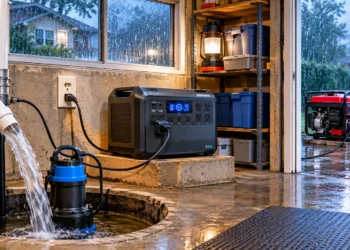
Can a Solar Pump Work With a Rain Barrel?
Yes. A compatible small water pump can move collected rainwater to an approved irrigation system or another suitable nonpotable outlet.
A solar-powered pumping arrangement needs an appropriate pump, controls, power supply, electrical protection, and dry-run protection when required.
For a simple gravity-fed barrel, a pump may not be necessary if the outlet has enough elevation and the intended watering method can operate at low pressure.
A pump does not disinfect water or remove dissolved contaminants. It only adds energy to move water through the system.
For more on selecting pump equipment, see our Water Tank Pressure Booster Pump Guide.
Frequently Asked Questions
Do rain barrels need filters?
A screened inlet is strongly recommended to reduce debris and insect entry. Additional filtration depends on the water source, intended use, and system design.
Can sand and gravel clean rainwater?
These materials can remove some suspended particles in properly designed filters. They do not automatically make water safe to drink or remove all chemical and biological contaminants.
Does biochar remove bacteria from rainwater?
Biochar performance varies by material and treatment design. Ordinary biochar should not be relied upon as a verified drinking-water disinfection method.
What is the purpose of a first-flush diverter?
It redirects some initial roof runoff away from storage to help reduce the amount of accumulated roof debris entering the tank. It does not guarantee safe water quality.
Can I drink water from a filtered rain barrel?
Do not assume it is safe. Water intended for drinking requires an appropriate treatment and testing program that addresses relevant microbial and chemical hazards.
Why does my rain barrel overflow?
The barrel may be full, the overflow may be blocked, or the drainage system may not have enough capacity for the incoming runoff. Confirm that excess water can leave safely without damaging the property.
Can I use a pump with filtered rainwater?
Yes, if the pump and filtration equipment are compatible with the water source and intended nonpotable application. Follow the equipment manufacturer’s specifications and applicable plumbing requirements.
Final Verdict: Is a Smart Rain Barrel Filter Worth It?
A well-designed rain barrel can help collect useful nonpotable water for suitable garden and landscape applications. The most important features are often simple: a secure cover, removable debris screen, proper overflow, safe support, and easy access for maintenance.
A barrel filled with sand, gravel, and biochar may look like an advanced filtration system, but the appearance does not prove water quality, effective flow, or long-term reliability.
Start with safe rainwater collection and storage. Add treatment equipment only when it has a defined purpose, known performance, and a maintenance plan. Above all, do not confuse clearer-looking rainwater with water that is safe to drink.
Technical sources: CDC: Collecting Rainwater and Your Health; Oklahoma State University: Rainwater Harvesting Design; Rutgers Extension: Rain Barrels and Mosquitoes; Alabama Extension: DIY Rain Barrel Construction; Virginia Tech: Rain Barrel Stormwater Management. Consult local regulations, public health guidance, and equipment instructions before installation.