
SOLAR ENERGY · BATTERY SIZING GUIDE 2026
What Size Solar Panel for a 12V Battery? 50Ah–200Ah Chart (2026 Guide)
Discover how many watts of solar power you need to charge a 12V 50Ah, 100Ah, or 200Ah battery. Learn the sizing formulas, compare battery types, estimate charging time, and choose the right solar charge controller.
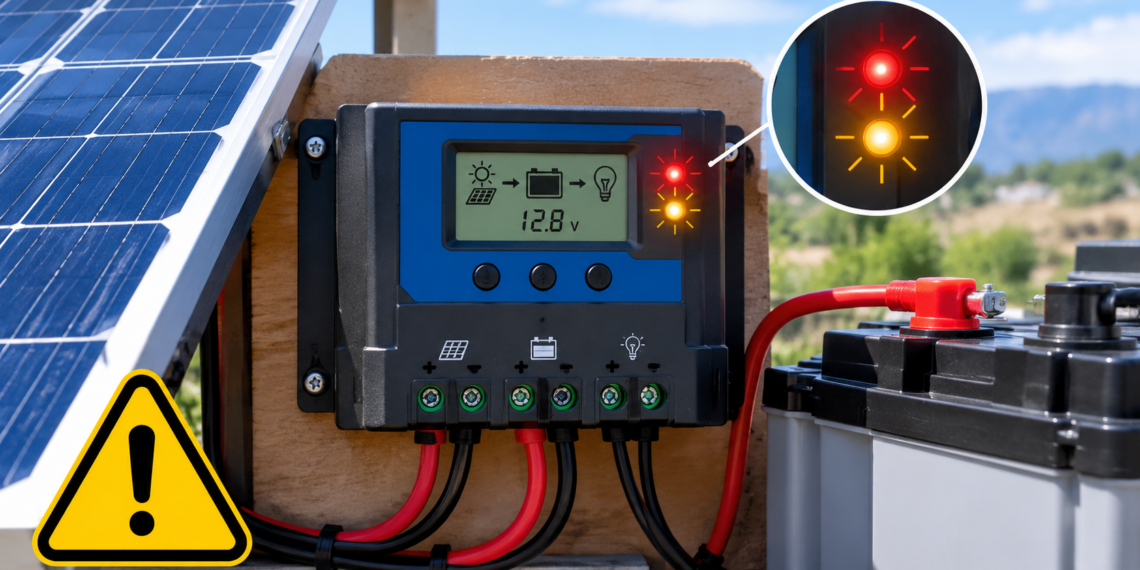
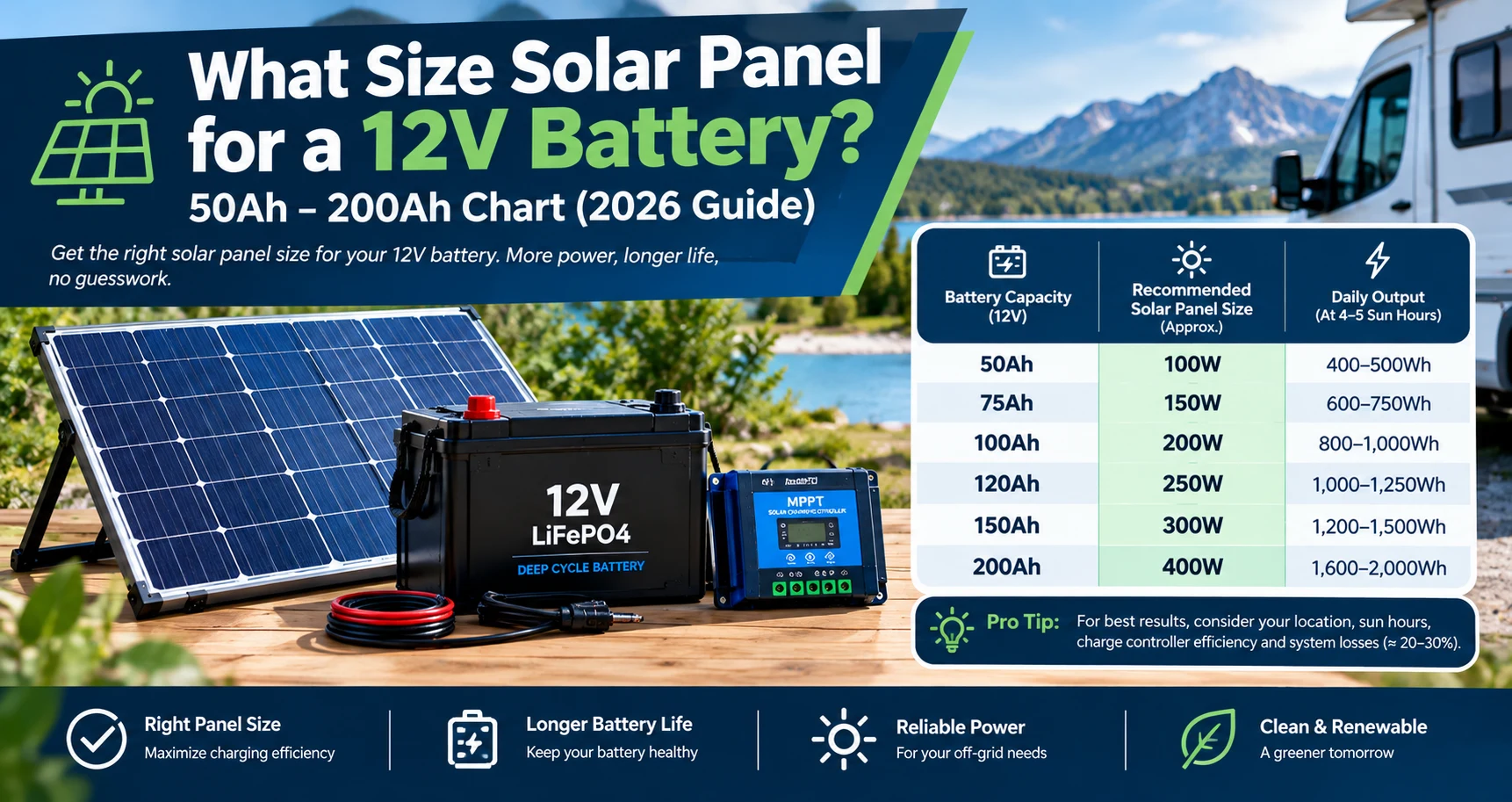
Suggested image: A 12V deep-cycle battery connected to solar panels and an MPPT charge controller, with sunlight and an off-grid power setup in the background.
Recommended image size: 1200 × 636 pixels
Choosing the right solar panel for a 12V battery is essential if you want reliable charging, better energy production, and a longer battery service life. A panel that is too small may struggle to replace the energy you use each day, while an oversized panel may exceed your battery or charge controller’s permitted charging limits.
The good news is that calculating the correct solar panel size does not have to be complicated. By understanding your battery capacity, daily energy requirements, available sunlight, and charge controller, you can estimate how much solar power your system needs.
In this guide, we explain what size solar panel for a 12V battery is suitable for common 50Ah, 100Ah, and 200Ah batteries. We also cover charging times, MPPT versus PWM controllers, battery chemistry, and practical examples for RVs, boats, cabins, and small off-grid systems.
For a typical 12V battery system, these are useful starting estimates:
- 12V 50Ah battery: approximately 100–150W of solar.
- 12V 100Ah battery: approximately 200–300W of solar.
- 12V 200Ah battery: approximately 400–600W of solar.
These are planning ranges, not universal requirements. The right size depends on how much energy you need to replace, local sunlight, battery chemistry, charging limits, and the time available for recharging.
1. 12V Battery Solar Panel Size Chart (50Ah–200Ah)
The following table provides a practical starting point for selecting solar panels for common 12V battery capacities.
The recommended ranges assume a reasonably sunny location, a properly matched charge controller, and a system designed to recharge the battery during the available solar window. They are not guarantees of a full charge within a specific number of hours.
| 12V Battery | Nominal Energy | Suggested Solar Range | Typical Applications |
|---|---|---|---|
| 50Ah | About 600–640Wh | 100–150W | Small RVs, camping, lights, electronics |
| 100Ah | About 1,200–1,280Wh | 200–300W | Vans, boats, refrigerators, small cabins |
| 200Ah | About 2,400–2,560Wh | 400–600W | Larger RVs, off-grid cabins, bigger energy needs |
Nominal energy depends on the battery’s actual rated voltage. For example, a conventional 12V battery rated at 100Ah has approximately 1,200Wh of nominal energy, while a 12.8V LiFePO4 battery rated at 100Ah has approximately 1,280Wh.
Can You Use a Smaller Solar Panel?
Yes. A smaller panel can charge a larger battery, but it may take several sunny days to replace the energy used. This may be acceptable for battery maintenance or systems with low daily consumption.
If your battery must recharge every day, size the solar array around your actual daily energy use and the sunlight available during the least favorable part of your operating season.
When Should You Choose a Larger Panel?
Consider additional solar capacity if your system experiences frequent cloudy weather, operates during winter, powers energy-hungry appliances, or must recover quickly after heavy battery use.
Always confirm that the battery and charge controller can safely accept the resulting charging current.
2. Understanding 50Ah, 100Ah, and 200Ah Batteries
Battery capacity is commonly expressed in amp-hours (Ah). It indicates how much electrical charge a battery can store under specified testing conditions.
However, amp-hours alone do not tell you the complete energy capacity. Battery voltage must also be considered.
Watt-hours (Wh) = Voltage (V) × Capacity (Ah)
For example, a 12V 100Ah battery stores approximately 1,200Wh of nominal energy. Actual usable energy depends on battery chemistry, its permitted depth of discharge, temperature, and operating conditions.
12V 50Ah Battery
A 50Ah battery is often suitable for light electrical loads, portable power systems, small camping setups, and basic lighting.
A 100W solar panel may be sufficient for some applications, while a 150W panel provides more charging capacity when the battery and controller support it.
12V 100Ah Battery
A 100Ah battery is a common choice for RVs, camper vans, boats, and small off-grid systems.
A 200W solar panel is a useful starting point for many systems, while 300W may be preferable when daily energy consumption is higher or solar conditions are less favorable.
12V 200Ah Battery
A 200Ah battery can store roughly twice the nominal energy of a comparable 100Ah battery at the same voltage.
A 400W solar array is a common starting point, while 500–600W can provide additional charging capacity if the controller, battery, and wiring are rated for the installation.
A battery’s capacity is not the same as the energy you should use every day. Lead-acid batteries are often operated with a more conservative discharge limit than LiFePO4 batteries. Follow the specific battery manufacturer’s recommendations.
3. How to Calculate Solar Panel Wattage
The best way to calculate the solar panel size for a 12V battery is to estimate how much energy needs to be replaced and how much sunlight is available for charging.
Step 1: Calculate the Energy to Replace
Suppose you have a 12V 100Ah battery that is currently at 50% state of charge.
For a simplified calculation, assume a nominal voltage of 12V.
Total nominal battery energy:
12V × 100Ah = 1,200Wh
Energy missing at 50% state of charge:
1,200Wh × 0.50 = 600Wh
This is an approximate energy calculation. Actual charging requirements vary with battery voltage, efficiency, chemistry, and the charging stage.
Step 2: Estimate Daily Solar Energy Production
Solar panels rarely produce their rated wattage continuously throughout the day. Their output changes with sunlight intensity, panel temperature, orientation, shading, and other factors.
A useful planning formula is:
Daily Solar Energy (Wh) ≈ Panel Wattage × Peak Sun Hours × System Performance Ratio
For example, suppose you have a 200W panel, receive 5 peak sun hours, and assume an illustrative performance ratio of 0.75.
200W × 5 × 0.75 = 750Wh per day
This is an estimate of energy available from the solar system after the assumed losses. Not all of that energy necessarily reaches the battery because the controller, battery charging process, and other system components affect the final result.
Step 3: Calculate the Required Panel Wattage
To estimate the solar power needed for a given daily energy requirement, rearrange the formula:
Required Panel Watts ≈ Daily Energy Need ÷ (Peak Sun Hours × Performance Ratio)
Suppose your system needs to replace 600Wh each day, receives 5 peak sun hours, and has an assumed performance ratio of 0.75.
600 ÷ (5 × 0.75) = 160W
Under these assumptions, the estimated array size is 160W. You might evaluate a 200W panel to provide additional margin, provided it is compatible with your charge controller and battery.
Remember: If you are replacing energy used by appliances every day, calculate the full daily energy requirement rather than sizing the panel only for the battery’s capacity.
4. How Long Does It Take to Charge a 12V Battery?
Charging time depends on the battery capacity, the amount of energy removed, panel wattage, solar conditions, controller efficiency, battery chemistry, and charging limits.
For a simplified estimate, you can calculate the number of peak-sun hours required to replace the missing energy.
Peak-Sun Hours ≈ Energy to Replace ÷ Effective Charging Power
Effective charging power is lower than the panel’s rated wattage in real-world conditions. This calculation estimates energy replacement and does not fully model the battery’s charging stages.
Illustrative Charging Estimates
The table below assumes a battery begins at approximately 50% state of charge, uses a simplified 12V nominal energy calculation, and is charged under favorable conditions.
| Battery | Panel Size | Energy to Replace | Estimated Peak-Sun Hours* |
|---|---|---|---|
| 12V 50Ah | 100W | 300Wh | About 4 hours |
| 12V 100Ah | 200W | 600Wh | About 4 hours |
| 12V 200Ah | 400W | 1,200Wh | About 4 hours |
*Illustrative calculation using an effective charging power equal to 75% of the panel rating. These are peak-sun-hour estimates, not guaranteed elapsed clock times. Actual charging can take longer because of weather, battery charging limits, absorption charging, temperature, and system losses.
Peak-Sun Hours Are Not the Same as Daylight Hours
Five peak sun hours does not mean that the sun is visible for only five hours. Peak sun hours represent the equivalent number of hours at a solar irradiance of 1,000W/m².
A location may experience many hours of daylight but receive fewer peak sun hours because of the sun’s angle, atmospheric conditions, clouds, and shading.
For reliable system design, use local solar-production estimates for the relevant season rather than assuming every day will provide ideal conditions.
5. Lead-Acid vs. AGM vs. LiFePO4 Batteries
Battery chemistry affects how the battery should be charged, how much capacity you can use, and how long it takes to complete charging.
Flooded Lead-Acid Batteries
Flooded lead-acid batteries are widely used in some backup and off-grid applications. They require a suitable charging profile and, where applicable, routine electrolyte maintenance.
They are generally best operated without repeatedly discharging them too deeply. Their absorption stage can also extend the time required to reach a full charge.
AGM Batteries
Absorbent glass mat (AGM) batteries are sealed lead-acid batteries that generally require less routine maintenance than flooded models.
They still need a compatible charging profile and must remain within the manufacturer’s charging voltage and current limits.
LiFePO4 Lithium Batteries
Lithium iron phosphate batteries often provide more usable energy per rated amp-hour than lead-acid batteries and can accept relatively high charging currents when permitted by their specifications.
However, the battery management system, temperature restrictions, permitted charge current, and manufacturer’s charging instructions must be respected.
| Feature | Flooded Lead-Acid | AGM | LiFePO4 |
|---|---|---|---|
| Charging profile | Lead-acid profile | AGM-compatible profile | Lithium-compatible profile |
| Maintenance | Periodic checks may be needed | Generally low | Generally low |
| Charging behavior | Absorption stage can take time | Absorption stage can take time | Often faster when within limits |
| Important limitation | Avoid excessive discharge | Observe voltage and current limits | Respect BMS and temperature limits |
There is no single solar panel size that is correct for every battery with the same amp-hour rating. Always check the permitted charging current and recommended charging profile for your exact model.
6. MPPT vs. PWM: Which Solar Charge Controller Is Better?
A solar charge controller regulates the electrical power supplied to a battery. It is an essential part of most solar battery charging systems.
The two common controller types are PWM and MPPT.
PWM Charge Controllers
Pulse-width modulation controllers are often less expensive and can work well in appropriately designed small systems.
However, a PWM controller generally cannot convert the voltage difference between a solar panel and the battery into additional charging current. As a result, it may capture less of the panel’s available power in some configurations.
MPPT Charge Controllers
Maximum power point tracking controllers adjust their operating point to extract power from the solar array and convert it to a suitable charging voltage.
An MPPT controller is often beneficial when using larger panels, higher-voltage arrays, or systems where maximizing energy production is important.
| Feature | PWM | MPPT |
|---|---|---|
| Initial cost | Usually lower | Usually higher |
| Power conversion | Limited voltage conversion | Converts excess voltage into useful charging current |
| Larger solar arrays | May be less suitable | Often a better choice |
| Compatibility | Panel voltage must suit the controller | PV voltage and current must remain within controller limits |
Which should you choose? For a larger 12V battery system, an appropriately sized MPPT controller is often worth considering. The best choice depends on the panel configuration, budget, expected energy production, and manufacturer specifications.
Never assume that any high-voltage solar panel can be connected to any 12V battery controller. Check the controller’s maximum PV open-circuit voltage, input current, output current, and battery compatibility.
7. Choose Solar Panels Based on Daily Energy Use
Battery capacity tells you how much energy can be stored. Daily energy consumption tells you how much solar production you need to replace that energy.
For many systems, daily energy use is the more important starting point.
Example: A Small RV With a 12V 100Ah Battery
Suppose an RV uses the following energy each day:
| Device | Daily Energy Use |
|---|---|
| LED lighting | 100Wh |
| Phones and small electronics | 100Wh |
| Ventilation fan | 150Wh |
| Other small loads | 150Wh |
| Total | 500Wh per day |
Using 5 peak sun hours and an assumed performance ratio of 0.75, the estimated array capacity is:
500Wh ÷ (5 × 0.75) ≈ 133W
A 150W or 200W array could be evaluated for this example, depending on the actual conditions, battery charging requirements, and desired margin for less sunny days.
If the RV also runs a refrigerator, inverter, or other large loads, daily energy consumption may be considerably higher. Measure or estimate each load before deciding on the final panel size.
8. Solar Panel Installation and Battery Charging Safety
After selecting the panel and controller, install the system according to the equipment manufacturer’s instructions and applicable electrical regulations.
Step 1: Choose a Suitable Panel Location
Install the solar panel where it receives good sunlight and minimal shading. Secure it properly and consider wind exposure, temperature, ventilation, and access for maintenance.
Step 2: Check Controller Compatibility
Verify the solar panel’s operating voltage, open-circuit voltage, current, and rated power. Confirm that these values fall within the charge controller’s permitted range.
Step 3: Confirm Battery Settings
Select the correct charging profile for the battery chemistry. Configure charging voltage, current limits, and temperature compensation or temperature restrictions as specified by the battery manufacturer.
Step 4: Install Appropriate Protection
Use correctly rated cables, fuses or circuit breakers where required, disconnects, and suitable enclosures. Battery circuits can deliver very high fault currents, so protective devices and wiring must be designed for the installation.
Step 5: Verify System Operation
After the installation is completed, verify that the controller recognizes the battery and panel, the charging current is within permitted limits, and the battery reaches the appropriate charging stages.
Never connect a solar panel directly to a battery without suitable charge regulation unless the equipment manufacturer explicitly specifies a safe, integrated design. Incorrect wiring, reversed polarity, inadequate fusing, and excessive charging voltage can damage equipment or create a fire hazard. Use a qualified installer when necessary.
9. Common Solar Battery Charging Mistakes
1. Choosing a Panel Based Only on Battery Capacity
Two people with identical 100Ah batteries may need different solar arrays because their daily energy use and charging schedules differ.
2. Ignoring the Battery’s Maximum Charging Current
A larger panel can exceed the recommended charging current if the controller does not limit it appropriately.
3. Underestimating Cloudy Weather
Solar output can fall significantly during cloudy weather. Consider local seasonal conditions and provide enough capacity for your intended level of reliability.
4. Using the Wrong Controller
A controller must match the battery chemistry, panel configuration, charging voltage, and maximum input and output ratings.
5. Forgetting Daily Energy Consumption
If appliances consume as much energy as the solar panels produce, the battery may never fully recharge. Estimate consumption before choosing the system size.
6. Assuming Rated Panel Wattage Is Available All Day
Panel ratings are measured under standardized test conditions. Real-world output varies throughout the day and with temperature, shading, and installation angle.
7. Neglecting Battery Temperature Limits
Some batteries have restrictions on charging at low or high temperatures. Check the manufacturer’s requirements, especially for lithium batteries in cold weather.
10. Frequently Asked Questions
What size solar panel do I need for a 12V 50Ah battery?
A 100W to 150W panel is a useful starting range for many 12V 50Ah systems. The correct choice depends on the battery type, daily energy use, available sunlight, and the permitted charging current.
What size solar panel do I need for a 12V 100Ah battery?
A 200W to 300W array is a reasonable starting range for many systems. A smaller array can work if energy consumption is low, while a larger array may be necessary when daily energy demand or weather conditions require it.
What size solar panel do I need for a 12V 200Ah battery?
Many systems start by evaluating 400W to 600W of solar power. The final size should be based on daily energy consumption, recharge time, sunlight, battery charging limits, and controller specifications.
Can a 100W solar panel charge a 12V 100Ah battery?
Yes. A 100W panel can charge a compatible 12V 100Ah battery, but the process may take multiple sunny days if a substantial amount of energy needs to be replaced. The result depends on solar conditions, controller performance, battery chemistry, and energy consumption.
Can I use a 200W solar panel with a 12V battery?
Yes, if the panel and charge controller are compatible with the battery system and the controller keeps charging within the battery’s permitted limits. Check the panel voltage, controller ratings, and battery manufacturer’s instructions.
Do I need an MPPT controller for a 12V battery?
Not always, but MPPT controllers often improve energy harvest, especially with larger arrays or higher-voltage panels. A properly matched PWM controller may be sufficient for some small systems.
Will a solar panel overcharge my battery?
A correctly selected and configured charge controller regulates the charging process. Overcharging can still occur if equipment is incompatible, settings are incorrect, or a component fails, so verify the system’s specifications and protection features.
Can I connect multiple solar panels to one 12V battery?
Yes, multiple panels can charge a 12V battery through a suitable controller. Their series or parallel configuration must comply with the controller’s voltage, current, and power limits, as well as the wiring and protection requirements.
Can solar panels charge a battery on cloudy days?
Yes. Panels can still generate electricity under cloud cover, but their output is usually lower. A larger array, lower energy consumption, or additional energy storage may help when sunshine is limited.
Conclusion: Choose the Right Solar Panel for Your 12V Battery
Choosing the correct solar panel for a 12V battery begins with understanding how much energy the battery stores and how much energy your appliances consume each day.
As a starting point, consider 100–150W for a 50Ah battery, 200–300W for a 100Ah battery, and 400–600W for a 200Ah battery. Then refine the sizing based on local sunlight, charging time, battery chemistry, controller specifications, and expected system losses.
Remember that a larger solar panel does not automatically mean faster or safer charging. Your battery and charge controller must be able to handle the available charging power, and your system must be designed for real-world conditions.
With the right panel size, compatible charge controller, and properly configured battery system, you can build a more reliable solar setup for an RV, boat, cabin, camping system, or other off-grid application.
Build a Smarter Solar Battery System
Calculate your daily energy needs, choose compatible solar equipment, and use your battery manufacturer’s charging specifications to create a reliable 12V solar power system.
Choosing what size solar panel for a 12V battery depends mostly on your daily Watt-hour requirements and sun hours.
Disclaimer: This article provides general educational information. Solar panel sizing and charging performance vary with battery chemistry, equipment specifications, climate, installation, and usage. Always follow the battery and charge controller manufacturers’ instructions and applicable electrical safety requirements.