
SMART SOLAR TECHNOLOGY · 2026
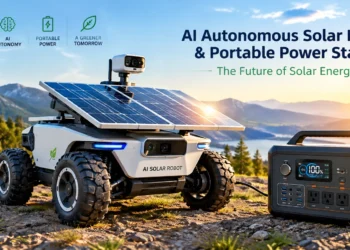
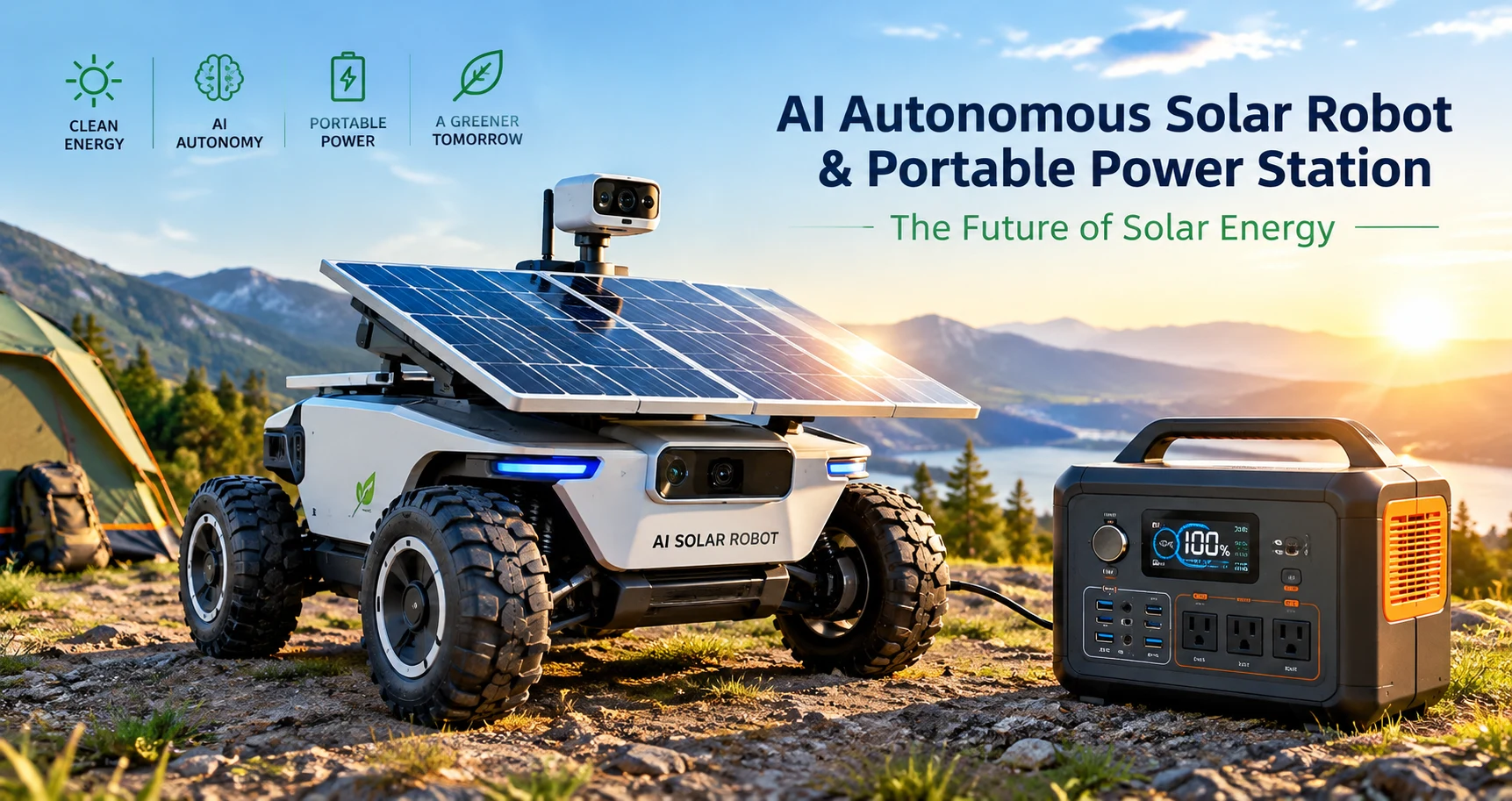
AI Autonomous Solar Robot & Portable Power Station: The Future of Solar Energy
Explore how artificial intelligence, autonomous solar robots, and portable power stations could transform solar maintenance, off-grid electricity, and mobile energy storage.
Solar energy is becoming smarter, more flexible, and easier to manage. Alongside traditional solar panels and home battery systems, new technologies are combining artificial intelligence (AI), robotics, automated maintenance, and portable energy storage.
An AI autonomous solar robot can use sensors, software, and navigation technology to perform specific tasks with limited human intervention. Depending on its design, a solar robot may inspect photovoltaic panels, identify dirt, monitor equipment, or carry out automated cleaning.

A portable power station provides a different but complementary function. It stores electrical energy in a rechargeable battery and supplies power to compatible devices through AC outlets, USB ports, and DC connections. Some models can recharge using portable solar panels.
When these technologies are used together, they can support a flexible energy setup for remote work, camping, emergency preparedness, solar maintenance, and selected off-grid applications.
AI autonomous solar robots use sensors, software, and automated controls to perform selected solar-related tasks. Portable power stations store electricity for use when grid power is unavailable. Depending on their specifications, these technologies can complement each other in remote locations, solar maintenance operations, and mobile energy applications. They are separate technologies, however, and not every solar robot can recharge or operate directly from a portable power station.
1. What Is an AI Autonomous Solar Robot?
An AI autonomous solar robot is a robotic system designed to perform tasks related to solar energy or solar installations with varying levels of automation.
Depending on its hardware and software, it may move across a solar farm, follow a predefined route, inspect equipment, detect dirt, or clean photovoltaic modules. More advanced systems may use cameras, sensors, machine learning, and navigation algorithms to adapt their actions to the environment.
Not every automated solar robot uses artificial intelligence. Some machines follow fixed routes or simple programmed instructions. Others use computer vision and decision-making software to identify conditions and adjust their behavior.
Common Types of Solar Robots
Solar Cleaning Robots
Remove dust and debris from compatible solar panel surfaces using designed brushes, air systems, or other cleaning mechanisms.
Inspection Robots
Use cameras and sensors to help identify visible defects, hotspots with suitable thermal equipment, or maintenance issues.
Autonomous Utility Robots
Move equipment, perform predefined tasks, or support maintenance teams in selected industrial environments.
The exact capabilities depend on the specific robot. Before buying one, verify whether it supports true autonomous operation, which tasks it can perform, and whether it is compatible with your solar installation.
2. How AI Solar Robots Work
AI-enabled solar robots combine mechanical components, sensors, control software, and a power source. Their systems work together to carry out tasks that might otherwise require repeated manual work.
Step 1: Collect Information
Cameras, optical sensors, navigation systems, and other instruments gather information about the robot’s position, surrounding environment, and assigned task.
Step 2: Analyze Conditions
Depending on the design, onboard software processes sensor readings to identify objects, recognize dirt patterns, follow routes, or detect conditions that require attention.
Step 3: Plan and Perform Actions
The robot uses its programmed control system to move, inspect, or clean according to its operating capabilities. Some systems can modify their route or behavior in response to sensor information.
Step 4: Report Results
Connected systems may send inspection images, operational data, battery status, or maintenance alerts to a monitoring platform. Some robots can also report errors or stop when they detect unsafe conditions.
Basic AI Robot Workflow
Collect environmental data
↓
Interpret information and select actions
↓
Perform the assigned task
↓
Report results and operating status
Artificial intelligence does not automatically make a robot more reliable or completely autonomous. Hardware quality, software design, environmental conditions, maintenance, and safety systems all affect real-world performance.
3. What Is a Portable Power Station?
A portable power station is a rechargeable battery-based power system designed to supply electricity to electronic devices and appliances without a direct connection to the utility grid.
Many models combine a lithium battery, a battery management system, an inverter, a display, charging electronics, and multiple output ports in one enclosure.
Main Components
- Battery: Stores energy for later use.
- Inverter: Converts battery DC power into AC electricity where supported.
- USB outputs: Supply compatible phones, tablets, and other electronics.
- DC outputs: Power compatible devices such as certain 12V accessories.
- Charging inputs: Accept energy from approved AC adapters, vehicle connections, or compatible solar panels.
- Battery management system: Monitors battery operation and provides protections supported by the design.
- Display or application: Shows information such as battery state, input power, output power, and estimated runtime.
Portable power stations are available in many sizes, from small units for phones and laptops to larger systems designed for refrigerators, work equipment, or emergency backup.
A portable power station is not automatically a complete off-grid home solar system. Its battery capacity, inverter output, charging speed, and supported solar input determine which loads it can operate and how quickly it can recharge.
4. Can a Solar Robot Work With a Portable Power Station?
Yes, in some applications. An AI autonomous solar robot and a portable power station can complement each other, provided that their electrical specifications and connection methods are compatible.
For example, a compatible portable power station could supply electricity to a robot’s charging dock, controller, communications equipment, or maintenance tools. The robot might then carry out an inspection or cleaning task within its designed operating area.
However, many industrial solar robots use dedicated battery packs, docking systems, or fixed charging infrastructure. They may not support direct connection to a portable power station.
Example of a Compatible Setup
Generate electricity
↓
Stores energy and supplies supported outputs
↓
Delivers compatible charging power
↓
Performs supported automated tasks
This diagram illustrates a possible arrangement rather than a universal connection method. Use the robot manufacturer’s approved charger and follow the power station’s voltage, current, and output requirements.
What Must Be Compatible?
- The robot’s charging voltage and current requirements.
- The power station’s continuous output rating and supported output type.
- The robot’s startup or charging surge requirements, if applicable.
- The approved charger or docking equipment.
- The power station’s operating temperature limits and environmental protection.
- The total energy required to operate or recharge the robot.
Never connect a robot battery directly to an incompatible power station output. Voltage differences, incorrect polarity, and unsupported charging methods can damage equipment or create safety hazards.
5. Key Features to Look For
If you are evaluating AI solar robots and portable power stations, focus on measurable capabilities rather than marketing descriptions alone.
AI Solar Robot Features
| Feature | Why It Matters |
|---|---|
| Navigation and obstacle detection | Helps the robot move safely within its designed operating area. |
| Computer vision | Can support visual inspection and identification of selected conditions. |
| Cleaning mechanism | Determines which dirt types and panel surfaces the robot can handle. |
| Battery runtime | Affects how long the robot can work before recharging. |
| Remote monitoring | Can provide operational status and maintenance information. |
| Weather resistance | Determines which outdoor conditions the robot can tolerate. |
Portable Power Station Features
| Specification | What to Check |
|---|---|
| Battery capacity | Usable watt-hours for your intended loads. |
| Continuous AC output | Whether it can support the required operating power. |
| Surge rating | Whether startup loads can be supported for the specified duration. |
| Solar input | Maximum PV voltage, current, wattage, and connector requirements. |
| Recharge time | Charging speed using supported solar and AC inputs. |
| Battery chemistry | Cycle life, temperature limits, and warranty conditions. |
6. Real-World Applications
AI-enabled solar robotics and portable energy storage have different strengths. Their usefulness depends on the task, available infrastructure, operating conditions, and the cost of alternatives.
Solar Farm Maintenance
Autonomous cleaning robots can help maintain large solar installations where repeated manual cleaning is expensive or difficult. Inspection robots may also help maintenance teams gather consistent visual information.
Portable power stations may supply compatible tools, temporary communications equipment, or approved charging equipment during maintenance work.
Remote Cabins and Off-Grid Locations
A portable power station can provide electricity for lighting, laptops, communication devices, and selected appliances in remote locations. Compatible solar panels can recharge the unit when sunlight is available.
An autonomous robot could perform a separate task, such as inspecting a solar array, if it is designed for that environment. Do not assume that a commercial solar-farm robot is suitable for a residential cabin.
Camping and Outdoor Activities
Portable power stations are useful for charging electronics and operating compatible small appliances while camping. Lightweight solar panels may provide additional charging capability during extended trips.
AI robots are more specialized and may be unnecessary for ordinary recreational use unless they provide a specific practical function.
Emergency Backup Power
A charged portable power station can supply selected essential devices during an outage. Its runtime depends on usable battery capacity, load consumption, conversion losses, and operating conditions.
Solar charging can help replenish the battery when conditions and equipment allow, although poor weather may limit the amount of available energy.
Industrial Inspection
Robots equipped with suitable cameras or sensors can assist with inspection in selected industrial environments. Their role may include collecting images, identifying visible abnormalities, and helping prioritize maintenance work.
Human review remains important where sensor limitations, safety requirements, or equipment-specific expertise affect the final decision.
7. AI Autonomous Solar Robot vs. Portable Power Station
Although these technologies can work together, they solve different problems.
| Category | AI Solar Robot | Portable Power Station |
|---|---|---|
| Main purpose | Automates specific physical or inspection tasks. | Stores and supplies electrical energy. |
| Core technology | Motors, sensors, control systems, and sometimes AI. | Battery cells, charging electronics, and power conversion. |
| Energy storage | Depends on the robot’s onboard battery or power arrangement. | A central function of the product. |
| Solar charging | Depends on the robot’s design and charging infrastructure. | Available on models with compatible solar inputs. |
| Typical users | Solar operators, industrial teams, and specialized users. | Campers, homeowners, mobile workers, and emergency-preparedness users. |
| Key buying factor | Task capability, reliability, and autonomy. | Capacity, output power, charging speed, and portability. |
Choose the robot when automation is the main requirement. Choose a portable power station when the primary need is mobile or temporary electricity. Consider both only when the combined setup provides a clear practical benefit.
8. How to Choose the Right Portable Power Station
The best portable power station depends on what you want to run, how long you need to run it, and how you plan to recharge it.
Step 1: Calculate Your Energy Needs
Estimate the energy required by each device using its wattage and operating time.
Energy (Wh) = Power (W) × Operating Hours
Add the energy requirements of the devices you plan to operate, then allow for inverter losses and other operating limitations.
Step 2: Check the Continuous Output
Make sure the station can supply the combined power of devices that will operate simultaneously. Also check whether any appliance or robot charger has startup or surge requirements.
Step 3: Evaluate Solar Charging
Check the power station’s maximum solar input voltage, current, and wattage. The solar panels must remain within those limits, including cold-weather open-circuit voltage where relevant.
Real-world solar charging usually delivers less energy than the panel’s rated wattage multiplied by the time outdoors. Sunlight, temperature, orientation, shading, and conversion losses affect the result.
Step 4: Consider Weight and Portability
A larger battery may provide more energy but can be difficult to transport. Consider handles, wheels, charging options, storage conditions, and the distance between the charging location and the devices being powered.
Step 5: Review Safety and Warranty
Check the battery chemistry, operating temperature range, protection features, warranty conditions, and local support options. Use only approved charging equipment and compatible solar panels.
9. Benefits and Limitations
Potential Benefits of AI Solar Robots
- Can reduce repeated manual work for suitable tasks.
- May provide consistent inspection data.
- Can help maintenance teams prioritize problem areas.
- Some systems can operate with limited direct supervision.
- May improve the efficiency of selected large-scale maintenance operations.
Potential Limitations of AI Solar Robots
- Initial purchase, deployment, and maintenance costs.
- Limited compatibility with certain panel layouts or environments.
- Dependence on software, sensors, batteries, and mechanical components.
- Potential need for human supervision and troubleshooting.
- Performance can vary with weather, dirt type, terrain, and equipment design.
Potential Benefits of Portable Power Stations
- Provide electricity without a permanent grid connection.
- Can recharge from compatible solar panels.
- Offer multiple output types in a portable enclosure.
- Can support selected essential loads during power interruptions.
- Can be moved between compatible applications.
Potential Limitations of Portable Power Stations
- Finite battery capacity and runtime.
- Solar recharge rates vary with environmental conditions.
- High-power appliances may exceed the inverter rating.
- Battery performance and charging can be affected by temperature.
- Battery capacity gradually changes with age and use.
10. Costs and Buying Considerations
The price of an AI autonomous solar robot can vary substantially depending on its intended task, navigation system, cleaning equipment, sensors, software, and level of autonomy.
Portable power station prices depend on battery capacity, inverter output, charging speed, battery chemistry, available ports, and manufacturer support.
| Cost Factor | What to Evaluate |
|---|---|
| Robot hardware | Sensors, motors, navigation, cleaning tools, and construction quality. |
| Software and support | Updates, monitoring subscriptions, technical support, and warranty coverage. |
| Power station | Battery capacity, inverter output, ports, and charging options. |
| Solar panels | Panel wattage, mounting equipment, connectors, and compatibility. |
| Long-term maintenance | Cleaning supplies, replacement parts, battery aging, and labor. |
Before making a purchase, compare the complete cost of ownership rather than focusing only on the initial price. For industrial robots, consider labor savings and maintenance outcomes. For portable power stations, consider the amount of energy delivered over the product’s expected service life.
Request manufacturer specifications, a clear warranty, compatible charging accessories, and documented operating limits. Avoid assuming that a product supports autonomous operation, AI-based defect detection, or direct solar charging unless those features are explicitly confirmed.
11. The Future of AI-Powered Solar Technology
Artificial intelligence and robotics may play a growing role in the maintenance and management of solar installations. Several areas are worth watching as the technology develops.
Smarter Solar Inspections
Computer vision can help identify visible dirt, damage, or unusual patterns in inspection images. With appropriate sensors and validation, automated systems may help maintenance teams identify which areas need closer attention.
More Efficient Cleaning Operations
Autonomous robots may help large solar farms schedule cleaning based on measured conditions rather than relying exclusively on fixed intervals. Their value depends on cleaning effectiveness, water requirements, maintenance costs, and the energy lost to contamination.
Improved Energy Monitoring
Smart monitoring systems can combine battery information, solar production, energy consumption, and equipment alerts. AI-assisted analysis may help identify unusual patterns, although predictions should be checked against reliable measurements and equipment documentation.
More Flexible Portable Energy
Portable power stations continue to serve applications where mobility and stored electricity matter. Better monitoring, charging controls, and integration with compatible solar panels may make them easier to manage in outdoor and backup-power settings.
These developments do not mean every system will become fully autonomous or operate without maintenance. The most useful solutions will combine appropriate automation with reliable hardware, transparent performance data, and clear safety controls.
Frequently Asked Questions
1. What is an AI autonomous solar robot?
It is a robotic system that uses sensors, control software, and sometimes artificial intelligence to perform specific tasks related to solar installations, such as inspection, navigation, or cleaning.
2. Can a portable power station power an autonomous solar robot?
Possibly, if the robot or its approved charging equipment supports the power station’s output specifications. Check voltage, current, power limits, connectors, and manufacturer instructions before connecting equipment.
3. Can a portable power station charge using solar panels?
Many models support solar charging through a compatible input. Verify the maximum voltage, current, wattage, connector type, and recommended panel configuration for the specific model.
4. Do AI solar robots clean panels automatically?
Some robots are specifically designed for automated solar panel cleaning. Others perform inspections or different tasks. Confirm the model’s cleaning capability and compatibility with your panel installation.
5. How long can a portable power station run an appliance?
Runtime depends on usable battery energy, appliance consumption, inverter losses, and operating conditions. A larger load consumes stored energy more quickly.
6. Are autonomous solar robots suitable for residential solar panels?
Some products may be suitable, but many are designed for commercial solar farms. Check panel compatibility, roof access, cleaning requirements, safety provisions, and total cost before purchasing.
7. Is a portable power station the same as a solar generator?
The terms are often used for similar battery-based products. A portable power station stores and supplies electricity, while a complete solar generator package may include compatible solar panels or additional charging equipment.
8. Can AI robots completely replace human solar technicians?
No. Robots can automate suitable tasks, but people are still needed for system design, complex repairs, safety oversight, equipment replacement, and decisions that require professional judgment.
Final Thoughts: Combining AI Robotics With Portable Solar Power
AI autonomous solar robots and portable power stations represent two different approaches to improving the way people manage solar energy.
Autonomous robots can assist with selected inspection, cleaning, and maintenance tasks. Portable power stations store electricity and make it available for mobile work, outdoor activities, remote equipment, and emergency backup.
When their specifications and charging systems are compatible, the two technologies may complement each other in specialized applications. However, selecting the right equipment requires a clear understanding of energy needs, operating conditions, safety requirements, and long-term costs.
Before investing in an AI solar robot or portable power station, verify the manufacturer’s claims and compare real specifications with your intended use. A well-matched system is more valuable than advanced features you do not actually need.
Explore Smarter Solar Energy Solutions
Understand your power requirements, compare compatible equipment, and choose technology that fits your real-world energy needs.
Disclaimer: This article provides general educational information and does not endorse a specific robot or power station. Capabilities, compatibility, and performance vary by model. Follow all manufacturer instructions and electrical safety requirements before connecting or operating equipment.